Beyond the hype: RELEX AI agents built for retail success
Mar 4, 2026 • 16 min
When it comes to AI, supply chain software suffers from chronic over-promise and under-delivery. Companies rush to rebrand existing technology as “AI agents,” flooding the market with promises of autonomous systems that exist only in mock demos and vaporware presentations. This “agent-washing” creates noise that obscures genuine innovation and leaves businesses struggling to separate functional solutions from empty marketing claims.
RELEX Solutions has spent 20 years building supply chain and retail planning systems with AI at its core. This foundation of using specialized AI, machine learning algorithms, and models to solve complex planning problems informs how we approach agentic AI development, with customer value driving every decision. Our agents go beyond theoretical concepts or co-development experiments to pilot-ready systems that our customers are already adopting.
What are AI agents, and why do supply chains need them?
Agentic AI agents are autonomous or semi-autonomous systems that plan, act, and collaborate with computer systems to achieve specific goals. These entities live in the planning environment and take actions based on operational data, automating processes and making businesses more responsive. At their core, agents are driven to achieve a defined goal and operate in feedback loops where they plan, execute, and self-reflect on whether they have completed their assigned task.
While both generative and agentic AI systems rely on large language models (LLMs) as their reasoning layer and need robust context, knowledge, and guardrails to avoid mistakes, there is a key difference. Gen AI assistants help users work by recommending actions and providing analysis. Agentic AI works on behalf of users, autonomously making decisions and triggering actions in compliance with established checks and balances, always with humans in the loop. Both use the same foundational technology, but agents add autonomy and tool use to enable action, not just information.
Gen AI assistants help users work; Agentic AI works on their behalf.
Traditional automation handles routine, rule-based tasks effectively. But modern supply chains face constant uncertainty and disruptions, such as demand shifts, vendor issues, market changes, and competitive pressures, that require proactive responses to keep operations on track. Businesses need software that does more than follow predefined rules — that can analyze conditions, reason through problems, and adapt strategies in real time.
Agentic AI addresses this gap by automating routine decisions at scale, enabling humans to focus on strategic opportunities. The “always on” nature of agents means they can continuously analyze situations at speeds humans cannot match. When market conditions shift or problems emerge, agents immediately generate scenarios, calculate impacts, and present options so they are ready for human input.
The RELEX difference
What sets RELEX AI agents apart is their execution capability and production readiness. Many vendors announce agent concepts or pilot programs requiring customer co-development. RELEX delivers supported products that customers are deploying today.
Plus, RELEX has true agents, not just “dressed-up” AI assistants. They go beyond data analysis and decision recommendations to take action within the application, adjusting parameters, triggering workflows, and modifying strategies based on their analysis. All of this is done under human guidance and bound within certain guardrails, giving users the automation benefits of agentic AI without ever relinquishing control over the decisions that matter most.
RELEX delivers supported products that customers are deploying today.
This execution capability stems from RELEX’s AI-native foundation. We have built specialized AI into our core platform for over 20 years, developing the domain expertise, data infrastructure, and computational tools that agents require to reason accurately and act reliably. Simply bolting agents onto legacy systems creates integration challenges that limit what their agents can accomplish. RELEX AI agents use proven algorithms and mathematical models for calculations and decision execution, with LLMs providing reasoning capabilities.
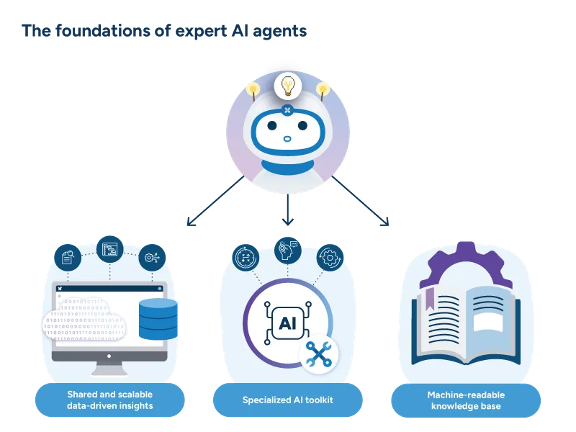
What makes RELEX agents trustworthy for enterprise operations is their architecture. They’re powered by an LLM that provides human-like reasoning capabilities, but they execute actions through computational and mathematical tools that deliver reliable, deterministic results.
RELEX agents operate within clear boundaries: specific tools they can access, explicit instructions defining their scope, and a documented context that prevents unpredictable behavior. This governed autonomy ensures agents explain their reasoning and enable human oversight for strategic decisions, with users validating recommendations until trust justifies increased automation.
The human-in-the-loop approach recognizes that systems only optimize based on accessible data. Human expertise provides essential context around vendor relationships, market dynamics, and strategic priorities that data alone cannot capture.
Meet the agents
RELEX has 10 AI agents available across Forecasting & Replenishment (F&R) and Pricing & Promotion (P&P), ready for customer adoption. These purpose-built agents automate complex decisions, diagnose performance issues, and provide actionable recommendations while maintaining human-in-the-loop governance.
RELEX Forecasting & Replenishment agents
Every day, retail, wholesale, and manufacturing supply chain operations demand millions of decisions that impact thousands of stock keeping units (SKUs) and locations. RELEX F&R agents automate these daily inventory and replenishment decisions while maintaining human judgment for high-value strategic choices.
| Agent | Primary purpose | Key benefits |
|---|---|---|
| AI-Assisted Diagnostics | Performs root cause analysis for lost sales, spoilage, and excess stock. | – Quickly identifies exceptions and prioritizes actions. – Reduces lost sales and spoilage. – Improves efficiency by addressing root causes. |
| Inventory Control | Automates strategic inventory decisions across thousands of SKUs. | – Improves and accelerates decision-making through scenario planning. – Translates strategic goals to execution across the entire product portfolio. |
| Order Proposal Troubleshooting | Resolves order issues and explains recommendation logic. | – Minimizes supply chain disruptions. – Increases efficiency through automated troubleshooting. |
| Product Attribute | Identifies relevant product attributes and automatically finds best-matched reference products. | – Enhances forecast accuracy through better data quality. – Improves decision-making. – Saves time and effort through automation. |
| Store Support | Empowers store teams with instant troubleshooting in RELEX Mobile Replenishment. | – Improves operational efficiency. – Empowers store teams with proactive tools. – Reduces support tickets and frees up central teams. |
| Location Clustering | Automatically clusters locations based on sales profiles. | – Improves forecasting accuracy through better pooling. – Supports swifter implementation with intelligent pre-processing. |
AI-Assisted Diagnostics: Addressing what goes wrong before it gets worse
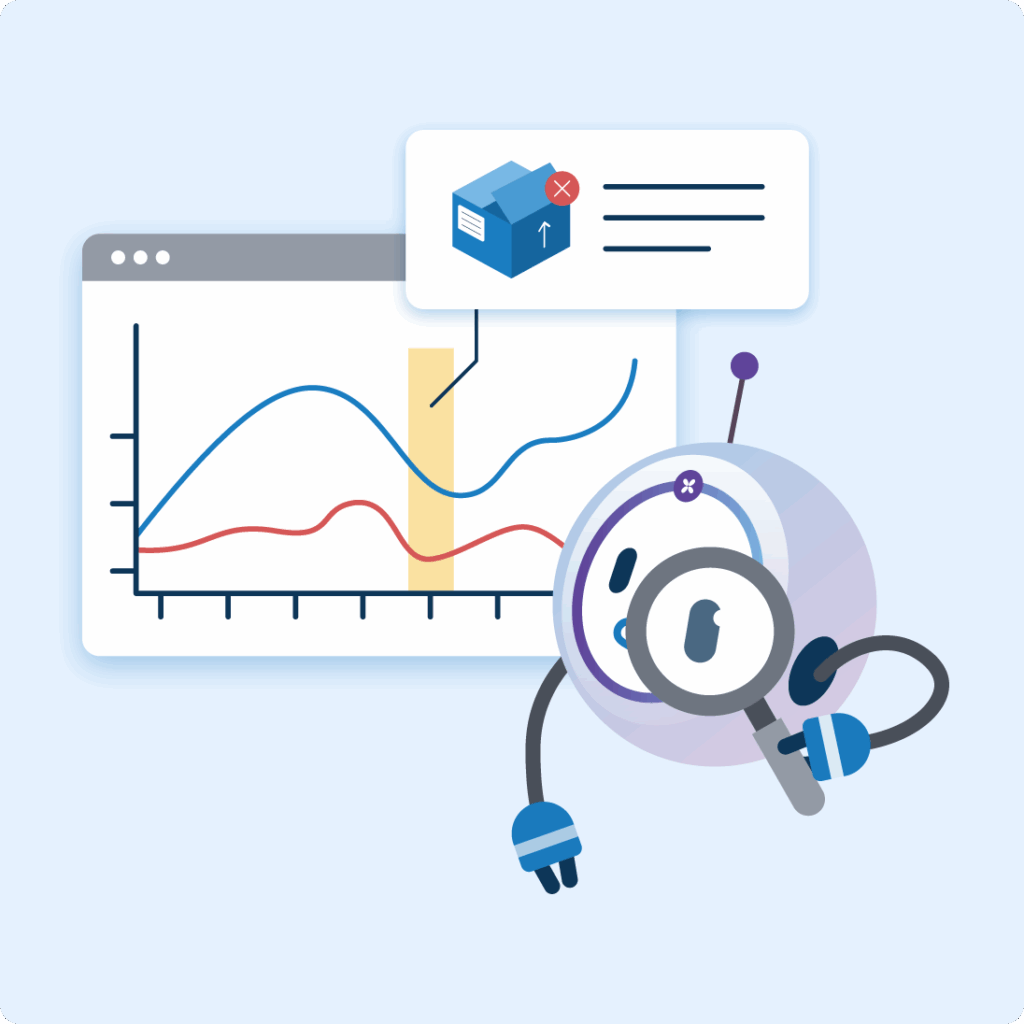
When stockouts, spoilage, or excess inventory occur, planners need to quickly understand the underlying issues to prevent the problem from escalating. But manually investigating root causes across multiple data points takes valuable time, delaying corrective action.
The RELEX AI-Assisted Diagnostics agent analyzes adverse outcomes, such as lost sales, spoilage, and excess stock. For example, when a stockout occurs, it flags the issue and triggers a response. The RELEX agent identifies the most impactful reason, such as “partial delivery the day before,” saving planners from manually investigating the problem. It analyzes patterns across all operations, provides customer-specific recommendations, and supports scenario planning to evaluate corrective actions.
Quickly identifying exceptions and their root causes allows supply chain teams to prioritize high-impact actions that reduce lost sales and spoilage. The AI-Assisted Diagnostics agent also provides the data foundation that powers other RELEX AI agents, converting basic metrics into the contextual intelligence that enables autonomous operations.
Inventory Control: Strategic decisions at scale
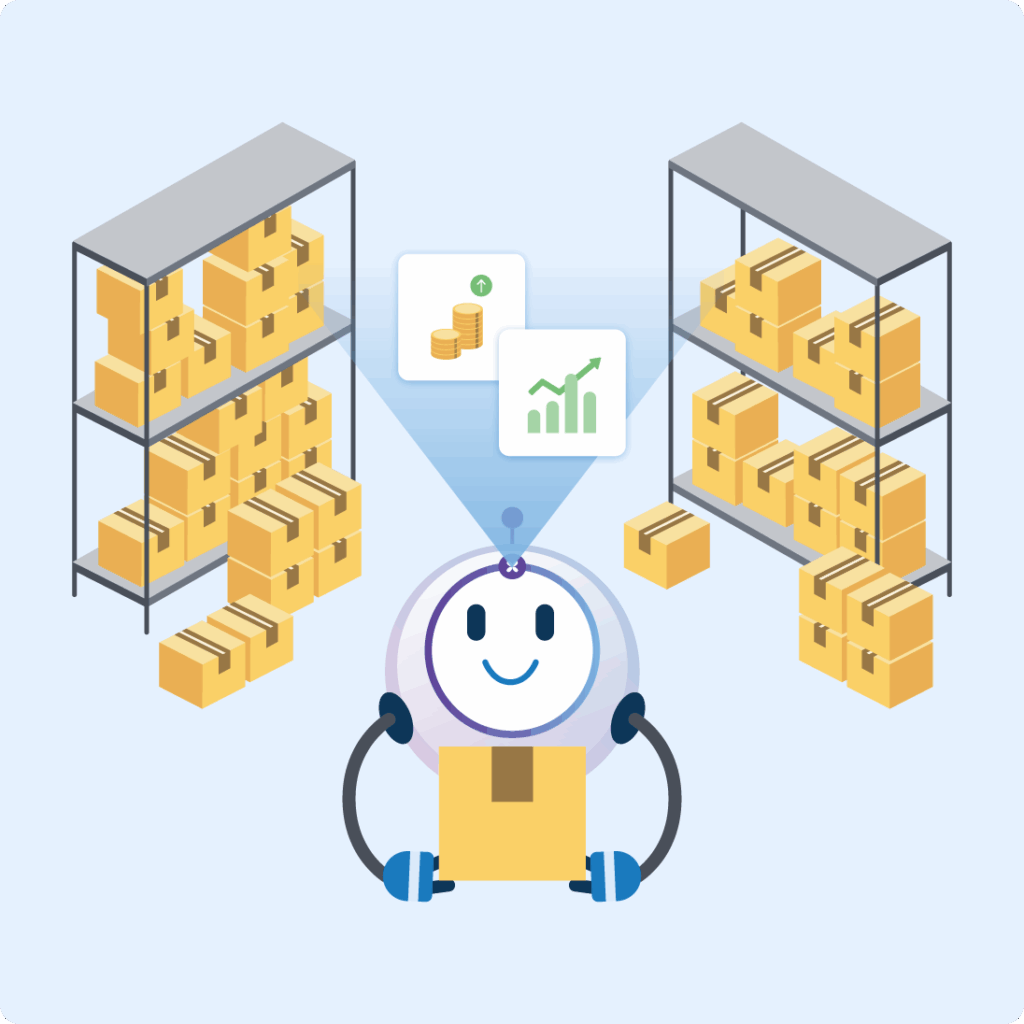
Managing inventory at scale requires complex calculations that translate strategic goals into tactical execution for each product across a range of SKUs. Manual optimization becomes impossible when balancing service levels, costs, and strategic objectives, such as improving on-shelf availability.
The RELEX Inventory Control agent automates strategic inventory optimization across thousands of SKUs by creating and evaluating various scenarios based on specific business goals. For instance, if the goal is to decrease waste by 10% in a category or improve the availability of fresh foods, the agent generates scenarios with different parameter values, calculates the trade-off between service levels and costs, and shows the profit impact of each option. Planners review the scenarios, make adjustments based on context the system doesn’t have, and select which strategy to execute.
Scenario planning allows teams to test different approaches with confidence, reducing the stress of making strategic changes that affect millions in working capital. It also enables faster, better-informed decision-making that translates business goals into execution across the entire product portfolio.
Order Proposal Troubleshooting: Understanding the logic behind recommendations
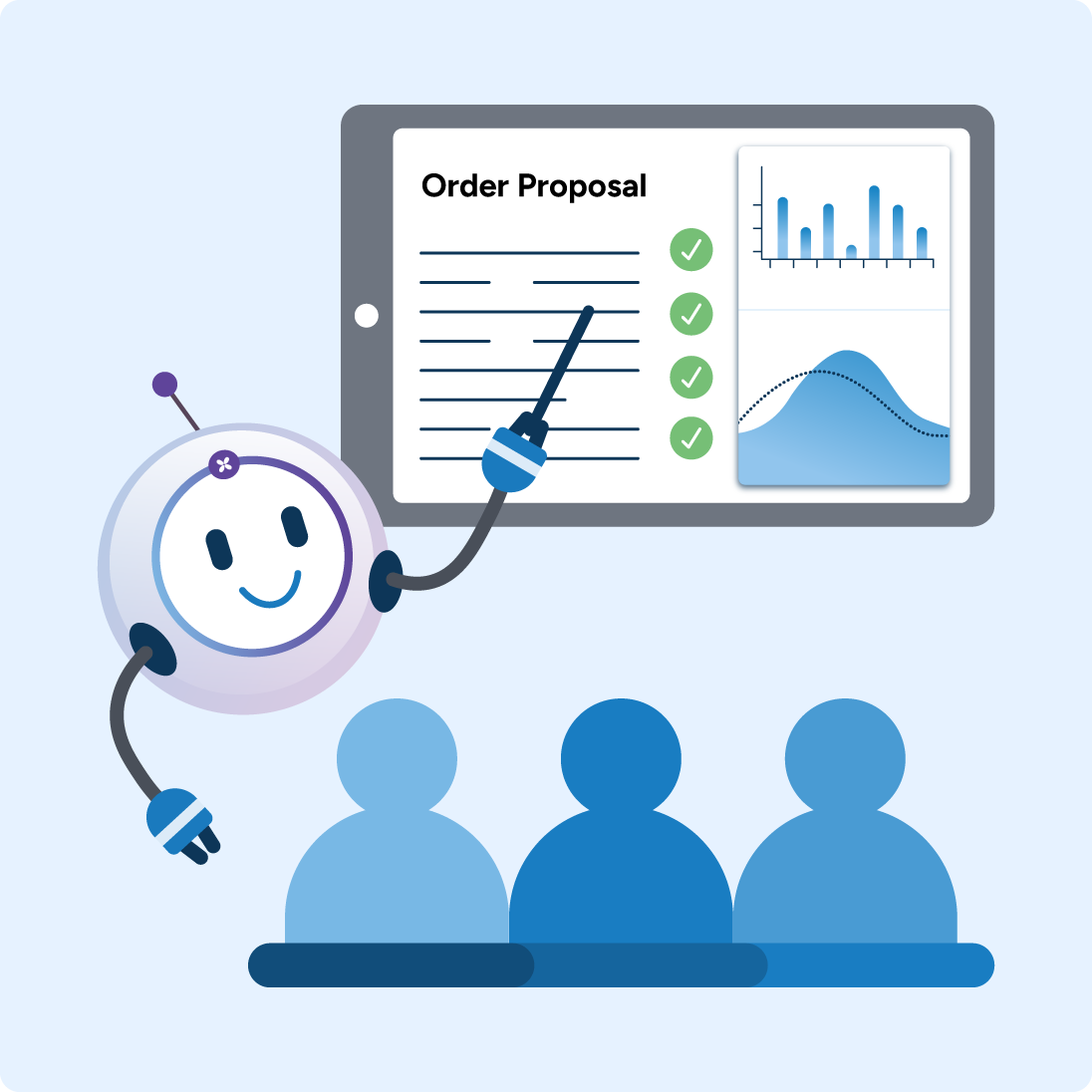
Reviewing ordering exceptions and understanding the calculation logic behind order proposals can be a challenging and time-consuming process that pulls central planners away from higher-value work. Without clear explanations, valuable time is spent investigating order issues and trying to understand why the system made specific recommendations.
The RELEX Order Proposal Troubleshooting agent analyzes order proposals, explains the rationale behind RELEX recommendations, and identifies issues such as distribution center scarcity or incorrect quantities. It breaks down the calculation logic in plain language, shows what would happen under specific parameter changes, and flags potential risks before they escalate. Planners can ask, “Why did RELEX recommend ordering more today compared to yesterday?” and receive an immediate answer without manual troubleshooting.
This RELEX troubleshooting agent reduces the time spent investigating order issues, minimizes supply chain disruptions, and empowers planners to make more effective manual adjustments. Automating troubleshooting frees central planners to shift their focus to proactive planning and builds user trust in system recommendations.
Product Attribute: Better forecasts for new products
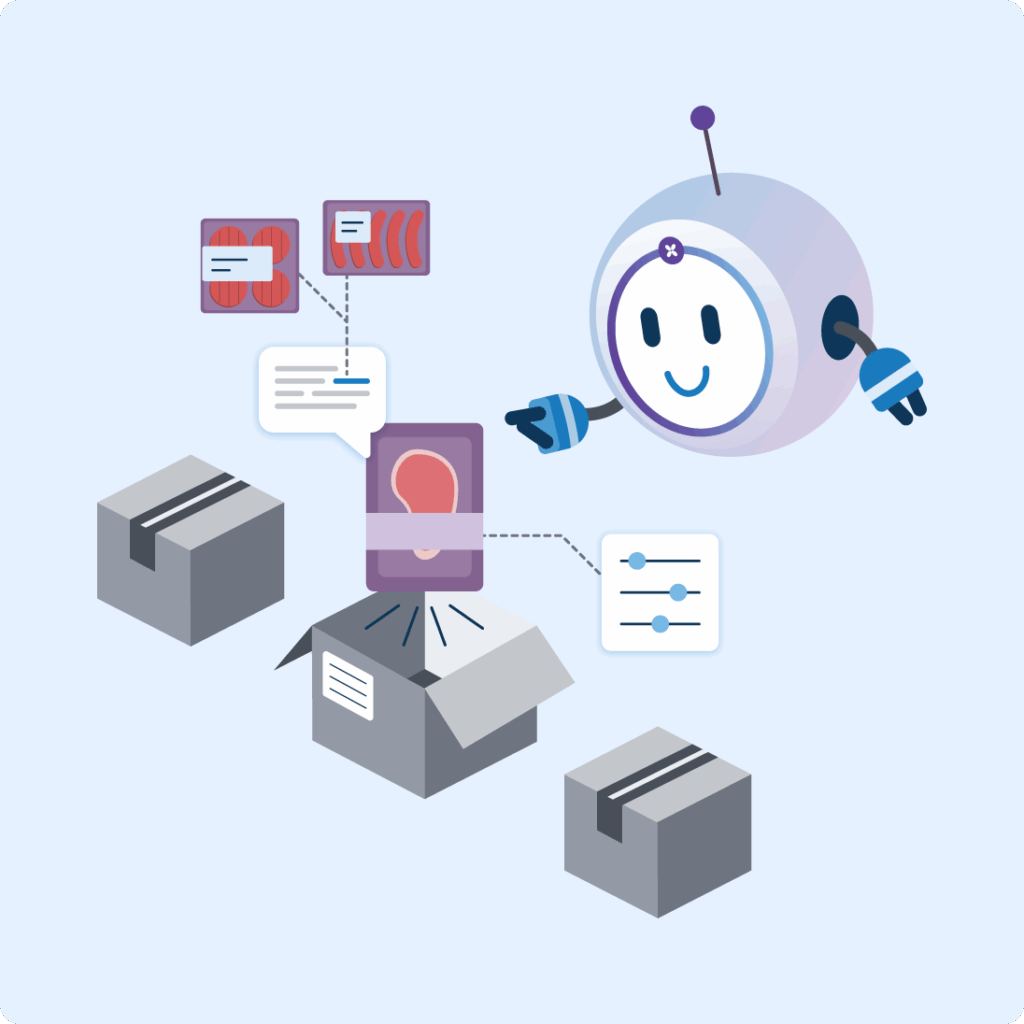
New product forecasting suffers from a “cold start” problem. Without historical data, planners must rely on product attributes that are increasingly difficult to isolate accurately. Previously, demand planners faced a paradox: the lack of historical data forced them to rely on a lengthy manual tagging and validation process, delaying accurate forecasts for new product introductions.
Now with the RELEX Product Attribute agent, demand planners can identify relevant product attributes and automatically find the best-matched reference products for new product introductions. This agent analyzes product names and descriptions, validates attributes like dimensions and categories across a company’s systems, and recommends reference products ranked by suitability. It flags missing or incorrect attributes and suggests corrections based on historical data, eliminating the manual tagging work that demand planners face.
This RELEX agent ensures accurate forecasts through enhanced data quality, while saving teams time managing product catalogs. Better attribute data also supports improved assortment planning, pricing strategies, and ultimately better customer experience.
Store Support: Instant answers feeding immediate action

Store associates need fast, accurate responses to take the right actions, but traditional support processes require significant effort from central teams. When store teams have questions about orders or system recommendations, they must contact central support and wait for answers, which delays decisions and ties up resources. This creates bottlenecks that slow operations and prevent store associates from resolving issues quickly.
The RELEX Store Support agent provides instant troubleshooting and explanations for store teams using RELEX Mobile Replenishment, helping them understand orders without contacting central support. It answers questions about recommendations, guides users through issue resolution, and offers real-time support tailored to store-specific situations. The Store Support agent integrates with store systems to provide contextual help exactly when teams need it.
The agent also dramatically reduces support tickets, freeing central teams to focus on value-creating work rather than answering repetitive questions. By empowering store teams with instant, autonomous support, it improves operational efficiency while ensuring stores stay well-organized and properly stocked.
Location Clustering: Smarter groupings for better forecasts
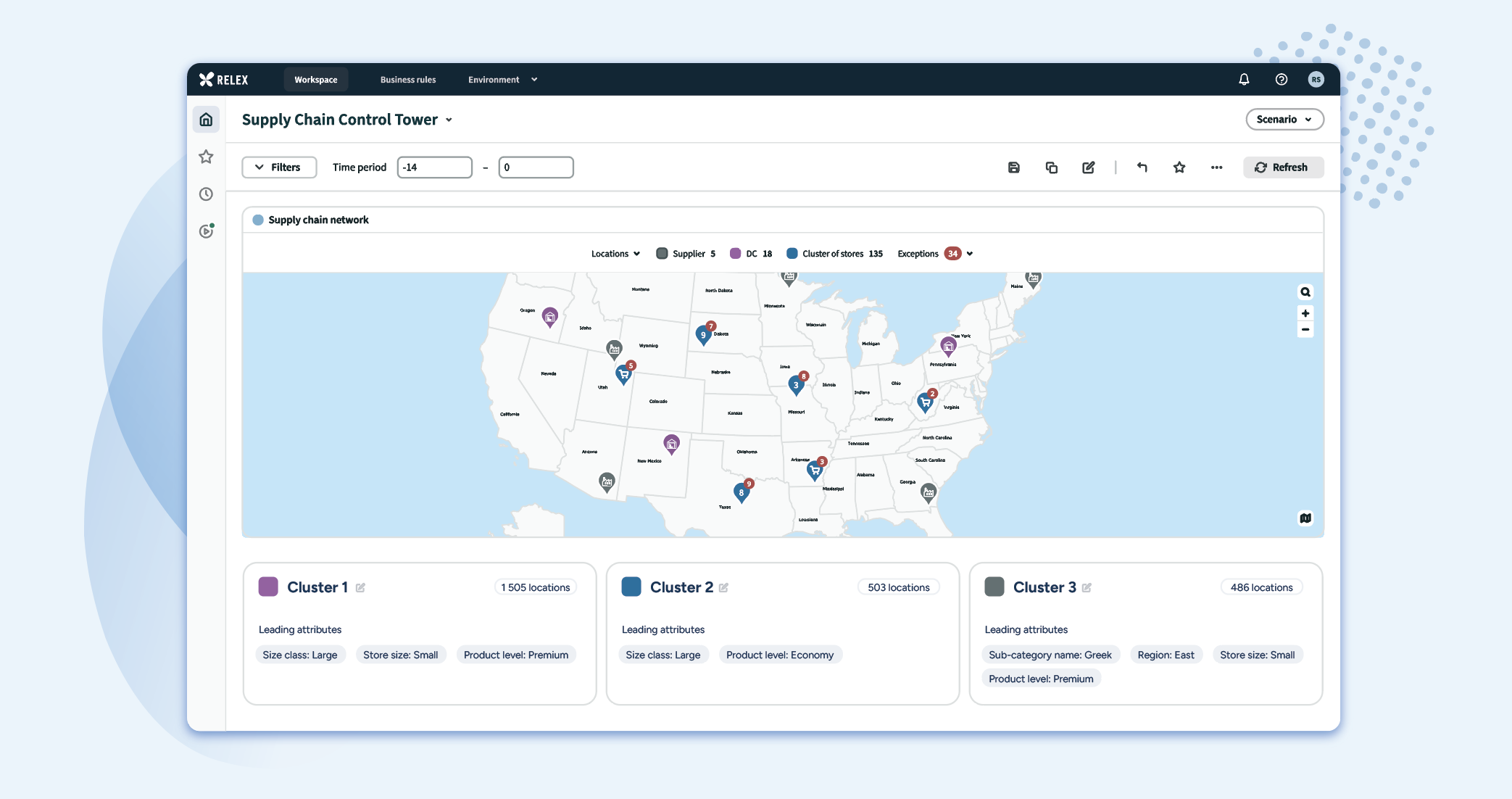
Poor location clustering leads to suboptimal seasonal forecasts and inaccurate weekly profiles. When stores with different demand patterns are treated identically, forecasting accuracy suffers because the underlying data doesn’t reflect the distinct characteristics of each location group. As store networks grow and evolve, the manual analysis required to establish and maintain effective clusters becomes increasingly time-consuming.
The RELEX Location Clustering agent automatically pools stores based on both location attributes and distinct demand characteristics using AI-based clustering methods. It analyzes sales profiles across the store network, identifies patterns in seasonal behavior and demand, and creates optimal clusters for forecasting. The agent continuously evaluates whether existing groupings still align with business needs, eliminating the manual work of defining appropriate location pooling.
This agent ensures better data pooling for machine learning model estimations through intelligent preprocessing, improving forecasting accuracy. It also automates the analysis that traditionally requires extensive manual evaluation, helping to accelerate implementation timelines.
RELEX Pricing & Promotion agents
Retail category managers juggle countless pricing and promotional decisions across diverse product portfolios, where scale makes automation essential but strategic complexity demands human oversight. RELEX P&P agents automate the time-consuming work of creating, analyzing, and optimizing pricing strategies and promotional campaigns while preserving that critical human judgment.
| Agent | Primary purpose | Key benefits |
|---|---|---|
| Promotion Diagnostics | Instantly diagnoses promotion performance with clear, actionable explanations. | – Promotion performance feedback to avoid costly mistakes. – Faster, smarter adjustments. |
| Promotion Strategy | Creates, optimizes, and modifies promotions, marketing campaigns, and strategies. | – Faster promotion setup (hours to minutes). – Reduced errors through AI interpretation. – Faster scenario testing for optimal decisions. |
| Insights and Reporting | Generates visualizations and charts for insights and reporting. | – Instant insights. – Clearer communication of results. – Accelerated decision-making. |
| Pricing Strategy | Creates pricing strategies and optimizes prices to achieve business goals. | – Faster troubleshooting with automatic identification of optimization opportunities. – Smarter pricing decisions balancing profit and margins. – Simplified strategy creation. |
Promotion Diagnostics: Improving understanding of promotional performance

When a promotion underperforms, uncovering the reasons why is often a frustrating, time-consuming process. Planners must dig through multiple data points and manually piece together the story bit by bit. Without clear explanations, the same mistakes get repeated because the root causes remain unclear.
The RELEX Promotion Diagnostics agent breaks down promotion performance into clear explanations, factoring in gross lift, switching, stockpiling, and halo effects, without requiring manual analysis. Users simply right-click any cell in their performance table and select “Explain This” to instantly understand why a promotion succeeded or fell short. The agent analyzes patterns in promotional history to identify what drives results and what leads to costly mistakes.
This diagnostics agent provides instant troubleshooting so planners can spot issues like excessive discounts or cannibalization immediately and take corrective action before the next campaign. Plain-language explanations help promotion teams learn from every promotion, avoiding cycles of repeating the same mistakes and enabling faster, smarter adjustments.
Promotion Strategy: Create and modify campaigns in minutes

Creating and editing promotions through traditional interfaces slows down merchandising teams with manual data entry and complex navigation. Form-heavy systems require planners to fill out multiple fields for each promotion, resulting in time-consuming setup and potential errors. This friction limits the growth of promotional strategies and a company’s ability to respond to changes in market conditions.
The RELEX Promotion Strategy agent automatically creates, modifies, and optimizes promotions by orchestrating form completion, querying historical data, and surfacing recommendations via natural language prompts. The agent provides real-time guidance on promotion parameters by analyzing past performance across categories and seasonality to recommend optimal approaches.
This RELEX agent reduces promotion setup time from hours to minutes, minimizes errors by interpreting intent and populating correct fields, and lowers the learning curve for new users. With a streamlined promotion setup, teams can test more promotional strategies and respond faster to market opportunities.
Insights and Reporting: Visualizations on demand
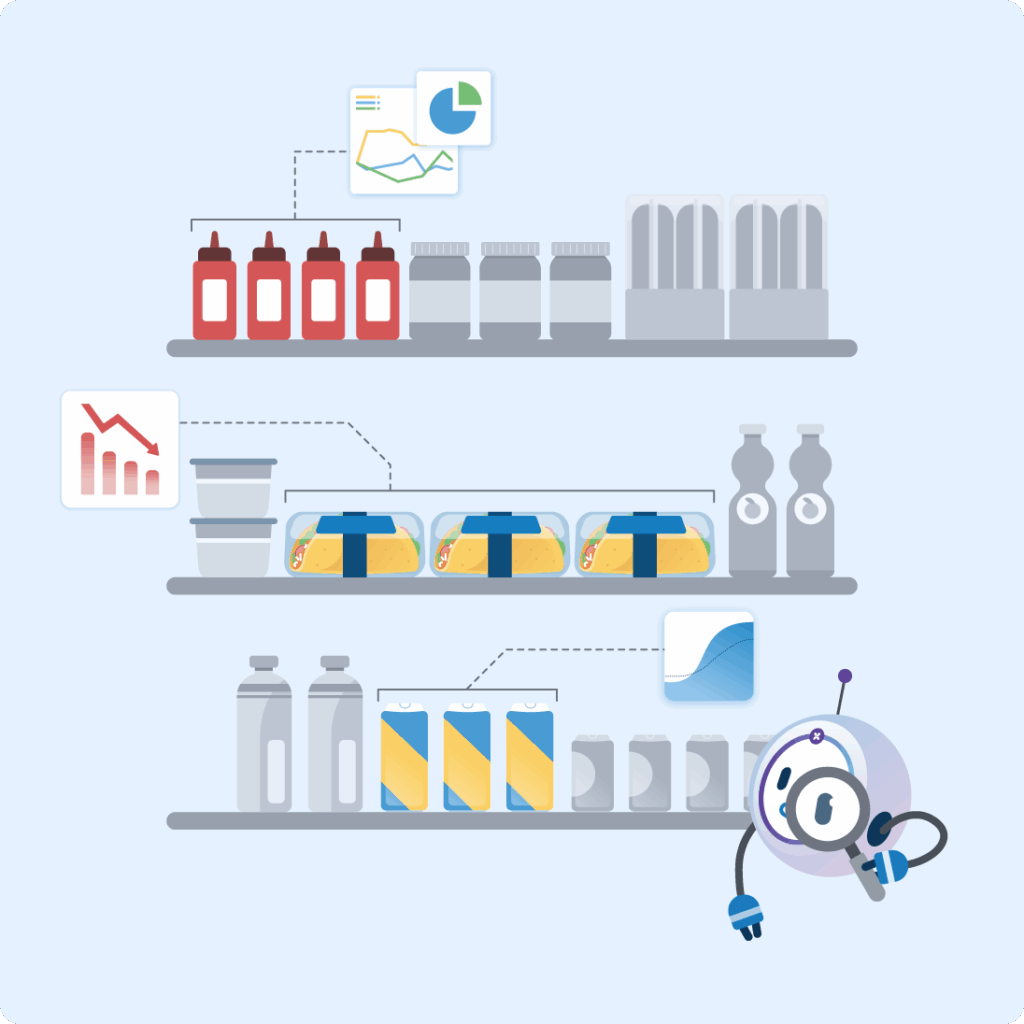
Creating pricing and promotional performance visuals traditionally requires analyst support, delaying insights and slowing stakeholder communication. Teams must submit requests to data teams, wait for reports to be built, and often go through multiple rounds of revisions to get the visualizations they need. This traditional approach prevents merchandising teams from accessing timely insights and responding quickly to performance trends.
Instead, the RELEX Insights and Reporting agent generates interactive visualizations and charts on demand through natural language queries, transforming pricing and promotional data into clear, stakeholder-ready visuals. This RELEX agent creates compelling visuals that communicate complex promotional data in ways stakeholders can quickly understand and act on, including:
- Performance trends.
- Category breakdowns.
- Brand comparisons.
- Discount distribution charts.
RELEX Insights and Reporting eliminates reporting bottlenecks and democratizes promotional insights across merchandising teams, letting people ask questions and get visual answers instantly. Teams accelerate decision cycles from days to minutes, spending less time building reports and more time optimizing their next promotion.
Pricing Strategy: Guided optimization opportunities
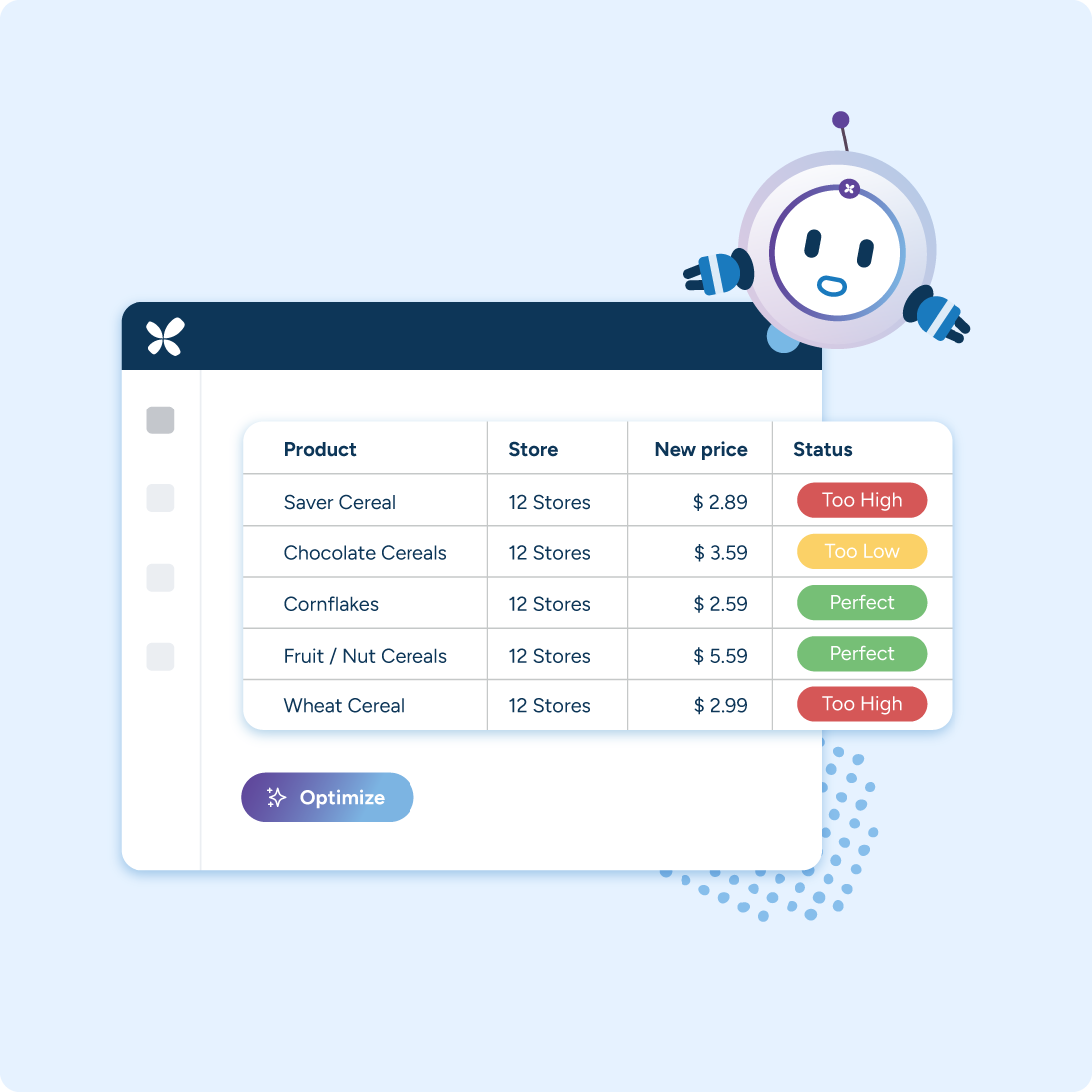
Normally, pricing optimization requires navigating intricate rule configurations and manually diagnosing issues across optimization groups, creating barriers for non-technical users. Without clear guidance, identifying what’s wrong and why becomes a frustrating, time-consuming process that limits who can effectively manage pricing strategies.
The RELEX Pricing Strategy agent guides users through pricing strategy configuration, diagnostics, and item-level recommendations through natural language interaction rather than complex rule interfaces. It automatically diagnoses problems within optimization groups, identifies root causes, and suggests fixes when requested. The Pricing Strategy agent generates item-level price recommendations that balance profit optimization with margin requirements, helping category managers build strategies with specific business logic through natural conversation.
This RELEX agent eliminates manual troubleshooting by automatically identifying what’s wrong and why, while simplifying strategy creation so users can build pricing approaches without technical expertise. Faster troubleshooting and smarter pricing decisions mean teams can optimize profitability while maintaining the margin guardrails that protect the business.
The RELEX vision: Building the multi-agent ecosystem
The RELEX AI agents available today represent the first practical steps toward realizing a broader vision, built on an AI-native platform with deep domain expertise. We are building toward a multi-agent ecosystem where specialized AI agents work together across our unified platform and, eventually, with external enterprise systems, to enable intelligent coordination for merchandising and supply chain operations.
Development is already underway on additional agents for manufacturing operations and space and assortment planning, with more specialized capabilities planned for release. Each new agent will follow the same principle that guides the existing agents: identify where autonomous intelligence delivers measurable value, build it with domain expertise, and deploy it with human oversight.
The ultimate goal is a network of agents that can collaborate with each other to execute complex workflows, drawing on RELEX’s toolkit of specialized AI and two decades of documented supply chain knowledge. For instance, an inventory agent might trigger a pricing agent to generate markdown scenarios when stock levels shift, or a promotion agent could coordinate with demand forecasting to optimize campaign timing.
The ultimate goal is a network of agents that can collaborate with each other to execute complex workflows.
These purpose-built assistants amplify human expertise while maintaining transparency and control at every step. And this is only the beginning. The RELEX agent ecosystem will continue to grow as capabilities expand and new opportunities emerge, providing our customers with tangible value.
The next chapter in the future of supply chain and retail planning
Instead of rushing to make “AI everywhere” claims, RELEX remains committed to a purposeful approach, focusing on building trust through proven results. Every agent expansion is grounded in real customer value, documented domain knowledge, and governed autonomy, ensuring users remain in control of strategic decisions.
Understanding what makes RELEX AI agents effective means understanding the platform and expertise behind them — what gives them the context to reason accurately, the tools to act reliably, and the guardrails to do both safely. Discover how our platform turns AI agents into genuine experts that retailers and manufacturers can trust.
FAQs
1. What are AI agents?
AI agents are autonomous or semi-autonomous systems that plan, act, and collaborate with computer systems and humans to achieve specific supply chain and retail planning goals. They’re powered by large language models for reasoning but execute actions through computational and mathematical tools that deliver reliable, deterministic results.
2. How are AI agents different from generative AI assistants like chatbots?
Generative AI helps users work by providing information, answering questions, and creating content, while agentic AI works on their behalf by taking autonomous actions toward goals. Both use large language models, but agents can query systems, run diagnostics, trigger workflows, and execute decisions without constant human input.
3. How many AI agents does RELEX currently offer?
RELEX has 10 AI agents available across Forecasting & Replenishment and Pricing & Promotion, ready for customer adoption today. These include AI-Assisted Diagnostics, Inventory Control, Order Proposal Troubleshooting, Product Attribute, Store Support, Location Clustering, Promotion Diagnostics, Promotion Strategy, Insights & Reporting, and Pricing Strategy agents. In manufacturing, RELEX has two additional agents: the Bottleneck Explainer agent and the Stress-testing agent.
4. What level of automation can I delegate to RELEX agents?
RELEX agents operate with human-in-the-loop governance, allowing users to control automation levels based on comfort and trust. Users validate agent recommendations until confidence justifies increased automation. For routine, low-value decisions, such as location clustering or product attribute assignment, agents can operate with minimal oversight. For strategic decisions such as inventory optimization or pricing, agents generate scenarios and recommendations that require human review and approval before execution.
5. How do RELEX agents scale across thousands of SKUs and locations?
RELEX agents are built on a platform designed to handle supply chain complexity at enterprise scale. The Inventory Control agent, for example, automates strategic decisions across thousands of SKUs simultaneously, while the Location Clustering agent analyzes entire store networks to create optimal groupings. Forecasting & Replenishment operations already process millions of daily decisions through RELEX’s proven algorithms, and agents extend this automation capability to more strategic, complex decision-making while maintaining performance.
6. How do RELEX AI agents maintain transparency and control?
RELEX AI agents operate within defined boundaries, with specific tools they can access, explicit instructions that determine their scope, and documentation that provides context. They explain their reasoning, enable human oversight for strategic decisions, and allow users to validate recommendations until trust justifies increased automation. This governed autonomy ensures users understand why agents make specific recommendations and maintain control over strategic business decisions.
7. What does the AI-Assisted Diagnostics agent do?
The AI-Assisted Diagnostics agent analyzes adverse outcomes such as lost sales, spoilage, and excess stock, performing root-cause analysis to identify the most impactful causes. When a stockout occurs, it flags the issue and identifies the cause, such as “partial delivery the day before,” saving planners from manually investigating problems. It provides customer-specific recommendations and supports scenario planning to evaluate corrective actions.
Written by


Related Articles

Planning to profits: AI-driven forecasting, automated replenishment, and the capabilities that matter
Learn how AI forecasting and automated replenishment drive retail profitability, plus a checklist to evaluate your strategy.

What makes the best production planning and scheduling software: Integration and automation
Learn how intelligent production planning and scheduling solutions help manufacturers overcome operational silos, protect service levels, and drive sustained ROI.
RELEX unified planning: End-to-end AI-powered retail planning
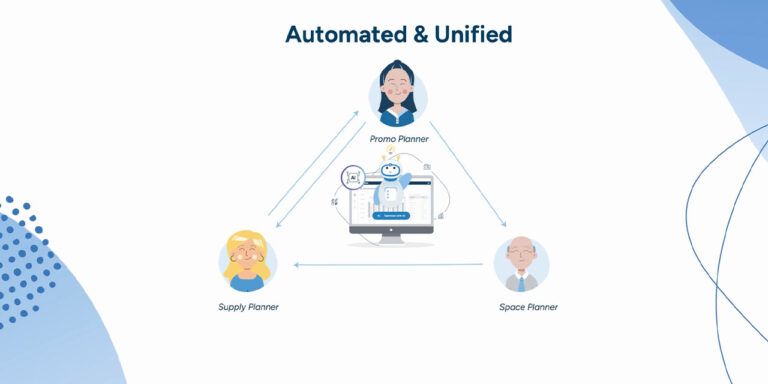
Learn how RELEX unifies promo, space, and supply planning to execute seasonal events with speed and accuracy.