Meatier margins: How supply chain technology improves meat industry profitability
Feb 16, 2026 • 15 min
Finding a supply chain as complex as the meat industry is hard.
Livestock production, slaughtering, processing, packaging, distribution — the steps required to get meat products from farm to fork go on and on. Producers grapple with the same big-picture difficulties as perishability and volatile customer demand that impact other food manufacturers. Throw in livestock production, slaughtering, and processing, and the complications compound quickly.
Each added layer of complexity in meat supply chain management is a chance for carefully laid plans to fail — and for already razor-thin margins to further erode. But each layer is also an opportunity for meat producers to optimize their processes to create new opportunities, provide new insights, and address existing production and delivery challenges. Higher visibility into the end-to-end supply chain enables companies to make more strategic, cost-effective business decisions that bolster profitability.
Traditional supply chain planning solutions can’t deliver the adaptability and visibility that meat producers require. As more constraints continue to affect supply, processing capacity, and demand, companies need a unified view of their supply chain that is visible to everyone across the organization.
Meat producers must implement advanced, scalable supply chain planning systems to succeed in the future and ensure both growth and profitability. These solutions must utilize and analyze all supply chain data available to provide optimized production and profitability plans.
Meat producers face many unique challenges
Meat producers face the difficult task of planning within thin margins in an increasingly complex market — and the limitations of traditional methods, such as spreadsheet-based planning, only magnify these difficulties. Planning challenges stem from a complex interplay of factors, including supply volatility, shifting consumer demand, and stringent food safety regulations, which require a more holistic, agile approach to supply chain management.
Traditional planning limitations
Producers must take an end-to-end look at their supply chain if they ever hope to manage it efficiently. Holistic visibility leads to more accurate and efficient planning, allowing companies to anticipate and respond strategically to changing market conditions.
Producers must take an end-to-end look at their supply chain if they ever hope to manage it efficiently.
This is easier said than done for the many producers still reliant on spreadsheets and other traditional planning methods. Such methods make it difficult, if not impossible, to account for basic constraints on supply and demand. Traditional, manual approaches cannot account for all variables simultaneously for optimal planning, and trying to do so requires time and expertise.
These variables include:
- Different lead times
- Varying supplier agreements
- Supply fluctuations and uncertainty
- Expiration and aging challenges
- Alternative recipes
- Consumer demand shifts
- Food safety legislation
- Customer priorities
- Competition
Supply headaches
Meat producers must constantly determine what supply they need, how much they need, and when they need it. This task is incredibly challenging due to the industry’s long planning horizons. The decision to increase the number of livestock will take years before they are available for slaughter.
The inherent volatility of the supply side in the meat processing industry further complicates matters. The availability and quality of livestock are constantly affected by weather, seasonality, and competition from rival companies for stock.
A few key drivers impact supply.
Liquidation due to environmental conditions (draught) → undersupply → price spike → multi years rebuild → oversupply → price fall
For supply forecasting:
- Rainfall outlook > price outlook for herd size
- Prices are better predictors of slaughter rate, not inventory
- Environmental shocks propagate through the system with 2–5 year effects
Farmers can hold on to cattle for longer based on prices, slaughter capacity pasture conditions.
Dwindling supply has sparked fierce competition among meat processing companies for stock. Many companies pay more to procure extra livestock and grow market share. Companies often find it difficult to gauge how much it is worth paying to secure supply, as they must balance their urge to fulfill orders against their desire to maximize profitability.
Securing livestock is only half the battle. While animals are purchased against expected specifications, processors can’t fully confirm suitability for a given end product until the carcass is on the hook. If it falls outside the intended spec, the processor may be forced to make rapid reallocation decisions that erode margin — for example, selling into lower-grade programs, shortening shelf life, or diverting product to frozen channels, thereby missing chilled-market premiums.
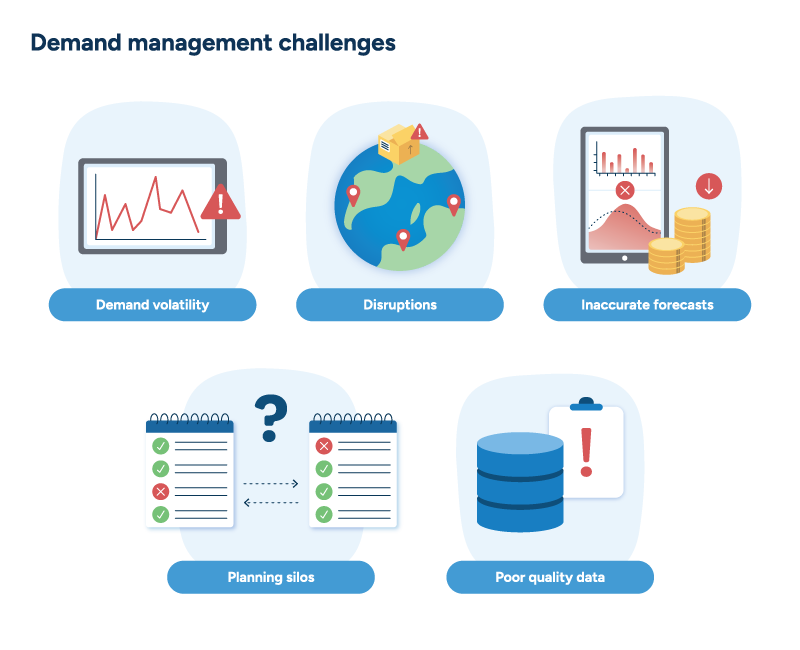
Demand volatility
Changing consumer preferences, such as replacing meat products with alternative sources of protein, influence demand. These factors, and others, drive extreme levels of demand management complexity for meat producers.
Meat processors must adapt their plans to these shifts, but the tendency of restaurant, fast-food, and supermarket chains to place large orders with short lead times makes such adjustments difficult. Processors may lack the livestock supply, processing capacity, or shipping availability to fulfil larger-than-expected orders on time, forcing delivery delays or suboptimal allocations.
Growing reliance on export markets further exposes processors to demand volatility. As per-capita beef consumption stagnates or declines in Western Europe, companies increasingly serve markets such as China, Southeast Asia, the Middle East, and Mexico. This dependence increases exposure to trade policy changes and currency fluctuations, further complicating planning.
A complete match between supply and demand is nearly impossible, but striking the right balance is critical for sustained profitability. Better alignment minimizes margin erosion and maximizes carcass utilization, enabling processors to extract value from each cut and recover a greater share of fixed processing costs.
Carcass balancing
Carcass balancing is the process of managing whole-carcass supply to maximize total enterprise profit by making integrated decisions across cut plans, demand allocation, shelf-life constraints, and logistics. For a meat producer selling only fresh and frozen cuts, every carcass represents a fixed biological yield that must be fully consumed across multiple products and markets. As a result, decisions must always be made at carcass level, not at individual cut or SKU level.
The fundamental economic objective of carcass balancing is to maximize total gross margin by allocating carcasses to the most appropriate cut plans and assigning the resulting cuts to the most profitable feasible demand. Demand is therefore not treated as something that must always be met, but as an opportunity that should only be fulfilled where it increases total carcass value. This requires explicit prioritization of demand based on net contribution, rather than volume, service targets, or historical allocation patterns.
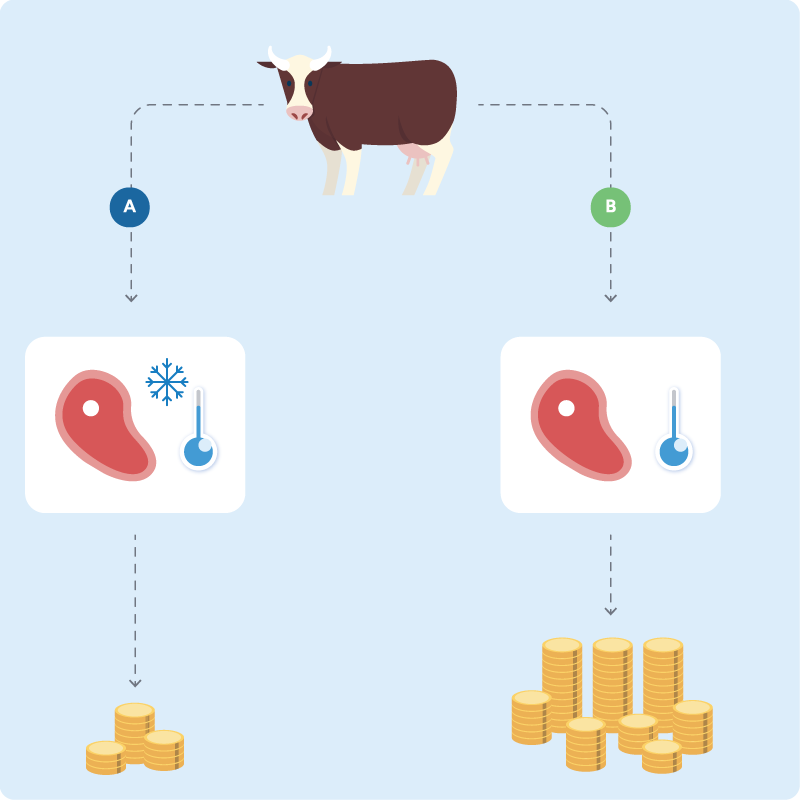
Fresh sales typically deliver higher margins than frozen sales, particularly in premium domestic and export markets. However, fresh demand is constrained by shelf-life and minimum life on Receipt (MLOR) requirements, especially in export channels with long, variable transit times. MLOR is a hard feasibility constraint: not all carcasses can access all fresh demand, and attempting to over-allocate to fresh can result in late downgrades, lost value, or customer non-compliance.
Frozen product, therefore, plays a critical strategic role in carcass balancing. While frozen often carries a lower unit margin, it is frequently the most effective way to:
- Absorb surplus cuts created by joint-yield imbalances.
- Protect total carcass value when fresh demand is unbalanced across cuts.
- Access markets with longer lead times or lower shelf-life sensitivity.
In many cases, deliberate use of frozen pathways is the most profitable way to manage surplus, rather than a fallback once fresh options have failed.
Mathematical optimization and the role of an integrated planning solution
Carcass balancing at scale cannot be solved reliably through manual planning or sequential decision-making. The problem is inherently multi-dimensional and highly constrained, with thousands of interdependent variables: carcasses, cut plans, yields, markets, prices, shelf-life, logistics, and timing. Optimizing one dimension in isolation inevitably leads to value loss elsewhere.
This is where mathematical modelling and optimization become essential.
The RELEX planning solution addresses this challenge by building a true digital twin of the carcass balancing problem, where:
- All physical constraints are explicitly modelled, including carcass availability, yield relationships, shelf-life decay, MLOR requirements, and logistics constraints.
- All commercial constraints and business rules are embedded, such as customer commitments, market eligibility, fresh vs frozen rules, and export specifications.
- All feasible cut plans are represented, with their associated yield profiles and downstream product implications.
- Future demand across all markets is included, with prices, priorities, and feasibility conditions.
The optimization engine then uses advanced mathematical algorithms to evaluate millions of possible combinations of:
- Carcass-to-cut-plan assignments.
- Cut-to-market allocations.
- Fresh vs frozen decisions.
- Timing and logistics constraints.
Rather than optimizing locally or sequentially, the model optimizes globally, identifying the plan that delivers the highest total profit across the entire supply chain, while fully respecting all constraints and rules.
Forward-looking visibility and cross-functional alignment
Because the optimization is demand-driven and forward-looking, planners and sales teams gain a clear, shared view of future surplus and imbalance by cut, market, and time. This enables:
- Early identification of structural surpluses before production decisions are locked in.
- Proactive commercial actions, such as redirecting demand, opening frozen channels, or adjusting pricing.
- Fact-based collaboration between sales and operations grounded in total carcass economics.
Instead of reacting to surplus after it appears, the organization can actively shape outcomes in advance, using optimization to guide cut plans, market commitments and logistics decisions.
7 ways to maximize profitability with supply chain planning and optimization software
Having established a true digital twin for a meat producer will help drive efficiency and benefits throughout the supply chain. Below is a list of seven strategies that underscore the critical role of advanced software solutions in navigating the complex dynamics of the meat production supply chain.
1. Enable higher cross-departmental supply chain visibility
Supply chain visibility provides an accurate, real-time picture of demand signals and livestock supply and surplus. RELEX enables this visibility by modeling the entire supply chain and its constraints and dependencies as a digital twin, creating a unified view across all planning layers.
Better supply chain visibility has been linked to better business performance for two big reasons:
- A prompt exchange of information between all stakeholders leads to better planning and coordination.
- Transparency and information integration are powerful competitive weapons in increasingly volatile markets.
Imagine that a company’s livestock team cannot secure the intended livestock. This company may waste money on surplus production capacity, forcing them to shelve marketing campaigns.
A lack of crossfunctional visibility can cause relationships to become adversarial, and planning meetings can spark debates over accountability.
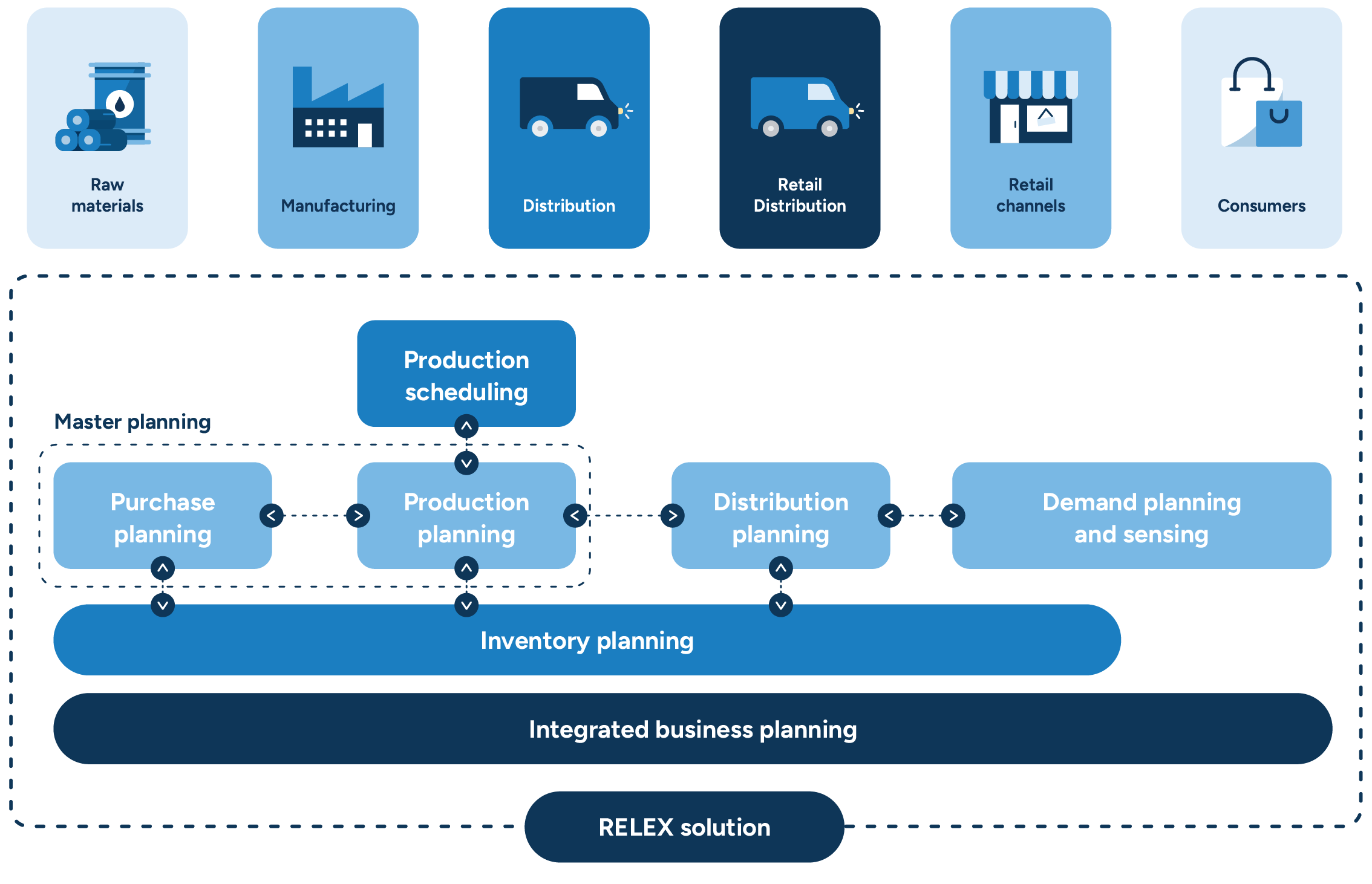
A supply chain planning and optimization solution supports the entire planning process, fully integrating supply chain, production, sales, demand, and livestock forecasting. The software delivers complete, end-to-end supply chain visibility across all departments and empowers organizations to plan over any period.
2. Break down siloes to enable faster decision-making
Livestock sourcing, production, and marketing departments often end up planning in siloes. Priorities are dispersed across teams, and they can’t share relevant information about goals, tools, and processes within departments.
This insulated decision-making leads to slower, inconsistent planning and execution. Companies can’t factor in all the variables that affect supply and demand, which impacts forecast reliability and makes it hard to match supply and demand.
Teams need a holistic picture of all processes and projects to develop a flexible course of action in their decision-making process without sacrificing stability, reliability, and control. Otherwise, they will likely deal with constant bottlenecks that halt productivity and affect clients.
A robust supply chain planning solution synchronizes teams across planning layers and time horizons, enabling more strategic, profitable decisions. Effective SCP operates across operational (daily/weekly production scheduling and livestock planning), tactical (monthly/quarterly supply-demand balancing and S&OP), and strategic (annual/multi-year capacity planning) horizons, with an integrated solution ensuring decisions cascade consistently from long-term strategy to daily execution.
Software designed to break down this silo mentality optimizes workflows and prevents delays caused by information exchanges among teams. Meat processing companies can then develop customer-centric solutions and manage operations at a new level of speed and scale.
3. Managing surplus through demand prioritization and substitution
Demand imbalance across the carcass is a structural reality in the meat industry. Even with stable aggregate demand, differences in demand by cut inevitably create surpluses in some cuts and constraints in others. Managing this surplus effectively is central to maximizing total carcass value and maintaining strong customer relationships.
Rather than attempting to fulfil all demand equally, meat producers must actively prioritize demand based on value, feasibility, and strategic importance. When supply is constrained for certain cuts and surplus exists in others, the objective is not to maximize service level by individual cut, but to maximize overall carcass profitability. This often means allocating limited supply to higher-value or more strategically important demand, while deliberately steering surplus cuts into markets or customers with greater flexibility.
A key lever in this process is the use of supplements or substitutes. In many cases, customers are willing to accept an alternative cut with similar characteristics when the originally requested cut is constrained. When managed proactively, substitution allows producers to:
- Place surplus cuts into viable demand rather than freezing or discounting.
- Balance carcass utilization without sacrificing total margin.
- Maintain service levels by offering acceptable alternatives.
To enable this, planners require clear, forward-looking visibility into expected supply, demand, and surplus across all cuts and markets. An integrated planning solution makes future imbalances transparent, allowing teams to identify where surplus will emerge, which customers can absorb alternative cuts, and how demand should be prioritized to protect total carcass value.
By proactively managing surplus and clearly communicating feasible supply options — including acceptable substitutes — producers can set realistic customer expectations while improving both service reliability and profitability. In practice, disciplined surplus management and demand prioritization turn carcass imbalance from a structural constraint into a controllable value lever.
4. Establish longer planning horizons
For a meat producer, the value of planning further into the future is not primarily about improving forecast accuracy at the individual cut level. The real value lies in gaining early visibility of future surplus and imbalance across the carcass.
Because carcass-based production creates joint supply, imbalances between demand and yield typically become visible weeks before they materialize physically, if they are planned for. A longer planning horizon allows the business to see where surplus cuts are likely to emerge based on expected production, cut plans, and forward demand, rather than discovering these issues once the product is already in inventory.
Early visibility of future surplus fundamentally changes the set of available commercial options. When surplus is identified late, producers are often forced to take reactive measures, such as freezing product or reducing prices to clear inventory — both of which erode margins. When surplus is identified early, the business has time to:
- Engage alternative markets or customers that can absorb the surplus.
- Offer substitutes or supplements as part of planned customer negotiations.
- Adjust cut plans to rebalance yield before production takes place.
- Align export programs and logistics to place surplus into viable channels.
In this way, longer planning horizons turn surplus management from a tactical, operational problem into a commercial planning opportunity. Sales teams can proactively place expected surplus at acceptable margins, rather than react under time pressure once the product is already available.
By reducing the need for last-minute freezing or price discounting, longer-term planning directly protects margin and improves total carcass value.
It also enables better alignment among sales, operations, and logistics, as all functions work from a shared, forward-looking view of supply, demand, and expected imbalances.
In practice, a longer planning horizon does not eliminate surplus — but it dramatically improves the quality of decisions made to manage it, resulting in less margin erosion and more controlled, profitable outcomes.
5. Help producers anticipate potential business scenarios
Meat producers strive to achieve and maintain a competitive edge, often quantifying potential business outcomes to devise long-term strategies. Supply chain executives must perform what-if analyses and study how specific roadmaps might affect performance to obtain accurate business forecasts.
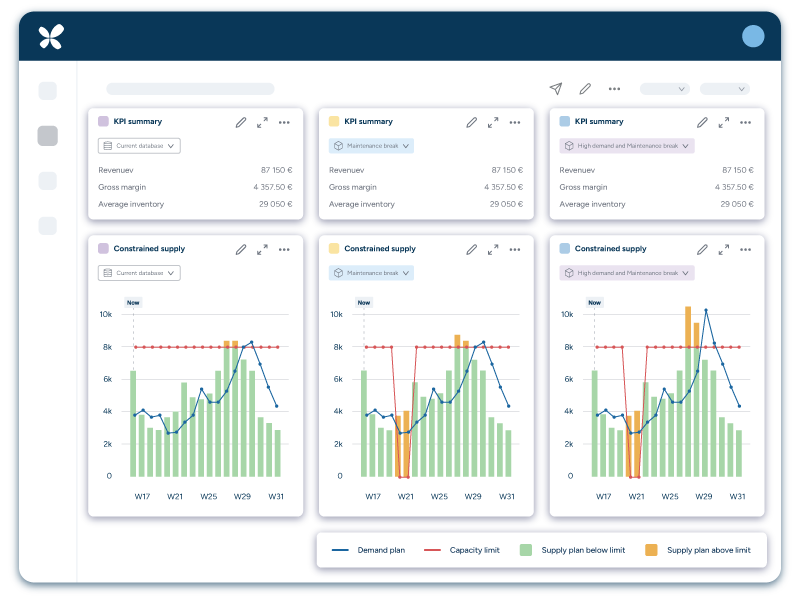
They might study how profits would be affected by procuring more supply, selling cuts chilled or frozen, offering discounts, or running marketing campaigns. Deeper insight into potential outcomes enables companies to fine-tune business processes and reshape their decision-making around analytics and hard data rather than gut feelings.
A robust supply chain planning and optimization solution can ease the burden of forecasting sales.
Decisionmakers can use statistical analysis based on historical trends and seasonality, reducing uncertainty on the demand side and enabling companies to find a good market for all the cuts in a carcass. Any compromise will affect profits, so creating alternative plans is essential to empowering executives to foresee market changes and respond accordingly.
6. Build more strategic marketing campaigns
Marketing teams play an increasingly vital role in supply chain management. They provide the necessary demand information that helps balance livestock/meat procurement and hold essential data on details such as:
- Promotions
- Products and availability
- Prices
- Order tracking
- Incentives
- Marketing campaigns
- Sales information
Optimizing supply chain planning strengthens the marketing department. It helps companies make more accurate forecasts, which, in turn, enables the marketing and sales departments to plan more strategic campaigns.
Visibility into supply availability can help marketers make more strategic decisions concerning accepting or rejecting promotion suggestions to maximize profitability.
However, active participation in the supply chain planning process requires marketing teams to obtain inside information to build relationships that improve operational supply chain efficiency. This information must flow automatically to marketing and key account managers so they can coordinate sales activation efforts accordingly. For instance, a marketing team that receives notice of additional raw material on the supply side can plan sales activation efforts that minimize spoilage and reduce the need to freeze the meat.
This end-to-end visibility and cross-functionality also benefit marketers directly. Visibility into supply availability can help marketers make more strategic decisions concerning accepting or rejecting promotion suggestions to maximize profitability.
Imagine a scenario in which the software forecasts a production surplus for a specific cut. The marketing and sales departments could plan promotions accordingly, liaising with customers to help sell the stock for a higher price while it is still chilled. This situation would strengthen the company’s competitive position and support the successful distribution of all cuts from the carcass.
7. Adapt intuitively to a fluctuating environment
The fluctuating market environment requires companies to adapt and respond promptly to multiple variables. Any delay in operations might erode the competitive edge, making easy customization the key to responding to market trends without disrupting operations.
A comprehensive supply chain management solution makes operations more intuitive for employees.
Yet employees often struggle when asked to switch frequently between scenarios, devise new strategies, and adjust variables. Constant context-switching takes a toll on employees who cannot handle complex processes simultaneously, and any mistake along the way can have serious consequences.
A comprehensive supply chain management solution makes operations more intuitive for employees. The right solution is much easier to use than spreadsheet-based planning. Employees don’t need to be experts in supply chain planning to formulate effective planning initiatives, because the software will handle most of the work. This encourages employees to test different scenarios and devise innovative solutions that will positively impact operations.
Plan for an optimized future
Supply chain complexities present both significant challenges and opportunities for meat producers. Adopting advanced planning software is a strategic imperative for those seeking to navigate the intricate balance of supply and demand and to capitalize on market opportunities.
These tools offer a pathway to streamline operations and enhance decision-making, ensuring that every step from farm to fork contributes to greater efficiency and profitability.
The meat production industry must continue to evolve, embracing innovative solutions to stay ahead in a competitive, volatile market. Producers can harness the power of sophisticated planning solutions to optimize every facet of their operations, from forecasting and procurement to marketing and sales, to improve margins and ascertain a stronger market position.
Written by


Related Articles

Agentic AI in manufacturing supply chain planning
Learn why most manufacturers need both general and tailored agents, meet the five core RELEX agents for manufacturing, and see how RELEX Open lets you deploy, connect, and extend AI across your supply chain planning.

Case Study: Grupo Vinoteca
The Challenge of Growth Without the Right Tools Grupo Vinoteca is one of Mexico’s leading retailers and distributors of wine…

7 ways AI planning software solves meat manufacturing’s supply chain challenges
Discover seven AI supply chain planning capabilities that close the margin gap in red meat manufacturing.