How mathematical optimization unlocks profits in the poultry supply chain
Jan 12, 2026 • 7 min
Why traditional manufacturing approaches don’t “fly” in poultry
When it comes to maximizing profitability, what works in broader manufacturing doesn’t always fly in the poultry industry.
The core challenge is that there are thousands of ways to cut each bird, and different cuts can be used to fulfill different types of demand. For example, if you’re producing a teriyaki chicken dish, the meat could come from a range of cuts, from different bird sizes, and even from different quality grades.
In other words, planners are constantly solving a massive jigsaw puzzle: there are many ways to use each bird to meet a wide variety of demands. Doing this in a truly optimal way is virtually impossible without advanced algorithms.
If your goal is to maximize the value of every bird, mathematical modeling and optimization are no longer “nice to have”; it’s a requirement.
RELEX provides a supply chain planning solution built on the latest and most advanced optimization algorithms to help poultry producers maximize profit across the entire supply chain.
A uniquely complex, push-and-pull supply chain
The poultry supply chain is becoming increasingly complex, and companies can no longer afford to make strategic decisions based on margin in isolation. To maximize long-term profitability, producers must examine the entire end-to-end value chain and adopt a more demand-driven planning approach.
Another unique challenge is the inherent mix of push and pull:
- Push: Birds arrive according to biological and farming schedules – you must process them, whether there’s demand for each possible cut.
- Pull: At the same time, you must fulfill specific customer and market demand, often with strict service levels and product specifications.
Without advanced planning solutions, many companies operate primarily on a push model. Production teams manufacture based on orders or forecasts, then sales and marketing are left to “deal with” the surplus. That surplus may need to be frozen or discounted, which can lead directly to margin erosion.
By establishing a planning model that finds the optimal cut plan across the full lifecycle of each bird, producers can:
- Minimize surplus
- Make earlier, smarter decisions about where to sell potential excess
- Give sales teams a clear view of future surplus 6–10 weeks before production, instead of discovering it at the last minute
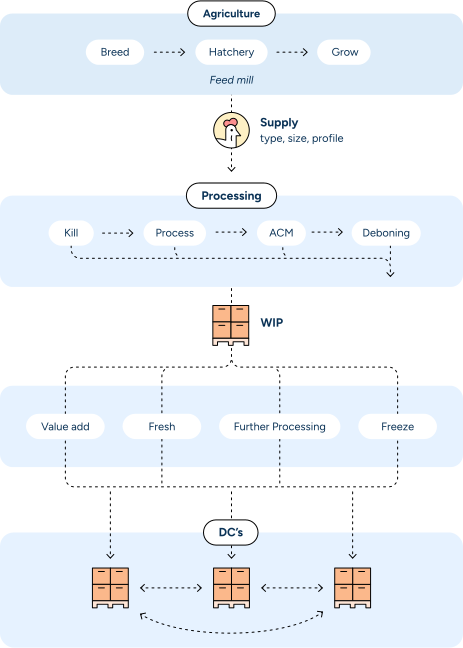
Why demand-driven models fit poultry better
Demand-driven planning models are often referred to as pull models because orders are effectively “pulled” through production in response to real market signals, rather than being pushed based on static estimates.
These models draw on real-time data such as:
- Buying patterns such as changing consumer behavior due to seasonality, economic conditions, or social media trends.
- Competitor activities, including pricing, promotions, product launches, and assortment changes that influence demand.
- Retail customer strategies, especially planned promotions, assortments, and category roles that shape volume and mix.
- Customer preferences, including trends toward organic, free-range, or higher-welfare poultry.
- Regulatory changes, such as new food safety or animal welfare legislation, that affect production costs and pricing.
- Supply chain dynamics, including fluctuations in feed costs, labor, energy, or transportation that impact margin and pricing.
Ultimately, a demand-driven approach yields more accurate, profit-focused plans than standard costing, which typically relies on fixed-cost assumptions and often overlooks critical elements, such as distribution costs and processing complexity.
Demand-driven models better suit the multifaceted needs of poultry industry planners.
It’s time to plan for profit, not just volume
Poultry supply chain planning is not for the faint of heart. Many companies have tried to tackle the challenge by:
- Planning with several disconnected systems.
- Relying heavily on experience, intuition, and gut feel.
Experience is valuable, but human bias makes it difficult to fully consider the complexity of the supply chain. Meanwhile, multiple unconnected systems make it nearly impossible to see the impact of each decision on the overall business.
As a result, many teams default to planning for sales and volume instead of planning for profit.
End-to-end supply chain digital twin for poultry
RELEX provides a supply chain planning solution that allows poultry producers to model their entire end-to-end supply chain, with all relevant constraints and business rules, to create a true digital twin.
For a digital twin to be effective, every business rule, constraint, and cost must be captured. The granularity of the RELEX solution enables exactly that. Producers can define all available options for how to cut the bird and specify how different cuts can be used as products are refined. In practice, this often results in several thousand distinct cut plans.
Once the model is defined, RELEX uses advanced mathematical modelling and optimization to identify the most profitable plan. It matches the various sizes, species, and quality grades of birds against the full spectrum of demand. The result is a supply chain plan that spans not only the next few days, but the entire lifecycle of the birds.
In short, the RELEX supply chain planning solution:
- Models the end-to-end supply chain, from live bird sourcing to final delivery
- Evaluates the full economic impact of each decision, not just standard cost
- Generates executable plans that operations, sales, and finance can trust
Profit optimization across every processing step
To truly optimize profitability, planning can’t stop at standard cost. Modern solutions use a planning engine that considers every variable supply chain cost component, such as:
- Bird sourcing and grow-out, including breed, growth curves, weights, and cycle optimization.
- Primary processing, covering slaughter, evisceration, cutting, and deboning.
- Secondary and further processing, marination, and value-added products.
- Tertiary processing such as smoking, small goods, and specialty products.
- Warehousing and inventory holding, including shelf-life and storage constraints.
- Distribution considerations such as transportation modes, routes, lead times, and service requirements.
Many legacy planning solutions rely on heuristics – rule-based methods that are fast but approximate. While heuristics can be helpful for speed, they cannot reliably determine the optimal solution in a highly complex environment, such as poultry, where every cut, process, and route can significantly impact the final profit.
Heuristics are helpful for speed but cannot reliably determine optimal solutions in a highly complex environment.
Only a comprehensive, mathematically optimal view of the end-to-end production process gives poultry producers an accurate picture of the cost side of the profit equation.
With that visibility, companies can:
- Drive avoidable cost out of the supply chain.
- Improve service levels and on-time delivery.
- Strengthen margins while avoiding unnecessary price erosion.
Adapt quickly to market dynamics
To remain profitable in the face of constant shifts in supply and demand, companies must be closely attuned to market dynamics. A digital tool with real-time demand sensing and analytics becomes a critical ally.
Such software continuously:
- Monitors market trends, competitor actions, and consumer demand.
- Identifies changes early, before they erode margin.
- Recommends adjustments to production plans, product mix, and pricing.
The ability to sense and respond means production strategies are not only reactive but also proactive, keeping operations in sync with the market’s pulse. When combined with competitor data and retailer strategies, these insights provide producers with a clear competitive edge, helping ensure that planning decisions remain the most profitable under changing conditions.
Companies must stay attuned to market dynamics to ensure their planning decisions remain the most profitable in the face of supply and demand shifts.
Plan confidently for every scenario
Uncertainty is a constant in the poultry industry, from disease and weather risks to supply disruptions and volatile demand. Optimization software helps producers manage this uncertainty through:
- Predictive analytics that identify potential supply chain disruptions and risk factors.
- Scenario planning that simulates different market, cost, and demand conditions to stress-test strategies.
Scenario planning allows poultry producers to understand the implications of decisions such as:
- Introducing new products or discontinuing existing ones.
- Adding, removing, or repurposing production lines.
- Adopting new manufacturing technologies or distribution strategies.
- Adding new growth sheds.
With this foresight, producers can make data-driven decisions, navigate challenges more effectively, and capitalize on opportunities more profitably.
The path to demand-driven profit optimization
As the poultry industry grapples with rising cost pressures and evolving market demands, advanced planning and optimization software is emerging as a key tool for unlocking profitability.
The shift is from reacting to market events to proactively shaping production strategies that both meet and anticipate demand.
The right optimization solution isn’t just another tool in the tech stack. It’s a strategic partner in the quest for profitability, offering:
- Clarity on the true cost and profit impact of every decision.
- Agility to adjust quickly to changing market conditions.
- Precision in planning across the entire end-to-end supply chain.
For poultry producers seeking to soar in a competitive market, embracing demand-driven mathematical optimization is no longer optional – it is essential for achieving sustainable, long-term success.
Written by


Related Articles

How to build a consumer decision tree: why the best CDTs start with shopper behavior, not supply logic
See why CDTs based on shopper behavior beat vendor- and workshop-built trees, and how RELEX CDT Builder applies the method.

Agentic AI in manufacturing supply chain planning
Learn why most manufacturers need both general and tailored agents, meet the five core RELEX agents for manufacturing, and see how RELEX Open lets you deploy, connect, and extend AI across your supply chain planning.
Case Study: Grupo Vinoteca
See how Grupo Vinoteca, a Mexican wine and spirits distributor, reduced lost sales by 34.7%, cut store replenishment time by around 50%, and saved on inventory with RELEX's unified planning.