How AI-optimized replenishment days cut costs and complexity in retail stores
Apr 23, 2024 • 5 min
Store staff are essential sales and cost drivers in physical retail. In grocery, store labor is the most significant operating cost, amounting to around 14% of revenue.
It’s always good business for retailers to improve work efficiency in their stores. And as retailers struggle to find store workers and see wages increase, in-store productivity is more topical than ever.
Store replenishment directly impacts operational efficiency in stores: poorly planned store replenishment leads to inefficient shelf stocking in the stores. In the worst cases, store workers spend a lot of time moving pallets around the store while stocking shelves and have to make frequent trips to and from the backroom storage area to fetch products.
Retailers that want to cut wasted labor time in stores should be structuring replenishment around designated main replenishment days. Concentrating deliveries and shelf-stocking into predictable windows replaces the reactive, fragmented workflows that send workers back and forth to the stockroom all day. AI pushes those gains further, optimizing schedules to reduce unnecessary movement and match replenishment more closely to actual demand patterns.
Why daily replenishment without structure costs retailers more than they realize
Most large retailers replenish their stores daily because fast-moving products and fresh items demand frequent deliveries. This frequency is also the case when delivery volume from the retailers’ distribution centers to the stores is large enough to warrant daily shipments.
Most replenishment systems base their planning on these distribution schedules. If daily deliveries are available, most systems will set safety stocks and estimate order needs based on next-day delivery.
Yet, if all replenishment opportunities are used for all products without discretion, two problems follow:
- Pallets or roll cages delivered to the stores carry a random mix of products representing many different product categories located in other parts of the store. This means store workers must spend a lot of time moving pallets around the store when stocking shelves.
- The delivery volume to the stores reflects the stores’ daily variation in sales. Often, there are delivery peaks towards the end of the week in anticipation of weekend demand. This leads to fluctuating capacity needs in both distribution and stores, which increases costs.
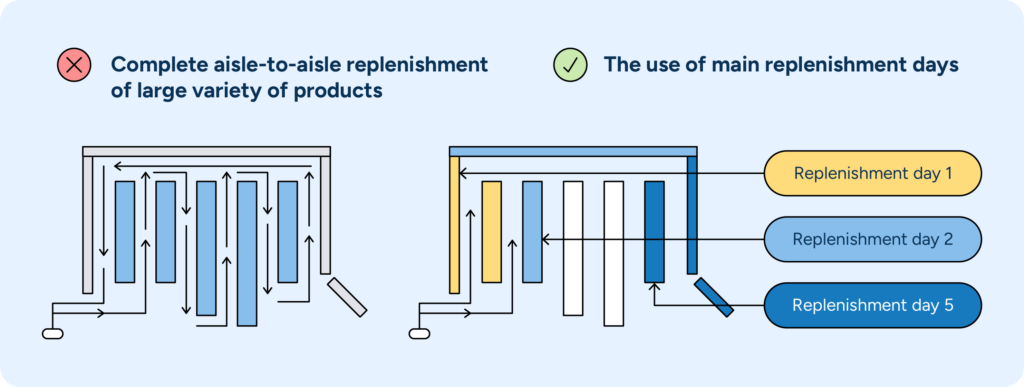
The best practice is to apply main replenishment days and concentrate the replenishment of products displayed in the same area of a store, such as a specific aisle, to certain weekdays. Safety stocks and order quantities are then calculated based on these main replenishment days. The replenishment system will place additional orders to avoid stock-outs in the case of unexpected demand spikes, ensuring the highest possible on-shelf availability.
In practice, this means that not all products are ordered every day. For example, fast-moving detergents would be replenished on Mondays and Thursdays, while slow-moving detergents would be replenished only on Mondays. The other available replenishment days would be used only when stock-outs are risky.
Main replenishment days are applicable to all but the shortest shelf-life products. In addition, the products need sufficient shelf space to accommodate at least a couple of days’ sales to avoid unnecessary backroom stock. In grocery, main replenishment days can typically be applied to all but the fastest moving or bulkiest center store products.
The use of main replenishment days substantially increases shelf-stocking efficiency in stores without hampering on-shelf availability. RELEX has observed reductions of 20% in time spent on stocking shelves following the introduction of main replenishment days.
READ MORE: Unlock profitability with replenishment optimization
Artificial intelligence optimizes inventory flows
Besides more consolidated deliveries, main replenishment days enable the leveling out of inventory flows. This is especially true when harnessing artificial intelligence to optimize main replenishment days.
RELEX’s AI-based optimization of main replenishment days uses a particle swarm algorithm for multi-objective optimization. This optimization prioritizes objectives based on customer-specific business targets.
In some cases, the main priority can be to achieve as smooth a goods flow over the week as possible. In other cases, a smoother goods flow must be combined with lower volumes during the weekend, when labor is more expensive. Optimization also minimizes the number of replenishment days and shelf breaches, which occur when a delivery exceeds available shelf space.
The optimization is done per store to find the best main replenishment days for groups of products displayed in the same part. It considers the products’ shelf-life, shelf space, and sales patterns. In addition, constraints such as the minimum and maximum number of replenishment days and the available distribution schedules are respected.
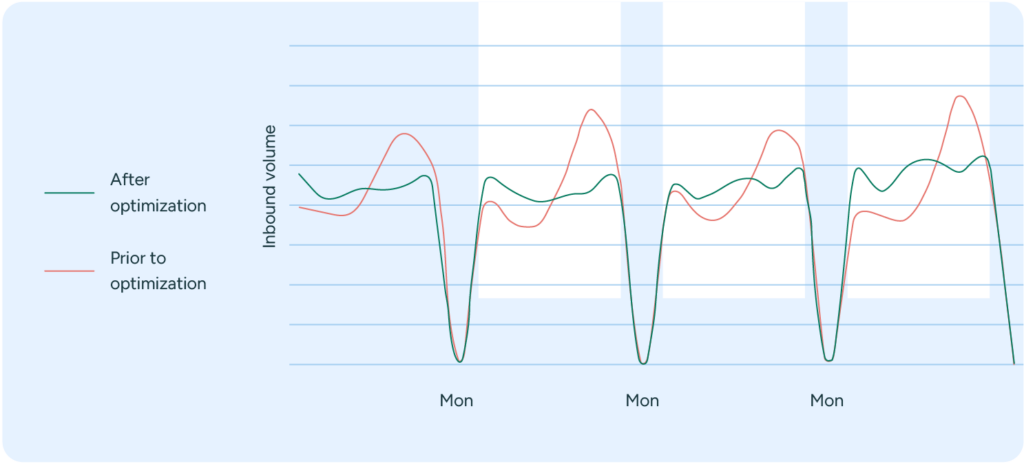
Compared to setting main replenishment days based on rules defined by replenishment planners, AI-driven optimization delivers clear additional benefits:
- A much smoother inbound goods flow to stores. This allows for more level workloads and more predictable work shifts in stores, increased cost-effectiveness, and significantly fewer capacity issues. In addition, a level base volume makes replenishment planning around major holidays easier.
- More of the same and similar products in one go. AI-chosen days make in-store replenishment more efficient without sacrificing availability or straight-to-shelf deliveries.
- A decrease in the number of store order lines. Optimization means lower picking costs in the distribution centers and reduced handling costs in stores.
As retailers undergo profound transformation under significant pressure only time will tell who the winners will be. In any case, it is evident that retailers can no longer afford to sustain inefficient operations. The ability to keep operational costs in check is essential for profitability and even survival. Applying pragmatic AI to optimize replenishment days and operations is an essential means to this end.
Written by

Related Articles

How to build a consumer decision tree: why the best CDTs start with shopper behavior, not supply logic
See why CDTs based on shopper behavior beat vendor- and workshop-built trees, and how RELEX CDT Builder applies the method.

Agentic AI in manufacturing supply chain planning
Learn why most manufacturers need both general and tailored agents, meet the five core RELEX agents for manufacturing, and see how RELEX Open lets you deploy, connect, and extend AI across your supply chain planning.
Case Study: Grupo Vinoteca
See how Grupo Vinoteca, a Mexican wine and spirits distributor, reduced lost sales by 34.7%, cut store replenishment time by around 50%, and saved on inventory with RELEX's unified planning.