Why predictive pricing lies at the heart of successful pricing efforts
Dec 8, 2025 • 12 min
No matter how big or small, every price change impacts a company’s retail operations and beyond. Lowering the price of one product can increase sales of related items, while raising it might push customers toward substitutes. When supplier costs increase due to tariffs or raw material changes, retailers need to know how resulting price adjustments will affect demand across multiple products and timeframes.
But visible sales shifts only show a snapshot of customer response to a price change. The real drivers of profit come from the hidden ripple effects a price change creates. Without visibility into these hidden effects, pricing decisions become a matter of guesswork.
Understanding how price changes affect customer behavior and demand requires analyzing millions of transactions across various categories and time frames. Retailers still working in spreadsheets lack the speed and analytical power to process this volume. What should take seconds stretches into days or weeks, leaving them unable to respond to market shifts.
Balancing immediate pricing opportunities with longer-term strategic decisions adds another layer of complexity. Without advanced analytics, retailers struggle on both fronts, missing tactical opportunities while making flawed strategic commitments.
Predictive pricing eliminates this uncertainty. Retailers can use AI and machine learning to quantify the short- and long-term effects of price changes, revealing purchasing patterns and product relationships that traditional models cannot detect. This level of precision and granularity gives planners the confidence to capture short-term opportunities while strengthening long-term pricing strategy.
What is predictive pricing?
Predictive pricing is a strategy used by pricing teams to forecast optimal prices for products and services. It factors in multiple variables to accurately predict customer behavior when a price change occurs, including:
- Historical sales data.
- Market trends.
- Competitor pricing.
- Seasonality considerations.
- External influences.
AI-powered pricing software analyzes these variables and uses the information to recommend prices that maximize revenue, profit, or market share based on specific business objectives. Price elasticity forms the foundation of this analysis, measuring the direct relationship between the price of an individual item and its demand.
However, predictive pricing extends far beyond elasticity. By analyzing millions of transaction-level records, a predictive pricing system can pinpoint how a price change affects a single item and how it alters what shoppers put in their baskets.
This deeper analysis captures the nuanced ways customers react to pricing across products, categories, and time periods. Retailers can then interpret both the direct and indirect effects of price decisions with far greater accuracy.
Short-term vs. long-term predictive pricing
Effective predictive pricing must account for two distinct time horizons, each with its own unique analytical requirements.
Short-term tactical pricing focuses on immediate market conditions. When a competitor drops prices on key items, retailers need to understand the impact within hours, not days. These decisions focus on weekly promotional calendars, competitive positioning, and capturing immediate sales opportunities. Predictive pricing solutions must process current market signals and deliver recommendations quickly, often running nightly to alert teams to high-impact changes that require attention.
Long-term strategic pricing involves examining pricing over several months or quarters. These decisions shape category strategies, margin targets, and competitive positioning for entire product lines. The analysis examines how pricing one category influences customer behavior in related categories over extended periods, enabling teams to model multi-product impacts and strengthen overall price strategy.
These time horizons constantly intersect. Strategic moves, such as repositioning private label pricing or reshaping category value, guide everyday pricing choices, while short-term signals feed back into and refine longer-range plans.
Advanced predictive pricing software handles both dimensions simultaneously, ensuring short-term actions support strategic goals while strategic frameworks remain flexible enough to capitalize on tactical opportunities.
How predictive pricing works
Retailers generate millions of transactions monthly, creating a rich source of behavioral insights for price optimization solutions. Modern predictive pricing technology uses AI and machine learning to process massive datasets that would overwhelm traditional analysis methods.
The process begins with an analysis of historical transaction data. Two years of data provides the best picture for accurate modeling, though a pricing solution like RELEX can work with less. The system organizes this data into a structured model by cleaning, normalizing, and enriching it with contextual factors that capture real-world drivers of demand across both time horizons:
- Short-term: Competitive price changes, promotional calendars, weekly events, store-specific conditions.
- Long-term: Seasonality patterns, market trends, economic indicators, product lifecycle stages.
With this foundation, machine learning models identify patterns across products, time, and context. Price elasticity is calculated for thousands of items simultaneously, forming the base layer of prediction. As new data flows in, the models continually update to reflect shifts in customer behavior and ensure accuracy even as conditions evolve.
Short-term tactical pricing
Predictive pricing evaluates near-real-time signals and runs on frequent cycles to flag high-impact price changes. Once trained, the AI identifies complex basket-level relationships. When the price of item A changes, the technology measures how demand for items B, C, and D shifts, detecting patterns human analysts would miss among the sheer volume of data.
Advanced analysis shows how promotional decisions affect both the featured item and the rest of the basket. In many cases, those secondary shifts matter more than the initial lift on the promoted product. The same analysis can separate the impact of merchandising tactics, such as endcaps or circular placement, even when prices stay the same. With this level of detail, teams can base short-term decisions on how shoppers actually respond, not just on promotional sales.
Long-term strategic pricing
On a longer horizon, predictive pricing informs strategic decisions shaping category performance over months and years. AI models incorporate macro-level factors, such as market trends, competitive shifts, and multi-year seasonal patterns, to model how pricing strategies will perform well beyond the next promotional cycle.
Scenario simulation enables testing strategic approaches before implementation, evaluating how different pricing pathways perform across categories and time periods. Examples include:
- Adjusting price gaps between value, core, and premium tiers to shape customer trade-up or trade-down behavior.
- Phasing in category-wide price increases to understand how gradual versus immediate changes affect demand and margin.
- Repositioning competitor-sensitive items to model how price shifts influence overall category share.
- Testing alternative promotional strategies to evaluate long-term effects on sales and loyalty.
These simulations quantify both direct and indirect impacts across related products, enabling retailers to commit to strategies with confidence rather than relying on intuition or historical norms.
As conditions change, the model refreshes its predictions, keeping long-term strategies aligned with current shopper behavior and market signals. This makes it easier for teams to manage pricing decisions across the product lifecycle while keeping daily actions consistent with broader financial goals, such as margin recovery or share growth.
The benefits of a comprehensive predictive pricing strategy
Predictive pricing technology delivers advantages that extend far beyond simple price recommendations.
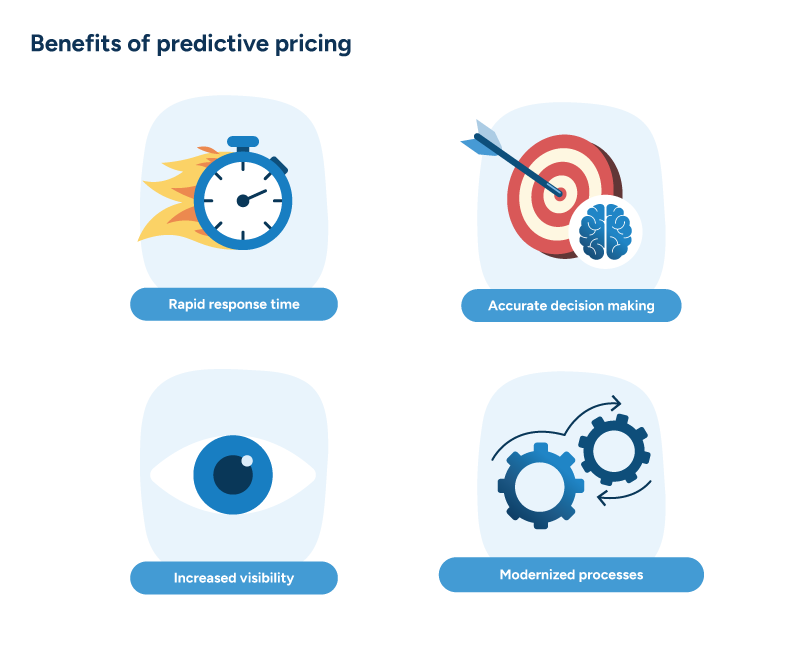
Speed & responsiveness
Traditional pricing reviews often happen monthly or quarterly, which make it difficult to react when the market shifts. Advanced predictive pricing tools continually analyze thousands of SKUs and alert teams to changes that require immediate attention. When conditions move because of competitors, demand, or costs, teams receive updated recommendations within seconds instead of waiting for the next review cycle. Allowing retailers to respond at the speed of business.
These tools also surface the pricing actions most likely to influence margin or volume, helping teams focus on the decisions that matter and reducing the risk of missing meaningful movements in the market.
Decision quality & accuracy
Rather than relying primarily on intuition, pricing teams can base decisions on behavioral forecasts that predict customer responses to price changes. This allows them to trust that projected outcomes will align with reality.
Each recommendation is accompanied by a quantified estimate of its expected benefit. Teams can prioritize changes that deliver meaningful impact while avoiding adjustments that waste resources. Accuracy improves continuously as the system learns from new data and outcomes. This precision enables proactive management rather than reactive corrections.
Enhanced visibility into customer behavior
Predictive pricing reveals the calculations behind price changes, helping planners understand cross-production relationships and the rationale behind pricing recommendations. Shedding light on these hidden dynamics separates sophisticated retailers from those operating in the dark.
When one brand of soda is on promotion, what happens to sales of a rival brand? How does turkey pricing affect the sale of closely related items, like gravy and stuffing? Advanced predictive models account for these cross-item effects, providing insights that basic elasticity models miss entirely.
Clear explanations behind recommended prices help teams understand how a price change affects related items and categories. When stakeholders can trace these connections and see the whole picture, it becomes easier to align on decisions and build confidence in a more data-driven pricing approach.
Process upgrades & efficiency
The shift from spreadsheets to AI-driven software represents a fundamental upgrade of price planning operations. Predictive pricing automates execution so teams can focus on strategy rather than manual data work.
Pricing software also helps teams avoid unnecessary work, such as printing labels for items that are about to go on promotion. When efficient practices like this are applied across thousands of SKUs and multiple locations, retailers reduce substantial amounts of avoidable labor and material costs.
Predictive pricing implementation challenges
Adopting predictive pricing delivers meaningful value, but it also requires organizations to rethink long-standing processes and assumptions. Moving from manual or spreadsheet-based workflows to AI-driven decision-making introduces several hurdles that retailers must anticipate and plan for.
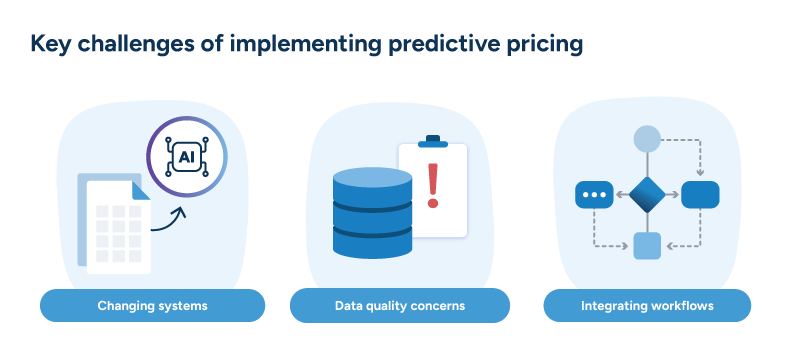
Change management
Change management represents the primary challenge when implementing predictive pricing due to pricing’s unique organizational visibility. Everyone from frontline analysts to the CEO knows the prices of key items. Customers provide direct feedback, and competitors’ pricing moves are constantly monitored.
This high-visibility environment creates strong opinions at every organizational level about how pricing should work. Category managers often resist moving from gut-feel decisions to AI-driven price suggestions. Building trust requires demonstrating how the models work, what drives the recommendations, and how outcomes improve when the organization embraces data-driven pricing.
Data quality concerns
Many retailers believe they lack sufficient data quality to implement predictive pricing effectively. This misconception stems from traditional approaches that required extensive product hierarchies and attributes. However, this fear is largely unfounded when using AI and ML approaches.
Modern AI-driven systems operate differently, focusing on transaction scale, not perfect master data. With two or more years of transaction history, capturing seasonality, promotional cycles, and customer behavior patterns, predictive models can generate highly accurate insights even when product data is imperfect.
This shift reduces the burden on data governance teams and removes one of the most common barriers to adoption.
Workflow integration
Sustained success requires integrating predictive pricing into everyday workflows, not treating it as a separate, ad hoc analysis tool. Many retailers still plan promotions, update price lists, or coordinate store execution in spreadsheets, even after deploying advanced pricing technology.
When insights and execution live in different systems, teams lose speed, accuracy, and consistency. Fully integrated workflows ensure that recommended price actions are transmitted directly into downstream systems, allowing decisions to be translated into action without the need for manual information transfer.
How RELEX delivers predictive pricing excellence today
Many retailers want to move beyond basic pricing tools, but getting there requires a solid data and system foundation. The industry is steadily shifting toward real-time pricing that reflects how shoppers behave at the basket level. RELEX already supports this approach, giving teams the ability to run these models and use the insights in daily pricing work.
The platform addresses data quality concerns through advanced AI, tackles change management through transparency, and streamlines complex pricing workflows. Critically, RELEX integrates both short-term tactical capabilities and long-term strategic planning within a single unified system, ensuring immediate pricing decisions align with broader business objectives.
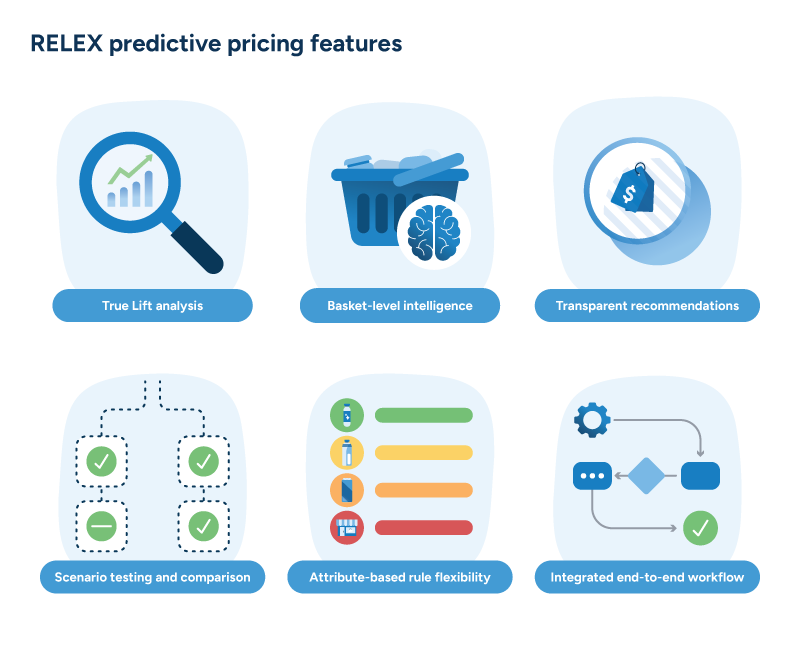
True Lift: Understanding promotional impact
Most retailers only see the tip of the iceberg when evaluating promotional pricing changes. RELEX True Lift uncovers the full financial picture through deep basket analysis, quantifying switching effects, halo effects, and stockpiling. This prevents false positives, avoids over-investment in underperforming promotions, and improves profit forecasting for weekly and seasonal campaigns.
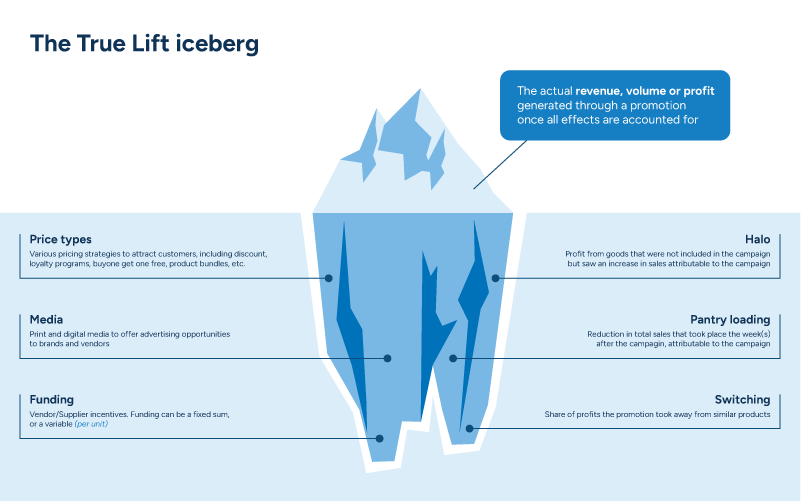
Basket-level intelligence powered by AI for short-term and long-term gains
RELEX maps product relationships across categories using transaction-level AI,
powering:
- Short-term decisions, understanding real-time basket shifts when prices or promotions change.
- Long-term decisions, identifying sustained category relationships and multi-quarter pricing impacts.
Connecting these insights across horizons allows RELEX to prevent short-term wins from undermining long-term goals and vice versa.
Transparent recommendations that build trust in every decision
RELEX addresses the “black box” concern that often slows AI adoption by making every recommendation fully explainable. Many pricing tools surface suggestions without showing how they were calculated, leaving teams unsure whether to trust the output. RELEX removes this uncertainty by clearly breaking down the drivers behind each price, including:
- Elasticity
- Competitive signals
- Rules
- Margin targets
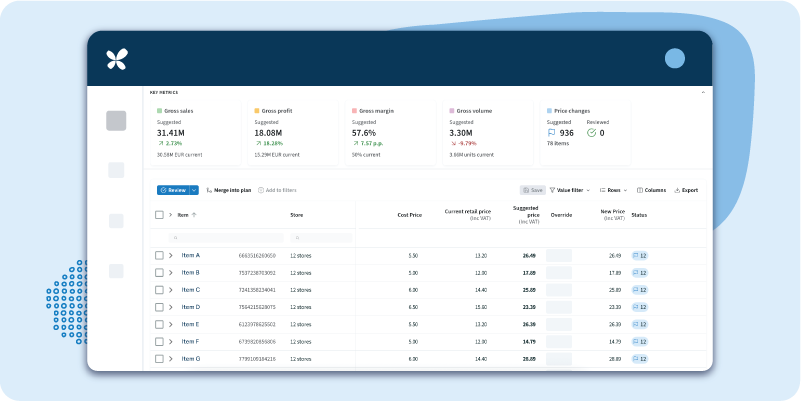
This transparency accelerates change management, improves cross-team alignment, and ensures that teams understand not only what the system recommends but also why it makes those recommendations.
Real-time scenario testing and comparison for improved short-term and long-term planning
RELEX turns scenario testing from being a time-consuming exercise into an instant capability. Pricing teams can copy existing strategies, modify specific rules, and immediately see the projected impact. What once required days or weeks of analysis now happens in seconds, enabling rapid strategic refinement.
The platform’s scenario comparison feature allows side-by-side evaluation of different approaches. Teams can test multiple pricing strategies simultaneously and compare their expected outcomes across sales, profit, and volume metrics. This flexibility supports confident experimentation in long-term planning and quick pivots in short-term planning when business objectives shift or market conditions change.
Attribute-based rule flexibility combining strategic framework with tactical execution
RELEX enables rule-building at the attribute level rather than requiring individual, manual SKU configuration. Teams can establish pricing relationships based on brand, size, package type, or any product attribute in the master data. When new products enter the assortment, they automatically inherit the appropriate rules based on their attributes.
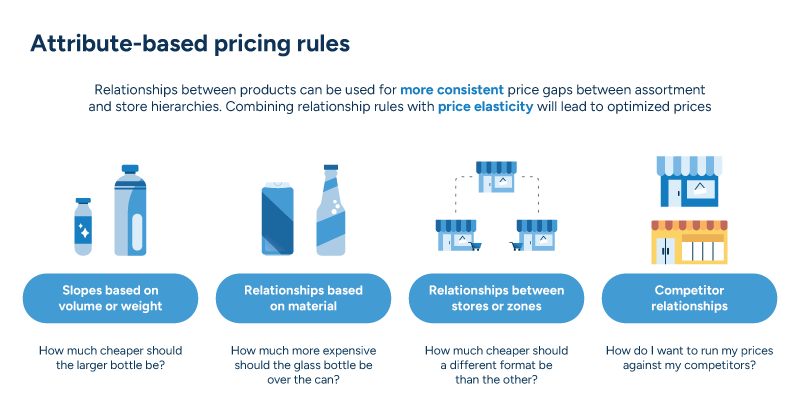
This capability serves both time horizons seamlessly. Strategically, it allows retailers to define long-term pricing frameworks, such as maintaining specific relationships between national brands and private labels or ensuring consistent size-based pricing across categories. Tactically, these rules execute automatically as new products launch or promotional decisions are made, guaranteeing day-to-day pricing aligns with strategic intent without constant manual intervention.
End-to-end workflow integration for unified short and long-term planning
RELEX provides end-to-end workflow coverage, from analysis to execution, inside a single platform. Rather than generating recommendations that teams must move into spreadsheets, all planning, prediction, and execution tasks stay within the RELEX environment.
Once price changes are approved, they flow directly to back-office systems without any additional data handling. Calendar views show upcoming promotions and price changes together, which helps teams coordinate timing and avoid conflicts. When predictive pricing is used alongside the RELEX forecasting and replenishment solution, promotional price changes and their expected impacts feed directly into demand forecasts, improving accuracy across the planning process.
Rejuvenate your pricing approach with confidence
Every single pricing decision influences multiple purchases and impacts complex product relationships. Retailers that gain visibility into these effects become informed and agile with their pricing strategies, enabling them to drive stronger financial performance and sustainable growth across their operations.
With predictive pricing powered by AI and machine learning, hidden dynamics become visible opportunities. Price changes are based on behavioral forecasts validated by millions of transactions, enabling category managers to proactively prevent cannibalization and optimize basket composition. The benefits of this new approach extend throughout the organization, with sales volumes increasing, inventory turns improving, and strategic investments replacing wasteful promotional spending.
RELEX predictive pricing delivers these capabilities, giving retailers the analytical foundation they need to succeed. With the amount of cost savings and revenue potential waiting to be unlocked, it’s easy to build a compelling case for investing in the proven, AI-powered price optimization solution that RELEX provides.
Written by

Related Articles
RELEX State of Supply Chain 2026: Volatility, trade-offs and the rise of AI
Find out why 77% of retail and manufacturing leaders remain optimistic, even as global disruptions, trade pressures, and demand volatility reshape planning.

Cracking the accuracy code: AI forecasting driving retail success
This session is for retailers focused on boosting forecast accuracy, what to measure to quantify its impact, and where to focus to deliver the greatest return.

Planning to profits: AI-driven forecasting, automated replenishment, and the capabilities that matter
Learn how AI forecasting and automated replenishment drive retail profitability, plus a checklist to evaluate your strategy.