Arguably, one of the most critical activities for retailers is also the most daunting. Promotions are universal to nearly every player in the retail sector. Retailers run thousands of promotions yearly, from online display ads to leaflets to loyalty club offers. They foster customer growth and loyalty, help shape the consumer experience, and play a significant role in retailer-supplier relationships and negotiations.
So, why do retailers struggle so much with such a frequent and vital aspect of their success? The bottom line is that the promotion process – high-level planning, optimizing offers, negotiating funds, and evaluating outcomes – is extremely difficult to do well.
You would be hard-pressed to find a retailer who doesn’t agree that running promotions that consistently perform is a significant challenge. However, retail is a margin game where even incremental improvements can result in substantial payoffs in the long run. Promotions, as challenging as they are, play a considerable role in winning that game, and retailers need to be able to meet that challenge head-on.
Key takeaways
- Promotion optimization uses technology to automate and streamline the planning, evaluation, and execution of in-store and online campaigns.
- Socio-economic shifts impact consumer buying power, making promoting the right products at the right price and at the right time critical to maintaining or growing margins.
- Retailers identify evaluation, planning, and scenario testing as their primary challenge areas for promotion management.
- By eliminating low-performing promotions, retailers can achieve a 3-6% increase in profit margins for promoted products and up to a 15% increase in incremental sales for the promoted product range through effective scenario testing.
What is retail promotion optimization?
Retail promotion optimization uses technology to automate and streamline the planning, evaluation, and execution of in-store and online sales campaigns for a specific set of products, at a specific discount, for a specific period. The primary goal of promotions is to increase consumer engagement, demand, and sales – all of which are primary drivers of profit margin and competitiveness. However, many retailers today still rely on manual, spreadsheet-based processes and struggle to consistently execute high-performance promotions.
Promotions are essential to retail success, but are extremely challenging to plan and execute when actionable insights are incomplete or hard to obtain. It’s time to optimize the promotion process from analysis to testing to planning with the power of automation.
Why do retailers need promotion optimization?
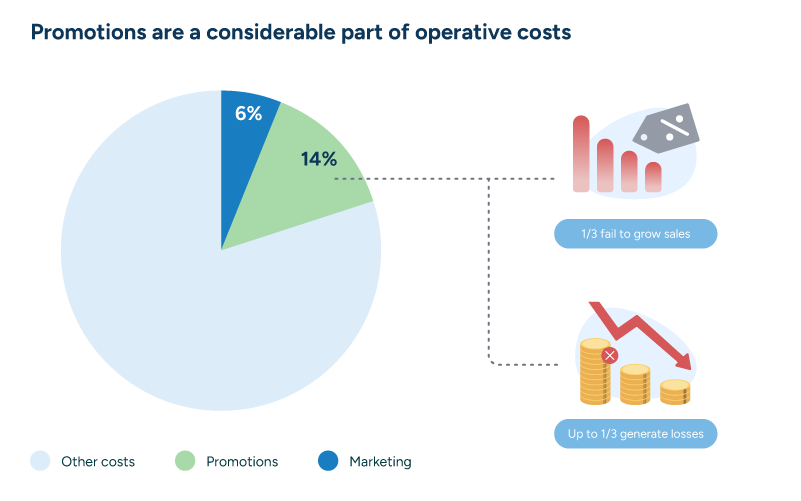
In a webinar about retail promotion pain points, we shared real-world insights from our conversations with retailers. That research shows that promotions and their associated marketing tasks account for approximately 20% of retailers’ operational costs. Add to that the findings that one-third fail to grow sales – and up to one-third actually generate losses – and it’s easy to see why retailers need to focus on optimizing planning and promotion strategy.
There are many reasons why optimizing promotions is so vital for retail success today:
- Ever-increasing and frequent socio-economic shifts directly affect consumer buying power, which is the lifeblood of all retail. The fight to maintain – even grow – margin depends on promoting the right products at the right price.
- Retailers run thousands of promotions across many channels. With so much riding on their success, actionable performance insights are essential to determine which promotions benefit the business and which don’t.
- Promotions play an essential role in preserving and growing market share. When done well, they drive the customer experience, foster loyalty, and help retailers stay competitive by attracting new customers.
- Retailers rely heavily on supplier recommendations due to data quality and volume. Retailers with automated access to analytics can better collaborate with suppliers and negotiate the best promotions to benefit all parties.
RELEX subject matter experts Jasper Nobelen and Thom Iddon take time from the NRF Big Show in New York to discuss promotion optimization and the keys to an effective technology approach.
To truly optimize promotion planning and execution, retailers need to invest in modern technology. With a significant portion of their budgets devoted to promotions and substantial potential to improve their bottom line, ramping up their technology landscape is the best approach to enabling retailers to make intelligent, informed decisions.
The critical challenges of retail promotion optimization
Retailers identify many challenges when dealing with promotions, but they can all be attributed to three primary challenge areas: evaluation, scenario testing, and planning.
Evaluation of past promotions
Retailers run thousands of promotions yearly. With so many promotions running at a high frequency, analyzing them in detail can be overwhelming, and many retailers prioritize execution over evaluation to avoid falling behind. Those attempting manual, spreadsheet-based analysis can only accomplish superficial evaluation: “Did we sell more? If yes, run the same promotion again,” or they only evaluate selected, “significant” promotions.
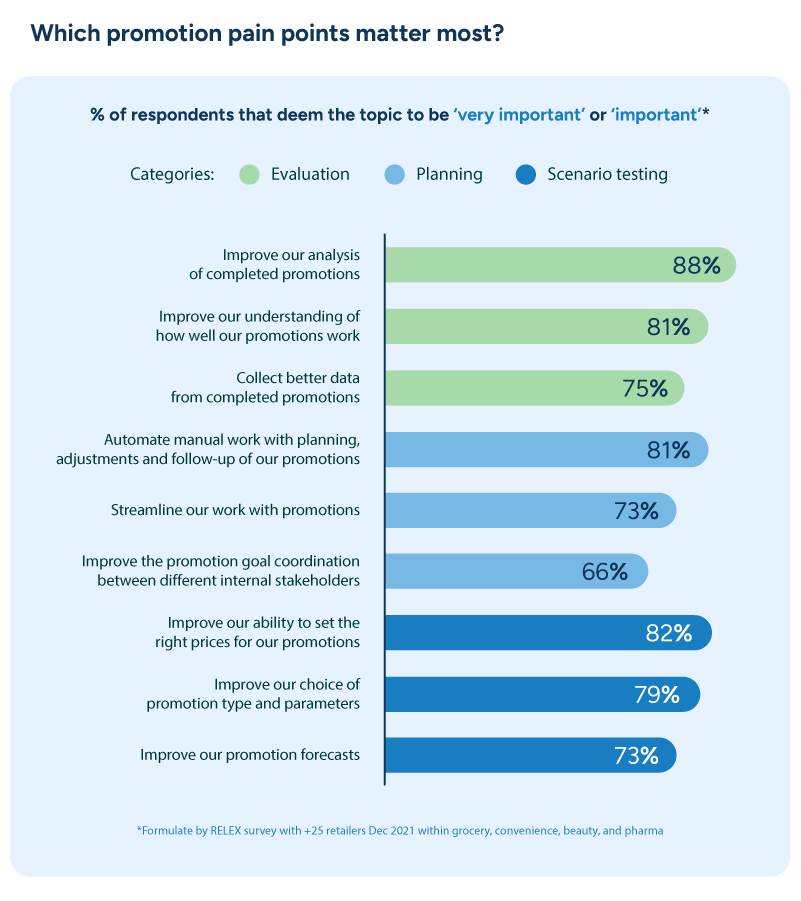
In preparation for our retail promotion webinar, we spoke to nearly 30 retailers in the grocery, convenience, and health and beauty sectors. Of those retailers, 88% identified completed promotion analysis as a top pain point. Further, 81% want a better understanding of how well their promotions perform, and 75% are not satisfied with the data they collect from them.
We mentioned earlier that one-third of promotions fail to grow sales, and up to one-third generate losses. When it comes to an activity as prevalent and with the potential for such significant impact – positive or negative – as promotions, the fact that almost 90% of retailers have limited or no actionable insights is staggering. Retailers need the ability to leverage analysis across all promotions for all products and locations to keep pace with the competition and drive customer experience.
Planning new promotions
Of the retailers we surveyed about promotional pain points, 81% said they want to automate manual processes for planning, adjusting, and follow-up for promotions. Moving data from spreadsheets to other systems can lead to compatibility issues, increased data corruption, and errors. Beyond being time-consuming, manual planning makes it difficult to sync with other systems that contain critical information, such as product lead times or price shifts.
Streamlining promotions (73%) and improving coordination between internal teams (66%) were top-ranking responses to which promotional pain points matter most. These goals are essential for success, but spreadsheets are not sufficient for the volume and complexity of data required to achieve them. For example, the complex statistical models required to understand impacts such as promotion uplift and cross-category effects are unsuitable for spreadsheets and need an automated system to process them efficiently and accurately.
Supplier collaboration is another critical aspect of promotion planning. Consumer goods companies often have a deeper understanding of data and insights than their retail partners, making them drivers of future promotions and offers. Since their internal capabilities to analyze and optimize promotions are limited, retailers have little choice but to lean heavily on supplier recommendations. Improved analysis of promotions and streamlined planning can help retailers collaborate on equal terms with their suppliers as they both seek to improve sales and margins together.
Proactive testing of promotion effectiveness
Scenario testing is a proven method for multiple functions in retail. Using a sandboxed environment that incorporates real-world data yields far greater accuracy in estimating results than benchmarking alone. However, many retailers lack the tools to test upcoming promotions proactively and end up launching campaigns based on limited data from the previous year.
In our research survey, 79% of retailers stated a need to improve their promotion types and parameters. Even so, the cycle of accepting previous promotions as “safer options” and running them repeatedly with minimal updates results in retailers copying around 95% of promotions year after year.
Beyond planning new promotions, retailers must promote the right products at optimal discounts to maximize profits. Of the retailers we spoke to, 82% stated a need for promotional price optimization, and 73% cited the need for better forecast accuracy. These considerations must be managed well in advance to mitigate the risk of running an ineffective or, at worst, damaging promotion. The best way for retailers to ensure reliable performance estimations is by leveraging a testing environment that assesses all promotion dimensions – place, price, and product.
The overlooked opportunity: Supplier collaboration in promotion planning
Approximately 70% of retail promotions are supplier-funded, making vendor partnerships crucial to their success. Yet most collaboration between retailers and suppliers still happens through fragmented emails, spreadsheets, and lengthy negotiation cycles. This manual, disconnected process creates bottlenecks that undermine even the most sophisticated internal promotion planning capabilities.
The collaboration gap
For many retailers, supplier collaboration continually surfaces as a pain point that touches every stage of the promotion lifecycle:
- Evaluation stage: Retailers lack structured ways to share performance data with suppliers, creating transparency gaps and weakening both parties’ ability to improve future promotions.
- Planning stage: Category managers spend hours manually tracking supplier proposals via email, making it challenging to evaluate offers systematically, leading to more negotiation rounds and suboptimal promotional strategies.
- Optimization stage: Without shared visibility into forecasts and historical performance, suppliers submit proposals based on incomplete information, limiting their understanding of the financial impacts of their mutual decisions.
The results are longer deal cycles, ongoing disputes over funding and settlement, and missed opportunities to leverage data to develop more effective, profitable promotions.
Closing the loop with RELEX Deal Management
Built directly into the RELEX Pricing & Promotions platform, RELEX Deal Management helps retailers and suppliers streamline fragmented processes into structured, data-driven partnerships.
Rather than managing vendor proposals through scattered emails and spreadsheets, retailers centralize all deal conversations, documents, and decisions in one shared workspace. Both parties work from the same promotional performance data, forecasts, and analytics, providing suppliers with the context they need to propose more effective deals and enabling retailers to evaluate and negotiate with confidence.
The unified platform approach means that deal collaboration isn’t a separate workflow. When suppliers submit proposals through Deal Management, that information flows directly into the Promotion Planning and Optimization platform, eliminating duplicate data entry and ensuring both vendor-funded and regular promotions are analyzed together for complete visibility into promotional ROI.
The transformation
When retailers close the supplier collaboration gap, they unlock benefits that cascade through the entire promotion lifecycle:
- Higher-quality proposals from suppliers who can access permissioned performance data and understand what drives results.
- Faster deal cycles through structured workflows and real-time visibility into proposal status and next actions.
- Stronger partnerships backed by shared analytics and transparent performance tracking.
- Better promotional ROI when both parties collaborate on data-driven strategies that meet customer needs.
3 tips for achieving retail promotion optimization
There’s no doubt that planning and executing retail promotions is deeply challenging. However, with the right tools, retailers can greatly simplify the process and boost margins. Based on our experience with a diverse range of retailers worldwide, here are our top tips for promotion optimization.
Tip 1: Automate analysis of promotion performance
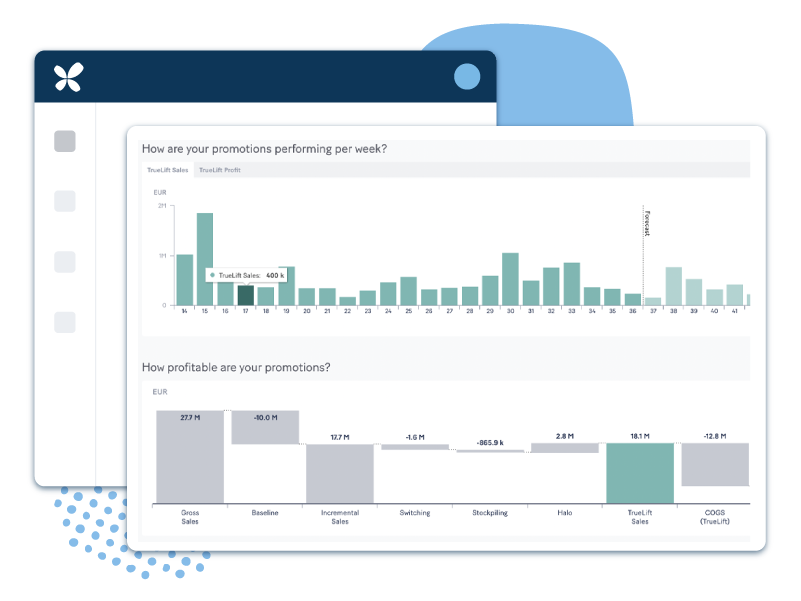
Retailers need a system that can provide automated analysis of past promotions across every product and every store, and comparisons of those promotions throughout the year. These analytics provide the insights planners need to maximize promotional results going forward. Armed with actionable, data-driven analysis, planners understand which promotions drive sales and margin, which past promotions to eliminate due to poor performance, and the optimal product assortments and discount depths for each.
Cutting off low-performing promotions also saves time that can be put toward developing new campaigns and strategies. An automated system also eliminates the need for time-consuming spreadsheets prone to data corruption, saving planners considerable time and boosting efficiency and accuracy across the supply chain.
Essential benefits:
- +3-6% increase in profit margins for promoted products by eliminating low-performing promotions.
- 20-25% reduction in time spent on manual planning that can be spent on the strategic development of new promotions and supplier collaboration.
Tip 2: Centralize promotion planning
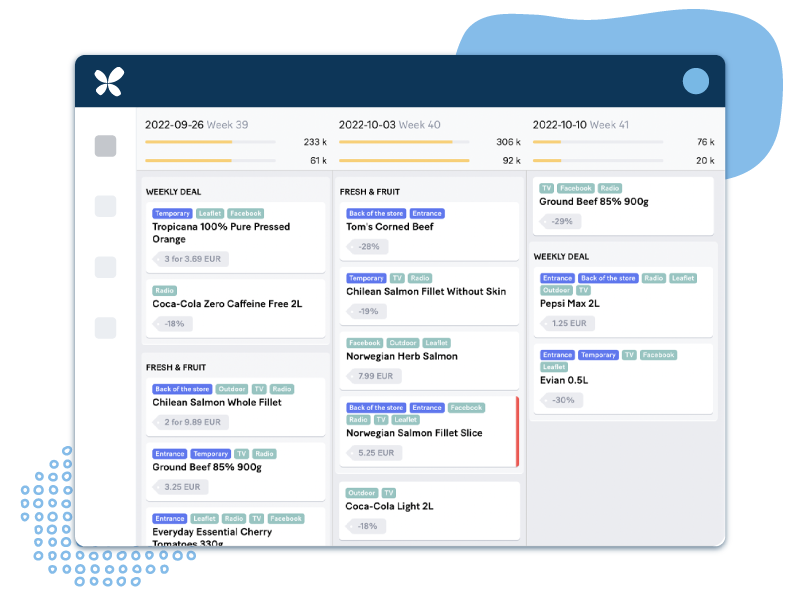
Retailers need the ability to plan all promotions in a single tool that makes sharing responsibilities easier, automates recurring manual processes, and maintains a single source of truth. From a broader business perspective, integrating promotion, forecasting, replenishment, and space planning creates a seamless process in which all teams work from the same data, plans, and expected outcomes.
Further, when forecasting and replenishment teams have complete visibility into promotion plans and data, they improve forecast accuracy, helping mitigate over- or understock situations and driving efficiency for store operations teams.
A better understanding of their promotions and an improved planning process also builds stronger supplier collaboration. Both parties contribute equally to promotion development as they strive for a higher market share and negotiate supplier investments and trade funds. Retailers are equipped to evaluate suppliers’ promotion recommendations and determine the best course of action for all, including their impact on the customer experience.
Essential benefits:
- Eliminate disconnected silos and create seamless end-to-end planning.
- Increase forecast accuracy to mitigate over- or understocks and drive in-store efficiency.
- Reduce waste for specialty, seasonal, and fresh items.
Tip 3: Test promotion scenarios
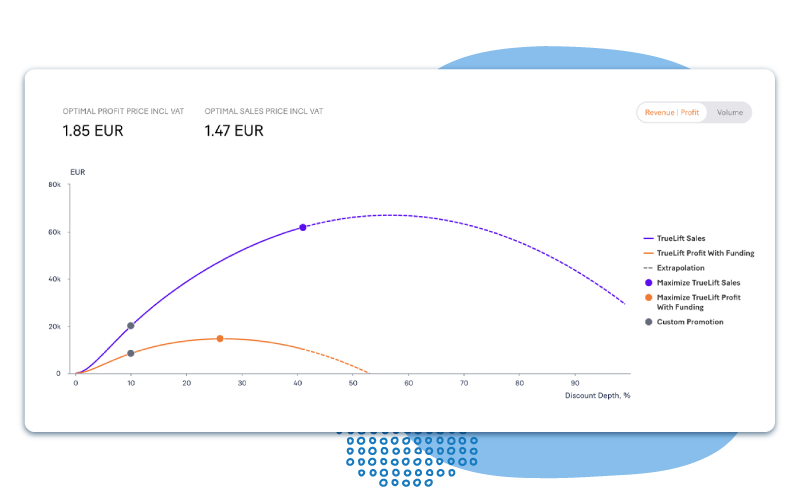
A sandboxed scenario testing environment enables retailers to test promotions using real-life data and estimate their performance proactively. An advanced simulation engine empowers retailers to test different campaign scenarios to determine which combination of price, mechanic, and display will drive the best result. Further, a flexible, user-friendly system that provides customizable business rules streamlines and increases promotion efficiency for central planning and store operations teams.
Effective promotion analysis and testing also give retailers improved insights into customer behavior in certain situations, such as seasonal events and economic changes. These insights provide an advantage when sudden market shifts occur, enabling them to react more quickly and better forecast products and sources to meet customers’ needs.
Essential benefits:
- 4-8% profit uplift for the promoted product range without impacting sales uplift.
- +15% increase in incremental sales for the promoted product range.
- Support better tactical supplier negotiations with mutual win-win outcomes.
Customer success: Practical examples of retail promotion optimization in action
Learn more about how our customers successfully drive improvements through promotion optimization and integrate promotion planning into the supply chain to create a seamless, end-to-end process.
Coop Estonia expands partnership with RELEX Solutions to optimize promotion planning and performance
Coop Estonia is a market leader in the Estonian grocery market, with 18 regional cooperatives operating 330 stores ranging from minimarkets to hypermarkets. Having experienced impressive results using the RELEX forecasting and replenishment solution, Coop Estonia expanded their partnership to include promotion optimization.
The RELEX solution is helping Coop Estonia manage more than 2,000 promotions each month across 15–16,000 SKUs, increasing the profitability of their promotions, optimizing their processes, and securing high availability for campaign products.
Oliver Rist, Coop Estonia Purchasing Director, shares insights into their partnership with RELEX and how they are increasing the profitability of their promotions, optimizing processes, and ensuring high availability of campaign products.
Coop Estonia needed a tool that could help their category managers make more evidence-based decisions, optimize planning processes, run more effective campaigns, find the right price point, and negotiate better deals with suppliers to drive increased revenue and profits and reduce costs. They chose RELEX promotion planning and optimization and concluded a very successful pilot and implementation in 2022.
“We have already seen the result in higher sales, higher profit, and more engaging campaigns. RELEX has been very accommodating and understanding of the Coop way of thinking, and we can’t wait to reap the benefits of the new solution.”
Oliver Rist, Purchasing Director at Coop Estonia.
Mathem optimizes e-commerce and promotion planning
Mathem, Sweden’s leading independent online grocery retailer, is a technology-driven e-commerce supermarket offering grocery, pharmacy, and kitchen products. Mathem self-distributes from six distribution centers, delivering high-quality products directly to their customers’ homes.
The company implemented RELEX promotion planning to give their promotion strategy an edge as customer shopping patterns shifted and the online grocery market became even more competitive. With a unified RELEX forecasting, promotion, and replenishment solution in place, Mathem has been able to strategically plan, optimize, and evaluate their promotions, seeing measurable results within six months of implementation.
Results include:
- 20% increase in sales on promotion.
- 32% true lift on sales (from more effective promotions yielding higher uplifts).
- 56% (21pp) improvement in share of profitable promotions.
- 55% reduction in time spent on supply chain promotion planning.
- 20% reduction in time spent on promotion planning.
“RELEX gave us an automated, integrated system that provides our teams with a much deeper understanding of the factors behind successful campaigns. Working with RELEX has really helped us to run our promotions more efficiently and profitably.”
Carl-Johan Sagner, Mathem Promotional Strategy Manager.
Tools and technology for optimizing retail promotion planning
Today’s retailers have a dizzying array of technology solutions available. However, they must be careful to select solutions that best fit the business’s specific needs. To accomplish this, retailers must assess their specific improvement needs, build measurable goals, and invest in solutions that meet those criteria.
Technology such as BI & data analytics, price optimization software, and inventory management solutions may include functions related to promotions. Still, they are too broadly focused to get into the specific details needed for true promotion optimization. Further, clearance optimization is extremely helpful when retailers need to sell off excess stock or end-of-season items. However, they still need a proactive promotion pricing solution to drive effective strategies.
With the RELEX solution, retailers can optimize promotions with automated analysis and testing to get to the heart of what works and what doesn’t. Supply chain integration provides complete visibility into planning across teams, ensuring allocation and replenishment accuracy. Finally, using the clearance optimization solution in conjunction with promotion optimization ensures retailers make the best discount decisions before, during, and after promotions and seasonal events.
FAQ
What is retail promotion optimization?
Retail promotion optimization uses advanced technology to automate and streamline the planning, evaluation, and execution of in-store and online sales campaigns for a specific set of products at a specific discount for a specific period. The primary goal of promotions is to increase consumer engagement, demand, and sales – all of which are primary drivers of profit margin and competitiveness.
Why do retailers struggle with promotion?
We have worked with and spoken to many grocery, convenience, and health and beauty retailers about promotion pain points. Of those retailers, 88% identified completed promotion analysis as a top pain point. Further, 81% want a better understanding of how well their promotions perform, and 75% are not satisfied with the data they collect from them. Regarding planning, 81% said they want to automate manual processes. Other top-ranking promotion planning challenges cited by retailers were streamlining promotions (73%) and improving coordination between internal teams (66%). Finally, 82% of retailers stated a need for promotional price optimization, and 73% cited the need for better forecast accuracy.
How do you optimize retail promotions?
Planning and executing retail promotions is deeply challenging. However, with the right tools and approach, retailers can greatly simplify the process and boost margins. Here are our top tips for promotion optimization:
- Automate analysis of past promotion performance.
- Centralize promotion planning across the business.
- Test promotion scenarios proactively in a sandboxed environment.