Sales and operations planning (S&OP): Build smarter supply chain decisions
Aug 21, 2026 • 12 min
Every company, at some level, has to answer the same two questions:
- Can we deliver what we’re planning to sell?
- Are we on track to achieve our business goals?
Sales and operations planning (S&OP) is the process that makes those questions answerable; connecting day-to-day operations with strategic objectives under a single, coherent plan.
The problem is that most organizations are attempting S&OP with fragmented data, disconnected systems, and planning cycles that can’t keep pace with the decisions they’re meant to inform. This results in a process that looks functional on paper but consistently falls short when it matters most. When conditions shift, when gaps open between plan and reality, and when leadership needs to make a call fast, many companies can’t react quickly enough.
Most S&OP failures aren’t due to process errors; they’re a result of poor data infrastructure. When demand, supply, and financial information live in separate systems, no amount of process discipline can produce the decisions S&OP is supposed to deliver.
But for those companies who do it well, S&OP isn’t a meeting cadence or a reporting workflow. It’s a decision-making engine that gives cross-functional teams the shared visibility to act with confidence across an 18 to 24-month horizon. And when S&OP operates on a unified platform, using data that’s always current and instantly shared, the process can finally deliver on its promise.
What is sales and operations planning (S&OP)?
Sales and operations planning (S&OP) is a structured business framework that aligns demand forecasts, supply capacity, and financial goals into a single, executable plan across the whole organization. It gives leadership a shared view of where the business is heading and the information needed to make proactive decisions. For organizations ready to go further, S&OP can serve as a natural foundation for integrated business planning (IBP) — and RELEX supports both.
What does the S&OP process involve?
Sales and operations planning typically runs on a monthly cycle, bringing together data and decisions from across the business into a structured review sequence that culminates in an executive meeting.
The cycle generally moves through four stages.
- Demand review. Sales forecasts are updated to reflect recent performance, upcoming campaigns, new product launches, and any known changes in market conditions.
- Supply review. Production, procurement, and logistics teams assess whether they have the capacity to meet projected demand and flag any constraints or bottlenecks.
- Pre-S&OP. The demand and supply picture is reconciled, surfacing the gaps, trade-offs, and recommendations that need leadership attention.
- Executive S&OP. Trade-offs are weighed and decisions are made, with visibility across the whole plan rather than just one function.
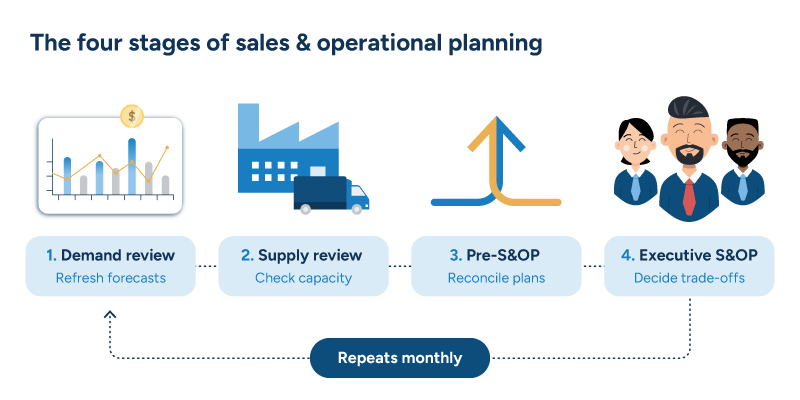
The planning horizon for S&OP typically spans 18 to 24 months. This window is long enough to allow meaningful capacity decisions, including:
- Adjusting production shifts
- Placing long-lead procurement orders
- Revising warehouse capacity or storage agreements
- Increasing or decreasing inventory targets
Within the typical S&OP planning horizon, the level of detail naturally tapers: near-term plans are granular, while longer-range projections work at product family or product line level.
How do S&OP, S&OE, and IBP work together?
Sales and operations planning does not exist in isolation; it sits within a broader planning framework. Understanding where it fits helps clarify both what it is designed to do and where its limits lie.
At its core, S&OP aligns strategic objectives with demand, supply, and capacity, ensuring the business can produce what it plans to sell. It brings together demand forecasts and supply capacity over an 18 to 24 month horizon, giving cross-functional teams the visibility to identify gaps, resolve bottlenecks, and keep the business operationally on track.
Sales and operations execution (S&OE) sits at the short-term end of the spectrum, managing weekly deviations from the S&OP plan. Where S&OP sets the operational plan, S&OE keeps the organization on track against it.
Integrated business planning (IBP) builds on S&OP’s foundation, creating a broader, longer-range decision-making structure. Where S&OP focuses on demand-supply balance, IBP adds financial integration, portfolio review, and direct leadership involvement. While IBP typically extends the planning horizon to 36 months, the more significant difference is the scope of decisions being made.
Together, the three processes form a planning continuum:
- S&OE manages execution in the near term.
- S&OP maintains the medium-term operational plan.
- IBP connects that plan to financial and strategic decision-making at the leadership level.
Why S&OP is harder than it looks
In theory, sales and operations planning is straightforward. Planners simply need to align their demand forecasts with available supply capacity, close any gaps, and ensure the whole business is working from the same plan.
However, in practice, most organizations find the process significantly harder to execute.
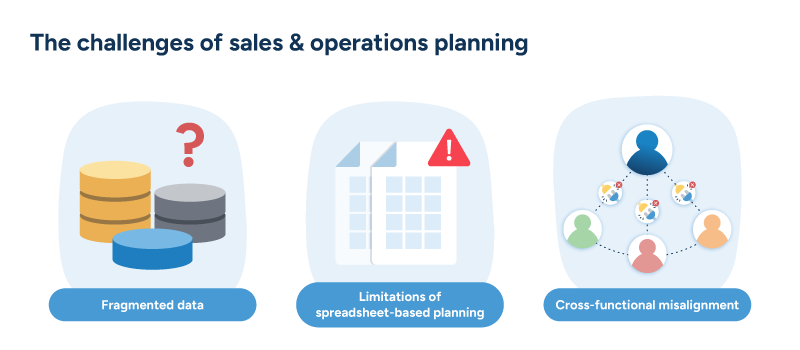
Fragmented data undermines planning efforts
Effective S&OP depends on having accurate, up-to-date information available to every function involved in the process. When demand and supply planning run on separate systems, that baseline is almost impossible to achieve. Planning teams end up working from different numbers, reconciling data manually before every planning cycle, and spending the majority of their time gathering information rather than acting on it.
The Excel-based processes limit what planners can do
Traditional spreadsheet-based planning struggles to model scenarios, track how plans change over time, or give multiple stakeholders a consistent view of the same data.
In Excel-based processes, 90% or more of the effort goes into data collection and organization, leaving almost no time for analysis or decision-making. And when the planning questions become complex, such as when demand shifts in a key category or a supply bottleneck requires choosing between multiple solutions, spreadsheets break down. Modeling scenarios involves manually duplicating data across files and accounting for interdependencies among demand, supply, and capacity. As these interdependencies multiply, maintaining consistency between copies becomes increasingly error-prone and unworkable.
When a plan goes through significant changes between cycles, those changes are hard to monitor and even harder to interrogate. Problems compound quietly until they surface at the wrong moment.
Cross-functional misalignment creates disputes, not decisions
S&OP is designed to get sales, supply chain, finance, and operations working from a single plan, but that alignment doesn’t happen automatically. When planning is fragmented across systems and teams, functions default to their own objectives and their own numbers. The S&OP meeting becomes a forum for reconciling figures that sales, supply, and finance each calculated separately, rather than a space for making forward-looking decisions.
Why getting S&OP right matters
At its best, S&OP gives companies a single, shared plan that everyone is actually working from. Demand, supply, and finance are no longer pulling in different directions. Cross-functional teams can see the same numbers, evaluate the same trade-offs, and make decisions that hold up across the organization.
The practical benefits are significant:
- S&OP gives planners the forward visibility to act before problems become crises.
- S&OP offers the ability to compare scenarios and evaluate options rather than defaulting to the most urgent one.
- S&OP provides the cross-functional alignment to ensure decisions at one end of the business don’t create problems at the other.
When done right, good S&OP is the difference between managing the plan and being managed by events. It puts planners in the driver’s seat, allowing them to set the direction for the business and make adjustments on their terms.
Taken together, the challenges facing S&OP share a common root. When the data foundation is weak, the quality of decisions suffers regardless of how well the process itself is designed. A company can have a well-established meeting cadence, a governance structure, and review cycles, but none of that matters if the system is built on incomplete or inconsistent information.
Poor S&OP is usually the result of fragmentation. This may present itself as:
- Demand and supply planning being managed in separate systems
- Functions working from different versions of the same numbers
- Decisions made without understanding their impact on the end-to-end plan
By the time the gaps surface, the options for closing them have already narrowed. For example, a sales plan that drives rapid volume growth without visibility into production capacity can force a decision between short-term fixes like additional shifts, co-packing arrangements, or emergency procurement. When decided under great time pressure rather than carefully evaluated in advance, any of these required fixes can quietly erode the margins that the growth was supposed to deliver.
Decision quality, not workflow management, is the real measure of successful S&OP.
When S&OP is working well, the process surfaces trade-offs before they become problems. Teams can evaluate options based on their implications, prioritize where service levels matter most, and make deliberate choices about how to close gaps between the plan and target. Decisions get made at the right level, with the right information, inside the planning cycle rather than in reaction to it.
This is why decision quality, not workflow management, is the real measure of successful S&OP. A process that runs smoothly but produces poor decisions that miss service levels, tie-up working capital, or erode margins, is not a success. The goal is to make sure that when a business needs to act, the planners making the call have everything they need to get it right.
How RELEX supports S&OP
Sales and operations planning only works as well as the data behind it. RELEX is purpose-built to help planning teams move past the work of collecting and reconciling data, so the focus of every S&OP cycle stays on the analysis and decisions that require their expertise.
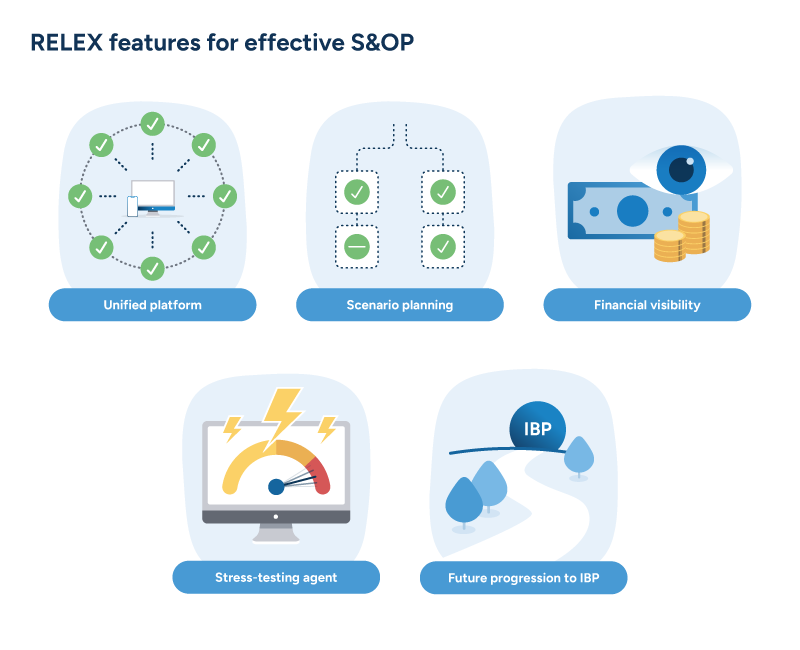
One platform, one source of truth
RELEX builds S&OP on top of a unified supply chain platform. Rather than pulling data from separate demand and supply systems and reconciling them before each planning cycle, the platform keeps everything up to date in one place. No manual data collection is required. The numbers everyone is working from are the same numbers, and they reflect what is actually happening in the business. The numbers everyone is working from are the same numbers, and they reflect what is actually happening in the business.
This always-on data foundation changes what is possible in an S&OP process; less time spent preparing for meetings, more time spent making decisions.
Scenario planning grounded in real operational data
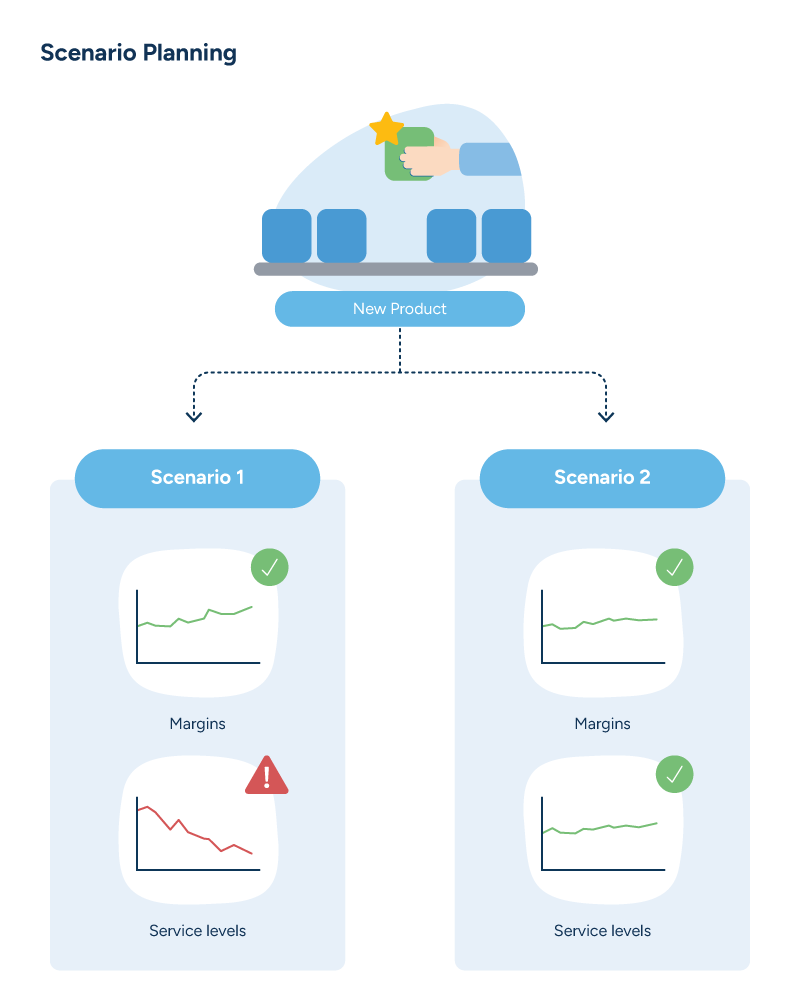
Scenario planning is where the RELEX data foundation pays off most directly. In an S&OP context, the questions that matter are rarely simple. For example:
- If demand shifts in a particular category, what are the supply implications?
- If we commit to meeting all projected volumes, what impact will that have on our margins?
- If a bottleneck emerges in production, which response option closes the gap at the lowest cost?
RELEX Scenario Planning allows teams to model these questions across demand, supply, and financial dimensions before committing to a course of action, testing assumptions against real operational data rather than spreadsheet estimates.
Financial visibility within the planning cycle
Financial data adds another evaluative layer to the RELEX platform. While financial integration is most fully realized in an IBP process, having cost and margin visibility within S&OP means planning decisions can be based on operational feasibility and financial implications. Two supply options might both meet demand yet carry different costs. With greater visibility, planners can evaluate the financial implications of each option and reach a more informed outcome.
Stress-testing S&OP plans for future viability
In early S&OP maturity, the goal is usually to create a single plan for the most likely future. But real supply chains run on uncertainty, and planning for one outcome leaves organizations exposed to unanticipated demand shifts, supply disruptions, and capacity gaps. Working with ranges instead of a single number leads to better decisions, but doing this well is hard without the right supporting system.
Running optimistic and pessimistic scenarios as a continuous practice shows the range a business actually needs to operate within, sharpening risk awareness and decision quality. The key is grounding those scenarios in real risks and opportunities rather than naïve guesses.
The RELEX Stress-testing Agent makes it easy to build these ranges, powered by RELEX’s built-in scenario capability. Stress-testing plans is what turns S&OP from a forecasting exercise into genuine decision-making.
A natural path to IBP
For organizations already running end-to-end planning on RELEX, the path to IBP is a natural extension rather than a platform change. The data foundation, the scenario capability, and the cross-functional visibility that structured S&OP requires are already in place. Expanding into IBP means bringing more high-level decisions into the process, not rebuilding the infrastructure that supports it.
S&OP in practice: how RELEX customers have made it work
For manufacturers running S&OP on RELEX, results tend to appear in operational outcomes rather than as a standalone S&OP metric. When S&OP is working as intended, it surfaces in service levels, working capital, and forecast accuracy, because better decisions are flowing through the business.
How Rastelli Foods Group transformed its S&OP process
Rastelli Foods Group, a premium meat and seafood supplier with over 6,000 SKUs and $600 million in annual revenue, had no formal forecasting process and an S&OP cadence that was largely reactive to customer orders. Supply and demand data lived in separate systems, making it impossible to build a reliable plan or challenge customer projections with confidence.
After implementing RELEX, Rastelli’s executive team, including sales, logistics, and operations, moved to a structured weekly S&OP meeting driven by accurate demand forecasts and optimized production and inventory plans. With a single view of the supply chain, the business could align internal projections with actual customer call-offs and make proactive decisions rather than reactive ones.
- Forecast accuracy improved to 85%
- $3.5 million saved through inventory visibility alone
How Finsbury Food Group improved S&OP and positioned for IBP
Finsbury Food Group, one of the UK’s leading specialty bakery manufacturers with a turnover of £356.8 million, was running planning across eight factories on legacy tools and spreadsheets. Enabling effective S&OP, and building a platform for a future IBP initiative, was one of the project’s core objectives.
With RELEX, demand and supply planning moved onto a single platform. Planners could assess the impact of forecast changes on inventory and service levels in real time, incorporate costs and working capital requirements into scenarios, and make proactive decisions on labor and resource capacity.
- £1.6 million reduction in net working capital
- 5% year-on-year service level improvement in Food Services
“Finsbury is on a journey, and we are happy to have RELEX onboard. We now have the people, system infrastructure, and process maturity to take on IBP.”
Liam McVey, Group Demand Planning Manager at Finsbury Food Group.
From S&OP to IBP: the path to smarter planning
Sales and operations planning works when it is built on a foundation of up-to-date data and connected systems that keep everyone working from the same numbers. When that foundation is missing, the instinct is to fix the process: tighten the cadence, restructure the meeting, add a governance layer.
But that rarely solves it. Disconnected demand and supply systems mean the numbers entering the room are already in question, and no meeting structure compensates for data the team doesn’t trust.
Organizations that get the foundation right make faster, better-informed decisions, with full visibility into the trade-offs behind them. The process finally has something reliable to run on, and the gap between where planning is today and what it could become starts to close.
For businesses ready to take the next step, integrated business planning extends the same foundation into financial and strategic decision-making. It isn’t a separate initiative so much as the same infrastructure, widened to include a broader circle of decisions in the picture. The infrastructure is already there — for what businesses are ready for now and what they’re building toward in the future.
Written by

Related Articles
QSR supply chain planning: overcoming operational friction with ingredient-level forecasting and franchise-wide visibility
Discover how connected QSR supply chain planning closes the gap between the kitchen and customer demand.
Case Study: Grupo Vinoteca
See how Grupo Vinoteca, a Mexican wine and spirits distributor, reduced lost sales by 34.7%, cut store replenishment time by around 50%, and saved on inventory with RELEX's unified planning.
Customer Story: Grupo Vinoteca
Karen Contreras, Supply Strategy Manager at Grupo Vinoteca, shares how the company selected RELEX to strengthen its supply chain ahead of an ambitious store and territory expansion.