How strategic distribution planning enhances supply chain optimization
Sep 30, 2024 • 11 min
Planning global distribution with spreadsheets is like climbing Mount Everest with nothing but a compass. Technically possible, but you’re lacking many of the tools that make success achievable.
Distribution planning in supply chain is challenging, especially for consumer packaged goods (CPG) and manufacturing companies synchronizing production, inventory, transportation, and fluctuating demand across complex, multi-echelon networks. A single miscalculation, whether in inventory levels, transportation routes, or demand forecasts, can mean stockouts, excess costs, and disappointed customers.
The most effective modern distribution planning solutions leverage heuristics and mathematical optimization to serve as the sherpas guiding companies on their intrepid climb toward profitability and supply chain efficiency. This cutting-edge technology helps planners gain the visibility, precision, and agility needed to navigate complexity and deliver optimal distribution results.
What is distribution planning in supply chain?
Distribution planning manages the movement of goods from production sites or suppliers to their final destinations — whether distribution centers, retail stores, or end consumers. It ensures products are delivered on time and in the right amounts. At its core, it is the process of deciding how much inventory to move, when, and from where to where across a supply network, so products are available at the right locations while keeping costs and inventory under control.
Successful distribution planning requires close alignment with production plans and sits within a broader supply chain planning process supported by demand and inventory planning. It directly impacts a company’s operational efficiency, customer satisfaction, and overall profitability, making it critical to get it right.
In practice, distribution planning typically covers:
- Demand coverage translates customer and region-level demand into DC and upstream replenishment requirements.
- Network flows govern the allocation of available stock, replenishment quantities, and deployment rules, such as prioritizing key stores.
- Timing and frequency encompass shipment schedules, lead times, order cycles, and consolidation.
- Constraints include DC and store capacity, truck and container constraints, supplier availability, MOQ, pack sizes, and service level targets.
- Outcomes include fewer stockouts, lower excess inventory, smoother DC workload, and better transport efficiency.
What are the benefits of optimal distribution planning?
A robust and efficient distribution planning system utilizes real-time data and advanced technology to coordinate all supply chain activities, minimizing costs and maximizing resource utilization and service levels.
Optimal distribution planning facilitates proactive planning and response to demand fluctuations.
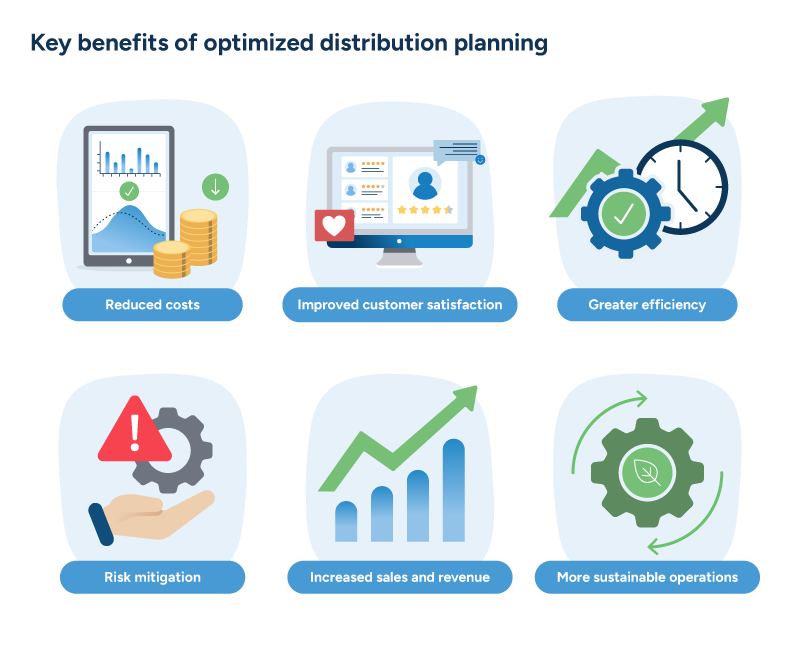
The benefits of optimal distribution planning include:
- Cost reduction. Companies can minimize inventory holding costs by maintaining optimal stock levels and reducing excess inventory. Refined transportation routes and load ties reduce transportation and fuel costs.
- Improved customer satisfaction. Optimized planning reduces order lead times and minimizes backorders, leading to better service levels. Satisfaction is enhanced by timely and accurate deliveries that meet customer expectations.
- Enhanced operational efficiency. Streamlined movement of goods, reduced transportation and warehousing costs, and minimized delays all contribute to greater operational efficiency. Accurate inventory levels reduce the need for excess stock and prevent stockouts, which leads to smoother operations and better resource utilization.
- Risk mitigation. Optimal distribution planning enables companies to anticipate and address potential supply chain disruptions, including delays, stockouts, demand spikes, and excess inventory. Accurately forecasting demand and optimizing inventory and transportation helps businesses to better prepare for uncertainties, ensuring supply continuity and minimizing the impact of unforeseen events.
- Increased sales and revenue. Ensuring product availability and timely deliveries helps companies increase sales and revenue. Optimal distribution planning also aligns inventory and distribution strategies with marketing demand to support promotional activities and new product launches.
- Sustainability. Streamlined transportation routes and reduced waste from spoilage or obsolescence lower a company’s environmental impact. This also supports sustainability initiatives by improving resource utilization and reducing emissions.
Overall, optimal distribution planning streamlines operations, improves inventory turnover, and supports data-driven decision-making, which in turn increases efficiency.
The key challenges of distribution planning in supply chain management
Planning distribution may sound straightforward, but as businesses and networks grow, so does the difficulty. With so many locations to plan for, products on the market, and supply chain changes and disruptions that require a response, CPGs and manufacturers face a variety of challenges.
To learn more about how retail, CPG, and manufacturing executives are tackling these challenges, read The State of Supply Chain 2026 report.
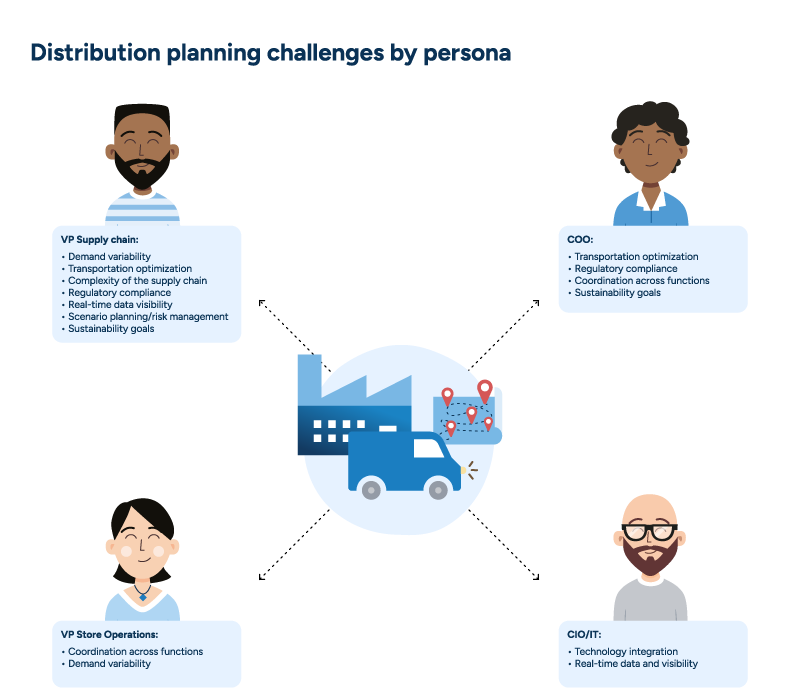
Demand variability
Demand in CPG and manufacturing is rarely stable, as seasonal peaks, promotions, and sudden market shifts can throw forecasts off course. Companies must also be ready to respond quickly to market changes such as new product launches or competitive actions.
Not all demand behaves in the same way. Forecast demand, customer orders, and safety stock each carry different implications for distribution. Understanding the type of demand matters just as much as knowing the volume because each one requires a different response across inventory positions, transportation scheduling, and replenishment strategies. Without real-time data to detect demand changes early, variability quickly becomes unmanageable volatility.
Many companies use demand propagation to understand demand at manufacturing sites or among suppliers, but do they know what kind of demand it is, and are they planning for it accordingly? Demand sensing helps answer this question. It provides real-time insights into demand fluctuations, enabling planners to make more accurate adjustments to inventory levels, delivery schedules, and replenishment decisions that align with actual market conditions.
READ MORE: Demand sensing: How to conquer manufacturing supply chain chaos
Inventory management
Maintaining the right inventory levels across a distribution network is often easier said than done. Too much stock increases holding costs, while too little results in stockouts. When customers increasingly expect on-time, in-full (OTIF) deliveries, there’s little margin for error in service levels and customer trust.
Part of what makes this so difficult is the precision required. Available-to-Promise (ATP) calculations, for example, require planners to consider on-hand inventory, confirmed inbound supply, and existing commitments (customer orders, allocations, reservations) to determine what can be reliably promised to a new customer. Small inaccuracies can trigger ripple effects, forcing planners to replan, reallocate inventory, or expedite shipments, impacting multiple downstream orders across the network. Effective inventory management, therefore, depends on timely, end-to-end visibility and the analytical horsepower to act on it.
Complex supply chains and cross-functional coordination
Coordination sits at the heart of effective distribution planning in supply chain, and getting it wrong has strategic consequences.
Multi-echelon supply chains that span multiple suppliers, production facilities, warehouses, and distribution centers are inherently difficult to coordinate. Each node adds complexity, and a disruption at any one point can send shockwaves through the rest of the network.
The problem is compounded when procurement, production, sales, and logistics teams are planned in isolated silos. Misalignment between functions means that decisions made upstream don’t account for downstream constraints, and vice versa. Regulatory compliance compounds this further, with traceability and product safety and quality requirements that must be managed and recorded at every stage.
Supply chain disruption and resilience
Supply chains don’t typically fail due to poor planning or scheduling, but rather because they’re unable to adapt when issues inevitably arise. Demand spikes, supplier disruptions, and transportation delays can happen at any time, and sometimes simultaneously, leaving planning teams scrambling when they do. Companies that factor uncertainty into their planning operations are better positioned to absorb it.
Effective scenario planning means modeling the impact of multiple variables, not just the most likely outcome, but a range of plausible ones. Doing this manually is rarely feasible for CPG and manufacturing companies, where short product life cycles, demand variability, and the need to react quickly to new orders all add to the planning burden.
Sustainability commitments further complicate this, as emissions targets and waste-reduction goals increasingly serve as planning constraints that must be weighed alongside cost and service-level trade-offs.
4 essential RELEX software features for optimized distribution planning
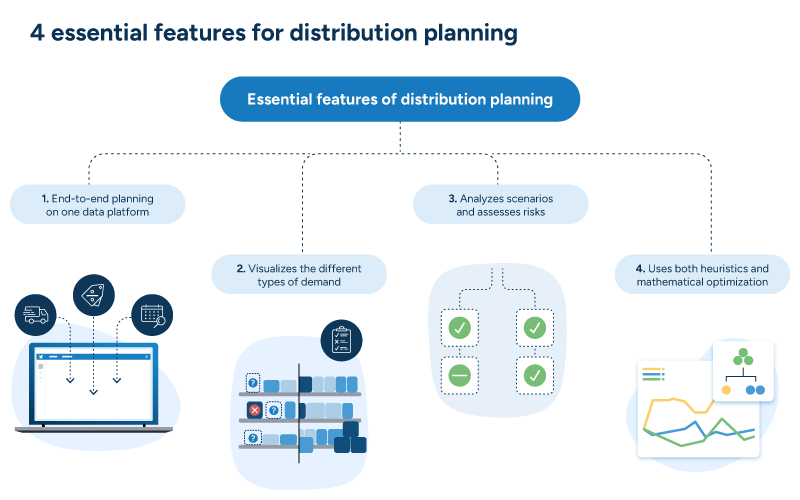
CPG and manufacturing companies need an optimized distribution planning solution to synchronize the flow of goods from production facilities to local warehouses and distribution centers. RELEX is built on four main features that together reduce costs, protect margins, and keep supply chains moving.
Many CPG products, especially perishable goods, have short shelf lives. Accurate distribution planning helps to manage these variations so that products are available when and where they are needed and reduces waste and spoilage.
1. Create end-to-end planning all on one data platform
Siloed planning systems are one of the most common sources of inefficiency in supply chain operations. When demand planning, production planning, purchase planning, and distribution planning run on separate platforms, data inconsistencies multiply, and coordination suffers. RELEX eliminates this problem by running all planning functions on a single unified data platform, providing every team with a single source of truth.
Running all planning functions on a single platform ensures consistent, up-to-date data across all teams. This improves visibility, eliminates coordination gaps, and enables the kind of real-time responsiveness that siloed systems can’t match. For CPG and manufacturing companies, this translates to fewer stockouts, less excess inventory, lower operational costs, and a supply chain that can absorb change without losing efficiency.
2. Visibility into all types of demand
RELEX collects demand signals from multiple sources, including orders, forecasts, and safety stock, and visualizes them by type. It also automatically applies those signals, such as prioritizing firm customer orders over safety stock in cases of scarcity, and propagates the resulting demand plan across every stage of the supply chain.
Planners can see precisely what they’re asking suppliers and production sites to fulfill, and whether that demand is driven by real customer orders, safety stock requirements, promotional uplifts, or seasonal patterns.
Knowing the difference between genuine orders and production for safety stock gives planners the clarity to make better decisions at the plant level. It also helps them maintain accurate inventory and ensure distribution schedules reflect actual market conditions rather than aggregated assumptions.
3. Scenario planning and risk management
Even the best distribution plan needs to be stress-tested. RELEX enables planners to build and compare alternative “what-if” versions of their distribution plan by adjusting key variables, whether it’s shifting demand assumptions, changing inventory policies, or modifying available distribution lanes and flows. The result is a clear, side-by-side view of how different inputs affect outcomes like inventory levels, service rates, and transportation costs.
RELEX scenario planning is particularly valuable for high-stakes decisions. Planners can use it to simulate peak season capacity constraints, evaluate the impact of a supply disruption before it escalates, or test new channel prioritization strategies without touching the live plan. Rather than reacting to problems after they occur, distribution teams can identify the best course of action in advance, protecting service levels and controlling costs when it matters most.
READ MORE: Supply chain scenario planning: Gaining clarity into uncertain futures
4. Heuristics and mathematical optimization working together
Optimized distribution planning in supply chain involves successfully leveraging heuristics and mathematical optimization together. RELEX is built to do both.
Heuristics handle the high-volume, time-sensitive decisions, whether determining delivery routes, allocating inventory across locations, or prioritizing orders in real time. They work by simplifying complex problems into practical, fast solutions when exact methods are too slow or networks too large. The result may not always be perfect, but for large CPG and manufacturing operations, the speed advantage is significant, and even approximate optimization at scale can unlock meaningful savings.
When greater precision is required, RELEX applies mathematical optimization to push further. The system uses advanced algorithms to balance supply and demand while accounting for hard constraints, such as production plans, supplier schedules, and order limits, to find the most cost-effective path forward.
This extends down to the level of individual transportation modes, accounting for which trucks and containers will be used, their sizes and capacities, and the specific distribution lanes they serve. That granularity is where significant cost is either recovered or lost, and it’s where the difference between a good distribution plan and an optimal one becomes measurable.
READ MORE: Supply chain optimization for manufacturers: It’s mathematics, not magic.
How Vita Coco used RELEX to optimize their global operations

The Vita Coco Company is the world’s leading brand in coconut and plant waters, with operations in 31 countries and an annual turnover of $428M (2022). But staying on top involves synchronizing a supply chain spanning 15 factories (and growing) and 20+ market warehouses on several continents, servicing major customers in the US and Europe. With so many nodes, constraints, and alternative supply routes, Vita Coco needed a solution capable of modeling and optimizing its entire network.
“RELEX has helped us to unlock millions of dollars in cost of goods value, mainly owing to better sourcing and distribution planning.”
Jonathan Burth, COO, The Vita Coco Company
Vita Coco worked with RELEX to build a digital twin of its supply chain, capturing every node, cost, and constraint as a mathematical optimization problem. With scenario simulation giving the logistics and S&OP teams a reliable way to test decisions before committing to them, Vita Coco converted its demand forecast into a fully optimized 18-month supply plan.
Other key results include:
- Millions of dollars unlocked in cost of goods value through improved sourcing and distribution planning.
- A fully integrated S&OP process, with all functions working from a single optimized plan.
- Enhanced logistics decision support, enabling more informed negotiations with freight brokers.
Create an optimized end-to-end distribution planning process
Today’s supply chains are absorbing pressure from multiple directions at once — like shifting trade policies, climate-related disruptions, or demand patterns that can change faster than operational plans can accommodate. For CPG and manufacturing companies, the question is whether their distribution planning processes are built to handle these disruptions when they occur and how quickly they can respond.
RELEX gives distribution planners the tools they need to respond to what’s happening now while staying ahead of what’s coming next. End-to-end visibility, scenario modeling, and optimization across costs, constraints, and service levels simultaneously — all on a unified platform that connects demand, inventory, and distribution planning in one place. Learn more about how RELEX distribution planning increases the efficiency of supply chain operations.
Distribution planning FAQ
What is distribution planning?
Distribution planning manages the movement of goods from production sites or suppliers to customers efficiently and cost-effectively, ensuring products are delivered on time and in the right amounts precisely where they’re needed.
What are the main benefits of optimized distribution planning?
Optimized distribution planning reduces inventory holding and transportation costs, improves customer satisfaction through timely deliveries, enhances operational efficiency, mitigates supply chain risks, and supports sustainability initiatives by reducing emissions and waste.
Why is distribution planning especially challenging for CPG and manufacturing companies?
CPG and manufacturing companies face complex multi-echelon supply chains, significant demand fluctuations due to seasonality and promotions, short product shelf lives, regulatory compliance requirements, high transportation costs, and the need to maintain high service levels with on-time, in-full deliveries.
How does demand sensing improve distribution planning?
Demand sensing provides real-time insights into demand fluctuations, enabling more accurate, responsive adjustments to inventory levels and delivery schedules, reducing stockouts, minimizing excess inventory, and improving alignment with actual market conditions.
What is Available-to-Promise (ATP) in distribution planning?
ATP is the amount of inventory you can reliably commit to fulfill demand for a given item, location, or time. ATP calculations consider current inventory levels, incoming shipments, and existing customer orders to determine how much product can be committed to new orders without affecting previously made commitments, ensuring accurate and on-time order fulfillment.
What is the relationship between ATP and OTIF in distribution planning?
ATP and OTIF are two sides of the same coin. ATP is the promise, and OTIF measures whether you kept it. Available-to-Promise calculations determine what quantity can be committed to a customer and by what date, based on current inventory, inbound supply, and existing order commitments. On-time, in-full delivery then measures whether that promise was fulfilled in practice.
The quality of your ATP directly influences your OTIF performance. For example, overly optimistic ATP counting uncertain inbound supply or overlooking existing reservations tends to result in late or short shipments. Conversely, overly conservative ATP protects OTIF but can mean underselling or offering unnecessarily long lead times. Improving ATP accuracy by improving inventory visibility, ensuring reliable supply dates, and establishing clear allocation rules is typically the most direct route to stronger OTIF performance.
How does mathematical optimization improve distribution planning?
Mathematical optimization uses advanced algorithms to balance demand and supply while accounting for constraints such as production plans and supplier schedules, resulting in highly efficient distribution strategies that optimize transportation routes, inventory levels, and delivery schedules to minimize costs and maximize resource utilization.
What are the benefits of end-to-end planning on one data platform?
A unified platform provides integrated data and visibility, improves coordination across functions, enhances responsiveness through real-time data sharing, reduces operational costs and redundancies, and minimizes stockouts and excess inventory through better forecast accuracy.
Written by

Related Articles

Case Study: Sandman Group
Sandman selected RELEX in 2021 to automate forecasting and replenishment across its stores, e-commerce channels, and DC.

Is forecast accuracy driving your decisions? 5 diagnostic questions for planning leaders
Five questions to help leaders figure out whether forecast accuracy measurements are shaping the supply chain or merely filling a dashboard.
Case Study: Prima Flour
Prima Flour selected RELEX in February 2023, implementing production planning and scheduling along with demand planning.