
Integrated business planning (IBP) almost seems designed to fail. Most manufacturers are asking it to do a lot at once:
- Align financial projections, demand forecasts, and production plans
- Compress cross-functional decision-making into a single monthly cycle that leaves little time for forward-looking planning
- Maintain visibility across planning horizons that typically stretch up to 36 months, and sometimes further
- Respond to markets that have become far less predictable
Throw in inadequate tooling and process stickiness, and it’s no surprise the resulting plan often leaves much to be desired.
This makes the reality even more frustrating: with the absolute need for manufacturers to automate their way to agility, getting IBP right is more important than ever. Without the guidance IBP provides, manufacturers risk building toward greater automation while lacking the strategic clarity needed to achieve their goals.
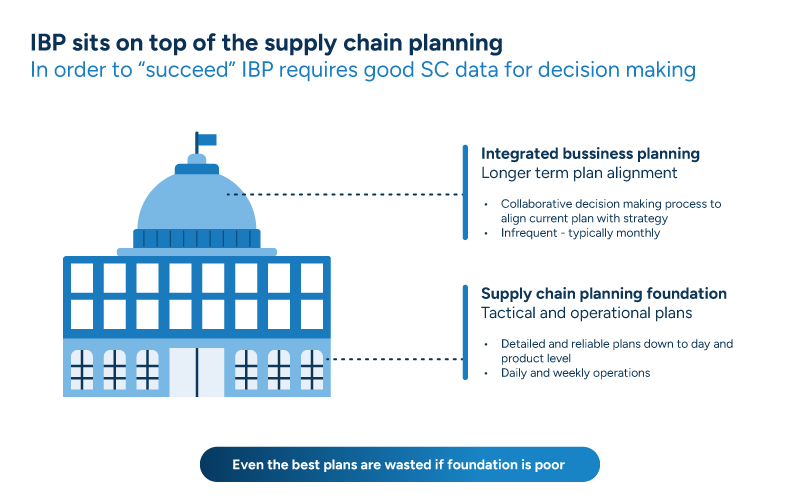
The best way to navigate these challenges is to build IBP on the right foundation. Effective IBP doesn’t make strategy. It steers toward it. It gives manufacturers the mechanism to check whether they’re on track and make the tactical decisions that close the gap between where they are and where they need to be.
When that process runs on RELEX’s unified platform, planners work from a single data model and a single version of the truth. From operational planning to executive decision-making, strategic guidance flows directly into execution — and manufacturers profit accordingly.
What is integrated business planning (IBP)?
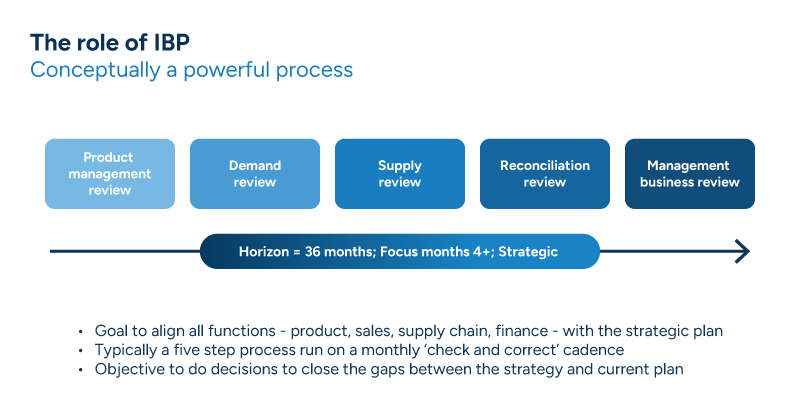
Integrated business planning (IBP) is the collaborative decision-making process that bridges both strategic and tactical planning, often occurring simultaneously across middle and upper management. Operating over a 36-month horizon, IBP aligns business functions with financial goals. Essentially, it tells touchless systems not just how to optimize, but what to optimize for.
IBP creates a unified planning process in which supply chain, finance, sales, and operations stop optimizing in isolation and begin working toward shared objectives. The process bridges the gap between a manufacturer’s 36-month tactical vision and daily operational reality, ensuring that today’s production decisions support tomorrow’s market position. Every decision gets evaluated not just on operational efficiency but on its impact on service levels, working capital, and profitability.
The benefits of successful IBP for manufacturers
Achieving true cross-functional alignment and strategic clarity requires significant organizational effort and commitment. Yet manufacturers continue to invest in IBP because the measurable benefits justify the transformation.
Companies achieving successful IBP realize:
- 1-2 percentage points higher EBIT compared to those without mature IBP processes.
- 15-30% inventory reduction while maintaining or improving customer service.
- 5-20 percentage point improvement in service levels through better supply-demand synchronization.
- 5.5% gross margin improvement from optimized planning and execution.
These benefits multiply when IBP operates on a unified planning platform. The same ML forecasts drive both daily operations and strategic projections, eliminating debates about data accuracy. Real-time information flows enable manufacturers to model scenarios and respond to customer requests within hours, while planners focus on higher-value tactical analysis instead of manual data reconciliation.
Critically, a unified planning platform ensures strategic decisions automatically cascade through operational planning. Changes made at the IBP level flow seamlessly through master planning, production scheduling, and daily execution without manual translation, implementation gaps, or wondering if operations actually reflect strategy.
The challenges of successfully implementing IBP in manufacturing
For every manufacturer that reaps the benefits of successful IBP, there are seemingly five more that struggle to get the most from their efforts. And those are just the companies that actually manage to get their IBP processes rolling in the first place.
Research backs the idea that, for too many manufacturers, something is very wrong with their IBP:
- Two-thirds of organizations treat IBP meetings as periodic business reviews rather than integrated decision-making processes.
- Over 70% report their operational plans don’t fully synchronize with financial objectives, despite regular planning cycles.
- Nearly half fail to incorporate meaningful financial controls into their IBP programs.
- More than 80% continue to rely primarily on spreadsheets for IBP execution.
This version of IBP exists primarily in name only. It lacks the unified vision and proper tooling required to keep cross-functional teams working meaningfully together. Suboptimal IBP consumes time and resources while failing to deliver the strategic alignment and operational agility that justify the effort.
The difference between this IBP that wastes time and an IBP that drives competitive advantage lies in understanding the fundamental tensions between strategic planning and operational reality.
Conflicting KPIs, objectives, and priorities
Manufacturing IBP demands unprecedented coordination. It requires getting people in the same conversation and aligning fundamentally different responsibilities, metrics, and concerns into a single coherent plan.
Consider the stakeholders who actually need to align:
| Stakeholders | Responsibilities | Key metrics | Biggest concern |
| Supply chain | Demand and supply balancing, production and inventory optimization | Inventory turns, safety stock, service levels | Failing to meet service levels and working capital targets |
| Finance | Cash flow, working capital, margins | P&L projections, EBITDA targets, working capital ratios | Inventory write-offs and margin erosion |
| Sales | Quarterly targets, customer commitments | Revenue, market share, customer satisfaction | Saying “no” to a major customer |
| Operations | Equipment capacity, maintenance windows, workforce planning | OEE, changeover times, labor utilization | Equipment failures and labor imbalances during critical production runs that can drive idle periods or costly overtime |
| IT | System integration, data flows | Data integrity, system performance, uptime | “Just one more report” requiring manual data manipulation |
In theory, this diverse group — each optimizing for their own success metrics — must forge a unified vision for the company’s future. Despite inherent tensions between their competing objectives, they’re expected to:
- Turn annual strategic goals into executable 36-month plans.
- Make capacity decisions before demand materializes.
- Balance service levels against working capital.
- Choose between competing alternatives when resources are limited.
In practice, these meetings often devolve into backward-looking business reviews. Each function feels pressured to explain why something didn’t work in the last month to other high-level department heads. By the time each function has reviewed the past, there’s no time left to plan.
Delayed data and mismatched cadences
Another reason planning meetings turn into review sessions is their cadence.
IBP is frequently built around a traditional 30-day planning cycle originally established by consulting firm (and S&OP pioneers) Oliver Wight. The 30-day cadence once represented the best practice for cross-functional coordination. It aligned with monthly financial closes, gave departments time to gather information from disconnected systems, and forced regular meetings between functions that historically never communicated.
The monthly cycle was never meant to restrict decision-making to a single meeting. In practice, urgent decisions happen as needed, with the monthly process serving as the structured backbone for routine alignment. The real problem is that when data is fragmented across disconnected systems, just getting ready for that monthly meeting consumes the entire cycle — leaving no time or energy for forward-looking decisions, scheduled or otherwise.
This monthly marathon persists because three fundamental problems make it impossible to do IBP any other way:
- The disconnection problem. Each function uses different systems that don’t communicate with each other. The result: Two weeks spent reconciling multiple versions of truth.
- The feasibility gap. Strategic plans look perfect on paper but lack operational validation. Boards approve targets, sales makes commitments, then operations discovers the physical constraints that make delivery impossible — but only after contracts are signed.
- The speed trap. Markets move faster than monthly planning cycles can accommodate, and customers often need decisions in days. This can lead companies to bypass the scheduled IBP process to avoid losing the opportunity. Without the right tools, these kinds of ad-hoc decisions are made reactively: without current data, without cross-functional input, and without any way to model the downstream consequences before committing.
Traditional approaches can’t solve these problems because they treat symptoms, not causes. Adding more meetings creates meeting fatigue. Creating more and “better” Excel sheets to solve data silos just creates more sophisticated silos. And improving integrations with standalone tools adds yet another system to integrate.
Disconnected systems at every planning horizon
Assuming the IBP team manages to align strategic plans, there’s still the risk that a strategy built in the boardroom breaks apart on the factory floor.
The issue is one of abstraction versus reality. Strategic planning operates in the realm of what should be possible, thinking in capacity percentages, financial projections, and market opportunities. But the factory floor operates in the realm of what is possible, navigating physical constraints, technical dependencies, and sequences that can’t be skipped.
Between these separate worlds lies a translation gap that no amount of meetings can bridge, because the languages themselves are fundamentally different.
Strategic planning operates in the realm of what should be possible, but the factory floor operates in the realm of what is possible.
Imagine a manufacturer making a seemingly simple IBP decision: prioritizing fulfillment of their premium product family above other product lines next quarter. Master planning translates that intent into capacity allocation, roughly 40% of Line 3, then feeds back what that means for every other SKU and customer.
In their boardroom, it’s a purely strategic choice. On the factory floor, it becomes a cascade of constraints:
- That capacity allocation flows down to master planning, which must now fit all SKUs within those boundaries.
- Master planning constrains production scheduling, which sequences actual orders.
- Production scheduling constrains shop floor execution, determining changeover sequences and crew assignments.
Each planning level amplifies the impact of this manufacturer’s IBP decisions:
- If their planning team overestimates Line 3’s available capacity by just 10%, master planning might commit to volumes that production can’t deliver.
- If they overestimate demand for the premium family by 15%, they will face excess inventory, write-downs, and wasted capacity.
What seemed like minor variances in their conference room become major disruptions on the production line — and the system meant to optimize profits ends up costing the business boatloads of money.
The RELEX approach: Supply-chain driven IBP
Every manufacturer faces unique challenges in setting up a successful integrated business planning process. But often, even organization-specific issues can be traced back to a single source: tooling. Far too many businesses attempt to solve 21st-century planning challenges with 20th-century tools.
RELEX Solutions approaches the challenge from an entirely different angle: building IBP as a native extension of supply chain planning rather than a separate system bolted on top. This technical distinction is the difference between IBP that creates more work and IBP that actually works.
The architectural advantage of supply chain-connected IBP software
The market offers three paths to IBP. Each promises to solve manufacturing’s strategic planning challenges, but their fundamental architectures determine whether they can actually work with the touchless planning systems that modern manufacturers rely on.
Spreadsheet-based IBP tools
Spreadsheet-based IBP relies on general-purpose office software to create a planning layer above existing systems, which gets the process moving and builds cross-functional habits. But the manual effort required to collect and reconcile data from disparate systems is enormous, and the tools themselves simply weren’t built for manufacturing. Meaningful scenario planning is effectively impossible, and operational constraints can’t be validated in any real depth.
Financial platform IBP
Financial platform IBP speaks fluently to the CFO but stumbles when operations asks, “How exactly do we make this?” These platforms understand budgets brilliantly but have no concept that adding a shift requires three months of training, or that a key supplier has a 16-week lead time.
Supply chain-driven IBP
Supply chain-driven IBP — the RELEX approach — builds strategic planning on operational reality. Every scenario, every projection, every strategic decision automatically validates against actual constraints. Teams can’t create an unexecutable plan because the system won’t let them.
| Capability | Spreadsheet-based IBP | Financial platform IBP | Supply chain-driven IBP |
| Strategic planning | Yes | Yes | Yes |
| Financial integration | Limited | Yes | Yes |
| Manufacturing constraints | No | No | Yes |
| Touchless planning foundation | No | No | Yes |
| Single platform architecture | No | No | Yes |
| Unified planning data | No | Limited | Yes |
| Execution capability | No | No | Yes |
The differences become crystal clear when examining the same scenario across all three approaches.
Imagine a manufacturer’s board asking: “Can we commit to our largest retailer’s request for 40% more volume starting Q2?”
- Spreadsheet-based IBP tools would model a scenario showing optimal production flows and financial projections but couldn’t validate whether the lines could actually handle the required changeovers or if suppliers have capacity.
- Financial platform IBP tools would calculate perfect P&L impacts and working capital requirements. But, it wouldn’t know that a key production line is already running at 95% capacity, or that adding meaningful volume would require a facility expansion within a 12-month lead time.
- Supply chain-driven IBP tools would show the complete operational reality in minutes: available capacity with overtime at two plants, the need to dual-source one component by March, required DC expansion by May, and profitability above 15,000 units monthly.
The ability to validate constraints, identify requirements, and calculate financial impacts makes supply chain-driven IBP the clear winner in a head-to-head matchup.
Scenario planning bridges the gap between ambition and execution
Strategic plans fail when they hit operational constraints. It’s not hard to imagine this scenario playing out for a manufacturer:
- The board approves aggressive growth.
- The sales team commits to volumes.
- The operations team faces unexpected constraints.
- Disaster ensues.
RELEX makes this impossible through “executable intelligence.” Every strategic scenario automatically validates network-wide against multidimensional operational constraints, such as:
- Production constraints, including capacity, changeovers, sequencing requirements, and quality standards.
- Material availability, including on-hand inventory, supplier capacity, lead times, and minimum order quantities.
- Network flows, including distribution capacity, transportation lanes, and warehouse constraints.
- Workforce reality, including skilled labor availability, and overtime limits.
- Financial boundaries, including working capital requirements, cash flow impacts, and margin implications.
Executable intelligence is all about taking strategic action, which requires interactive, real-time analysis so companies can adjust on the fly. RELEX allows manufacturers to examine all sorts of scenarios within minutes, including:
- What if demand is less than expected?
- What if we delay the launch by two months?
- What if we use co-packing for initial volume?
- What if we limit geographic rollout?
- What if we sign that big customer?
Perhaps most importantly, RELEX displays every scenario’s operational requirements, meaning companies can’t create an inexecutable plan. There are no more surprises, failed launches, or capacity crunches that “nobody saw coming.”
READ MORE: Supply chain scenario planning: Gaining clarity into uncertain futures
A unified platform solves organizational disconnection
The endless cycle of manual data gathering, reconciliation, and translation can cause IBP meetings to fail at execution. Decisions must be manually re-entered and translated into each operational system, losing accuracy and context along the way.
RELEX eliminates this through unified architecture. Our IBP is built on unification: one platform, one data model. When planners need a stable view of the business for strategic purposes, they draw on the same underlying data that powers operational planning, captured at the point it’s needed. This gives them consistency and clarity without the noise of continuous real-time updates disrupting longer-horizon thinking.
With a unified platform, the data reconciliation problem is resolved. Teams have immediate access to a consistent, trusted view of the business, ensuring strategic direction can be translated into operational planning without the accuracy loss that plagues multi-system environments. The manual work that previously consumed countless hours of planning time disappears, freeing teams to focus on analysis and decision-making rather than data wrangling.
And because collaboration happens inside the same platform — with comments, discussions, and decisions anchored directly to the data and scenarios being reviewed — nothing gets lost in different planning silos.
From monthly cycles to always-on decisions
Decision-makers at many companies ask for an answer within days, even though the planning team meets monthly. Companies beholden to traditional planning face two bad options:
- Make a reactive decision with incomplete data, risking a costly misstep.
- Make the customer wait, risking the opportunity at hand.
Instead, RELEX customers can turn to their “always-on IBP” — strategic planning that operates in real-time, not monthly cycles. “Always-on” means the IBP process is continuously ready to evaluate scenarios and make decisions, rather than waiting for scheduled meetings to analyze opportunities that require immediate action.
Consider this scenario:
On a Monday morning, a retailer calls and requests 40% more volume for their summer promotion. In pre-RELEX times, this would trigger panic. Salespeople would make promises, operations would scramble, and finance would rush to calculate margins.
But because the organization uses always-on RELEX IBP, the entire response can happen within a single day:
- The demand increase is modeled across the network. Capacity exists but requires overtime at Plant 2 and expedited raw materials.
- Finance confirms the margin impact. Sales negotiates prices to cover expedited costs. Operations validates the overtime plan.
- The cross-functional team reviews three scenarios via web conference without needing to gather data or reconcile spreadsheets.
- By the end of the day, the customer receives a commitment with their delivery schedule. All systems are updated, and suppliers are notified automatically.
With RELEX IBP, the company can win the opportunity with protected margins because they can move at the speed of the need, not at the speed of meetings.
The essential features for building supply chain-driven IBP
Of course, always-on IBP doesn’t just happen by magic. RELEX IBP is stacked with features designed with the understanding that strategic opportunities and threats emerge daily, not monthly.
RELEX engineered these features to address the specific pain points that make traditional IBP fail. When a customer needs an answer ASAP, you need:
- Instant access to current data, not last month’s snapshot.
- Scenarios that run in minutes, not overnight batch jobs.
- Decisions that flow automatically to execution, not manual translation.
Making this shift requires specific capabilities that traditional IBP systems simply weren’t designed to deliver:
| Feature | Business impact |
| AI-driven automation | Ensures accurate, ML-powered demand forecasts and optimized supply plans, which boost automation and enable additional agentic AI capabilities (including the stress-testing agent) for faster, more confident decision-making |
| Business adaptability | Uses configurable tools like the Business Rules Engine so customers can independently adapt workflows and processes to evolving needs |
| Collaborative scenario planning | Build, share, and compare what-if scenarios end to end with in-app collaboration anchored to scenario views, so decisions stay in context rather than fragmented in emails |
| End-to-end integration | Connects strategic, tactical, and operational planning layers across all time horizons, ensuring decisions are synchronized and executable through touchless execution |
| Financial and volume alignment | Integrates financial and operational data so users can reconcile volume-based plans with P&L targets, providing a holistic view of business performance |
| Intuitive role-specific dashboards | Provides stakeholders with tailored, high-level visibility into plans, performance, and financial data to support cross-functional decision-making |
| Proactive exception management | Alerts users automatically to deviations from targets or thresholds, enabling timely interventions before issues escalate |
| Seamless tactical alignment | Integrates IBP with RELEX’s tactical and operational planning layers, ensuring decisions are synchronized and executable |
Critically, these features don’t exist in isolation. They build on the same machine learning intelligence and unified data that powers a manufacturer’s daily touchless operations. When strategic planning shares the same “brain” as operational execution, always-on IBP becomes both possible and natural.
The compound financial impact of building unified IBP
The complexity around touchless planning, unified platforms, and always-on IBP discourse can make it easy to lose sight of why manufacturers embark on this endeavor in the first place. The answer is simple: supply-chain driven IBP unlocks measurable financial returns that separate market leaders from those struggling to compete.
The financial impact of RELEX IBP multiplies across three critical dimensions:
- Freed capital compounds. Decisions are executed when ML-driven forecasts seamlessly flow into strategic planning. McKinsey research shows mature IBP implementations reduce freight costs and capital intensity by 10-15% while customer delivery penalties drop by 40-50%.
- Speed creates revenue. Manufacturers who model scenarios and commit during customer meetings — not weeks later — win business. BCG documents 2-4% revenue increases from IBP-enabled agility. For a $500 million manufacturer, that’s potentially $10-20 million annually.
- Platform unity prevents failure. Unfortunately, 60% of IBP implementations fail to deliver ROI when companies bolt on disconnected systems. But when IBP is native to the planning platform and shares the same data, constraints, and ML intelligence, those implementation risks almost disappear.
Simply put, IBP on a unified supply chain planning foundation delivers rapid return on investment through cost reduction, revenue capture, and risk elimination. Facing tough competition, the only question is whether manufacturers will capture these returns or watch competitors get there first.
Building an IBP success story with RELEX: From vision to value
Most manufacturers have lived through “transformational” initiatives that transformed nothing except budgets. The prospect of change management across every planning function, every system, every process can feel overwhelming.
Most IBP implementations fail because they try to solve everything at once. But:
- Strategic planning can’t succeed until operational planning runs reliably.
- Cross-functional alignment can’t happen until everyone trusts the same data.
- AI can’t add value until humans know which decisions matter most.
That’s why RELEX structures IBP implementation as three progressive phases, each building on the last and laying the ground for what’s to come. But our customers control the pace while knowing their investment in the current phase pays dividends today and scales with tomorrow’s innovation.
Phase 1: Establish operational and tactical planning
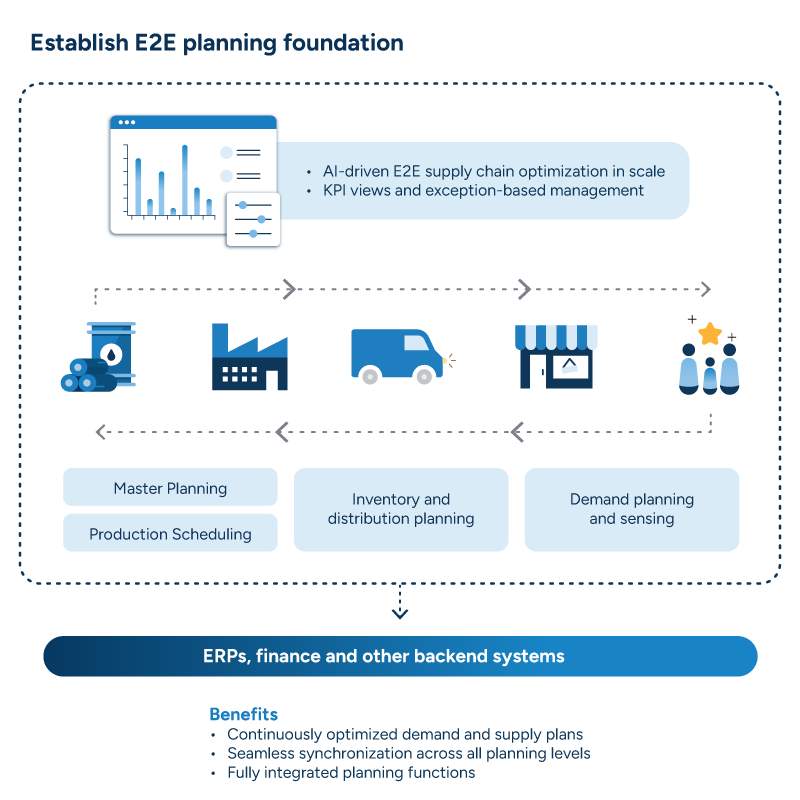
Whether starting fresh with RELEX or expanding what’s already running, Phase 1 establishes the operational intelligence that enables strategic planning. In this phase:
- Manufacturers can achieve highly optimized, short-term demand and supply plans.
- One day’s production schedules can power the next day’s capacity scenarios.
- The same constraint knowledge preventing a short-term scheduling disaster can validate next year’s expansion plans.
Phase 1’s focus remains on operational excellence, but the RELEX unified platform positions manufacturers for future IBP maturation. Every optimization, every constraint learned, and every pattern detected becomes the foundation for strategic planning — whenever manufacturers choose to activate those capabilities.
Phase 2: Embrace the power of always-on IBP
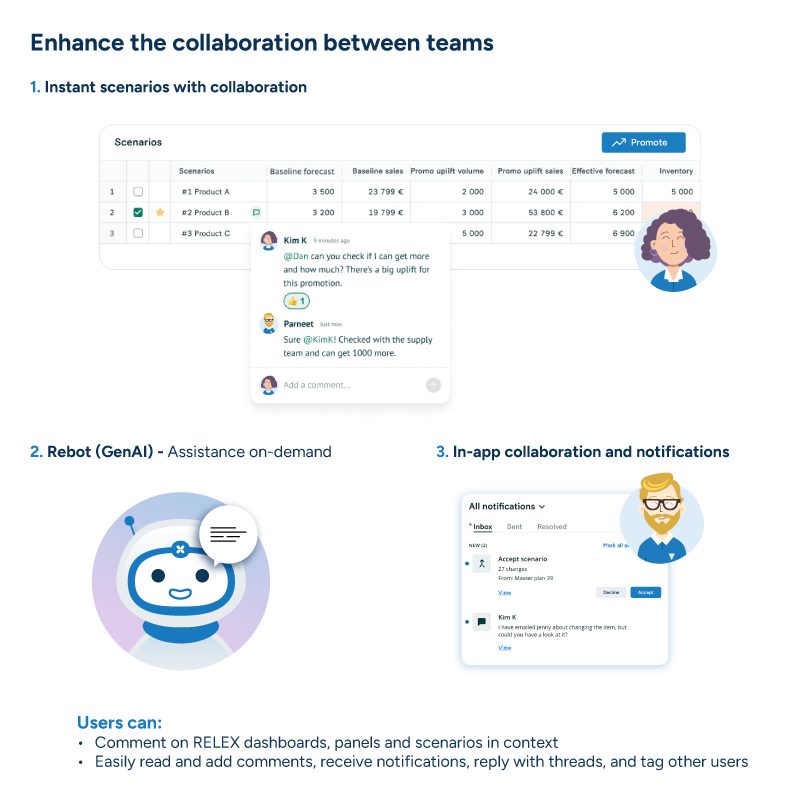
The next phase is where IBP formally comes to life on the RELEX platform. The operational foundation built in Phase 1 gets a strategic overlay. Operational data is aggregated across the 36-month IBP horizon and surfaced through preconfigured financial dashboards, giving cross-functional teams the visibility to steer the business. From there, the platform’s scenario planning and in-app collaboration tools give teams everything they need to model, debate, and decide. Because decisions can be triggered by events rather than constrained to a monthly cycle, the business can respond at the speed the situation demands.
In this phase:
- Executives and planners access intuitive dashboards tailored to their role, with decisions always based on the latest data rather than stale exports.
- Dashboards include supply chain P&L projections down to gross profit, so teams can review actuals against targets and evaluate plans based on their financial impact, not just operational metrics.
- Teams can build, share, and compare what-if scenarios instantly, assessing the impact of risks and opportunities together in a single view.
- In-app collaboration means scenario discussions happen in context. Users can tag colleagues, thread comments, and receive notifications directly within the platform, with scenario promotion workflows ensuring decisions move forward without leaving the system.
- Rebot, RELEX’s GenAI assistant, can surface insights on demand that would otherwise take analysts hours to compile manually.
Strategic thinking becomes ongoing rather than episodic. The IBP cycle alleviates the burden on cross-functional planning teams each month as scenarios, discussions, and decision trails accumulate, replacing the grind of rebuilding context from scratch.
Phase 3: Setting the groundwork for agentic AI
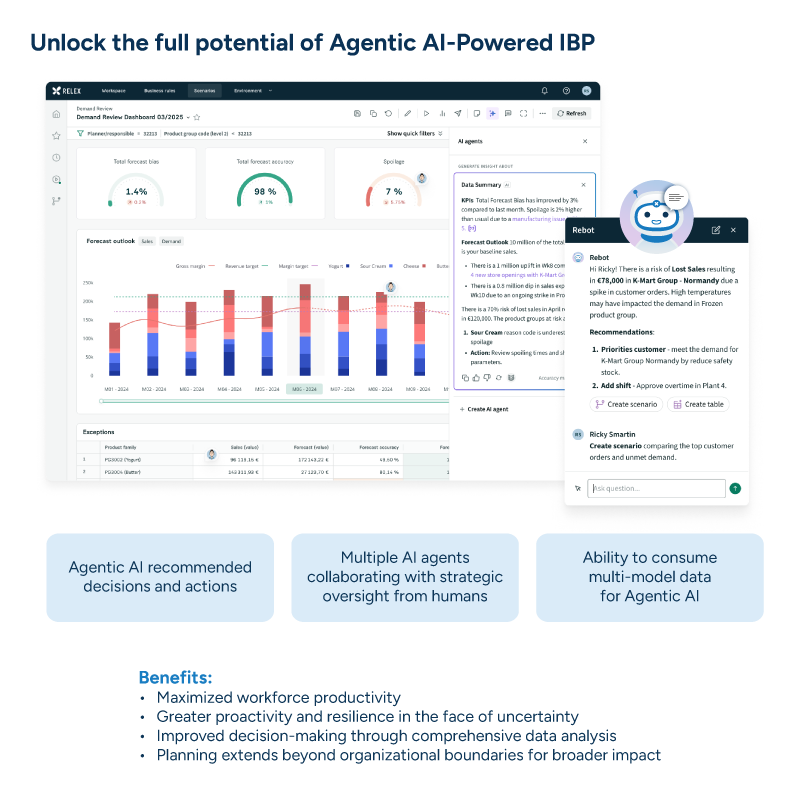
Phase 3 represents RELEX’s vision for the future of IBP. The process will incorporate AI agents that actively work on the business’s behalf, recommending decisions and automating steps in the planning cycle that would otherwise consume planner time and attention. RELEX’s strong, proven AI foundation means agentic workflows can be built and deployed quickly. Because they sit on the same unified platform as the rest of the IBP process, they feed directly into the decision-making cycle rather than operating in isolation.
In this phase:
- AI agents recommend decisions and actions based on continuous monitoring of the plan, surfacing structured proposals for planners to review rather than waiting for someone to think to run them.
- Multiple AI agents collaborate across the value chain with strategic oversight from humans, consuming multi-model data to deliver comprehensive analysis that no planning team could replicate at the same speed or scale.
- Planners shift from rebuilding context and running manual analyses to higher-value work, such as setting targets and goals, evaluating agentic recommendations, and making the final call on consequential decisions.
- Planning extends beyond organizational boundaries, with greater proactivity and resilience in the face of uncertainty.
The stress-testing agent is one example of this in practice. Built on top of the risks and opportunities framework, it automatically builds scenarios and checks how the plan would look if identified risks or opportunities were to materialize. This turns what was once a manual analytical task into an automated step in the IBP cycle.
Once fully realized, Phase 3 augments human-guided IBP with AI that sees further and thinks faster. This helps maximize workforce productivity while keeping humans firmly in control of the decisions that matter most.
IBP software decisions today determine tomorrow’s manufacturing success
The planning software manufacturers choose now determines competitive survival in an increasingly brutal market that punishes the slow and rewards the agile. And the manufacturing winners of tomorrow will all share three characteristics:
- They will make tactical decisions in days, not months. When opportunities emerge or threats materialize, they’ll arrive at meetings with pre-modeled scenarios ready for evaluation before committing to the best option with confidence. Their competitors will still be gathering data.
- They will execute plans reliably. Their board’s vision will become operational reality because IBP surfaces relevant constraints and identifies what actions to take to navigate them before committing to a plan. No more “great idea, but operations can’t deliver.”
- They will turn planning from a cost center to a competitive advantage. While competitors treat the supply chain as a necessary evil, these manufacturers will wield it as a strategic differentiator. They’ll say “yes” to opportunities others can’t fulfill.
As AI evolves from an assistant to a strategic partner, manufacturers with unified operational and strategic planning will naturally unlock its full potential. Those who have built IBP on a foundation of reliable, connected data will be best placed to take advantage of whatever comes next, with every decision grounded in operational reality.
RELEX customers already operate with this advantage, with touchless planning that handles complexity at scale, IBP that guides strategic direction, and a unified platform that stands ready for whatever AI capabilities emerge next. For them, the future isn’t coming — it’s here.
Integrated business planning (IBP) FAQ
What is integrated business planning (IBP) in manufacturing?
Integrated business planning (IBP) in manufacturing is a collaborative process that synchronizes planning across supply chain functions, business departments, and time horizons up to 36 months or beyond. It establishes bidirectional data flows between the strategic and operational layers, enabling manufacturers to make proactive capacity decisions, align financial goals with operational realities, and respond to market changes in days rather than weeks.
How is IBP different from S&OP for manufacturers?
S&OP focuses on making the plan executable, aligning supply and demand to ensure the business can deliver on its commitments. IBP builds on this by adding a financial lens, linking plans to targets and making trade-offs explicit across functions. Where S&OP ensures the plan is workable, IBP connects it to broader business performance and P&L accountability.
The biggest difference is that IBP includes financial projections down to the gross margin level and enables strategic decision-making, while S&OP emphasizes operational efficiency. For manufacturers, IBP’s longer horizon allows capacity decisions when cost-effective solutions still exist.
Why do manufacturers need IBP if they have automated planning?
Automated planning excels at optimizing the 90% of decisions that follow patterns, achieving 95%+ forecast accuracy for stable products. But some decisions carry tradeoffs significant enough that they require human judgment to steer, such as how to respond to a capacity shortfall, whether to prioritize service levels or margin, or when to commit to additional capacity. IBP provides the intelligence layer that guides automated planning toward business objectives, ensuring operational excellence serves strategic success.
Why should manufacturers implement IBP now instead of waiting?
Every month of delay creates a competitive disadvantage. While one manufacturer perfects their business case, competitors with IBP are already winning deals by committing to customers in days rather than weeks. Market volatility continues to increase, customer demands are becoming more complex, and supply chains face mounting pressure.
The cost of inaction compounds. Today’s planning limitations become tomorrow’s lost market share. Manufacturers who wait risk falling permanently behind competitors who’ve already transformed their planning capabilities.
Why do manufacturers need IBP if they have automated planning?
Every month of delay creates a competitive disadvantage. While one manufacturer perfects their business case, competitors with IBP are already winning deals by committing to customers in days rather than weeks. Market volatility continues to increase, customer demands are becoming more complex, and supply chains face mounting pressure.
The cost of inaction compounds. Today’s planning limitations become tomorrow’s lost market share. Manufacturers who wait risk falling permanently behind competitors who’ve already transformed their planning capabilities.
Why should manufacturers implement IBP now instead of waiting?
Every month of delay creates a competitive disadvantage. While one manufacturer perfects their business case, competitors with IBP are already winning deals by committing to customers in days rather than weeks. Market volatility continues to increase, customer demands are becoming more complex, and supply chains face mounting pressure.
The cost of inaction compounds. Today’s planning limitations become tomorrow’s lost market share. Manufacturers who wait risk falling permanently behind competitors who’ve already transformed their planning capabilities.
What if my manufacturing company has already tried implementing IBP and failed?
Previous IBP failures typically stem from three root causes:
- Disconnected tools that require constant integration.
- Unrealistic implementation timelines.
- Solutions that ignore operational constraints.
Much of this has to do with IBP tool architecture. Standalone IBP tools often create theoretically perfect plans that operations can’t execute. Meanwhile. financial planning platforms model ideal P&Ls while ignoring manufacturing physics. RELEX IBP succeeds where others fail by building on existing operational systems rather than around their limitations. When strategic planning shares the same platform as daily operations, implementation becomes evolution rather than disruption.
How can manufacturers ensure successful IBP adoption across their organization?
Manufacturers should start where they’re already strong. If their organization excels at demand planning, they should build from there. If production scheduling works well, expand outward from that success. Beginning in familiar territory creates confidence and demonstrates value quickly, and user success in one area naturally creates demand for expansion into others.
Written by