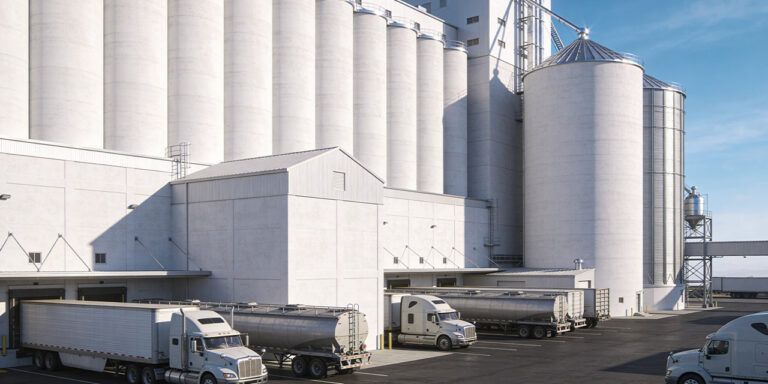
The equipment fails on one of your production lines, and the clock starts. Raw ingredients start spoiling. Packaging lines are at a standstill. Blind, ad hoc decisions lead to chaotic production, inventory imbalances, and jeopardized service levels. And all it took was one common occurrence: a broken machine.
Poorly optimized production planning and scheduling decisions often stem from siloed, manual processes and outdated solutions. These all-too-common planning hindrances undermine service levels and productivity, squander tech investments, and obscure growth opportunities.
Attempts to solve these problems with a new software solution sometimes just make them worse. Conflicting stakeholder priorities and messy integrations complicate vendor selections and implementations. Soon after, manufacturers may discover their solution cannot easily incorporate innovations, leaving manufacturers ill-equipped to handle today’s expected complexities and tomorrow’s unforeseen disruptions.
Avoiding these pitfalls requires technology that balances business requirements across operations, supply chain, finance, and IT. RELEX Production Planning and RELEX Production Scheduling are intelligent, efficient, and elastic solutions that smooth out complexity, deliver immediate, sustained ROI, and adapt to changing supply chain and business needs.
Integrated production planning and scheduling
At RELEX, we champion integrating production planning and scheduling processes. This integration supports target-based planning, ensuring that every production decision works toward the same business objectives with the same data at the same time.
Let’s start with production planning.
RELEX Production Planning: Capability and benefit overview
RELEX Production Planning analyzes the latest data and automatically balances available options, constraints, and costs to create optimized production plans. It uses scenario planning to help planners weigh decisions as changes occur and maintain control over production. With RELEX, users can delegate routine or data-heavy processes to automation while monitoring and managing anomalies at each node of the supply chain.
These capabilities help businesses improve on-time, in-full (OTIF) rates in the most operationally sound and cost-efficient way, reducing waste while improving service levels and margins.
| RELEX Production Planning features | Capabilities |
|---|---|
| Automated, optimized production order proposals | – Balance resources and constraints through optimization, heuristics, and automation. – Alert planners to exceptions and help prioritize orders in cases of scarce supply, additional overtime, and other anomalies. – Optimize decisions like alternate bill of material (BOM) choices and reverse BOM plans. |
| Near real-time integration with ERP and other data | – Incorporates forecasts, customer orders, production order reporting, material usage, actual stock levels, and other factors into production planning decisions and recommendations. – Ensures smooth and updated data sharing across the organization. |
| Production capacity management | – Tracks machinery, tools, and labor availability to determine efficient, cost-effective operational decisions. – Uses scenarios to calibrate machine and labor usage for better short- and long-term planning. – Issues early alerts about potential bottlenecks. |
| Constraint management | – Tracks production, warehouse, material, transportation, and financial constraints. – Incorporates additional, advanced constraints such as product mix, aggregation rules, and set-up time cost to ensure plan feasibility. – Allows planners to aggregate constraints for easier management. |
| Demand and inventory rules | Quickly and automatically mitigate disruptions through customer prioritization and stock management rules that support short-term resolutions and long-term business strategies. |
| Other rules-based planning adjustments | Automatically govern BOMs, routes, and setup times to optimize responses and minimize the impact of changing production circumstances. |
RELEX Production Planning helps manufacturers achieve:
- Improved planning efficiency and collaboration across teams.
- Greater data visibility and insights.
- Enhanced service levels.
- Minimal inventory and waste.
- Increased profitability.
Once manufacturers have an optimal production plan, they can translate it into executable schedules in the production scheduling module.
RELEX Production Scheduling: Capability and benefit overview
RELEX Production Scheduling handles complex and time-sensitive decisions while keeping planners in the loop via visual overviews, dashboards, and interactive Gantt charts with drag-and-drop elements. By aligning plans with real-time supply and demand, the system avoids overproduction and overtime, keeping costs low and minimizing maintenance and cleaning times.
The scheduling system uses the daily or weekly production plans generated by RELEX Production Planning to automatically generate optimized production schedules. Once the schedule is finalized, the module sends updated production orders, including start and end times, quantity, and resource usage, back to RELEX Production Planning to ensure the master plan reflects the latest production realities. This feedback loop ensures two-way communication between planning teams and mitigates the potential fall-out from disruptions on the factory floor.
The RELEX system also sends plans and product status reports to the manufacturer’s ERP or manufacturing execution system (MES).
Efficient production scheduling picks up where production planning left off, ensuring the manufacturing process follows the right sequence and supports the same goals as the production plan: improved OTIF rates, cost efficiency, inventory turnover, service levels, and profit.
| RELEX Production Scheduling features | Capabilities |
|---|---|
| Automated production schedules | – Creates production schedules down to the hour, minute, and second. – Dynamically refreshes schedules to reflect new input and constraints. |
| Order sequencing | – Automatically generates sequences that account for product type, allergens, or other defined criteria. – Considers overlap rules to ensure smooth transitions between production orders. |
| Order synchronization and visualization | – Synchronizes and updates orders across teams. – Provides a visual overview to help planners correct inefficiencies. – Uses accurate, real-time data to determine the best order of tasks. – Connects supply orders to demand sources through pegging links so users can see and analyze the impact of supply and demand shifts on production and prioritize orders accordingly. |
| Scheduling and production resource alignment | Automatically assigns the right task to the right machines with the right number of workers. |
| Scarcity prioritization | Automatically allocates resources to the most critical orders or high-priority customers during scarcity situations. |
With RELEX Production Scheduling, manufacturers can:
- Improve labor, machinery, and resource utilization rates.
- Increase planner productivity and operational efficiency.
- Streamline production through shorter setup times.
- Increase inventory turnover.
- Raise OTIF rates and service levels.
- Save time and costs, supporting sustained ROI.
Plus, RELEX Production Planning and RELEX Production Scheduling exist within RELEX’s unified planning architecture, which allows businesses to implement and scale data management and AI capabilities at every planning stage.
RELEX Production Planning: Capability deep-dive
Production planning often involves making decisions one day and pivoting the next. Outdated legacy systems aren’t going to help manufacturers manage uncertain demand, limited resources, or capricious lead times.
RELEX Production Planning helps manufacturers make fast, intelligent decisions by combining:
- Automation.
- Real-time data.
- Constraint-sensitive optimization.
- User-controlled configurability and transparency.
With these capabilities, manufacturers can put timely insights to good and prompt use, balancing supply and demand amid fluctuations and making good on their promises to customers in the most cost-effective way possible.
Here’s how each RELEX Production Planning capability transforms challenges into business wins.
1. Automated, optimized production order proposals
The challenge: A supply chain can get so bloated with inefficiencies like late shipments and unexpected demand spikes to material and labor shortages that it compresses profit margins. This complex web of decisions is a lot for human planners to manage, but if these issues go unseen and unaddressed, manufacturers end up with disgruntled customers and low ROI.
That’s where intelligent automation and touchless planning come in.
The solution: RELEX Production Planning automatically calculates the ideal quantity of each BOM (also referred to as a product structure) at each site to generate optimal order proposals. It incorporates:
- Demand input.
- Production capacities and constraints.
- Demand and inventory rules governing prioritizations, safety stock requirements, stock builds, and more.
- Product structures and alternatives.
- Routes and setup times.
The solution uses mathematical optimization and heuristics, applying each technique to suit different planning needs. Optimization balances multiple trade-offs simultaneously during complex, highly constrained tasks. Heuristics, on the other hand, automate routine, less complex, or less time-sensitive decisions.
Using both approaches allows the solution to scale more easily without sacrificing the heavy-duty calculating power needed for optimal outcomes.
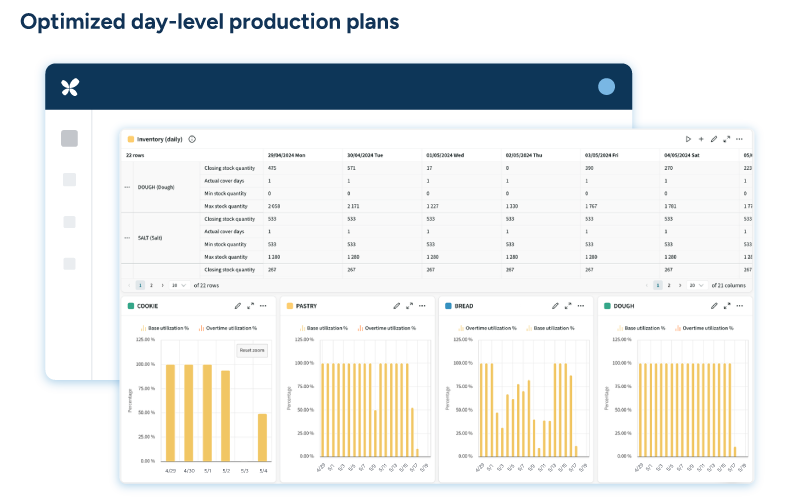
For users, this automation removes most of the drudgery, allowing them to manage exceptions instead of getting bogged down in every planning decision. Using near real-time data, the system triggers notifications about potential bottlenecks, shortages, or disruptions, so users can adjust production volumes, redistribute materials, or plan additional shifts. However, planners still maintain control over the system’s behind-the-scenes calculations through custom thresholds and configurable automated workflows.
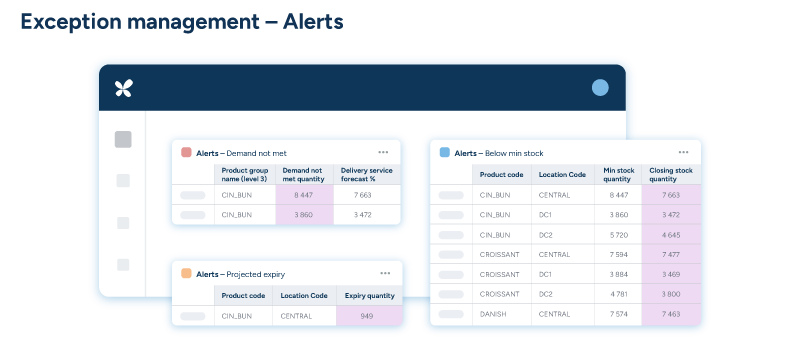
For instance, if customer orders significantly differ from the forecast, users can trigger replanning capabilities that modify workflows and realign the production plan with current parameters.
These alerts and configurable automation allow planners to respond quickly to flagged issues and focus on the decisions that need a human judgment call.
The payoff: RELEX Production Planning’s automated order proposal calculations enhance planner productivity and decision accuracy so manufacturers can improve efficiency, raise service levels, and reduce overall costs.
2. Near real-time integration with ERP and other data
The challenge: One of the biggest supply chain headaches is the latency between when a disruption starts affecting supply chain performance and when that disruption becomes visible in the organization’s data. Slow, manual handoffs between disparate systems and teams result in master data that’s incomplete, outdated, or incorrect.
The solution: RELEX Production Planning resolves data visibility and quality issues by incorporating data from multiple sources, such as ERPs and adjacent planning systems, into the planning process. This connected network of data ensures planners have current, reliable data to make more refined and strategic decisions across teams.
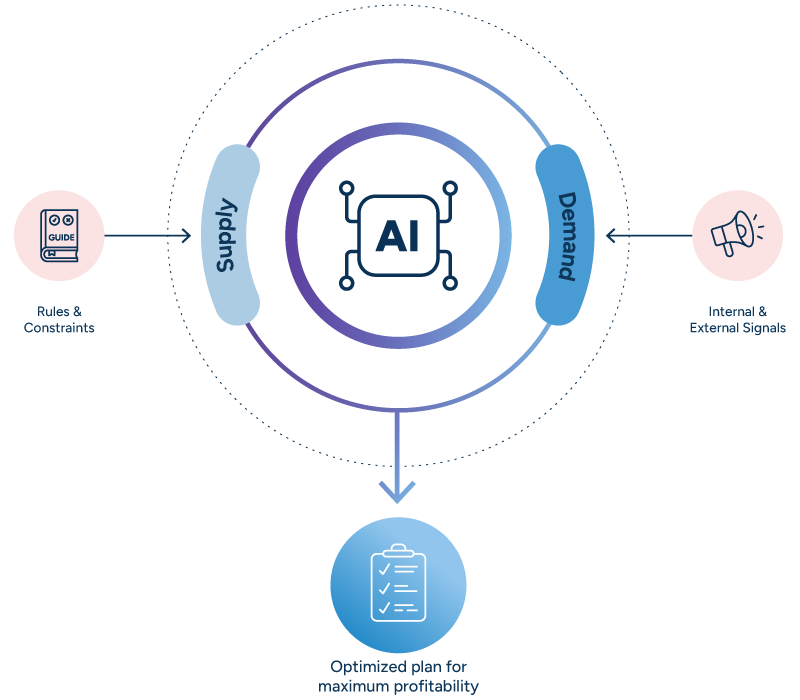
The solution allows planners to trigger batch publications of data, disseminating planning decisions across organizations and systems. The RELEX platform also captures smaller, more frequent updates and maintains a bidirectional flow of information between different planning systems so that changes are communicated back and forth.
The payoff: Shared, current data prevents users from working at cross purposes. It reinforces all the efficiencies of integrated, end-to-end supply chains and directs every planning decision toward greater efficiency, competitive service levels, and wider profit margins.
3. Production capacity management
The challenge: Production planning is full of physical moving parts that see significant wear and tear. If tools and machines break down, these failures can throw carefully constructed production plans into disarray, sending a ripple of compounding problems from the factory floor throughout the rest of the supply chain. If planners can’t amend or optimize plans on the fly, a single malfunction can result in idle time, wasted manhours, and spoilage.
The solution: RELEX Production Planning ensures machinery and labor are used efficiently thanks to optimization models and scenario planning comparisons that determine the optimal shift patterns and number of workers needed for production. Maintaining minimum utilization helps manufacturers avoid idle production lines and put spare capacity to good use. When changes occur or when companies want to test different strategies, users can run scenarios to assess fluctuations and align plans with schedules and forecasts before deploying changes, matching long-term strategies to real-world constraints.
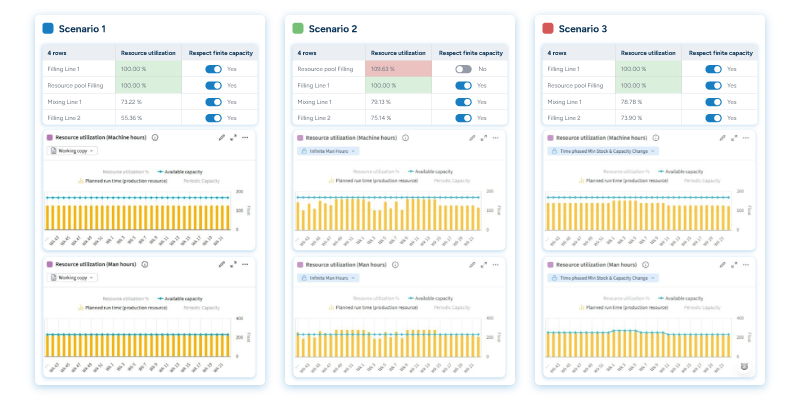
The payoff: With RELEX, manufacturers can balance available equipment, tools, and labor, even when striking this balance involves last-minute replanning. This adaptability reduces stock-outs and improves on-time delivery so that customers are never disappointed.
Tank planning
RELEX also provides optional tank planning capabilities that serve a host of industries, from food and beverage to health, beauty, and pharmaceuticals.
RELEX Tank Planning uses heuristics, optimization, and machine learning to coordinate limited tank resources. It accounts for run time, filling and emptying duration, capacity, turnaround constraints, lead times, and downstream packaging processes.
By coordinating these time-sensitive factors, RELEX helps manufacturers avoid wasted capacity, prevent batch spoilage, maintain production flow, and maximize profitability.
4. Constraint management
The challenge: Constraints come in all shapes and sizes. They are numerous and changing, so they can easily blindside planners who don’t have the means to track and manage them at all levels and hierarchies.
The solution: RELEX Production Planning uses production, warehouse, material, transportation, and financial constraints as planning inputs. For example, the solution will automatically consider the availability of raw materials, semi-finished goods, and packaging. When planners face material constraints, scenario planning helps them make strategic ad hoc adjustments based on updated data to avoid late deliveries, stock-outs, and inefficient production.
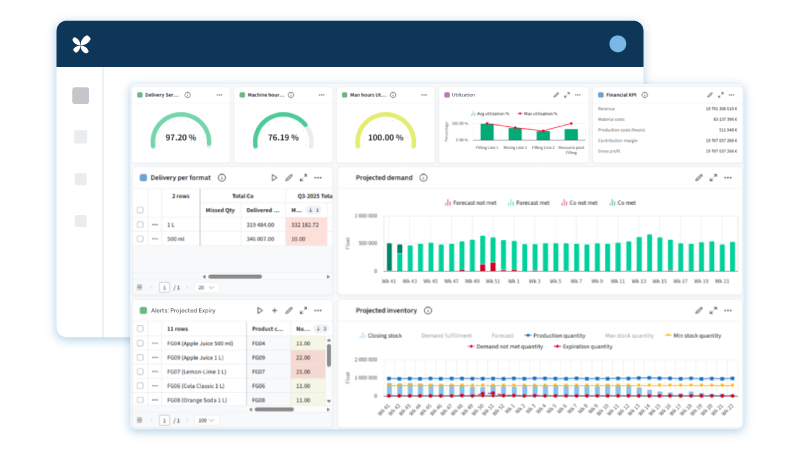
RELEX Production Planning also offers flexible product mix constraint management and aggregated batch constraints, so planners can design feasible plans that don’t exceed supply chain limitations. From eliminating cross contamination to minimizing cleaning time, RELEX Production Planning sets product mix rules that dictate when and how certain products must (or must not) be combined. Planners can also apply mix constraints to predefined BOM groups to speed up planning and optimization.
Plus, RELEX users can aggregate constraints and set production limits for groups of similar products, product structures, or custom attributes. They can define minimum and maximum production quantities, batch sizes, or limits for each aggregated group to avoid exceeding production thresholds. These constraints can be hard limits that protect capacity or soft limits that incur penalties but allow for more flexible planning.
The payoff: By aligning production plans with available resources, RELEX Production Planning helps manufacturers avoid overextending themselves or underutilizing resources. This alignment reduces changeover times and improves line utilization while minimizing waste, labor requirements, and storage costs. Companies can enhance throughput to ensure timely delivery of the right product mix and achieve competitive service levels.
Livestock planning and recipe optimization
RELEX livestock planning and recipe optimization is an additional capability that ensures supply and demand are matched in the most profitable way and finds cost-effective means of using excess inventory.
Since every animal is different, every yield is different. If realized supply differs from forecasts, the solution can replan production to cut down on waste and maximize profitability. It uses reverse BOMs to account for the multiple ways carcasses can yield cuts of varying quality, size, certifications, and origins. The solution then matches available cuts to demand and determines how to best use excess inventory downstream.
5. Demand and inventory rules
The challenge: In production planning, the best-laid plans can change tomorrow. New constraints may be added, demand may shift, supply may fall short. Planners need to quickly balance multiple and sometimes conflicting customer SLAs or risk accruing penalties or losing trust with key accounts.
The solution: RELEX’s customer prioritization and stock management rules give planners the flexibility, data, and optimization they need to adapt as quickly as their supply chain changes.
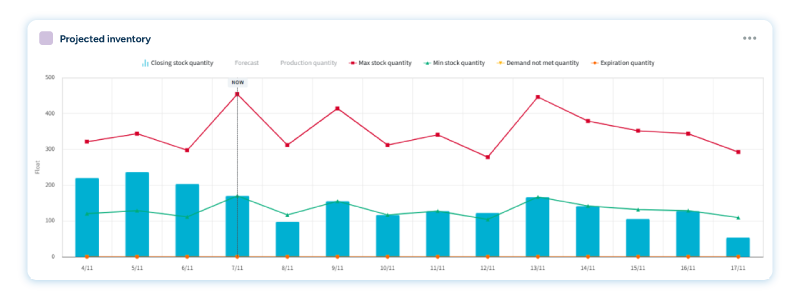
The customer prioritization capabilities in RELEX Production Planning use digital twins and penalty matrices to help planners balance high-priority customers, demand urgency, inventory levels, and profitability. The system automatically adapts to near real-time supply chain changes, so manufacturers can fill the most critical orders first. This adaptability allows planners to align production with service level targets and KPIs, even amid disruptions like delayed deliveries or material shortages.
The payoff: By using automated rules to respond to shifting circumstances, RELEX Production Planning ensures short-term adjustments don’t throw off long-term business strategies. With RELEX, manufacturers keep production flowing smoothly and protect critical orders while mitigating waste, stock-outs, and operational costs, maintaining order fulfillment rates, and accelerating inventory turnover.
6. Other rules-based planning adjustments
The challenge: Error-prone manual processes and an abundance of product structures and constraints can overwhelm production planners. Add disruptions to the mix, and creating plans that are both efficient and flexible becomes near-impossible.
The solution: In addition to demand and inventory rules, RELEX automation allows manufacturers to automatically govern decisions surrounding product structures, product alternatives, routings, and setup times to minimize the impact of changing production circumstances.
Take product structures (BOMs) as an example. RELEX Production Planning allows companies to configure and integrate product and alternative structures into its optimization model. The model weighs production plans against business objectives and penalties and automatically switches to an alternative product structure if it better serves profit goals.
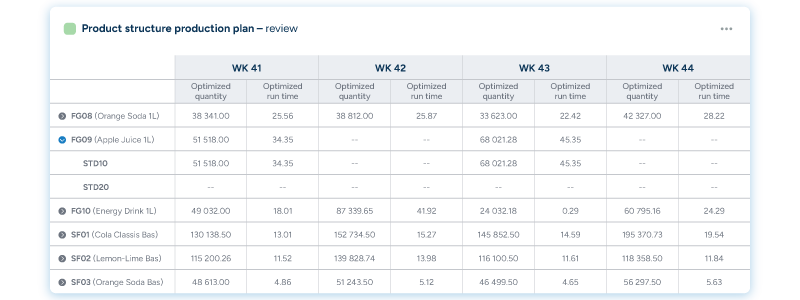
The payoff: Planners can be confident that their decisions won’t exacerbate problems and will strengthen any weak links in the supply chain. Manufacturers can ensure production remains efficient without sacrificing flexibility or letting vital constraint considerations slip through the cracks and damage service levels.
RELEX Production Scheduling: Capability deep-dive
Production plans can be perfect in theory, but production schedules have to quickly and accurately turn that theory into action.
RELEX Production Scheduling automatically generates schedules aligned with higher-level production plans and allows easy adjustments via an intuitive user interface (UI). The system tailors these schedules to real-world constraints, like capacity and sequencing, to help companies save time, reduce waste, fulfill SLAs, and produce orders as profitably as possible.
1. Automated production schedules
The challenge: Manual planning processes trap manufacturers in a mire of slow, inaccurate decisions. Companies need to make the most of their data, time, and resources by strategically dividing tasks between human expertise and automation.
The solution: RELEX Production Scheduling automatically creates production schedules down to the hour, minute, and second. It dynamically accommodates new inputs, such as manually added orders, and regenerates production schedules that satisfy constraints.
The visual user interface includes a Gantt chart and dispatch list, allowing users to review and modify the schedule, move or add orders, and replan as needed.
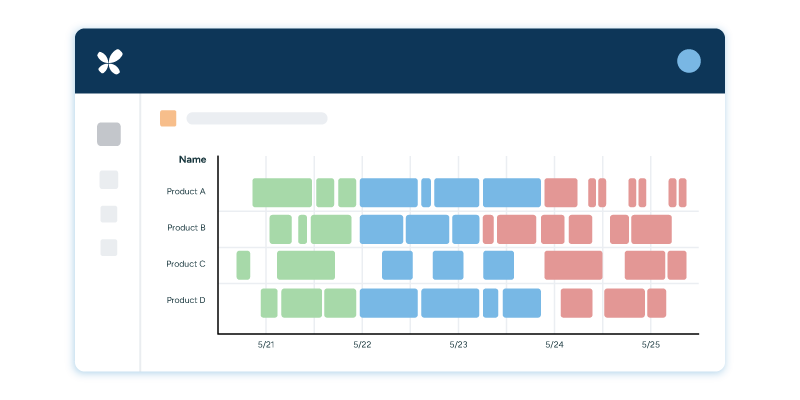
The payoff: Automation optimizes scheduling decisions and helps companies plan and produce as quickly as the market requires. It elevates planners to strategic roles that put their expertise to best use analyzing longer-term strategies and resolving disruptions that require human judgement calls.
2. Automated order sequencing
The challenge: High production volumes, coupled with the sheer number of constraints, SKUs, and planning variables, make order sequencing a complex process.
The solution: RELEX helps planners determine the best order sequences by adhering to business rules and applying tailored logic across product portfolios.
RELEX Production Scheduling creates order sequences based on predefined rules and constraints, including:
- Product characteristics such as product type and allergens.
- Resource constraints such as tools, molds, or packaging requirements.
- Delivery priorities based on demand, inventory requirements, and scarcity prioritization.
- Setup times and overlap rules that minimize transition time and complexity.
The system automatically incorporates new orders, but users can also manually adjust the sequence, using intuitive drag-and-drop features. The system’s mix of automation and planner expertise allows for greater flexibility and control when optimizing sequencing decisions.
RELEX also provides real-time feedback, so planners can view the ripple effects of changes on efficiency, costs, and resource utilization and adjust plans accordingly.
The payoff: Better order sequencing improves production efficiency and minimizes setup times, thereby reducing operational costs and increasing product availability.
3. Automated order synchronization and visualization
The challenge: Supply chain is rife with dependencies and delays that wreak havoc on production plans and schedules. Planners are frequently in danger of either missing a problem altogether or identifying a problem without having the means to solve it.
The solution: RELEX gives planners a complete picture of their supply chains and the tools they need to make sense of their data and determine the best response to disruptions.
RELEX Production Scheduling automatically links dependent purchase, production, distribution, and customer orders and identifies delays and bottlenecks in real time. It alerts planners to changes and makes it easy to visualize the impacts on the entire production flow. Planners can then expedite, reprioritize, or split orders to reduce lead times and increase capacity.
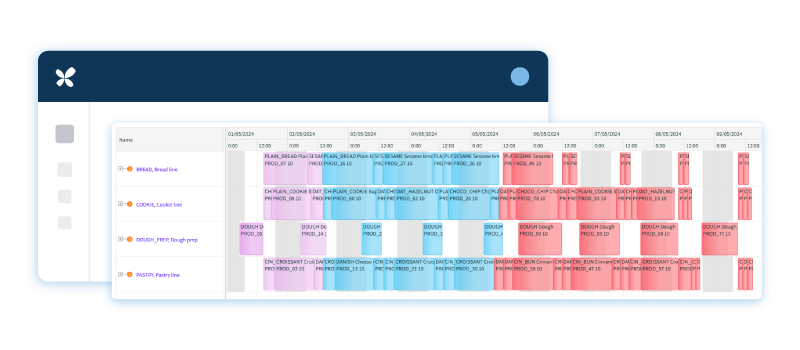
The payoff: With RELEX, planners have better visibility and control across their organization. This clarity leads to faster, more strategic responses to sudden or drastic market shifts that ultimately improve operational efficiency and customer satisfaction.
4. Automated scheduling and production resource alignment
The challenge: Keeping production schedules lined up with reality is too monumental a task for siloed, outdated tech stacks. Machines break, patterns shift, supply runs short, and planners are left scrambling to undo the knot of interdependent processes and meet SLAs.
The solution: With RELEX, planners can stay ahead of scheduling needs, even when a single production resource involves multiple scheduling resources.
RELEX Production Scheduling monitors and considers factors such as:
- Resource availability.
- Dependencies between production orders.
- Delivery timelines.
Using these inputs, the system automatically assigns tasks to the right machines, workers, or tools based on availability and capacity to ensure resources are used efficiently.
For example, suppose a bakery produces multiple types of bread and pastries, requiring specific ingredients, molds, and ovens. RELEX will optimize sequencing, ensuring that allergen-free products are baked first to minimize cleaning times between batches.
If, however, a primary oven stops working, the RELEX system will automatically reschedule production, allotting batches to available ovens while ensuring high-demand products are available and ready to meet delivery deadlines.
The payoff: By automatically linking scheduling and production resources, RELEX helps manufacturers avoid delays, reduce manual effort, and adjust plans ad hoc to keep customers happy and costs down.
5. Automated scarcity prioritization
The challenge: Inevitably, there will come a day when demand will surpass available supply. Whether there’s a worldwide shortage of materials or a delivery truck broke down, manufacturers will be forced to make some fast decisions to keep production lines moving.
The solution: RELEX automatically prioritizes customer orders in the case of limited production capacity, ensuring key customers or time-sensitive products take precedence.
RELEX Production Scheduling uses configurable penalty matrices to balance competing requirements. It calculates the cost of not fulfilling each order to develop the least detrimental plan for the business.
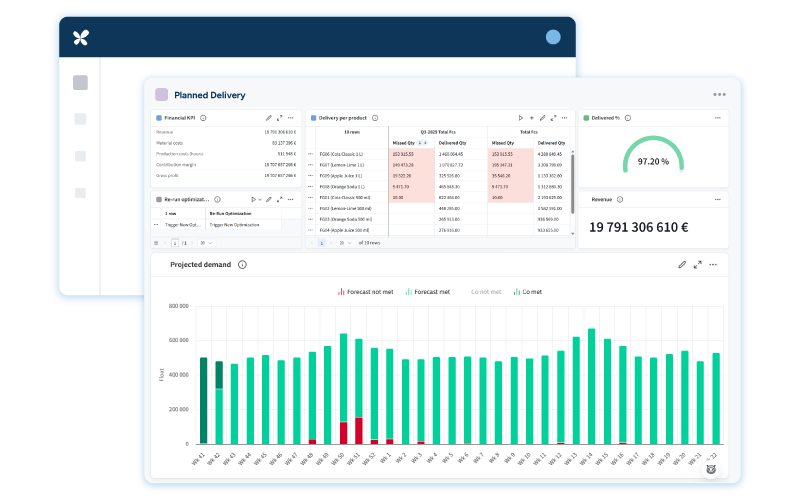
Planners can review prioritized orders and resource allocations and adjust plans as necessary. They can instantly see the impact of manual overrides on schedules and utilization for better control and clarity in scarcity situations.
The payoff: Automated scarcity prioritization helps manufacturers make the most of available resources so they can best balance new constraints with business goals and service level targets.
Achieving solution longevity: Configurability, AI, and unified planning
RELEX Production Planning and RELEX Production Scheduling are part of the RELEX platform, which brings together configurability, integration, shared data, and AI capabilities.
Each of these elements plays a role in fitting processes to business needs, harmonizing cross-departmental decisions, and building the scaffolding for future, incremental, and steady implementations and upgrades.
Configurability and control on the RELEX platform
The challenge: Customizing most supply chain planning solutions requires difficult, costly, and time-consuming coding changes. Inflexible planning solutions make it difficult for manufacturers to respond to changes and fine-tune their own processes to changing business needs.
The solution: RELEX allows companies to configure settings in-house, keeping planning processes malleable and sparing manufacturers the hassle of long, expensive coding projects.
The RELEX business rules engine (BRE) is a graphical interface that allows users to automate and adjust workflows, increasing planning transparency and control and eliminating the unease surrounding “black box” solutions.
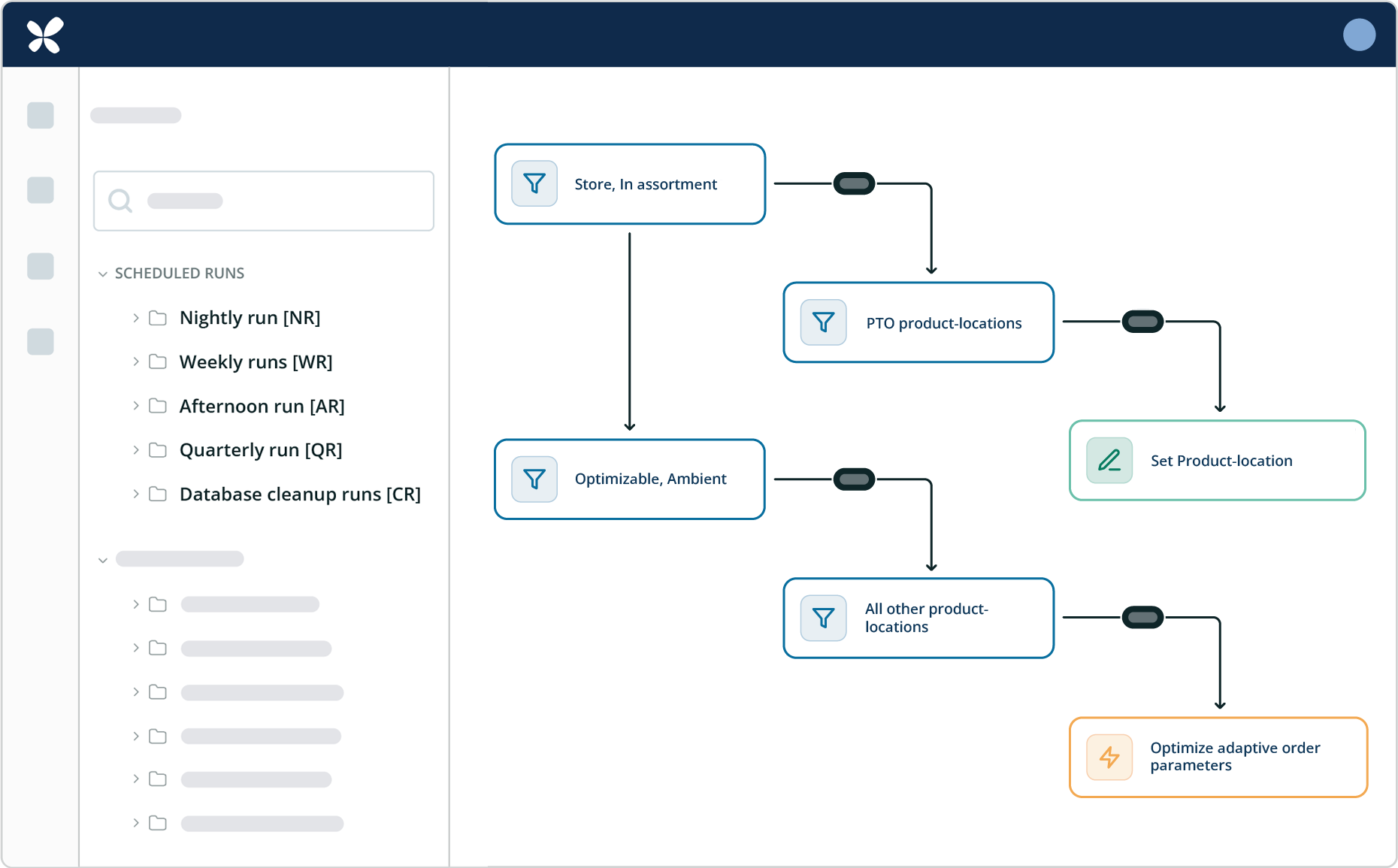
Plus, the BRE’s configuration layer remains separate from the software layer, allowing companies to update software versions without disrupting existing rules.
The payoff: The RELEX BRE minimizes the IT resources needed for solution implementation and maintenance. It keeps businesses operating with the latest innovations and sustains ROI and efficiency gains far into the future.
AI at RELEX: Machine learning, generative AI, and AI agents
The challenge: Many boards have issued their marching orders to the C-suite: “Implement AI and get results.” But it can be difficult to know what kind of AI to invest in and how to implement it.
RELEX Solutions keeps manufacturers ahead of the industry with a diverse portfolio of AI tools, developed over years and continuously improved through significant, ongoing R&D.
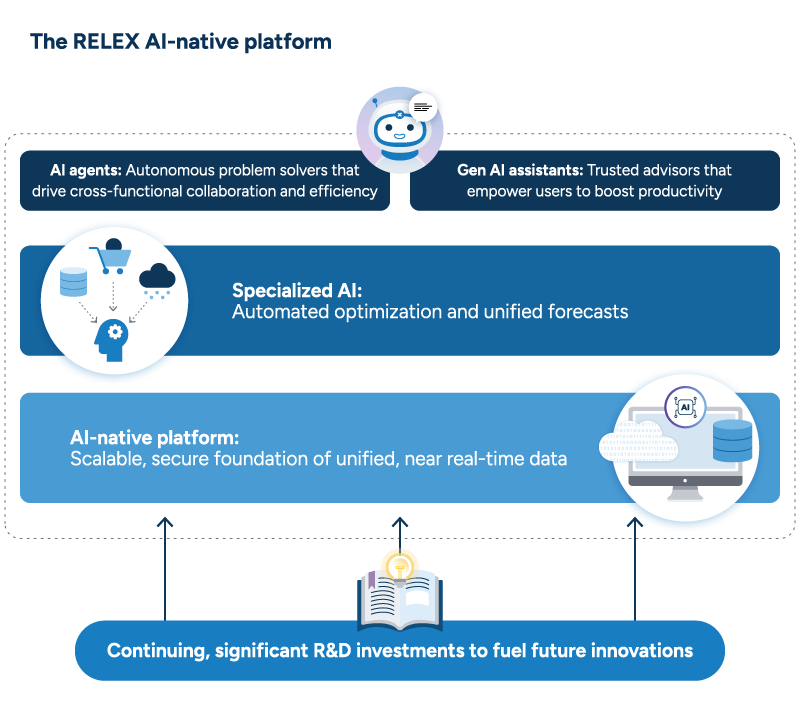
The solution: RELEX AI falls into three categories: specialized, generative, and agentic.
Across its solutions, RELEX tailors specialized AI (like machine learning and optimization) to industry-specific use cases for more accurate decision-making. The proof lies in the results, like Atria’s 98.1% forecast accuracy and 13% reduction in manual forecast changes.
“Following the introduction of machine learning, we were extraordinarily impressed to see just how much further RELEX algorithms could improve our forecast accuracy and stability.”
Tapani Potka, SVP, Delivery Chain Management, Atria
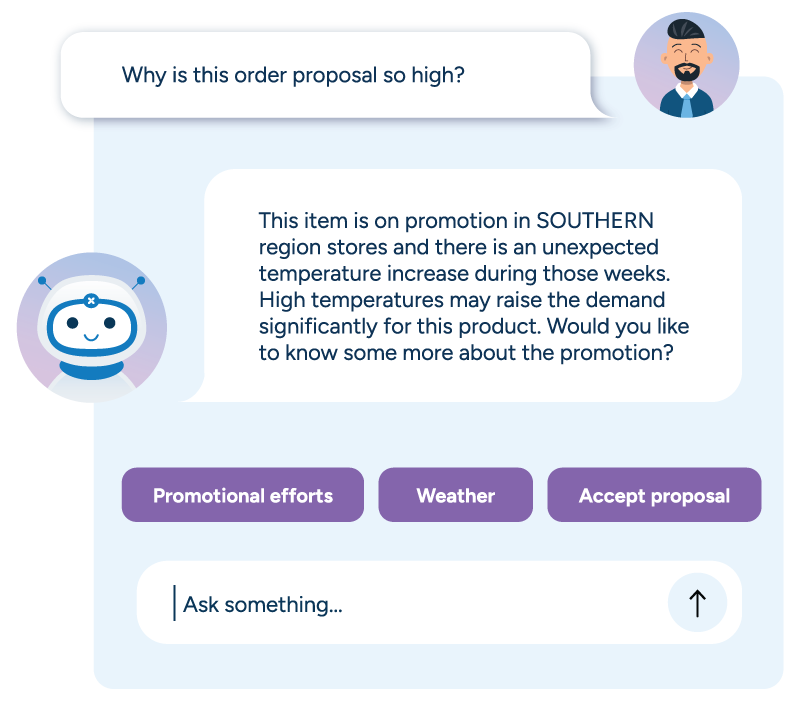
RELEX also launched Rebot, the first gen AI assistant for supply chain and retail planning. Rebot acts as an on-demand consultant, answering questions that traditionally required more time and external support.
According to RELEX customer Robin Olsson, Supply Chain Developer and Global Business Processes Owner at Beijer Byggmaterial:
“Improving operational efficiency is one of our key objectives, and Rebot has been instrumental in achieving this. It helps us identify the right changes to our business configuration, which in turn supports better product availability. Rebot has also shortened our learning curve with RELEX. By enabling interactive, system-level discussions, it has made the platform easier to understand, driving stronger adoption across the business.”
Plus, RELEX is actively developing and piloting supply chain agents, including the launch of Diagnostics agents that identify the root causes of supply chain issues and recommend corrective measures.
Learn more: How RELEX turns agents into experts
RELEX envisions a multi-agent system in which agents work collaboratively with humans and other agents to analyze data faster, anticipate changes more accurately, and make better planning decisions.
The payoff: RELEX Solutions makes AI useful and usable. ML algorithms help manufacturers hit service level targets; Rebot reinforces adoption and best practices; and agentic developments enable more autonomous planning. Together, these capabilities support manufacturer’s tech maturity, return on IT investments, and AI scalability.
From forecast to factory: How RELEX unifies supply chain processes
The challenge: According to the RELEX State of Supply Chain 2025 report, 50% of CPG companies surveyed reported that keeping planning inputs in sync with the real world was the biggest impediment to synchronized planning and execution.
RELEX helps teams keep decisions aligned with supply chain conditions across the organization.
The solution: The RELEX unified platform acts as a hub, sharing real-time data, forecasts, AI calculations, and decisions across modules, teams, and supply chain partners.
For example, let’s say a manufacturer uses RELEX Demand Planning, Production Planning, and Production Scheduling. The ML-based forecasts significantly reduce the risky guesswork that comes with poor demand signals. Greater confidence in the forecast leads to more strategic production plans that in turn improve the minute details of the production schedule.

The payoff: The RELEX unified platform’s adaptability, modularity, and scalability promote efficiency, collaboration, and ROI. The returns from one investment fuel the next, helping manufacturers achieve self-funded digital transformation.
Why manufacturers trust and partner with RELEX
RELEX Solutions understands the unique requirements of manufacturing. Our customer base includes companies specializing in baked goods, beverage production, meat and dairy processing, fresh food, health and beauty, home goods, and more.
Across industries, our perfect implementation record, our innovations, and our customer-first mentality have earned us analyst recognition and a customer NPS score of 61 in an industry where the benchmark is 40.
“We accomplished our goals and then some with RELEX.”
Jonathan Wells, Sr. Director of Demand Management, Blount Fine Foods
At RELEX, we take pride in working alongside our customers as a software provider and a supply chain partner, focused on delivering measurable value.
RELEX production planning and scheduling success stories
With RELEX Production Planning and Production Scheduling, manufacturers have increased planning and production efficiency, raised service levels and OTIF rates, and reduced inventory costs.
Liam McVey, the Group Demand Planning Manager at specialty bakery manufacturer Finsbury, described the company’s experience with the RELEX: described the company’s experience with the RELEX:
“The teams have done a fantastic job. The RELEX consultants worked closely with our experts and took the time to understand our business. This meant they could design a solution that was right for Finsbury. It was never a case of just pushing textbook best practices. We also conducted a proof of concept and post-implementation assessment at each site. This way, we could gradually establish a scalable implementation process.”
Finsbury achieved a £1.6 million reduction in net working capital and saw a 5% year-on-year service level improvement in their Food Services division.
And they’re not alone in achieving significant business benefits with RELEX software:
- Leading HVAC supplier Systemair achieved 90+% forecast accuracy and service levels while lowering inventory up to 22%.
- Rastelli, a leading supplier of premium quality meats and seafood, saw a 95% drop in production planning time and saved $3.5M in the first year.
- Blount Fine Foods, a family-owned and operated manufacturer of premium fresh prepared foods, reduced waste by 35%, increased production output by 5%, and improved production efficiency by 2%.
As RELEX customer Jonathan Burth, COO of the Vita Coco Company put it:
“Success requires more than a great planning system. The RELEX consultants are not only experts in their field. They have also been extremely responsive. No request or problem is ever left unresolved. They’ve made the system work for us, balancing industry best practices with those special things that make Vita Coco unique.”
Industry recognition
RELEX has gained recognition for supply chain planning from top analyst firms, including being named a Leader in the 2025 Gartner® Magic Quadrant™ for Supply Chain Planning.
Gartner does not endorse any vendor, product or service depicted in its research publications and does not advise technology users to select only those vendors with the highest ratings or other designation. Gartner research publications consist of the opinions of Gartner’s research organization and should not be construed as statements of fact. Gartner disclaims all warranties, expressed or implied, with respect to this research, including any warranties of merchantability or fitness for a particular purpose.
GARTNER is a registered trademark and service mark of Gartner and Magic Quadrant is a registered trademark of Gartner, Inc. and/or its affiliates in the U.S. and internationally and are used herein with permission. All rights reserved.
RELEX Solutions was also recognized as a Leader in the 2025 IDC MarketScape for Advanced Production Planning & Scheduling. According to Lorenzo Veronesi, Associate Research Director at IDC Manufacturing Insights:
“RELEX’s unified platform connects demand planning through production scheduling, removing silos that slow manufacturers down. With strong AI-driven innovation, rapid development, and a clear focus on complex manufacturing, they’re well-positioned to deliver end-to-end visibility and agility for CPG and food & beverage companies.”
At RELEX, our goal is to continue innovating in retail and supply chain planning and delivering measurable benefits that validate our customers’ confidence in their tech investments.
Next steps: Achieving a buildable strategy
Independently, RELEX Production Planning and RELEX Production Scheduling make the most of available data for fast, accurate plans that improve operational efficiency.
Integrated, they magnify those benefits, achieving collaboration-driven improvements and boosting service levels. They are embedded in the RELEX platform, built for perennial AI innovation, so manufacturers can prolong ROI, increase profitability, and stay competitive by employing the latest technological advancements.
Learn more about how you can build and strengthen these processes, taking full advantage of intelligent, efficient, and flexible planning capabilities to meet current and future business needs across operations, supply chain, finance, and IT.
Written by