What is price planning, and why should it matter to retailers?
Nov 20, 2025 • 9 min
On a Sunday afternoon, a customer visits her favorite local grocery store to pick up supplies for the week. As she reaches for a package of chicken in the meat section, she checks the price to see if it fits her budget before adding it to her cart.
This quick price check might seem routine from the shopper’s perspective, but behind that price tag sits a complex web of merchandising decisions:
- Should this chicken be priced to compete aggressively with the store across town?
- Should it protect margins to offset losses on promotional items?
- Should pricing vary by location based on local demographics?
- And when costs spike, how quickly can prices adjust without alienating budget-conscious shoppers?
Effective price planning involves setting the right price for the right products while striking a balance between competitive positioning and maintaining a healthy margin. However, getting this right consistently is challenging when relying on outdated processes and fragmented data sources.
Planners must navigate competitor pricing, supplier costs, and customer expectations while contending with inflation, limited resources, and shrinking budgets. The sheer volume of daily data they contend with to stay competitive is time-consuming to manage and often lacks the granularity required for effective optimization.
Overcoming these challenges and providing the price stability customers expect requires retailers to embrace AI-powered pricing technology. The best way for retailers to achieve this is through a unified platform that integrates pricing, data, and strategy management. This unified approach is at the core of RELEX’s philosophy of intelligent price planning.
What is price planning?
Price planning is the process of defining, implementing, and managing pricing strategies to achieve specific business objectives, whether that’s maximizing sales, improving profit margins, or gaining market share.
Price planning doesn’t ignore market conditions, nor does it react to every fluctuation. It uses pricing strategy as a compass that continuously guides decisions. Unlike price setting, which addresses short-term market changes, price planning focuses on executing long-term pricing strategies that keep retailers proactive and aligned with their business objectives.
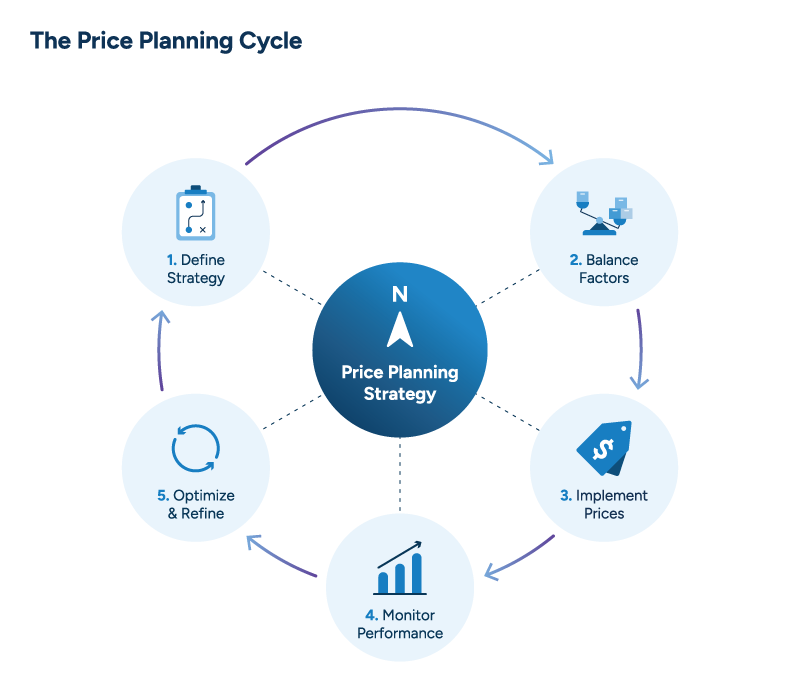
Price planning requires retailers to balance multiple factors:
- Competitive positioning: Monitoring market positioning and responding to competitive moves when needed.
- Pricing clarity: Consumers walking down aisles want a clear and logical pricing structure. Should they opt for the private label or the national brand equivalent? What is the gap between the two options?
- Cost fluctuations: Adapting to changes in the cost of goods sold and supply chain expenses.
- Price elasticity: Understanding how price changes impact customer purchasing behavior across different products and categories.
- Customer willingness to pay: Not every shopper seeks the lowest price. Some customers value freshness, convenience, or added services, and the pricing should reflect what they are willing to pay for that value.
- Regulatory requirements: Ensuring compliance with regional pricing laws and directives.
Price planning doesn’t end once prices are set. Planners regularly monitor the performance of the plans to ensure they align with business goals, while considering suggestions for further price optimization.
Why price planning is important for retailers
Price planning matters to retailers because it directly impacts profitability, competitiveness, and customer perception. Companies that fail to optimize their pricing strategies can soon find themselves out of touch with market demand and seasonal trends, resulting in inefficient operations that can have a lasting impact on their long-term business success. This includes unsold inventories, missed promotional opportunities, increased waste, and weakened customer loyalty.
As customers become increasingly price-sensitive and competitive pressures mount, optimal price planning has become more critical than ever. Retailers need to find the balance between responding quickly to market changes and maintaining profitability, all while managing thousands of products across multiple locations and channels.
The key components of a pricing plan
An effective pricing plan comprises six main components that work together to support informed pricing decisions. Each element plays a crucial role in ensuring prices remain competitive, profitable, and aligned with business objectives.
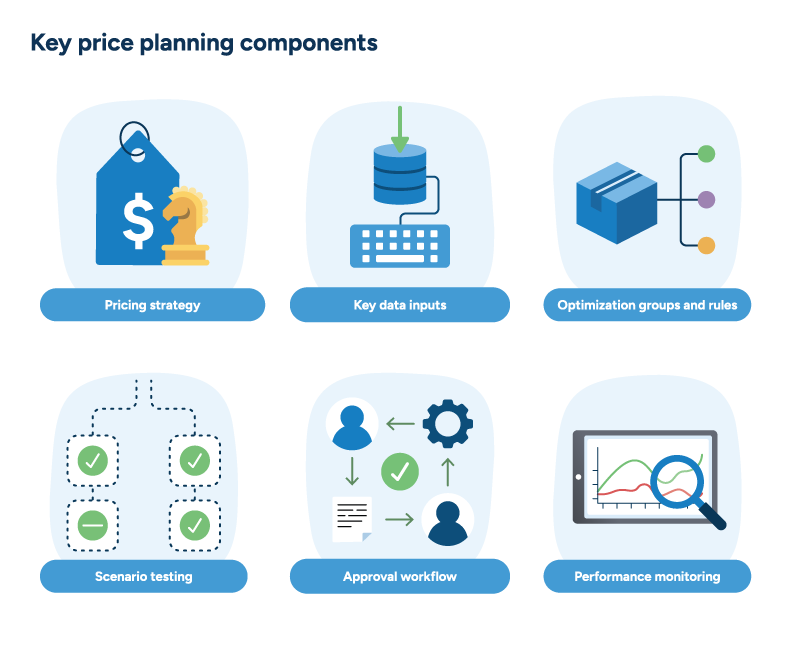
- Pricing strategy. This forms the foundation of the plan, where strategic objectives and constraints are defined, and pricing tactics are designed to achieve those objectives.
- Key data inputs. These include cost updates, competitor pricing, demand elasticity, and regulatory adjustments, which drive price changes and provide relevant information about market conditions and customer behavior.
- Optimization groups and rules. Pricing plans can incorporate hierarchical rules and specific groups, allowing for granular control over pricing by product, store, category, or even across multiple banners and price zones.
- Scenario testing. Teams simulate different pricing scenarios and compare KPIs to refine strategies before implementation.
- Approval workflow. Pricing suggestions are reviewed and approved through a structured workflow, facilitating alignment and allowing human expertise to guide critical choices.
- Performance monitoring. Planners regularly track key performance indicators (KPIs) to ensure the pricing plan achieves its objectives.
When integrated effectively, these six components enable retailers to move from reactive pricing decisions toward a disciplined, data-driven approach that drives sustainable profitability and competitiveness. However, coordinating these elements manually at an enterprise scale requires advanced pricing software to balance real-time market shifts with strategic objectives while maintaining consistency. Only then can retailers achieve the automated coordination, seamless data flow, and reliability that manual processes struggle to deliver.
Benefits of optimized price planning
With the key components in place, an optimized price planning process can provide retailers with a tangible competitive edge and lay the foundation for sustainable growth. Effective execution allows retailers to deliver measurable improvements across key business metrics and strategic capabilities, including:
- Improved margin protection. Making accurate, data-informed pricing moves rather than reactive adjustments to market pressures helps retailers maintain profitability even during challenging economic conditions.
- Enhanced competitive positioning. Strategic price positioning that considers both market dynamics and business objectives helps retailers maximize sales and profit margins, rather than simply matching competitor prices.
- Bolstered customer loyalty. When pricing aligns with customer willingness to pay and their perception of value, it builds trust and strengthens loyalty over time.
- Minimized price wars. Proactive pricing strategies focused on strategic positioning and value delivery help retailers avoid destructive competitive spirals that erode margins across entire categories.
How to unlock price planning profitability using pricing software
AI-powered pricing software turns price planning into a scalable, data-driven process by automating data-intensive tasks at a speed previously impossible through manual methods.
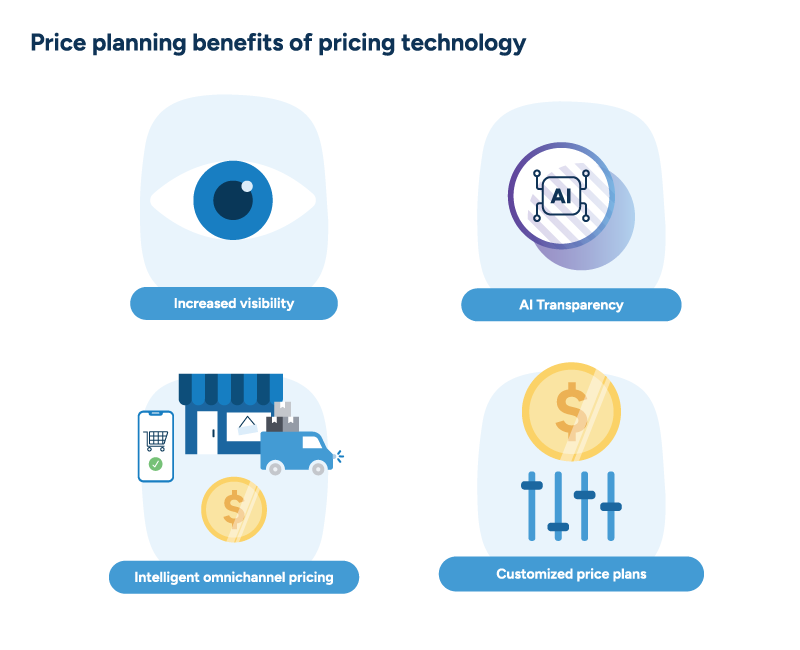
Gain visibility and break down planning siloes
Modern solutions process vast amounts of information in real time, including competitor prices, cost changes, demand patterns, and market dynamics. This processing is especially powerful when it is shared between functions that are often planning in silos. When pricing, merchandising, finance, and supply chain teams can access the same data and understand how actions impact different departments, collaboration improves and conflicts decrease.
Build trust in AI-powered pricing recommendations
Beyond visibility, modern pricing solutions provide transparency into the reasoning behind AI-driven recommendations. Teams can see which factors influence each suggested price change. This explainability gives planners greater confidence in automated systems and allows them to refine strategies based on clear logic rather than treating AI as a black box.
Manage omnichannel pricing complexities
The omnichannel environment requires retailers to maintain coordination between online and offline pricing. Advanced solutions enable them to set consistent pricing strategies across physical stores and e-commerce platforms, while accounting for channel-specific factors like fulfillment costs, competitive dynamics, and customer expectations. This coordination prevents pricing conflicts that could erode customer trust or create margin leakage.
Customize pricing plans at the store- and product-level
With comprehensive data at their fingertips, retailers can tailor pricing plans based on the variables that impact performance. Modern solutions account for local market conditions, customer preferences, and competitive dynamics that vary by location and product. This granularity enables retailers to move beyond one-size-fits-all approaches, optimizing profitability and competitive positioning for each unique market.
Common challenges in implementing pricing software
While pricing technology clearly offers several benefits, retailers still face some barriers when implementing it within their price planning ecosystems.
Change management concerns and limited resources can make it challenging to decide whether to invest in a pricing solution, especially when organizations are balancing competing priorities. Successful implementation requires top management sponsorship and cross-departmental alignment between pricing, finance, merchandising, and revenue management teams.
But these challenges are not insurmountable. Retailers that clearly define their pricing goals and understand where technology can best support them often find the transition smoother and more rewarding. Asking a few key questions can help guide that decision:
- How advanced do they want their pricing strategy to be?
- What pricing maturity are they aiming to achieve?
- Is their pricing strategy keeping up with the competition?
- How much central control do they want over their pricing?
- What business strategies can their planners focus on if the daily repetitive tasks are automated?
How RELEX supports modern retail price planning
The RELEX AI-powered pricing platform streamlines retail price planning by automating manual processes and enabling data-driven decisions at scale. By integrating pricing with promotions and other merchandising operations, RELEX supports consistency, compliance, and profitability across all channels and locations.
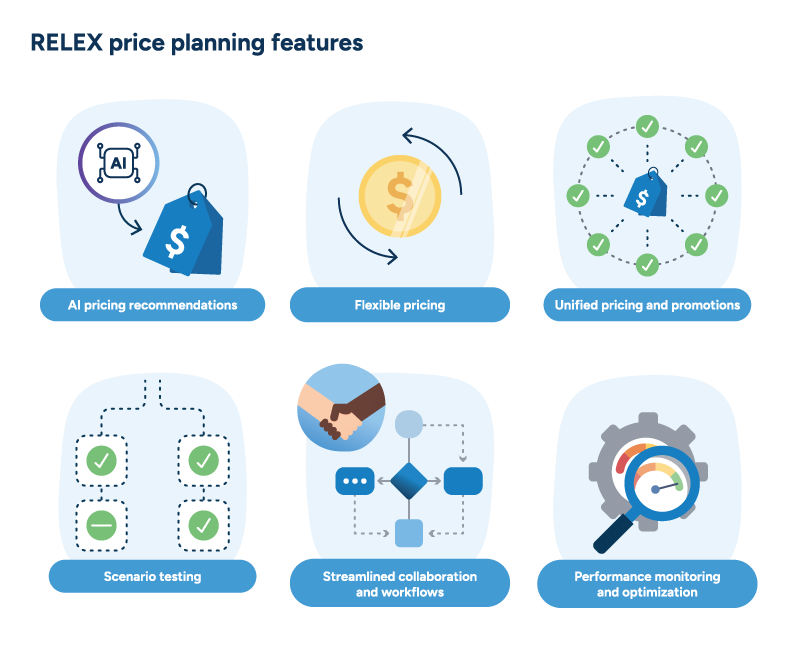
AI-driven price recommendations
RELEX quickly generates optimized price recommendations by combining rule-based strategies with predictive analytics and price elasticity models. The system automatically factors in business constraints, such as margin requirements, competitor pricing positions, and rounding rules, while calculating optimal prices at both the product and store levels.
This approach allows retailers to maintain control over their pricing choices while leveraging AI to process complex data relationships that would be impractical to manage manually.
Flexible price strategy management
Retailers can configure tailored pricing strategies for different products, categories, regions, and product relationships within a single platform. RELEX supports hierarchical rules and optimization groups, enabling granular control and allowing businesses to apply specific strategies to individual stores or product groups.
This flexibility helps pricing approaches align with diverse business objectives, whether maximizing profit margins in premium categories or defending market share in price-sensitive segments.
Unified pricing and promotion planning
RELEX integrates regular price planning and promotional pricing within the same solution, eliminating conflicts and ensuring transparency across merchandising activities. When planning regular prices, users can view upcoming promotions for products and implement price locks to ensure compliance with regulations, such as the EU Omnibus Directive.
Similarly, promotion planners can access current regular prices and the lowest prices from the past 30 days, ensuring promotional offers meet legal requirements and guidelines.
READ MORE: Why retailers need to integrate pricing and promotions
Scenario testing capabilities
A key feature of RELEX is the ability to simulate scenarios and use the results to better inform future supply chain planning decisions. Retailers can simulate price changes and analyze their impact on sales, margins, competitive positioning, and regulatory compliance before implementation.
Pricing teams can test multiple scenarios side by side, comparing KPIs to identify the most effective strategy for different seasons, market conditions, or competitive situations. This capability reduces risk by catching errors and inconsistencies during the planning phase rather than after prices reach customers.
Streamlined collaboration and workflows
Built-in approval workflows, notifications, and alerts facilitate cross-functional alignment between stakeholders. RELEX provides shared data visibility and transparency between pricing, merchandising, finance, and other teams, allowing everyone to understand the rationale behind pricing plans and their alignment with broader business strategies.
This collaborative approach reduces friction in the approval process and provides pricing decisions with the appropriate review time, based on their strategic or commercial importance.
Performance monitoring and optimization
RELEX tracks Key Performance Indicators (KPIs), including sales, margins, and volume, to measure the effectiveness of pricing strategies in achieving their objectives. The system provides regular performance insights that enable pricing teams to identify necessary adjustments, allowing them to respond quickly to market changes or shifts in business priorities.
This continuous monitoring creates a feedback loop that enables retailers to refine their pricing strategies over time and enhance their outcomes.
Take the next step in your pricing journey
Optimal price planning has become essential for retailers navigating today’s complex market dynamics. Between rising costs, intensifying competition, and increasing price-sensitivity, retailers need agile pricing strategies that adapt quickly while protecting margins and maintaining customer trust.
Modern pricing technology from RELEX makes this possible by automating data-intensive tasks and facilitating strategic decision-making at scale. However, implementing pricing technology requires investment, cross-departmental alignment, and top management sponsorship to succeed.
Building a compelling business case is the critical first step. Understanding the potential return on investment helps secure stakeholder buy-in and makes sure that your pricing initiative receives the necessary resources and support. Our comprehensive ROI guide walks through the key considerations, metrics, and approaches for demonstrating the value of pricing technology to your organization.
Written by

Related Articles

Customer Story: Premium Nexus
Premium Nexus is a massive franchisee of their CU brand from BGF Retail Today, they operate over 600 stores and three distribution centers across all Mongolia.

Phantom inventory: What it is, what causes it, and how to fix it
Phantom inventory costs retailers in stockouts, spoilage, and wasted labor. Learn what causes it, how to detect it, and how RELEX eliminates it.

From knowing to doing: How RELEX agents close the gap in retail planning
Discover how RELEX agents close the gap between knowing and doing in retail planning, from inventory to promotion optimization.