For beauty and personal & home care manufacturers, demand shifts faster than it used to. Social media trends and influencer recommendations can boost product sales overnight. But packaging components are purchased months ahead of production runs, based on forecasts that may be outdated by the time products reach shelves.
The supply chain is made up of multiple tightly-coupled phases — demand, purchasing, and production — that rely on one another to function. In beauty and personal & home care manufacturing, those links are especially tight. Formulations for dozens of SKUs use the same ingredients and packaging and often run on shared production lines, so a single supply shortfall can affect large portions of the portfolio. Production must account for constraints from bulking and filling to quality control (QC) and changeover rules, meaning a bottleneck at any step can disrupt the entire operation.
Fragmented steps managed on disconnected systems just intensify these challenges. Decisions are too often tucked away in private meetings, spreadsheets, and message threads. As each plan is based on the assumptions of the one before it, flaws from earlier in the process are discovered too late. Whether a manufacturer runs mass-produced lines or small-batch luxury beauty, the results are costly. Fragmentation leads to last-minute buys, idle fill lines, penalties for outdated stocks, on-time in-full (OTIF) failures, write-offs, and poorly informed decisions about whether to dispose of or discount stock.
To avoid these costs, manufacturers need to synchronize demand, purchasing, and production phases, along with the decisions around them, on one plan. That way, changes in one area appear everywhere else in time for planners to respond. Achieving this requires an end-to-end supply chain planning system that unifies the operation under a shared data model and accounts for all its combined constraints, rules, and workflows.
The 4 planning challenges in beauty and personal & home care manufacturing
Demand, purchasing, production, and operational decision-making are foundational to manufacturing. But if these phases are out of step with each other, they become liable to recurring problems that hinder processes, causing headaches for planners while frustrating retail partners.
Responding to demand variations
Demand doesn’t have the same tempo across industry segments. Mass-marketed products may have more stable demand, as consumers buy them out of well-established purchasing habits. Beauty products, on the other hand, can be less predictable. They’re sensitive to influencer recommendations and viral social media trends, so they can fly off the shelves without warning.
New product introductions (NPIs) add another degree of uncertainty for demand planning. Considerable capital is spent on marketing high-value beauty products to signal their differentiation and justify premium price points. There’s a lot of pressure to support ramp-ups, manage short launch windows, and prepare kit and bundle configurations.
But NPIs aren’t easy to plan proactively. Forecasting the sales of NPIs is naturally unreliable because they’ve never been sold before. Projected uptake can be quickly invalidated by disruption from a competitor’s strategy, marketing delays, or just bad timing. However, manufacturers must commit ingredients, line time, and batches to the launch long before they know it will take off.
Handling promotional uplift is a challenge across beauty, personal and home care brands. Promotions create unpredictability in several ways, such as artificial spikes in demand, distortion of the baseline, and even permanent changes in purchase behavior.
When NPIs and promotions run concurrently, planners must commit capital against two unknowns at once: the future success of the launch and the promotion’s impact. Launches often bring a burst of initial traction, but early sales data is noisy, showing a mishmash of launch interest and promotional lift. As a result, planners can’t tell whether a high-volume week is real demand or just a temporary blip.
There’s no all-encompassing demand signal, but several that run simultaneously. High runners are stable and regular, whereas slow movers are infrequent and erratic. And forecasting has to cover both. Manufacturers also serve separate channels (from retail to ecommerce) with different service expectations, lead times, and shopping behaviors.
Purchasing raw materials and packaging
Complications arise when the deliveries of ingredients don’t align with the production schedule. Because suppliers determine arrival times, manufacturers are exposed to disruptions upstream, often without recourse. Single-source dependency for an essential ingredient is especially precarious and can morph into a material risk for manufacturers.
Beyond sourcing uncertainty, long and rigid lead times for raw materials are another constraint on production schedules. Packaging lead times typically run between 8 and 20 weeks, so some manufacturers forecast what they’ll need months in advance.
Speculative ordering is risky, though, especially with beauty products. The wide window between purchasing and production gives fickle consumer behavior plenty of time to shift. If forecasts become outdated, manufacturers can’t expedite replacement packaging because the production run is fixed to the initial packaging horizon.
Suppliers sometimes impose minimum order quantities (MOQs), compelling manufacturers to purchase a minimum number of units, even if they don’t need that much packaging. They could comply with the MOQ and receive more than what production requires. But that ties up working capital and occupies warehouse storage.
Alternatively, a manufacturer could insist on ordering only what is needed (known as sub-MOQs). The problem with sub-MOQs, though, is that they often come with an inflated unit price or a fixed fee that could severely compress margins. Making matters worse, this type of order is likely to be deprioritized, causing lead-time volatility and possible production delays.
Multi-level bills of material (BOMs) compound the purchasing challenge. Consider a manufacturer of home care products with a scheduled production run for a diffuser. The diffuser’s fragrance is made up of five substances that must be sourced and blended. Purchasing them involves a chain of sourcing and concoction, with varying constraints across them.
Now suppose this fragrance is infused into numerous other SKUs. Demand will cut across multiple forecasts, and each step in those product recipes produces different yields with varying lead times. For finished products to reach retailers with OTIF intact, those five substances must arrive on time and in the necessary quantity, before being blended and filled across product lines without delay or waste. It’s a lot to manage, especially when using disconnected spreadsheets and enterprise resource planning (ERP) tools.
Enabling consistent production
The tempo of formulation-based production is determined by where a product sits on the volume-to-value spectrum. Mass-market, everyday items are made in high volume and blended in one large batch. On the other side, low-volume, high-value product lines are produced in smaller batches. When these multi-SKU runs share production lines, changeovers become more frequent. These frequent changeover reduce line efficiency, but higher margins per unit offset the cost.
Mixing and filling — the key stages of production — are often planned as one step. But these are two distinct production environments, and treating them as one figure obscures each stage’s limits and break points and leads to problems down the road.
The manufacturing process as a whole is planned sequentially. Every phase is planned to fit around the one before it. If a conflict eventually emerges, the planner has to manually trace its impact and then rebuild the plan. If the clash is uncovered too late and the mixing has already started, changes to the batch cannot be made — no splitting or topping up midway.
Planning production on spreadsheets and ERP systems doesn’t work, because these tools base capacity solely on allotted line hours. They can’t account for the web of constraints and rules that are key to working out what’s feasible: tank rules, fixed batch sizes, sequence-dependent changeovers, and variable QC release times. These constraints also interact with one another, so if they’re sitting in separate systems, a change to one constraint doesn’t reach the others, and the plan then has to be reconciled by hand.
One of the main culprits of wasted line time is misalignment with QC processes. The situation occurs when QC doesn’t release the batch in time, blocking it from moving to the filling stage. That takes up tank capacity and diminishes the sitting batch’s shelf life, while preventing the next run from starting.
Sequencing multi-SKU runs on shared production lines are often complicated by compulsory procedures, from mixing light-colored liquids before dark-colored ones to cleaning after a run of wax and solid pigments. But these procedures are critical because they prevent costly and even dangerous contamination. Getting them wrong or missing one can be a disaster for an operation.
Making coordinated, responsive decisions
External factors drive demand, production, and material purchasing. While these are beyond a manufacturer’s control, what can be influenced is their decision-making and the speed at which they respond to those external factors. But the willingness to act is not the same as actually being able to do so. If a planner can’t to see how demand reacts to their actions, or whether they’ll run up against constraints, how can they be confident in making the right decisions?
When teams work from separate plans and data, the operation doesn’t function as a cohesive body. A commercial team rolling out promotions or launching products without visibility of supply constraints risks stockouts. Similarly, finance has no way to align operational plans with company targets if they can’t access those plans in the first place.
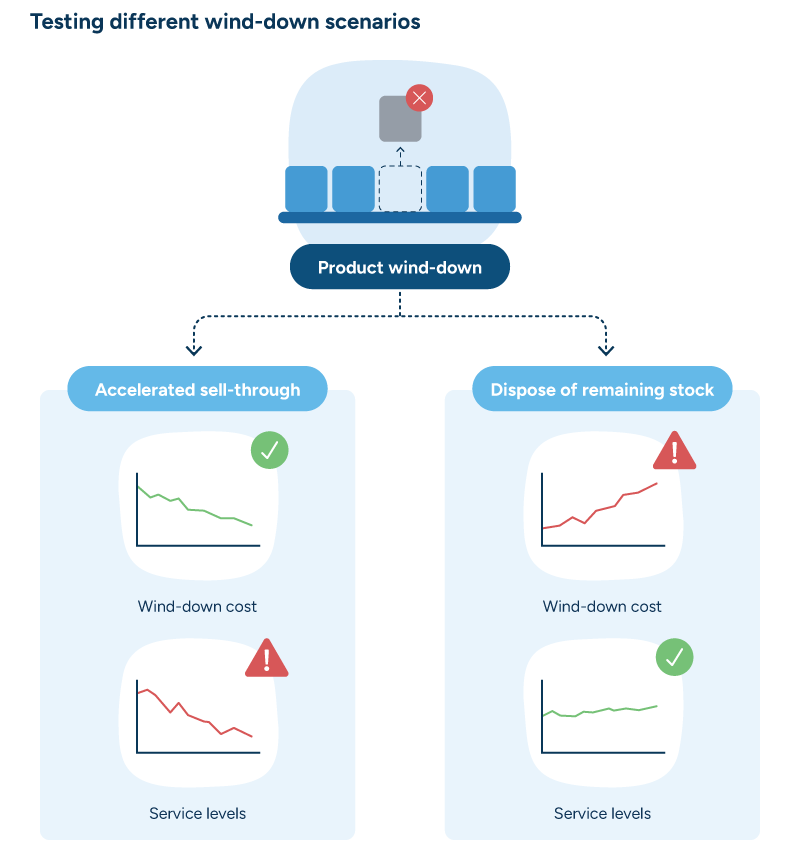
Effective decision-making requires fresh, timely insights. Say a manufacturer with a home care portfolio is told that a floor-cleaning liquid is being discontinued at a fixed cutoff date. Such a process involves poring over inventory for any held stock, checking open production orders, and assessing how much remaining bulk the market will absorb. Only then can planners choose the best wind-down option. This multi-step process needs complete, up-to-date data from across the operation.
Obsolescence risk is often present in the data, but manufacturers have to check for it manually. This review is a cumbersome activity that usually catches expiring stock after it’s too late to act.
What does poor planning cost?
Demand determines what’s needed and when; supplier lead times for packaging and ingredients establish the earliest date production can begin, while tank and line availability sets the schedule. However, if they aren’t aligned, costs soon follow:
- Ingredient shortfalls that appear too late.
- Wasted and oversubscribed production line bookings.
- Stock that fails shelf-life requirements or becomes obsolete.
- Reactive problem-solving in place of anticipatory planning.
- Margin erosion that eats away at the bottom line.
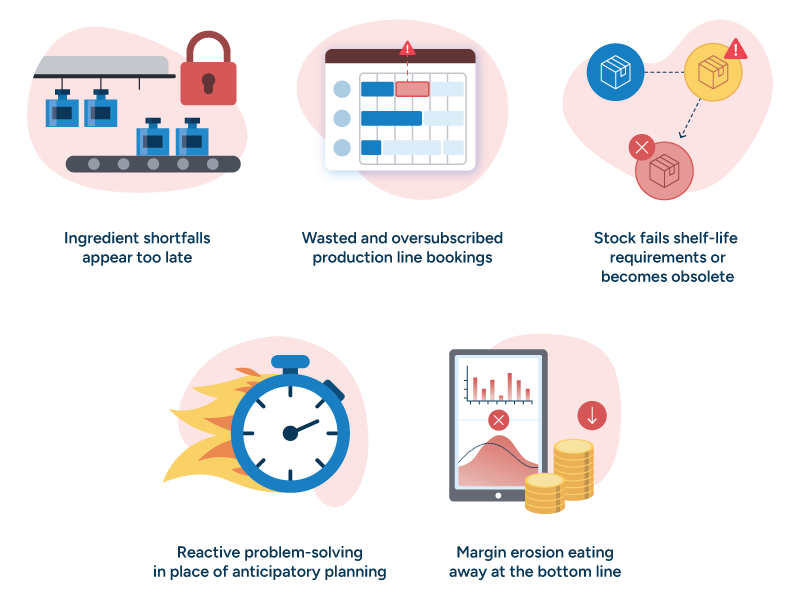
Planning demand, purchasing, and production in one system, with every team working from the same view of the operation, keeps these costs from adding up.
How manufacturers can use RELEX to plan multiple product formats on one platform
Balancing bulk preparation, filling, and packaging across multiple product formats and demand patterns is difficult enough without a patchwork of disconnected tools and spreadsheets.
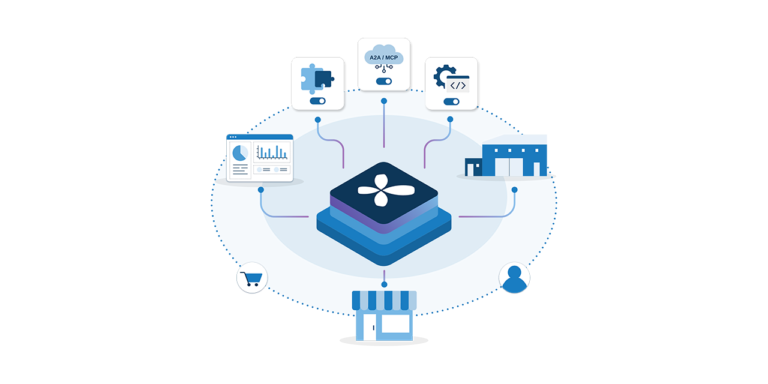
On RELEX, manufacturers coordinate every stage of the production process, from formulation to arrival at retail stores. The platform enables supply chain planners to:
- Schedule batches for liquid, powder, and solid products.
- Source ingredients and packaging in line with production plans.
- Understand demand at retail partners’ stores in near real-time.
- Avoid time-consuming manual reconciliation between separate plans.
Because every plan draws on a shared dataset, a change in one area immediately informs the others.
How RELEX forecasts volatile beauty and personal & home care demand
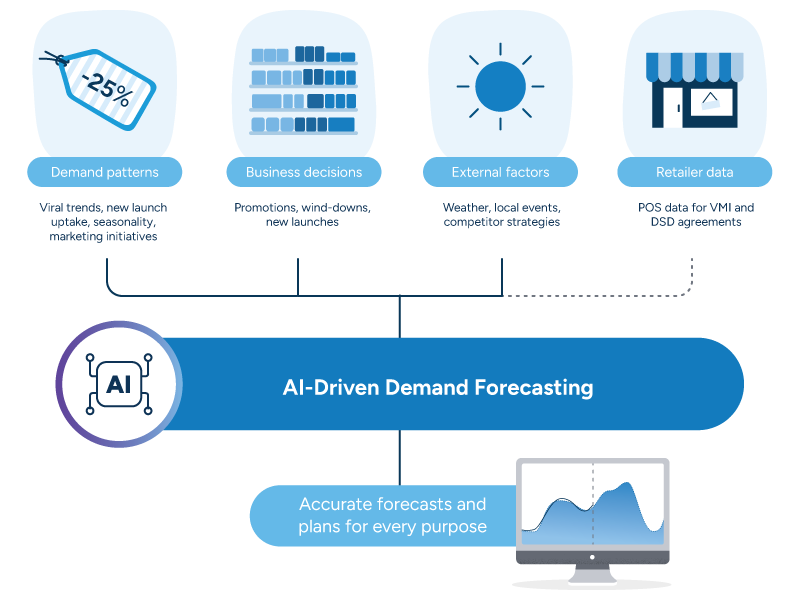
RELEX solves the fragmented picture of demand with its ML-powered forecasting engine. It covers the entirety of a manufacturer’s portfolio, from high-volume SKUs to seasonal and promotional items to specialty goods. Planners across purchasing, production, and distribution operate from this single forecast.
The RELEX forecast processes historical sales data and external signals to generate projections for future periods. Traditional time-series forecasting methods project past sales forward. In contrast, the RELEX forecast first figures out why the product was sold before applying those causal factors to predict future demand.
Let’s say in March a bronzer is featured in a popular online magazine. Its sales climb sharply, then fall back to the baseline. The RELEX forecast learns that the feature drove this jump in demand as a distinct event. When the next feature is scheduled for the following year, this time in May, the forecast adapts to project the uplift from the feature for that month. It applies what it learned from last year’s feature while accounting for current conditions.
For slow movers with sparse sales or NPIs without historical data, RELEX applies pooled forecasts to generate projections. They plug information gaps for slow movers by using data from groups of similar products. RELEX matches products with no sales history to existing SKUs with the same attributes. Once NPIs have enough sales data, they get their own forecast.
Manufacturers of beauty products typically oversee a wide portfolio with thousands of SKUs. Rather than leaving planners to manually review and tweak thousands of forecasts by hand, RELEX handles routine forecasting through touchless planning. Combining artificial intelligence (AI) and real-time data, it automates the bulk of routine forecasting work, only bringing in human planners for exceptions.
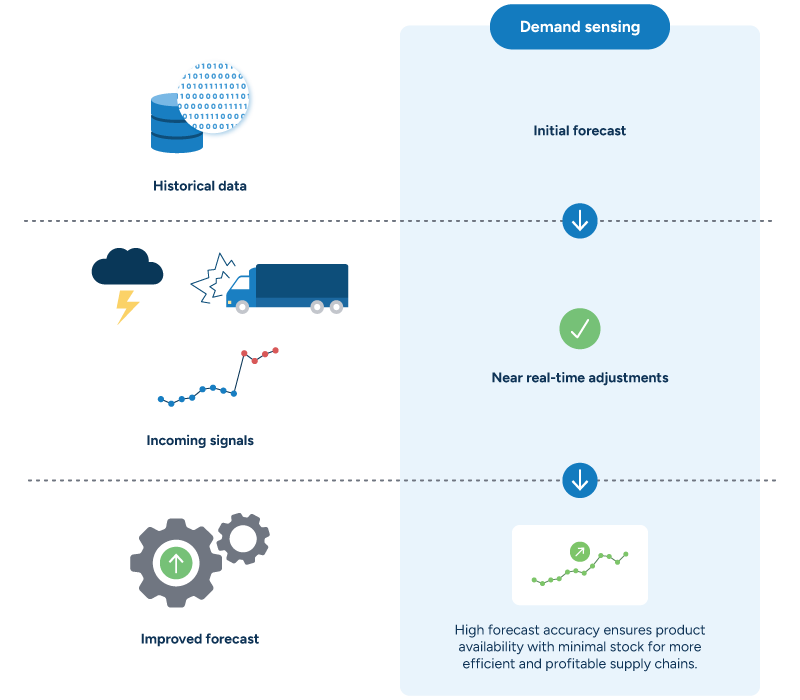
Manufacturers that deal with vendor-managed inventory or direct store delivery agreements use RELEX to ingest point-of-sale data and adjust forecasts in real time. Known as demand sensing, the process helps manufacturers plan replenishment based on the sell-out reality at the stores, preventing the bullwhip effect before orders arrive upstream.
How RELEX ties ingredient and packaging purchases to the production plan
Purchasing Planning on RELEX links the purchasing of ingredients and packaging with demand forecasts using a multi-level BOM. This is especially advantageous for products with multiple ingredients or components, because purchasing proposals can be generated simultaneously from a single demand signal.
RELEX enforces MOQ thresholds at the product-location level as part of its ordering logic. Products are grouped by supplier in the system, allowing manufacturers to apply the MOQ or minimum order value for that whole group at once. If the group falls short of the threshold, RELEX identifies components with the lowest stock across the group and then tops them up until the minimum is met. Maximum order limits can also be set to prevent over-ordering any single product.
RELEX factors supplier cycles into purchase proposals so manufacturers order materials at the agreed frequency or the most economical one, while always covering the needs of the production plan. For each cycle, the RELEX optimizer identifies the ordering date with the lowest total cost of ordering and holding stock.
Purchase planning in an ERP lacks visibility into production and supply constraints, so material shortfalls often go undetected until the production plan is locked. With Master Planning, purchasing and production proposals are created together from the same plan, so those shortfalls would appear while the plan is open, and therefore still solvable.
Master Planning moves ahead with the stated preferred approach to production by default. For products that can be made more than one way, the system automatically switches to the next-best option if capacity runs out or an ingredient becomes unavailable.
If needed, RELEX weighs other contingency plans, such as buying extra product from a co-manufacturer or transferring stock from another site. It then recommends the most cost-effective way to fulfill the order.
How RELEX schedules multi-SKU runs across tanks and fill lines
Rather than treating bulk preparation and filling as a single process, RELEX Production Scheduling treats them as two distinct but linked stages. Tanks and fill lines have their own dedicated calendars, but a co-schedule keeps them aligned. RELEX plans mixing, buffers, and filling lines together, accounting for all constraint and resolving conflicts during scheduling.
QC is one such constraint factored proactively into the plan. Bulk is typically tested immediately after mixing, though quality checks can occur at multiple points of the production process, depending on product format. Regardless of when it happens, QC must release the batch before production can proceed to the next stage. Because testing durations vary widely, RELEX Production Scheduling builds dynamic hold buffers into the schedule, factoring in testing times, hold windows, lab hours, and bulk transfer schedules.
The rules and conditions unique to tank processing — single-product tank occupancy, empty-before-refill rules, discrete batch availability, non-linear processing times, and intermediate transferring flows — require specialized capabilities. RELEX developed Tank Planning to optimize tank and vessel utilization, treating vessels as individual entities with their own limits and constraints, while providing planners with visibility at the vessel level.
With this capability, planners:
- See which tanks are free and at what time.
- Match batch sizes to tank capacity limits.
- Align bulk preparation with filling and packaging lines.
- Incorporate cleaning time and changeovers into schedules.
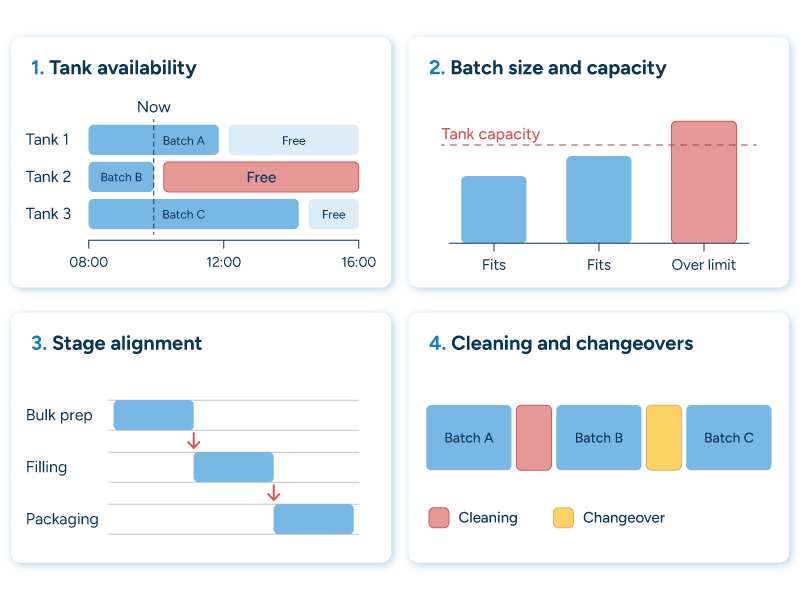
As a result, planners reduce tank contention, minimize holding time (which limits bulk degradation), and improve OTIF fulfillment for retail partners. Intermediate inventory acts as a middle point between mixing and filling to hold bulk when there’s a wait for a fill line, allowing mixing tanks to be cleaned before the next mix on the schedule.
It’s especially useful for high-volume operations that prioritize output and tank utilization. They can immediately shift bulk from the mixing tank, proceed with the cleaning cycle, and then move on to another large batch without having to wait for an open line.
When it comes to responding to shortfalls and overproduction, intermediate inventory is an ideal fallback option. When producing slow-moving SKUs that need only small volumes of bulk, manufacturers aren’t forced to mix blends to the tanks’ limits and accept excess as waste. Any leftover bulk can be placed in the intermediate hold and used for other sizes and orders. If demand for more finished products appears soon after, the manufacturer can simply extract the required material from the intermediate bulk.
Manufacturers, no matter their portfolio, face two persistent risks: retailer shelf-life penalties and obsolescence in their own operations. RELEX gives them a two-pronged defense: dynamic safety stock and shelf-life-aware distribution.
Dynamic safety stock, a part of RELEX Inventory Planning, automatically adjusts finished-goods buffers in line with changes to the manufacturing portfolio and demand patterns. SKUs are allocated buffers that reflect how they’re selling. Because dynamic safety stock is also shelf-life aware, buffers only get filled with stock that has a high chance of being sold before it expires or gets too old. That means less excess inventory, fewer write-offs, and protected service levels.
Shelf-life-aware distribution checks the remaining shelf life of each batch before matching it to customers based on their particular shelf-life requirements, reducing the risk of rejected and unsold shipments. RELEX can also rebalance stock across distribution centers (DCs), further reducing write-offs.
How RELEX connects decisions across teams
A patchwork of solutions with manual workarounds doesn’t support quick, accurate, and data-backed decisions. Achieving this type of decision-making requires demand, production, purchasing, and distribution to work together from connected information.
This is how connected planning works on RELEX: Demand runs through a multi-level BOM, which tells the purchasing team which materials and packaging it needs. Production capacity is then assessed to determine the earliest availability of the lines to complete the bulk order. Once the run is scheduled, distribution is planned around its date.
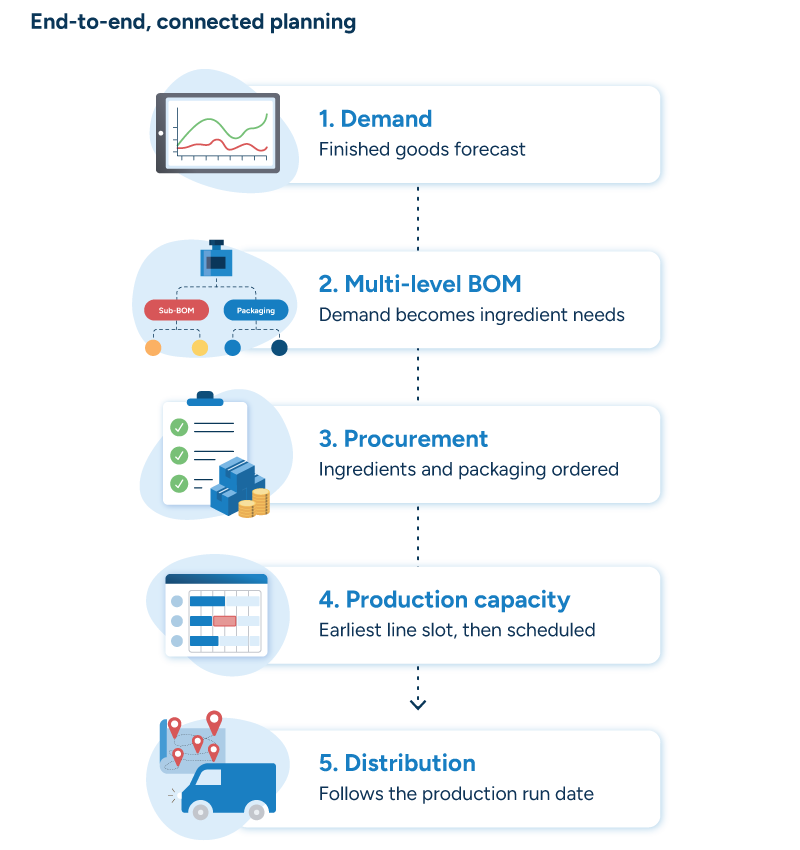
Decisions on RELEX aren’t made by isolated departments with separate views of the business, but with visibility across all operational functions. Teams understand how one change influences the whole supply chain, allowing them to resolve conflicts before they disrupt production.
With Scenario Planning, teams evaluate assumptions and strategies by simulating the operation using live production data in a secure copy of the planning environment. They can explore multiple what-if scenarios, experimenting with various constraints and conditions without affecting the live operation.
For beauty and personal home care manufacturers, scenario planning is especially useful to test different product wind-down options, comparing the costs and service consequences of each choice. Teams can also scrutinize demand-uplift assumptions and supply responses to understand how to deal with demand spikes. Upstream, they can test how alternative sources, lead-time changes, and sudden shipment disruptions affect production.
On RELEX, planners can codify their operational knowledge through configurable rules on the Business Rules Engine. These rules determine which automated actions are permitted, which constraints apply, and which parameters guide decisions. Planners use rules to proactively govern which products can follow one another on a shared line, set mandatory cleaning between runs, match mixing and filling times with material availability and capacity, and anticipate QC releases to minimize their impact on OTIF.
If something changes and an update to production workflows is needed, planners aren’t restricted by rigid, developer-maintained logic. Instead, they go into RELEX and reconfigure the rules themselves to reflect the new conditions. Or, they can deploy purpose-built agents that autonomously investigate broken logic, stress-test a new plan, and resolve constraints. Managing automated workflows and recommendations becomes a leaner, more straightforward process.
How RELEX has helped real beauty and personal & home care manufacturers
RELEX has supported manufacturers across beauty and personal & home care. We’ve worked with some to generate value across demand and supply planning for over a decade. Others are just starting to roll out RELEX capabilities. Each started with a specific goal, whether improving demand forecasting, production planning, or purchasing.
| Manufacturer | Industry segment | Operational size and scale | RELEX capabilities used | Tangible outcomes |
| Kiilto | Home care | Across 9 countries and 3 ERPs | Demand, Replenishment, and Distribution | Service level up from 97% to 98%. Inventory value down 48% in Sweden. Purchasing workload reduced by more than 50%. |
| Transmeri | Cosmetics | Multi-subsidiary rollout | Demand Planning | Forecast accuracy up 10 percentage points. 95% of forecasts are automatically generated. |
| Lumene | Cosmetics | Over 1,700 product lines in various lifecycle phases. Production and warehousing across Finland, Russia, and the USA. | Demand Planning, ML Forecasting, Supply Planning | Faster, more accurate campaign planning. 16-month sales planning horizon for production and supply chain. Full supply chain transparency for all stakeholders. |
| Orkla Home & Personal Care | Home & personal care | 1,000 SKUs across two production sites | Demand Planning, Production Planning & Scheduling, Inventory, Promotions, and Supplier Collaboration. | Aim is to improve forecast accuracy, lower working capital through more precise inventory management, and increase service levels. |
How end-to-end planning helps manufacturers manage uncertainty
Packaging will still be ordered months ahead of production, ingredients will still arrive late, and demand for some launches will still outperform their forecasts. No plan can remove that uncertainty. But one plan with visibility across every phase helps manufacturers limit the damage from unexpected issues, correct wrong assumptions, and protect margins and service levels.
Because every phase of manufacturing runs on the same underlying data, RELEX gives planners foresight and coordination that siloed planning can’t. Problems with inventory and line schedules are flagged with enough time to act, and expiry risks surface well before finished goods become write-offs or bulk goes to waste. Capabilities like scenario planning go a step further, letting planners assess trade-offs and compare possible responses before committing to a decision.
RELEX capabilities are rolled out from the same data model, so manufacturers can build on what’s already in place. That enables incremental deployments at the manufacturer’s pace, with plenty of time to demonstrate value before adding the next capability.