What does the data say about supply chain AI readiness in retail and manufacturing?
Nov 10, 2026 • 8 min
Across supply chains, the gap between AI adoption and governance is widening. According to the RELEX State of Supply Chain AI Practitioner Pulse, a survey focused on AI readiness in retail and supply chain planning, AI governance was the lowest-ranked readiness area. Despite this, only 15% of respondents highlighted governance when describing their AI goals, pointing to a mismatch between the areas needing the most attention and the areas getting the most attention.
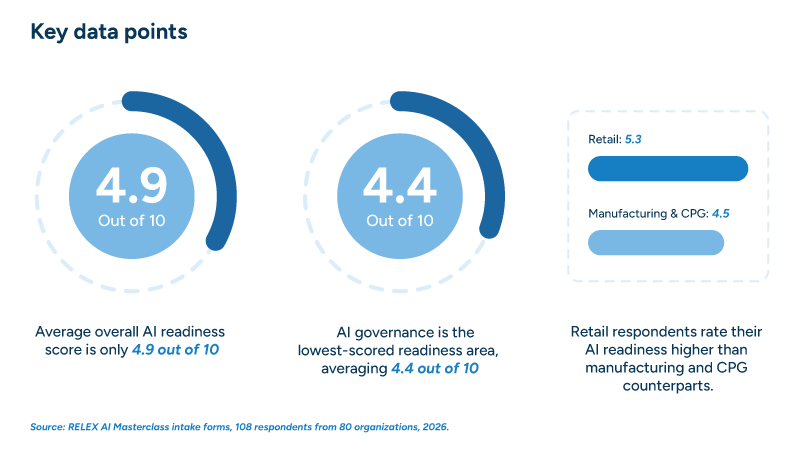
And AI governance isn’t the only gap. The survey asked 108 respondents across 80 organizations to rate their AI readiness across five areas: AI governance, data foundation, planning process maturity, technology platform, and people and change leadership. Across all areas, the average overall score was only 4.9 out of 10, and only 8% rated their organizations 7 or higher.
There’s also a split along industry lines. On average, retail leaders exhibited higher confidence in their overall AI readiness (5.3) than their manufacturing counterparts (4.5).
As long as the architecture and best practices supporting AI investments lag behind the technology itself, ROI from tech investments remains in question. But business leaders can protect that ROI using repeatable, iterative frameworks and a foundation of proven AI capabilities. With this approach, best practices can grow alongside technology at speed, reinforcing cohesive, durable tech stacks that weather technological and commercial shifts.
Takeaway #1: AI governance is a low-confidence area but also a priority blind spot
According to RELEX’s survey data, AI governance was the lowest-performing readiness area across the board:
- AI governance had the lowest average rating of 4.4 out of 10.
- 35% of respondents rated AI governance between 1 and 3, and only 18% rated it 7 or higher.
- AI governance was the lowest- or joint-lowest-ranked area for 58% of respondents.
- AI governance was the lowest-scored area both for retail and for manufacturing and CPG (at 4.7 and 4.1, respectively).
- 48% rated their technology platform higher than their governance, suggesting that platforms are getting ahead of guardrails.
But governance may be slipping through the cracks as respondents deal with other concerns. RELEX asked retail and supply chain leaders to describe their goals concerning AI. The table below details the share of respondents whose goals included each theme. (Note: Answers can fall into more than one theme.)
| Theme | Share of respondents |
| Practical use cases and where to start | 32% |
| Strategy, frameworks, and roadmap | 30% |
| Peer benchmarking and best practices | 23% |
| Proving value, ROI, and measurement | 20% |
| Adoption, change, and workforce | 18% |
| Governance, risk, and security | 15% |
| Forecasting, replenishment, and planning use | 13% |
| Agentic AI | 10% |
Despite being the biggest AI readiness gap, AI governance appeared in only 15% of responses pertaining to AI goals.
One possible interpretation of this data is that business leaders are trying to get AI stood up, working with practical use cases and gradually developing and iterating processes. And with the ambiguity that initially plagued AI use cases and how quickly those use cases are changing, it’s understandable that companies are focusing on first steps, practical applications, and overall strategies.
However, business leaders can’t afford to lose sight of the governance question for two reasons. First, governance guardrails protect against internal mistakes, keeping data clean, decisions accurate, and outcomes on track. Second, as cyber risks increase, organizations should build on their existing governance protocols rather than scramble to catch up once a risk has been exploited.
Takeaway #2: Supply chain leaders recognize significant gaps across all AI readiness areas
RELEX’s AI Practitioner Pulse survey found that, in terms of overall AI readiness, only 8% of respondents scored themselves 7 or higher out of 10. The average overall readiness score was only 4.9.
A closer look at the data reveals few outliers. The average scores are all pretty middling, hovering between 4.4 and 5.1.
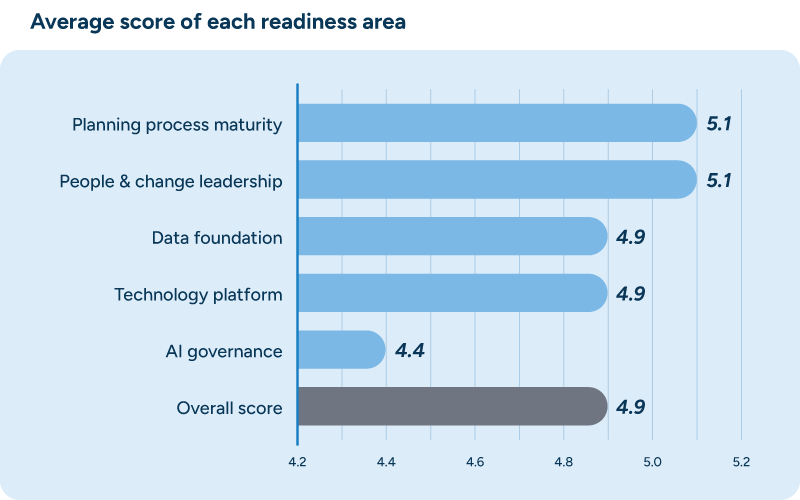
The table below shows the share of respondents who rated each readiness area from 1-3, 4-6, and 7-10, as well as each criterion’s average score.
| Readiness area | Scored 1-3 | Scored 4-6 | Scored 7-10 | Average score |
| Data foundation | 30% | 47% | 23% | 4.9 |
| Planning process maturity | 23% | 53% | 24% | 5.1 |
| Technology platform | 26% | 51% | 22% | 4.9 |
| People & change leadership | 24% | 50% | 26% | 5.1 |
| AI governance | 35% | 47% | 18% | 4.4 |
In each area, about half of respondents rated their AI readiness only between 4 and 6. This spread suggests that business leaders are well aware of the roadblocks and untapped opportunities for ROI when it comes to AI implementations. And those roadblocks and opportunities are not confined to one particular area. Improving AI readiness will require a strategy that integrates all readiness areas, rather than concentrating efforts on just one.
Takeaway #3: Retail leads manufacturing in AI readiness, but both industries have opportunities to increase AI-supported competitiveness
According to the survey, on average, retailers have a 5.3 AI readiness score, while companies in manufacturing and CPG average 4.5 overall.
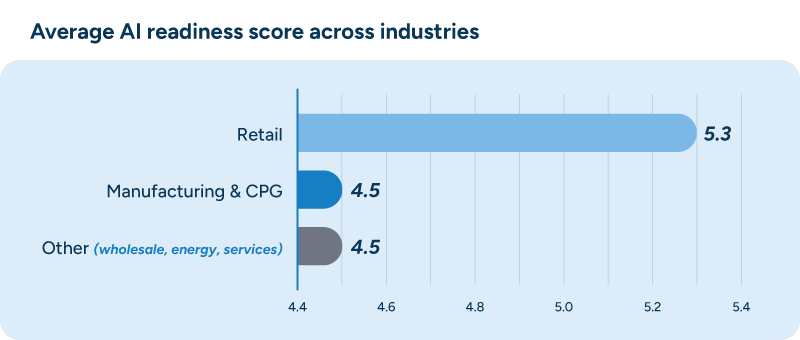
A breakdown of each readiness area shows that retail leads manufacturing in all areas, especially in planning process maturity and technology platforms.
| Readiness area | Average score: Retail | Average score: Manufacturing & CPG | Average score: Other (wholesale, energy, services) |
| Data foundation | 5.3 | 4.5 | 4.3 |
| Planning process maturity | 5.8 | 4.6 | 4.6 |
| Technology platform | 5.4 | 4.3 | 4.7 |
| People & change leadership | 5.5 | 4.9 | 4.6 |
| AI governance | 4.7 | 4.1 | 4.4 |
| Overall | 5.3 | 4.5 | 4.5 |
Across industries, companies share that same AI governance gap, so they should be making strides to construct AI guardrails. But each industry also has unique opportunities suited to its own circumstances.
How retailers can build on their planning strengths
In the survey, retailers feel most secure in their planning processes (5.8). While there’s room to improve, this finding echoes data from the separate 2026 RELEX State of Supply Chain report, which found that 48% of retailers express high confidence in their ability to adjust production, inventory, and store replenishment in real time. This percentage suggests that approximately half of retailers have invested successfully in demand-responsive systems and processes.
The danger lies in ignoring the other factors that will keep those investments working, especially as AI offerings evolve. To keep their processes responsive, retailers still need to ensure that:
- Their systems can operate at retail scale: Retailers’ data foundations and technology platforms must be reliable, adaptable, and scalable enough to support and grow with processes as they change.
- Employees are empowered from the central planning hub to the store floor: The people organizing and running these processes must have access to the latest AI tools to get the answers they need and make the changes they require as shifts occur.
- Forecasting and replenishment are unified with merchandising and operations planning: AI platforms should help retailers optimize business constraints, gain end-to-end visibility, and tailor decisions to customer behaviors and preferences.
Retailers that strengthen every area of AI readiness, not only planning, will be better positioned to keep their planning gains as AI capabilities change.
How manufacturers can gain ground through unified planning
On average, manufacturers surveyed rate themselves less AI-ready than the retail contingent. That lower baseline also means manufacturers that improve their AI readiness now can gain ground on competitors.
With an AI-driven platform that unifies decisions across departments, manufacturers can:
- Improve operational outcomes by coordinating complex decisions across demand, materials, production capacity, inventory, and service.
- Connect functions that have historically operated separately, such as commercial planning, procurement, production, and distribution.
- Build capabilities competitors may take years to replicate, since every planning cycle creates opportunities to improve forecasts, accuracy, and user expertise.
Even gradual improvements in AI readiness can ultimately help manufacturers coordinate planning, respond faster to market and customer changes, and reduce operational and inventory costs.
How retailers and manufacturers can become (and stay) AI-ready
Technology isn’t the primary limitation to becoming an AI-ready company. New technology and innovations often outpace how well companies can use them with existing processes. It takes time for workflows, best practices, and governance to catch up with new capabilities.
This pattern appears in both the gaps and the priorities seen in the survey. 48% of respondents rated the AI readiness of their technology platform higher than that of their governance protocols. And the top two themes mentioned in AI goals were “Practical use cases and where to start” (32%) and “Strategy, frameworks, and roadmap” (30%).
Business leaders know that they need to consider everything that connects to their technology just as closely as the technology itself. These considerations include the workflows, processes, data, and planners that interact with AI platforms every day.
Technology keeps developing faster, so the market will favor companies that can move quickly and adopt AI strategically. Here’s how retailers and manufacturers can ensure they become and stay AI-ready.
1. Construct a framework
To build frameworks for governance, strategy, and ownership, and tech stacks that deliver ROI, business leaders should:
- Prioritize high-value use cases. Start with business decisions that are made frequently, can be tied directly to a measurable financial impact, and have sufficient data to track baselines and improvements. That data should be clean and usable to prevent AI models from degrading.
- Assign clear ownership. Different teams will have different responsibilities; IT ensures the solution is integrated correctly while operations owns the outcomes. But each AI initiative should be sponsored by a specific business leader and assigned to one named owner who is responsible for delivering and validating the financial benefits.
- Make governance part of the regular operating process. Review AI performance, exceptions, and manual overrides weekly, and adjust decision authority as trust and results improve.
- Start small, then scale. Once a baseline is established, expand a use case only after demonstrating measurable improvement, scalability, and user adoption.
- Train employees well. Ensure people’s skills are scaling, too, so they can get the most out of the AI tools they’re given. With AI built into their daily workflows, planners can better manage exceptions, evaluate recommendations, and improve the decisions that deliver the payoff from AI investments.
Standardized, repeatable governance processes help companies set expectations, monitor performance, track ROI, and improve and scale processes as they gain traction.
2. Start with proven AI to avoid delaying ROI
It didn’t take long for AI agents to outshine even the novelty of early gen AI chatbots. But AI investments encompass more than just agentic capabilities. Even as new capabilities hit the market, tried-and-true technology can still deliver significant, dependable business value. Retailers and manufacturers can implement AI that’s already been proven to work for years.
For instance, specialized AI, which includes machine learning and optimization capabilities, already powers the most advanced planning models across supply chain and retail planning. The more sophisticated agentic capabilities rest on these specialized AI models. The better the specialized AI, the better the agentic AI.
Plus, companies can combine these capabilities with extensible, AI-native platforms. This approach allows them to achieve measurable ROI by deploying proven AI in daily operations and progressively expanding automation as trust and governance mature.
With these frameworks and capabilities in place, retailers and manufacturers can tie AI investments to measurable ROI from the start.
Want to become more AI-ready?
Methodology
The RELEX State of Supply Chain AI Practitioner Pulse is based on intake surveys completed by registrants for five cohorts of the 2026 RELEX AI Masterclass Series. The analysis includes 108 respondents from 80 organizations across retail, manufacturing, consumer packaged goods, and distribution. Participants rated their organizations’ readiness across five areas on a 1–10 scale. Results reflect self-assessed readiness from a self-selected sample and are not representative of the industries as a whole.
Written by

Related Articles

Beauty and personal & home care manufacturing: how end-to-end planning keeps operations in sync
Learn how end-to-end planning aligns demand, ingredients, production, and decisions for beauty, personal, and home care manufacturers.
Introducing RELEX Open: Building and buying in the age of AI
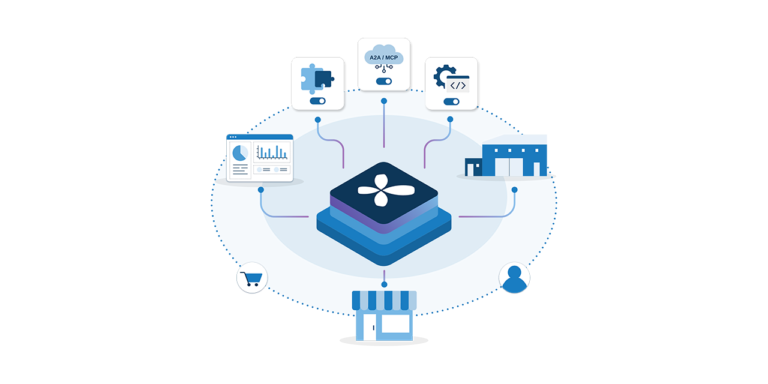
RELEX Open gives retailers and manufacturers three ways to chart their own course with AI: deploy validated solutions, extend the platform with new tools built on proven foundations, and orchestrate existing systems to make context-aware, explainable decisions.

QSR supply chain planning: overcoming operational friction with ingredient-level forecasting and franchise-wide visibility
Discover how connected QSR supply chain planning closes the gap between the kitchen and customer demand.