AI investment is surging, and so is the pressure on supply chain leaders to turn potential into profit.
In the next 18 months, over 90% of executives plan to invest in AI, building on the $252.3 billion already invested globally in 2024. Yet 85% of AI initiatives deliver close to zero measurable value. And of the 88% of organizations that report using AI in at least one operational function, only a third eventually scale.
Where things often go wrong is when businesses treat AI as a technology decision rather than a readiness one. An organization’s level of maturity determines what AI capabilities can currently deliver and, critically, where investment should go next.
The companies that consistently convert AI spending into returns are the ones that understand their current state clearly enough to plot a deliberate path toward compounding, measurable value.
Mark your place on the AI maturity map
Marking where your organization sits on the maturity curve is easiest when you have a map.
There are four distinct stages of AI adoption and company readiness. Each stage is a step-change in competency and progress, capable of delivering greater, more consistent growth.
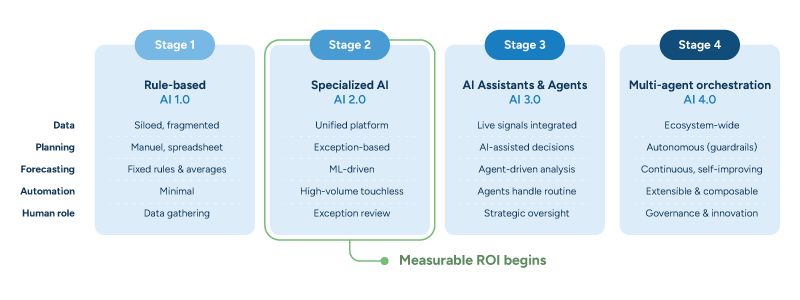
Stage 1: Rigid rule-based system
In this initial stage, planning happens despite the system rather than because of it. It depends heavily on pre-defined rules and considerable manual effort by planners reliant on spreadsheets updated through rudimentary data input processes. Data is dispersed, walled off inside impermeable ERPs and rigid legacy platforms. At the same time, crucial institutional knowledge stays locked away in planners’ minds.
Such limitations leave the organization struggling to find consensus. Operational functions work in silos, decisions contradict each other, and planners are often left to absorb volatility on their own.
Stage 2: Foundational, specialized AI
At this stage, companies implement the technological foundation that’s essential to later-stage evolution. It’s where ROI is seen for the first time. Those static, inflexible rules are replaced by ML-driven forecasting, which adapts in real-time, learns from incoming data, and improves how it deals with complexity after each cycle.
Companies in Stage 2 advance to a variety of sophisticated capabilities. Diagnostics allows them to pinpoint the root causes of inventory issues. Predictive analytics let them anticipate what’s likely to happen based on past and current data, with tools like scenario testing and demand forecasting. Finally, prescriptive tools make recommendations on the most optimal responses to emerging situations.
Here, technology doesn’t just provide insight but recommends action. While the planner still owns decision-making, the system advises them on the best move to make.
Real results from leading organizations
Blount Fine Foods (fresh prepared foods manufacturer, US)
Managing 1,500 SKUs across 10 distribution centers on spreadsheets and a legacy ERP, Blount Fine Foods connected ML-driven demand planning from RELEX to production and went live on day one.
The results included:
- 50% reduction in forecasting errors
- 35% less waste
- 20%+ compound annual growth
Stage 3: Assistive & agentic AI
AI no longer operates behind the scenes but plays a central role in planning decisions. Purpose-built AI agents carry out specific, high-value supply chain tasks: analyzing forecasts and performing root cause analysis across the supply chain.
What does that look like on the ground?
Imagine a key supplier reports a sudden large shipment delay. The AI agent immediately identifies which SKUs will be affected, calculates the availability risk, stress-tests alternative sourcing options, and then suggests the optimal response, all before the planner has even loaded up the dashboard.
GenAI assistants, steeped in domain-specific intelligence, augment planning workflows. They understand the nuances of supply chain planning in a way generic AI tools simply cannot. Natural language interaction levels the playing field of strategic analysis, putting it in the hands of everyone on the team. Through plain and simple dialogue, they can all probe forecast anomalies, scrutinize scenario outcomes, and review inventory positions, without relying on specialist teams.
Real results from leading organizations
KICKS (beauty retailer, Nordics)
KICKS was losing sales to inexplicable stockouts with limited visibility into why. Manual analysis was consuming time without producing answers. They deployed RELEX Diagnostics, which autonomously identified DC scarcity and late deliveries as the main culprits, guiding the team toward corrective action at source.
Improvements included:
- 34% reduction in lost sales value
- Late deliveries reduced from 5.2% to 3.4%
- Supplier processes redesigned based on data-driven evidence
Stage 4: Multi-agent orchestration
The most transformation-ready organizations become truly AI-native and largely autonomous. Beyond adopting AI capabilities from third parties, they develop and deploy their own through an extensible platform. This means domain experts can create custom agents, install plugins, and add automated skills designed exactly to the specifications of the business.
At this point, AI runs at the highest level of autonomy. Agents are used to their full potential — analyzing new data, adapting to market conditions as they emerge, and taking independent action across the operation. Agents do so individually, or within an interconnected multi-agent system where several work in tandem, each dedicated to and governing a particular domain within the business.
Humans focus solely on strategic oversight, creative problem-solving, and imparting their contextual experience. Their roles have evolved to human-in-the-loop: overseeing agent goals and supervising autonomous processes. They are also largely responsible for maintaining accountability, such as setting clear governance frameworks for autonomous technology.
What does this look like in practice?
Consider a situation where a manufacturer’s retail partner significantly increases their order volume with less than a week’s notice. Instead of panicked planners scrambling with escalation emails or emergency meetings, a network of agents spanning demand, production, inventory, and logistics springs to life.
Without human input, they model the incoming uplift against current capacity, re-sequence production to expedite the order, and uncover raw material constraints before they become shortages. Finished goods inventory is reallocated between DCs to ensure revised fulfilment timelines are met.
Assessment: Is your organization ready to be AI-native?
Knowing where your organization currently sits on the maturity curve is only part of the challenge. You must also understand what’s holding it back from advancing to the next stage. Once you identify which areas of the business are the bottleneck to progress, you can make the right decisions to move forward. Your organization may have implemented best-in-class ML forecasting and AI assistants, but without proper governance established, the ROI promised by Stage 3 may never materialize.
Below is an assessment that scores your organization across five key dimensions that together determine AI readiness in supply chain planning. Rate each dimension from 1 to 5: 1 being if your organization still operates with legacy systems and ways of working, 3 if you’re making notable progress toward AI-powered systems, and 5 if you’re well ahead of the AI adoption curve. Your lowest score is your transformation bottleneck, and your starting point for change.
Data foundation: How ready is your data?
1 (laggard): Your data is dispersed across ERPs, spreadsheets, and legacy systems. Your sales history is patchy and unreliable, making confident forecasting close to impossible. Each operational function has its own version of truth.
3 (reformer): You’ve consolidated essential data streams, but with only partial system integration. You can see where the quality issues are and are working to resolve them.
5 (leader): You have a unified architecture of data that connects all planning functions. The data itself is clean, and you have access to a well-structured, complete history of performance. External signals that impact market conditions are incorporated into the model and factored into forecasts.
Planning processes: Are your workflows up to scratch?
1 (laggard): Your planning is labor-intensive and largely organized around unwieldy spreadsheets. Forecasts are rebuilt from scratch every cycle, leaving little time for strategy development. In times of volatility, responses are often too slow and uncoordinated.
3 (reformer): Automation has been incorporated into some processes, but manual overrides happen regularly. You have an S&OP cadence in place but haven’t yet achieved cross-functional alignment or constructive methods of collaboration. AI exists within pockets of your planning function, but its impact on how things get done is negligible.
5 (leader): Your planning is AI-driven and exception-based. Touchless forecasting drives the vast majority of decisions across your portfolio, with planners able to fully focus on where technology is not an appropriate substitute for their judgment and experience. Every function — demand, supply, and production — is aligned to your S&OP process, and all pulling in the same direction.
Technology platforms: Has your tech stack set you up for success?
1 (laggard): The platforms your business relies on are brittle and rigid, incapable of communicating with other systems and, consequently, resistant to change. When new capabilities are needed, you struggle to meet the moment, beholden to vendor release cycles and costly custom development.
3 (reformer): You have a modern platform in place, but extensibility is still limited. While you can set business rules, tweak workflows, and connect with a defined number of approved integrations, you’re still unable to deploy custom capabilities or connect your broader tech stack to external systems without constraint. What you can and cannot do in terms of transformation still largely depends on what vendors are willing to accommodate.
5 (leader): Your platform is both extensible and composable, meaning it is built from separate, modular components. This includes planning functions, connectors and plugins, adaptive business rules, and task-driven AI agents, which can be incorporated without overhauling the whole system. Your supply chain planners can build AI capabilities and set skills for automation as and when the business needs them.
People and change leadership: Will your culture embrace transformation?
1 (laggard): New AI initiatives are launched without a champion in senior leadership to drive momentum, while roles have not adapted to the new environment that requires innovation and rapid iteration. There is a company-wide attitude that the deployment of AI is the responsibility of IT, rather than a business-wide priority. Nobody owns outcomes or is accountable for project performance, making AI a hot potato in the organization.
3 (reformer): Internal sponsors are often assigned to new launches, and many departments have discovered the role they play in driving the initiative forward. Some roles have already adapted to the new AI-assisted planning environment. Yet the bigger picture of the transition is uneven. While there are AI-curious team members who engage where they can, others resist the change. Ownership of outcomes is clearer than it has been, but a question mark still sits over accountability, and there are lingering doubts about organization-wide readiness.
5 (leader): Every function involved in AI initiatives in your business has a clearly defined area of ownership and accountability for outcomes. Initiatives never launch unless there is a confirmed senior leader willing to put their name to it — personally accountable for AI performance and the promised ROI. Roles have been radically changed. Your planners no longer build forecasts. Instead, they manage exceptions, coach AI models, and analyze outcomes. KPIs have been revised and your people upskilled to match.
Governance: Do you have the appropriate guardrails and procedures in place?
1 (laggard): Your organization doesn’t have a formal governance framework for AI initiatives. Decisions are made in the spur of the moment, untraceable and inconsistently applied. You have no established process for reviewing AI outputs or challenging system reasoning. Often, your teams launch AI capabilities on intuition alone. Trust in AI-generated recommendations is in short supply, with planners overriding the system or eventually lobbying to drop it entirely.
3 (reformer): Your organization has a governance framework, but it’s applied haphazardly, leading to knee-jerk reactions when anomalies occur. Reviews of AI outputs are ad hoc, occurring only when something goes wrong rather than as part of a structured routine. KPIs are tracked, but there is no agreement yet on how or when they should be acted on. The degree of independence your AI systems are permitted to exercise was initially defined but has not been revisited much since.
5 (leader): Your organization maintains structured governance reviews that include reviewing outputs, regularly assessing KPIs against pre-AI performance, and routing decisions to humans when they fall outside AI’s ability to make judgments. You are comfortable with AI systems being highly autonomous, as there are sufficient guardrails, and you know exactly how to rein them in if necessary. Every decision made by AI is auditable, explainable, and reversible. Governance is not something that requires enforcement, but simply how innovation is done.
The three most common failure patterns (and the companies doing things right)
Having completed the maturity assessment, you may now have a better idea of where your organization sits on the path to becoming AI-native. Equally important, though, is understanding what can stymie your progress between stages. The most debilitating obstacles are almost always behavioral, and they follow recognizable patterns. There are three that stand out above the rest.
1. Starting with the technology before defining the problem
Caught in the allure of a shiny new AI capability, supply chain companies fall into the trap of deploying before they have even defined what they are trying to solve. Not enough effort is put into articulating the actual business problem — one that, if resolved, would make a measurable difference to the P&L.
Every AI initiative should start with the highest-value and most feasible use case, where the business impact is clear and feedback loops are fast enough to prove it quickly.
Doing it right — Rastelli Foods: Defining the problem, then deploying the tech
When Rastelli adopted ML-driven forecasting from RELEX, they had a specific use case in mind. Before comparing vendors, they identified that their forecasting process was inadequate, and every technology deployment discussion revolved around solving it. They focused on finding a solution to help them overcome this problem, which turned out to be highly accurate forecasting used as a single source of truth for production and inventory teams. Rastelli’s teams now meet weekly and base every planning meeting discussion on AI-driven forecasts. The impact on business and operational performance was soon evident:
- $3.5M saved in the first year from inventory visibility alone
- 85% forecast accuracy achieved
2. Bypassing the foundation in pursuit of the cutting edge
Like opening a commercial kitchen and hiring a world-class chef before buying the essential ingredients, some supply chain leaders try leaping straight to the latest technology before building the specialized AI foundation those capabilities depend on.
The boundless potential of AI agents and autonomous planning can be intoxicating enough to tempt some supply chain leaders to skip the necessary groundwork entirely. But consolidating data into a unified platform and replacing static rules with adaptive, learning-based models is precisely what makes those more advanced capabilities so impressive in the first place.
Doing it right — Bünting Group: Setting the proper foundations for automation
Bünting Group, a German family grocery retailer, had a clear goal: automating the replenishment of its fresh fruit and vegetable categories. But before landing on any automated solution, they made the conscious decision to get their data infrastructure in order first. To do this, they used True Inventory, a predictive inventory capability from RELEX, which detected stock discrepancies, corrected balance data, and prompted inventory checks.
Only once the data foundation was solid did Bünting Group place automated replenishment on top. But it was worth the wait. Stores went from daily manual ordering to exception-based inventory counting, with the large majority of the process now automated.
- +2% increase in sales value vs reference stores
- -43% reduction in balance errors on inventory count days
- Expansion earned to centralized ordering across all fresh categories
3. Treating AI as a technology upgrade rather than an organizational shift
This is one of the more pernicious failure patterns. Supply chain organizations can do the hard work of selecting an AI-powered capability for the right reasons before carefully and thoughtfully deploying it throughout the business. The technology may perform just as intended. Yet, soon after, the transformation splutters to a standstill.
Why does this happen? Usually because planners have not been given the time or involved enough to trust the new systems and fully incorporate them into their workflows. The misalignment between technology adoption and organizational preparation is common, with 84% of organizations yet to redesign roles around AI. Employee remits, KPIs, and ways of working remain the same long after deployment.
The organizational structure for AI adoption in the supply chain
All of these failure patterns point to the same single origin: inadequate organizational structures. They are incapable of making AI into real business assets, driving efficiency, and, ultimately, accelerating growth.
This calls for you to assess your organizational structure and ensure it is designed for AI. You should consider whether you have the right roles in place, and if they are in place, whether they are held by people with the right mindset and accountability to create change. Enterprises that are serious about becoming AI-native rebuild teams with four key transformation-focused roles, assigned to individuals instead of whole departments.
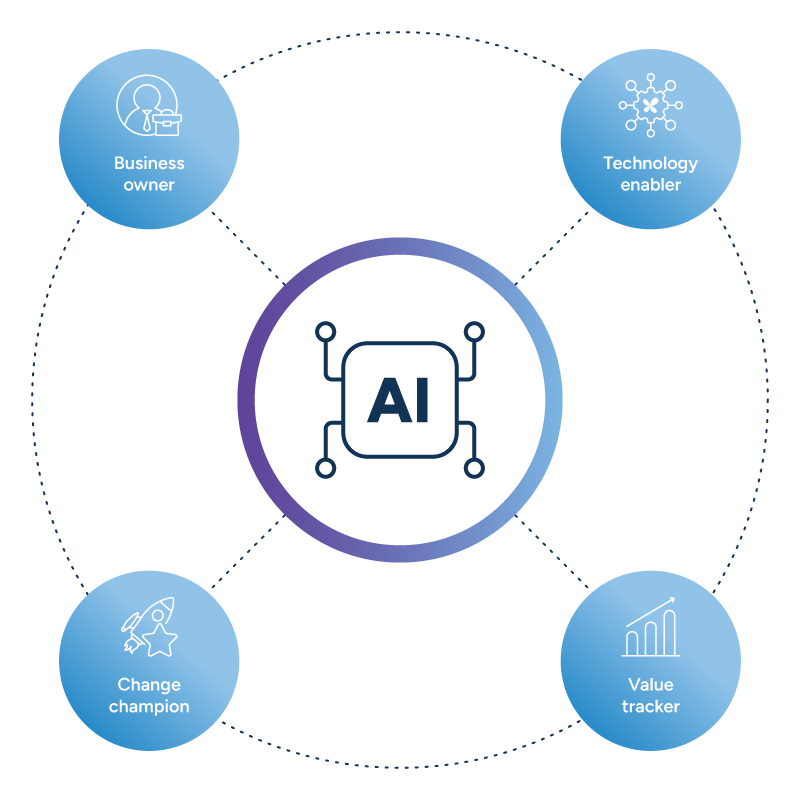
The business owner is accountable for the outcome of the initiative in its entirety. They define the problem that needs solving, set the success criteria, identify and deploy the right AI capability, own the associated KPIs, and answer to any movement in them, positive or negative. The business owner is accountability incarnate, taking corrective action when necessary and preventing initiatives from drifting or being deprioritized.
The technology enabler owns everything that keeps the AI capability and the systems it runs on working reliably in production — whether that’s forecasts, generated recommendations, or autonomous agents. They are also responsible for the data infrastructure AI depends on, overseeing data streams as well as external and internal integrations. This role prevents technical failures and data quality issues from clogging up the AI initiative.
The change champion ensures the potential of AI is fully realized in how the business works day to day. They are responsible for translating technical possibility into tangible process transformation: redesigning workflows, retraining planners, and cultivating a culture that’s more receptive to new AI initiatives. On the ground, this involves preventing planners from reverting to old habits or defaulting to manual workarounds when autonomous systems are available.
The value tracker has an overarching goal of showing how and where AI investments are yielding financial returns. They link improvements in forecast accuracy, inventory reductions, and waste reduction to concrete financial results. The value tracker ensures that every AI initiative is financially validated — backing ROI with evidence — keeping the business case for scaling strong. They are the bridge between operational KPIs and P&L impact.
If any of these roles are left unassigned or absorbed into someone’s existing job description without explicit accountability, transformation will likely not succeed. These roles must be filled by the right people, with the right level and scope of accountability — each with equal amounts of skin in the game.
The 30/90/12-month supply chain transformation roadmap
The maturity map has revealed what’s possible, and the assessment has shown you where your organization currently is. But now, you need a practical sequence of steps toward becoming an AI-native business. With three distinct phases, straightforward actions, and a checkpoint that indicates when the conditions for the next phase are met, this roadmap is your blueprint for making that happen.
| 30 days | 90 days | 12 months | |
| Phase | Assess and anchor | Prove value in production | Scale and extend |
| Focus | Establish the problem and define success. | Go live on your highest-impact use case and prove value. | Scale what capabilities work, then advance to a later stage in AI adoption. |
| Actions | – Place yourself on the AI maturity map and take the assessment at the start of this guide. – Identify 2–3 use cases with the clearest ROI. – Set a baseline for your KPIs (inventory days/ forecast accuracy/OTIF-OSA). – Assign someone as an official transformation owner with authority. – Evaluate your platform: can it support Stage 2 on the maturity map and beyond? | – Implement specialized AI for your most critical use case. – Launch as soon as you have a minimum viable data foundation. – Track KPIs weekly against the baselines you set. – Set wider business ownership and enforce a weekly operating cadence. – Build trust with planners via explainability, transparency, and human-in-the-loop workflows. | – Scale proven capabilities across sites, categories, and use cases. – Connect demand, supply, and production planning. – Introduce AI-assisted workflows with natural language systems and root cause analysis. – Explore how agentic capabilities can handle high-frequency tasks in the near future. – Revisit the maturity model to see if you’re at Stage 2 and progressing to Stage 3. |
| Checkpoint | You have chosen a transformation owner, defined your use cases, and set baselines for project KPIs. | AI is running effectively in your operational processes, ROI is tracked weekly, and planner trust is developing. | You have proved value at Stage 2 and have a clear path to Stage 3. |
Moving up the AI maturity curve is possible if you’re willing to invest the time, resources, and effort to judiciously incorporate capabilities. It’s about understanding the route you are taking in your transformation, not about being the quickest. That means starting with the problem, laying the foundations, and letting results determine how you move forward.
The AI potential that lies ahead
As you follow the frameworks and practices above, working through the stages with your team, you may be wondering what an AI-native supply chain operation, with networks of AI agents, looks like from function to function.
In manufacturing
S&OP: Agents pre-build scenarios, flagging trade-offs, and identify the decisions that require human judgment.
Production scheduling: Finite schedules are built around existing constraints, sequenced to minimize changeovers, and recalibrated as disruptions happen.
Inventory optimization: Safety stocks and inventory order positions are adjusted daily based on real-time demand signals, lead time changes, and capacity.
Logistics and fulfilment: Disruptions are detected immediately; shipments rerouted and warehouse allocation continuously updated.
Sourcing and procurement: Supplier risk is monitored on an ongoing basis. Exceptions are escalated to the right people automatically. Routine procurement is executed within pre-approved parameters, so teams can focus instead on relationships and negotiations.
For retail and grocery
Demand forecasting & replenishment: Touchless forecasts are generated across the vast majority of the range. Planners focus exclusively on the exceptions that require contextual experience.
Fresh and perishables: Allocation is optimized with granularity, by store and by day, and includes an array of critical variables like shelf life, local demand patterns, and weather. Waste is reduced without compromising availability.
Promotion planning: Automatically predicts promotional uplift, halo effects, and cannibalization for every campaign. Stock is allocated to precisely meet the demand for every upcoming promotion. Performance insights are then fed back before the next campaign launches.
Space and assortment: Continuous cluster-level testing for assortments. Underperformers are instantly flagged, and planogram adjusted based on sales velocity per store.
Store operations: Detects phantom stock and prioritizes inventory counts according to their impact on the business. Store teams shift focus to customer experience.
Regardless of your current readiness or maturity stage, AI innovations will inevitably reshape your organizational processes. What you need to be asking is whether you have the necessary foundations and structures to enter that AI-driven future as an innovative supply chain leader.
Want to discuss how RELEX can help you realize the ROI from your AI initiatives?
Written by