Safety stock: What it is, how to calculate it, and how to optimize it
Jul 16, 2026 • 10 min
Safety stock is the buffer inventory businesses hold to protect against unexpected demand spikes and supply delays, so how much should you be keeping at any given time?
Smart safety stock management requires more than traditional forecasting and manual adjustments because factors, like weather, can disrupt seasonal patterns or social media trends can spike demand overnight. Without modern tools, retailers face a lose-lose decision: Sink capital into excess inventory that may never be bought or watch sales walk out the door to competitors during stockouts.
So, while it’s important to maintain some safety stock, exactly how much is needed for each product is an increasingly complex question to answer.
The RELEX State of the Supply Chain report found that the most popular approach to maintaining good safety stock levels was to optimize backstock with technology.
Modern supply chains are frequently disrupted while customer demand changes rapidly. Retailers are finding that the optimal safety stock for each product is always changing, and it’s important to continually refine safety stock carefully to achieve higher service levels and maintain financial health. This strategic shift transforms inventory planning from an operational liability to a competitive advantage.
What is safety stock?
Safety stock is the extra inventory businesses maintain to protect against unexpected supply and demand fluctuations.
Take a national grocery retailer managing fresh food across 800 stores. Historical data shows each store moves roughly 1,000 units of strawberries weekly, with supplier deliveries arriving every three days. But what happens when a heat wave drives unexpected demand for summer fruits? Or when weather delays impact their distribution network?
Without adequate safety stock across its network, the grocery store chain risks empty produce sections during peak shopping hours and disappointed customers taking their grocery lists to competitors.
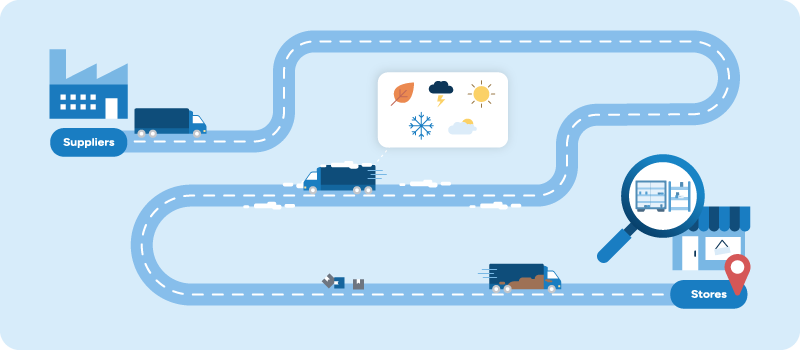
Safety stock helps companies:
- Handle surprise demand spikes without breaking a sweat.
- Keep customers happy when suppliers hit unexpected delays.
- Maintain smooth operations even when the market throws curveballs.
Keeping the right amount of safety stock requires understanding unique business patterns, supplier reliability, and customer expectations. Managing inventory without keeping too little or too much stock involves analyzing vast amounts of sales data, understanding supply chain quirks, and planning reasonable contingencies.
Striking that perfect balance between holding enough inventory and keeping carrying costs in check is difficult, and many retailers find it more complex than they expected.
Why is safety stock important?
Safety stock directly impacts a company’s bottom line by protecting revenue and managing costs. Too little safety stock forces retailers into expensive emergency replenishment orders and risks permanent customer loss to competitors. Too much safety stock bloats carrying costs, consumes valuable warehouse space, and increases the risk of obsolescence — especially for seasonal items.
There are many benefits to properly maintained safety stock:
- Revenue protection: Guard against lost sales during demand spikes or supply disruptions, keeping customers satisfied and revenue flowing.
- Operational stability: Prevent costly rush orders and emergency shipping fees when suppliers face delays.
- Market responsiveness: Let companies capitalize on unexpected sales opportunities without scrambling to secure inventory.
- Brand protection: Maintain customer trust by consistently meeting their expectations for product availability.
Optimizing safety stock levels requires analyzing historical patterns, monitoring performance, and adjusting dynamically.
The real challenge lies in finding the right balance for a specific operation. Leading retailers combine sophisticated demand forecasting with a deep understanding of supply chain dynamics.

How to calculate safety stock
A basic, traditional safety stock formula often looks something like this:
Safety Stock = (Maximum Daily Usage – Average Daily Usage) x Lead Time
If your store typically sells 100 units per day but sees sales spike occasionally to 150 units, and your supplier takes 5 days to deliver, you’d calculate:
(150 – 100) x 5 = 250 Units of Safety Stock
But the basic safety stock formula is rarely effective enough today. That’s the forecast integration and desired service levels (in the form of Z-scores) come in.
A basic forecast-integrated formula might look like:
Safety Stock = Z-Score x √(Lead Time x Forecast Variance)
A Z-score translates your desired service level into a numerical value that can be used in calculations. These values come from statistical tables that map service levels to standard Z-scores:
- 90% service level = 1.28
- 95% service level = 1.645
- 97% service level = 1.88
- 99% service level = 2.326
Retailers don’t need to calculate these Z-scores themselves, as they’re standard statistical values used across industries. Instead, planners simply specify their desired service level, like 95% or 99%. Modern planning software automatically translates these percentages into the correct Z-scores, eliminating the need for manual lookups or conversions.
How to choose the right safety stock formula
Whether you want to start with the basic formula or the Z-score formula depends on how detailed you want to get. If you’re using an entirely manual approach to calculating your safety stock needs, you might start with the basic, traditional formula. But the basic formula won’t cut it for most retailers.
The basic forecast-integrated formula outlined above packs more punch than traditional methods because it combines two critical factors:
- Forecast variance (for measuring how much your actual sales typically deviate from predictions).
- Lead times (for how long it takes to get more inventory).
The mathematical combination of these factors yields a safety stock number that’s more likely to match future demand.
Historical data alone doesn’t tell the full story, but forecast variance (i.e., how much your actual sales typically differ from your forecasts) can help fill in the gaps. If your forecast is typically off by 20-30 units each day, that’s crucial information for setting safety stock levels.
At a minimum, most retailers need to use a Z-score formula to incorporate desired service levels into the calculations.
Of course, the RELEX platform calculations go deeper than both the traditional formula or the forecast-integrated formula, incorporating machine learning algorithms and real-time data analysis. These systems process thousands of variables simultaneously to optimize safety stock levels across your entire network.
RELEX platform calculations go deeper than the Z-score formula, incorporating machine learning algorithms and real-time data analysis.
Many retailers still rely on historical data, looking backward to move forward. They analyze past sales patterns, calculate average demand, and set safety stock levels accordingly.
The problem with relying only on historical data, lead times, and service levels is that past performance doesn’t guarantee future results. If yesterday’s patterns don’t match tomorrow’s reality, then historical information isn’t enough.
What if that spike to 150 units happened during a promotion that won’t repeat? Or what if a business is entering its peak season when demand typically doubles?
Retailers who want to accurately forecast their inventory needs must move to a more dynamic approach that integrates forecasting data to predict and prepare for future demand patterns.
A dynamic approach considers factors like:
- Seasonal demand shifts before they happen.
- Promotional impacts across your network.
- Supply chain disruption risks.
- Market trend predictions.
- Supplier closures.
- Product terminations.
What is dynamic safety stock?
Dynamic safety stock takes the guesswork out of inventory optmization and uses complex data to make more sophisticated stocking decisions.
ML-driven approach vs. static formulas
While static formulas (i.e., traditional inventory approaches) only consider past demand spikes when predicting stock requirements, machine learning can learn automatically and improve stock recommendations by recognizing patterns in data. Because machine learning can consider vast quantities of data (vastly more than any human could review in a short period of time), it can process large data sets from a wide variety of sources quickly.
The RELEX approach
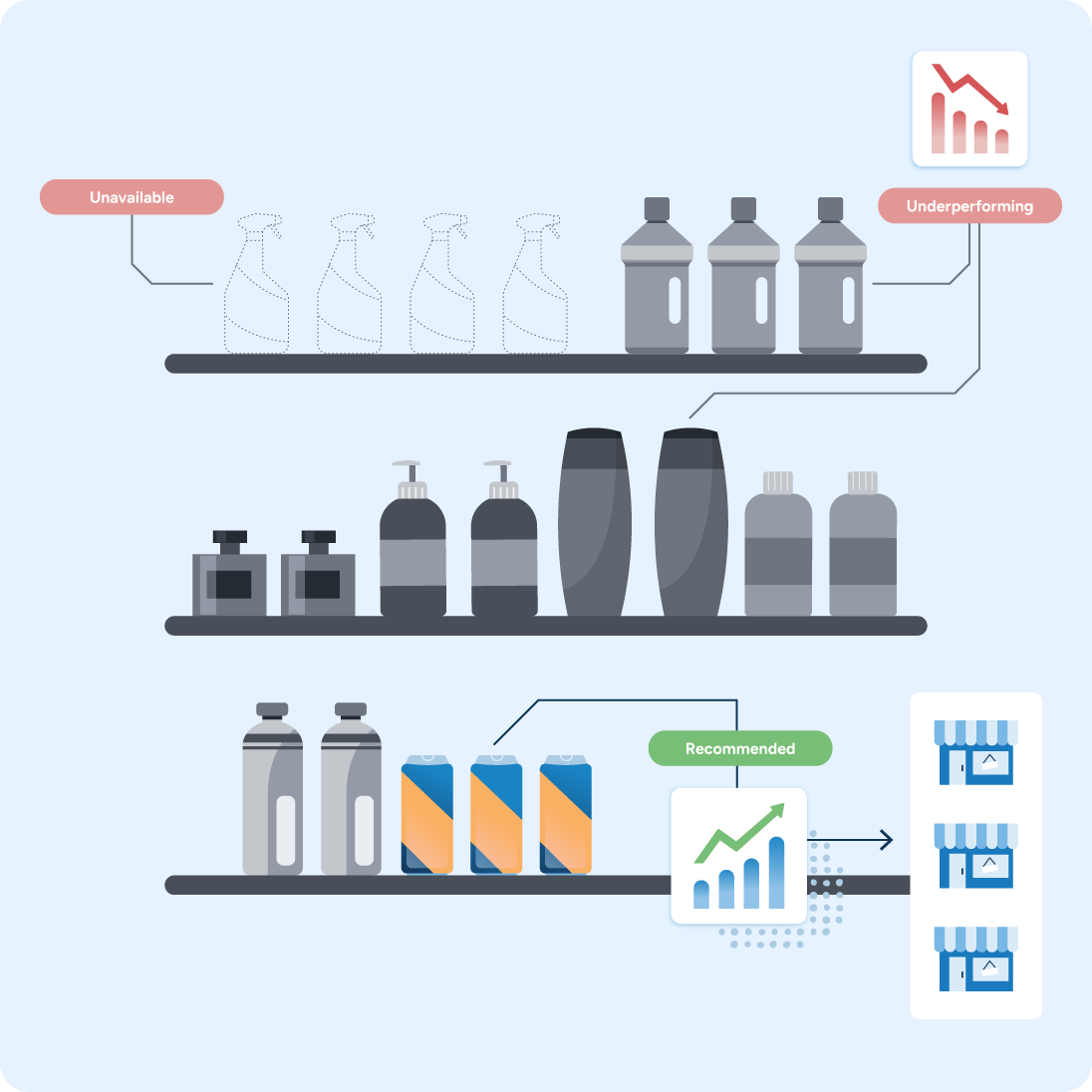
The RELEX platform continuously updates safety stock levels based on a variety of factors, including demand, supply chain conditions, upcoming promotions, weather, local events, and other external factors.
The level of sophistication is what sets the RELEX platform apart, considering risks, such as sales cannibalization, that other formulas can’t factor in.
How to optimize safety stock with software
Much like paper ledgers and wall-mounted inventory boards before them, spreadsheets and manual calculations belong in the past. Modern businesses need modern solutions. The RELEX platform makes safety stock calculations easier while transforming them into a strategic advantage, with features like:
1. Smart, AI/ML-driven forecasting
Traditional forecasting feels like throwing darts blindfolded, but software can remove that randomness, analyzing everything from seasonal trends to customer buying patterns to create predictions that actually match reality. A truly comprehensive solution will keep learning and improving, catching subtle patterns that human analysts might miss.
RELEX analyzes everything from seasonal trends to customer buying patterns to create predictions that actually match reality.
Use machine learning (ML) and AI to create smarter forecasts. ML algorithms dig deep into past performance data, uncovering hidden patterns and relationships. This goes beyond better predictions, enabling teams to understand why certain patterns emerge. The system grows smarter over time, continuously refining its predictions based on new data and outcomes.
READ MORE: The complete guide to machine learning in demand forecasting
2. Real-time supplier performance tracking
Track supplier performance in real time, monitoring factors like delivery times and reliability patterns. With continuous monitoring, teams receive early warnings of potential delays, allowing them to adjust safety stock before problems occur and account for lead-time variability from less reliable suppliers.
3. Smart optimization
Gone are the days of choosing between stockouts and excess inventory. Advanced inventory optimization models juggle multiple variables simultaneously. For instance, a system like RELEX factors in:
- holding costs.
- service levels.
- spoilage and expiration dates.
- lead times.
- demand patterns.
- product units (like batches or pallets).
Find the sweet spot where inventory costs stay low while service levels remain high. A comprehensive platform adapts continuously as conditions change, maintaining optimal levels without constant manual adjustments.
4. Time-saving automation
Go beyond automating calculation to amplify human expertise. Automation handles the number-crunching, freeing supply chain professionals to focus on strategic decisions. Teams spend less time wrestling with spreadsheets and more time driving business growth. This combination of artificial and human intelligence creates results that could not be achieved alone.
How ICA Sweden optimized safety stock with RELEX
Sweden’s leading grocer faced a complex challenge in managing inventory effectively across 1,300 independently operated stores. ICA Sweden’s manual systems couldn’t handle the complexity of coordinating safety stock levels across this vast network. Seasonal demand swings created particular headaches, with stores struggling to maintain appropriate stock levels during promotional periods and holiday peaks.
Some stores carried excess inventory while others faced stockouts, a classic safety stock dilemma.
RELEX transformed ICA Sweden’s safety stock management with AI-driven forecasting to predict demand patterns store by store, automatically adjusting safety stock levels based on each location’s unique needs.
Dynamic safety stock calculations adapted to seasonal variations and promotional impacts in real time, particularly crucial for ICA Sweden’s extensive fresh produce selection. The RELEX platform automatically adjusted inventory levels for seasonal items, ensuring optimal stock even during the peak summer demand. Combined with the system’s ability to process vast amounts of data, this intelligent product handling eliminated the manual burden on store managers while dramatically improving forecast accuracy.
“Not only has our collaboration produced tangible results, such as the 32% decrease in safety stock inventory, but working with RELEX has been easy and innovative.”
Andreas Persson, Head of Replenishment, ICA Sweden
The results transformed ICA Sweden’s operations:
- Safety stock inventory dropped by 32%.
- Forecast accuracy jumped by 6.69 percentage points.
- Capital previously tied up in excess inventory became available for strategic investments.
These improvements translated into tangible business benefits. Lower inventory levels reduced carrying costs, while more accurate forecasting meant fewer stockouts and happier customers. The freed-up capital could now support growth initiatives instead of gathering dust on warehouse shelves.
Master safety stock with RELEX
Recognizing the limitations of manual safety stock management marks only the first step. Companies must transform this awareness into action, moving beyond outdated tools that drain resources and limit growth potential.
Companies that embrace modern safety stock management now position themselves to navigate market complexity, reduce costs, minimize waste, and drive sustainable growth. Those that don’t risk falling behind competitors who have already made the shift.
Learn more about how RELEX can optimize stock levels.
Safety stock FAQs
What is safety stock?
Safety stock is the excess inventory retailers keep to prevent stockouts when demand spikes or disruptions impact suppliers.
What are the challenges in setting safety stock levels?
Setting safety stock levels means accounting for compounding variables, like demand variability, lead time variability, and supplier reliability. Slow movers, seasonal items, and high-margin SKUs all carry different risk profiles, and applying differentiated logic requires clean data many retailers don’t have. Without a way to account for that, many retailers end up over-buffered in the wrong places and under-protected where it matters.
How do you calculate safety stock?
A common approach to calculating safety stock involves multiplying a Z-score (representing your target service level) by the square root of lead time multiplied by forecast variance. RELEX goes beyond Z-scores to account for promotional impacts, seasonality, and supplier reliability simultaneously.
What is dynamic safety stock?
Dynamic safety stock adjusts automatically as conditions change, rather than holding a fixed buffer based on historical data. Instead of recalculating manually when demand patterns shift or a supplier becomes unreliable, a dynamic system recalibrates based on current signals.
What is the difference between safety stock and reorder point?
Your reorder point is the inventory level that triggers a new order; safety stock is the floor beneath that point that you don’t plan to touch under normal conditions. The reorder point accounts for unexpected demand during lead time, and safety stock covers the unexpected.
What Z-score should I use for safety stock?
Deciding which Z-score to use depends on your target service level. Higher service levels mean larger safety stock buffers, so the right Z-score is ultimately a business decision that weighs stockout risk carrying costs.
Service levels and their corresponding standard Z-scores:
- 90% service level = 1.28
- 95% service level = 1.645
- 97% service level = 1.88
- 99% service level = 2.326
A basic forecast-integrated formula with a Z-score might look like:
Safety Stock = Z-Score x √(Lead Time x Forecast Variance)
What is a good safety stock level?
There’s no universal ideal safety stock level that works for every business. The right safety stock level depends on your demand variability, supplier lead times, and service level targets. A good safety is one that protects against realistic disruption scenarios without consistently tying up capital in inventory that rarely moves.
Written by

Related Articles

How to build a consumer decision tree: why the best CDTs start with shopper behavior, not supply logic
See why CDTs based on shopper behavior beat vendor- and workshop-built trees, and how RELEX CDT Builder applies the method.

Agentic AI in manufacturing supply chain planning
Learn why most manufacturers need both general and tailored agents, meet the five core RELEX agents for manufacturing, and see how RELEX Open lets you deploy, connect, and extend AI across your supply chain planning.

Case Study: Grupo Vinoteca
See how Grupo Vinoteca, a Mexican wine and spirits distributor, reduced lost sales by 34.7%, cut store replenishment time by around 50%, and saved on inventory with RELEX's unified planning.