Retailers are swapping safety stock for smarter inventory
May 27, 2026 • 6 min
Retailers spent the past few years building buffers against disruption. Now those buffers are proving expensive to maintain and difficult to scale.
Instead of stockpiling inventory or continuously expanding supplier networks, many retailers are investing in forecasting, analytics, and closer supplier coordination to maintain availability while carrying less excess stock.
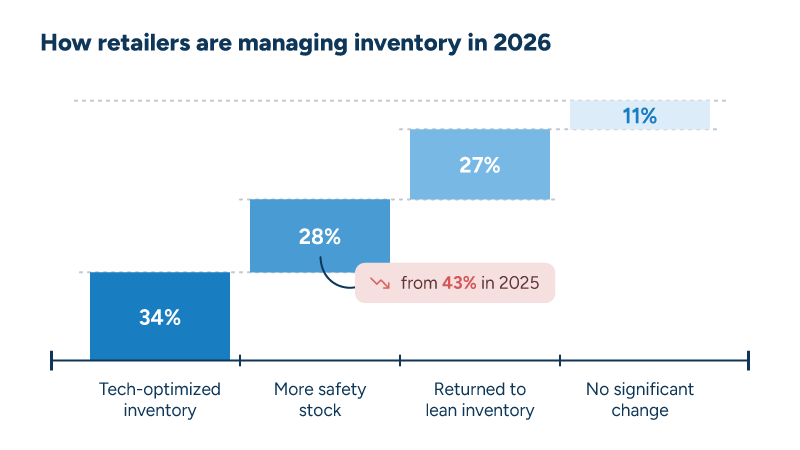
Our annual State of the Supply Chain report found that holding extra safety stock (as a resilience strategy) fell from 43% to 28% in just one year. Meanwhile, 34% of respondents are optimizing inventory with technology. Retailers are moving away from general buffer inventory towards precision planning.
Two distinct forces are driving the reversal away from keeping excess stock on hand: economic forces and technological innovation.
The macroeconomic environment has changed
Rising interest rates and inflation have made inventory genuinely costly again after years of near-zero carrying costs.
When money was cheap, holding excess stock was easy to justify as insurance. That calculus has changed. Post-pandemic demand patterns have been unusually erratic, which exposed a weakness in static safety stock models. Buffers sized for “normal” variability kept getting overwhelmed or made redundant. And the bullwhip effect became very visible during this period, making the cost of miscalibrated safety stock tangible in a way it hadn’t been before.
Many retailers came out of 2021–2022 with massive excess inventory after over-ordering during supply crunches. That experience made the cost of holding too much stock very real (and very recent) in leadership’s memory. It shifted the internal conversation from “what if we run out?” to “what if we’re stuck with it?” Inflation squeezed margins from the cost side while consumers became more price-sensitive, making efficiency gains in inventory a strategic priority rather than a nice-to-have.
Margins are tight, and retailers looking for efficiency gains are increasingly finding that smarter inventory management is one of the highest-ROI levers available.

The technology available to retailers has improved
According to the State of the Supply Chain, 34% of retailers are now using technology to optimize inventory, overtaking the 28% still solely relying on safety stock buffers. This shift to technological solutions reflects a genuine change regarding where the industry sees the best returns.
Retailers now have much better tools to optimize stock levels accurately, which means they no longer need to compensate for demand forecasting uncertainty with large buffers. The technology itself has matured to the point where it can model not just demand variability but the full cost picture. We now have the ability to simultaneously optimize across carrying costs, freshness for perishables, and lost sales from stockouts. That kind of holistic optimization simply wasn’t accessible at scale before.
Crucially, modern tools can now optimize safety stock at the individual SKU and day level while concurrently managing category-level targets, making it possible to dynamically determine when and where safety stock is actually needed. This means retailers aren’t choosing between precision and efficiency; they get both. The drop from 43% to 28% of companies using safety stock as a resilience strategy reflects both economic and technological forces working together.
Safety stock is fundamentally a tool for managing uncertainty. You hold more when you can’t predict demand or supply accurately. What’s changed is that the uncertainty itself has decreased, thanks to better forecasting, improved real-time visibility into actual stock levels across the supply chain, and more sophisticated demand sensing.
Uncertainty is not static, but dynamic. The modern tools have made it possible to adjust safety stocks (and decisions) based on varying uncertainty, so retailers have more buffer when needed and less when they don’t.
When companies can see more clearly what’s happening and model it more accurately, retailers can have exactly what they need, when they need it.

What counts as “safety stock”
Safety stock is inventory held above expected demand to absorb uncertainty, but what counts as “enough” is changing.
The older model treated safety stock as a static number: a fixed buffer per SKU, set periodically and adjusted manually. The problem is that this approach buffers against the worst-case scenario for each product independently. A retailer with 400 SKUs in a category is effectively insuring each one separately, even though demand shifts within a category tend to move together. If consumers trade down from one SKU to another within the same group, a SKU-level buffer can’t absorb that; it just sits on the wrong product.
Managing safety stock at the category or group level changes the math. Instead of each SKU carrying its own worst-case insurance, a shared buffer covers the group. Because the risks are correlated, the total buffer needed is lower than the sum of individual SKU buffers would be (and the protection is actually better calibrated to how demand behaves in practice).
Dynamic safety stock takes this further. Rather than one fixed number per SKU or category, the buffer adjusts continuously based on actual demand variability, forecast accuracy, and lead time risk. You carry more protection when uncertainty is high and less when it isn’t. The result is the same or better service levels with less capital tied up in inventory that may never move.
Add rising carrying costs to the mix, and the case for moving away from blanket SKU-level safety stock becomes very compelling.
Where retail goes from here
It’s unlikely that we’ll see a full pendulum swing back to blanket safety stock increases. The efficiency gains from technology-driven optimization are too tangible to abandon. But the current market is volatile, with ongoing trade policy uncertainty and geopolitical pressures. Expect to see targeted buffer increases in specific high-risk or strategically critical product categories.
The more interesting trend, though, is the move toward deeper supplier collaboration powered by AI. Access to more accurate, real-time information across the supply chain, from supplier capacity to in-store stock levels, has the potential to unlock planning and optimization benefits that go well beyond what any single company can achieve by holding more inventory.
The retailers investing in those collaborative, data-driven relationships will be better positioned than those who simply choose between buffers and lean inventory.
Adaptability is the key to future retail success
The common thread across all of this is adaptability. Markets are shifting faster than ever, and uncertainty isn’t going away; it’s becoming the baseline condition. In that environment, the strategic advantage goes to retailers who can move and respond quickly, not those who’ve placed a single big bet on one approach to resilience.
The choice of technology matters enormously, for the optimization it delivers today, and for the agility it gives retailers to adapt as conditions change tomorrow.
Get insights into how your competitors are adapting to changing conditions. The 2026 RELEX State of the Supply Chain report surveyed over 500 supply chain leaders across retail, wholesale, and manufacturing to find out how organizations are responding to disruption, where strategies are shifting, and where the gaps remain.
Written by

Related Articles

How to build a consumer decision tree: why the best CDTs start with shopper behavior, not supply logic
See why CDTs based on shopper behavior beat vendor- and workshop-built trees, and how RELEX CDT Builder applies the method.

Agentic AI in manufacturing supply chain planning
Learn why most manufacturers need both general and tailored agents, meet the five core RELEX agents for manufacturing, and see how RELEX Open lets you deploy, connect, and extend AI across your supply chain planning.

Case Study: Grupo Vinoteca
See how Grupo Vinoteca, a Mexican wine and spirits distributor, reduced lost sales by 34.7%, cut store replenishment time by around 50%, and saved on inventory with RELEX's unified planning.