How to achieve ROI from grocery optimization
Aug 3, 2026 • 8 min
Grocery retailers spent the last decade buying systems, like ERP (Enterprise Resource Planning) systems, POS (Point of Sale) systems, and e-commerce solutions, yet the ROI still hasn’t shown up.
They help stores function, but they don’t usually offer optimization capabilities. Transactional investments are primarily made to mitigate risk rather than achieve high ROI. The problem isn’t a lack of technology, it’s that the value retailers have already paid for has yet to activate.
While 62% of grocery retailers expected to increase their technology budget in 2026, in many cases the systems and the data needed to optimize are usually already in place, retailers just have to activate the tools in the right way to see the profits. Optimization can help retailers move from keeping the lights on to improving sales, reducing waste, and offering better service.
Why transactional systems leave money on the table
Transactional systems are the backbone of grocery retail operations, encompassing a range of tools and technologies designed to handle the day-to-day activities of running retail stores, like orders, receiving, financials, employee hours. What they can’t tell teams to do is what’s next. A POS system can show grocers how many rotisserie chickens they sold on Monday, but it won’t tell them how many to cook on a Tuesday.
But grocers can build a strong foundation of transactional systems into optimized systems by leveraging advanced technologies to enhance demand forecasting, inventory management, and replenishment processes.
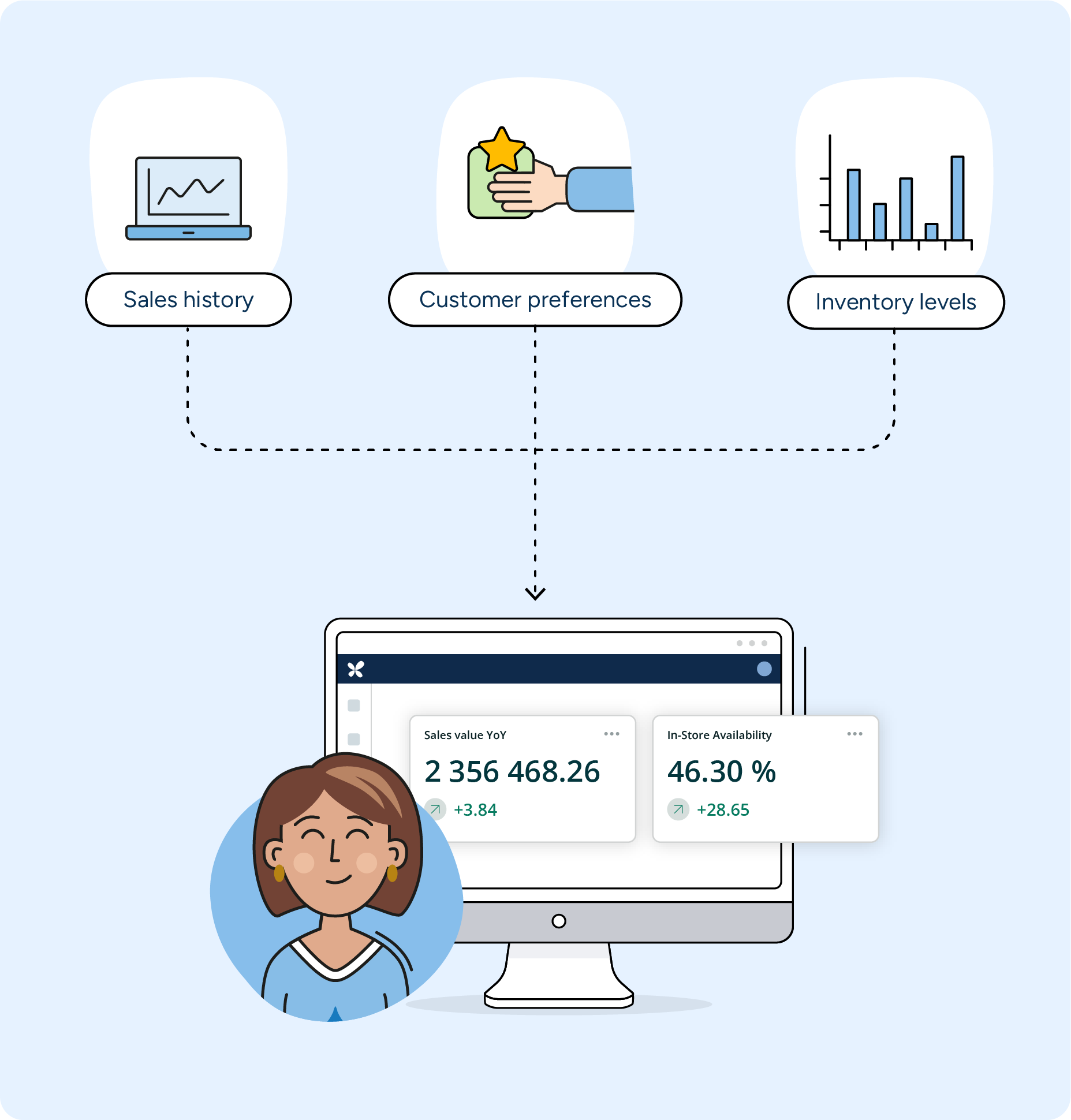
The data needed to optimize is already being generated in stores every day. In the past, it was too time-consuming to sift through all that data, because it had to be sorted and processed manually, so it sat unused. But that’s no longer the case. It’s now possible use the wealth of data collected to make smarter, data-driven decisions with the help of targeted AI and ML (machine learning).
Why grocers should start optimization with forecasting
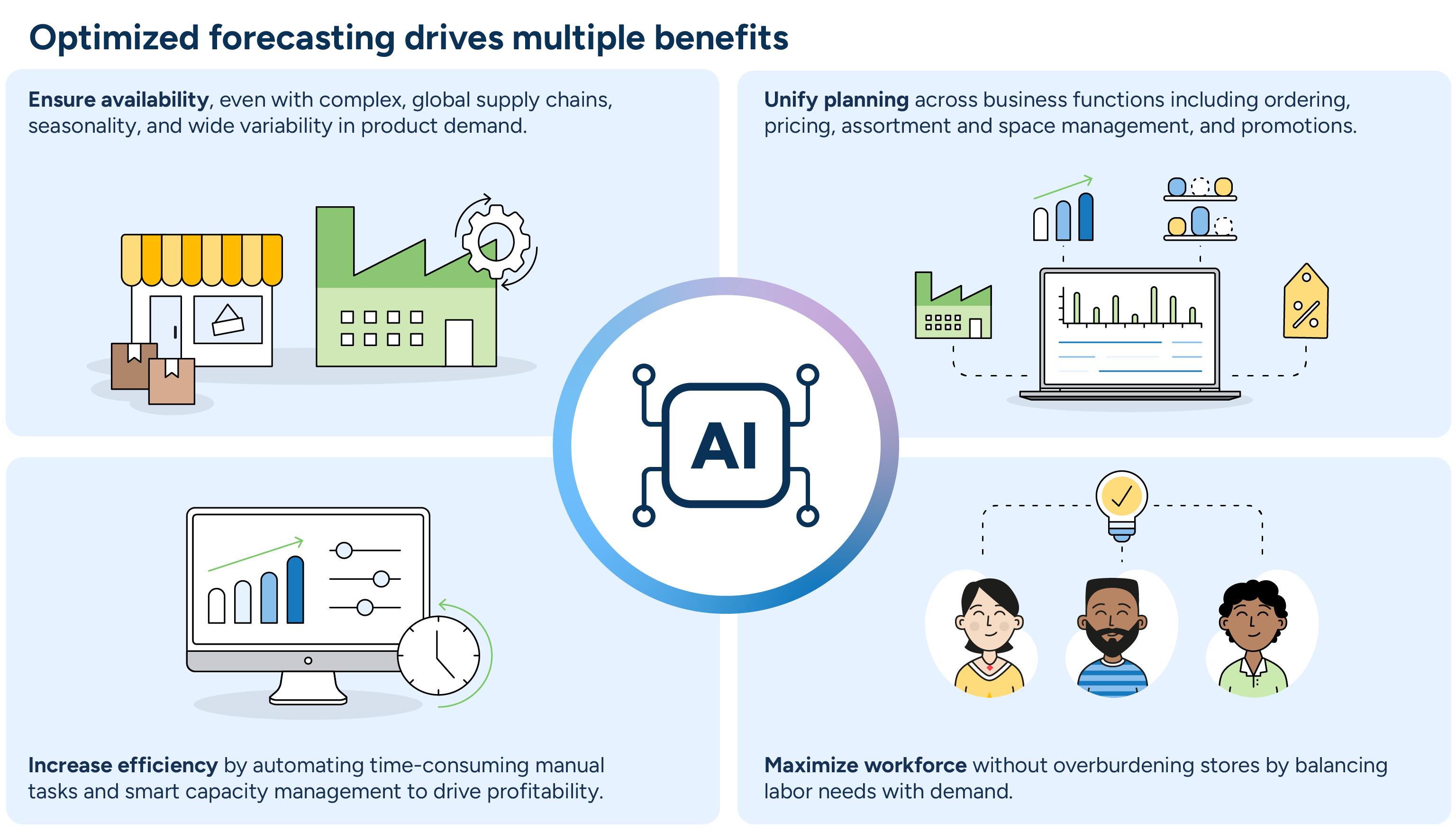
Forecasting demand, pricing, and workload needs is the best place to start optimizing because its benefits cascade across the operation. By leveraging advanced forecasting models, grocers can predict demand and anticipate how different pricing strategies will impact sales and profitability, enabling more agile responses to market changes and better margins.
Accurate workload forecasting enables grocers to align staffing levels with actual labor demand, ensuring the right number of employees are scheduled for peak times and reducing overstaffing during slower periods. That same forecasting foundation also feeds promotional planning and supply chain logistics.
Starting with forecasting means you’re doing more than just solving one problem, you’re building the input every other optimization area runs on.
How to get started with grocery optimization
Instead of treating grocery optimization as one massive overhaul, approach it in three steps. Optimization works best as a series of changes. First, start with the smallest projects that can make a difference, then move on to forecasting, and finally address data gaps. Each step naturally builds on the one before.
1. Start with small optimization projects to establish buy-in
It’s very common for grocery retailers to feel overwhelmed by the complexity of optimization and skeptical about the benefits. Because of this, many brands make the mistake of hesitating to implement and adopt tools that could help them stay ahead of the competition. This stagnation ultimately leads to falling behind competitors and losing out on those optimizing opportunities.
Grocery optimization decision paralysis can be prevented by starting with small, manageable optimization projects that demonstrate quick wins and tangible results. It’s not necessary to overhaul every corner of every store immediately.
Instead, start by optimizing product ordering or inventory reduction, then move on to another area, like workforce optimization. A single-category project has a defined scope, a measurable outcome, and a short timeline.
When that project succeeds, the internal skepticism that caused the original freeze tends to dissolve, and expanding into the next area becomes a much easier conversation. By gradually building confidence and showing the measurable value of optimization, grocery retailers can overcome any initial doubts stakeholders may have and fully embrace the transformative potential of advanced technologies.
2. Optimize forecasting for far-reaching benefits
After establishing confidence and buy-in from stakeholders, the optimization priority can turn to high-impact areas—namely, forecasting.
Optimizing forecasting for demand, pricing, and workload needs provides benefits that cascade across the operation. By leveraging advanced forecasting models, grocers can predict demand and anticipate how different pricing strategies will impact sales and profitability, enabling more agile responses to market changes and better margins.
Accurate workload forecasting enables grocers to align staffing levels with actual labor demand, ensuring the right number of employees are scheduled for peak times and reducing overstaffing during slower periods. That same forecasting foundation also feeds promotional planning and supply chain logistics.
3. Tackle data gaps with regular audits
One of the most critical mistakes grocers make when transitioning from transactional to optimized systems is assuming their existing data is good enough for optimization. Good data is crucial because it forms the foundation upon which advanced analytics and predictive models are built. Any optimization efforts will likely be flawed and ineffective without accurate, comprehensive, and timely data.
The gap is easy to miss: a retailer might believe they have a clear picture of their inventory because they track orders and sales. But if they aren’t tracking item-level receipts or item-level throwaways, they have no real-time visibility into what products are on the shelves, what just arrived, and what has been tossed out. Without information on what happens to every item in the store, it’s impossible to accurately forecast demand or optimize replenishment.
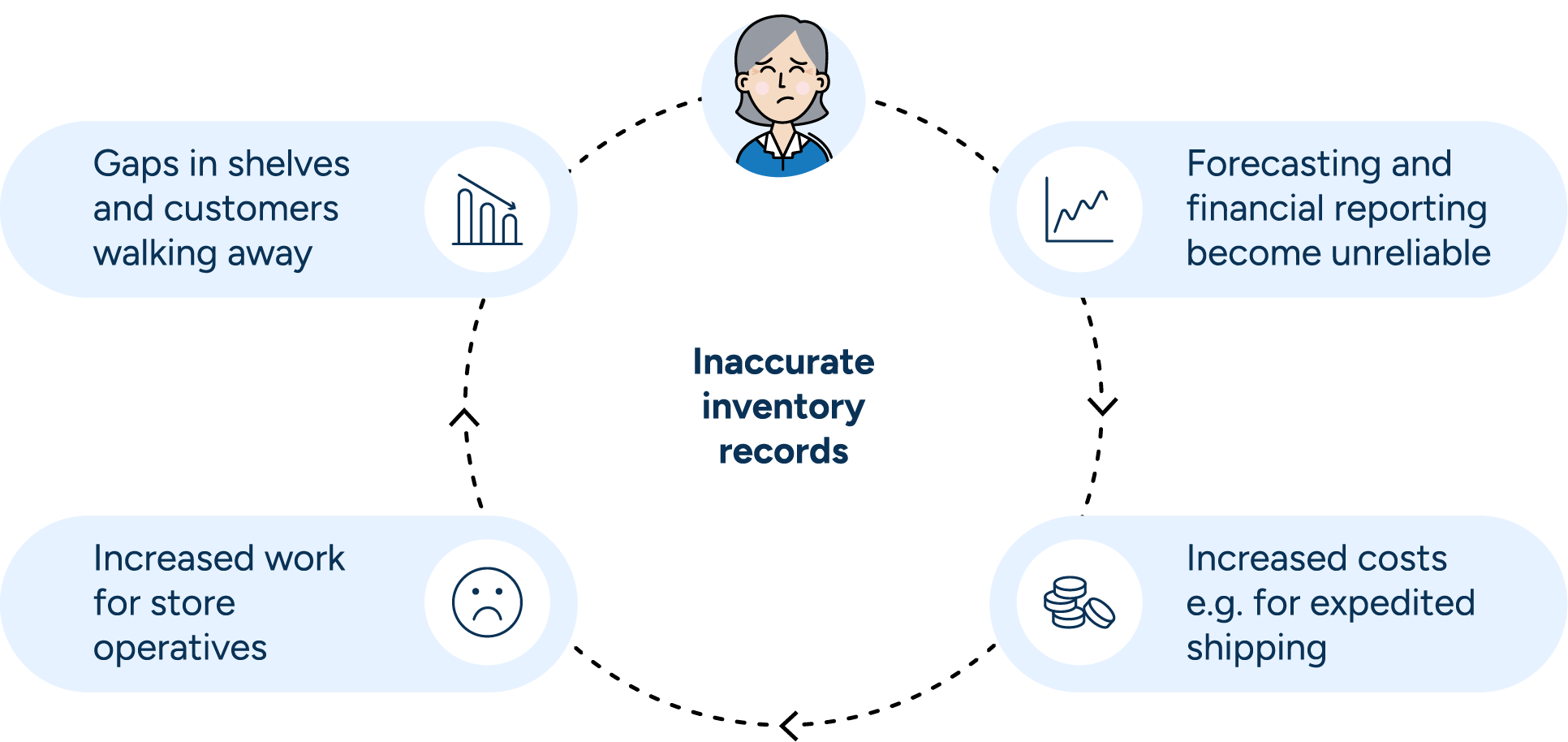
Beyond stockouts and excess inventory, inaccurate inventory records also create:
- unreliable forecasting and financial reporting.
- gaps on shelves that send customers elsewhere.
- higher costs through expedited shipping and emergency orders.
- more work for store teams who are already stretched.
Each gap in the data creates a downstream problem that compounds the one before it.
To assess and improve data quality, grocers should conduct regular audits of all data sources, implement robust data governance practices, and invest in technologies that enhance data accuracy and visibility. These technologies include advanced ERP systems that track item-level receipts and a unified planning platform for integrated analysis.
For example, RELEX Demand Planning is built on exactly this kind of unified data foundation, turning “good enough” data into forecast-grade inputs.
How to get store teams to use the optimized grocery retail system?
A common mistake grocers make when optimizing is underestimating the importance of change management and employee training. Employees, who are on the front lines of daily store execution, need to be guided through the transition in a meaningful way. Effective change management is best done with a structured approach that addresses the human side of change, particularly clear communication about the benefits and impacts of the new system, and honest handling of concerns or resistance from employees.
Optimizing your grocery retail systems can significantly benefit your employees by reducing manual, repetitive tasks that humans find least fulfilling. Make sure your employees get the complete picture of how they will benefit from these new tools. Real examples and case studies can also help illustrate effective practices and address questions about how the tools will change day-to-day tasks.
RELEX Mobile provides fresh item management capabilities in a single application that enables direct store-level input into order quantities. Incorporating user-friendly solutions, like RELEX Mobile and Rebot, can also help smooth the transition and speed up training. Change management is hard, but the culprit when it fails is almost always the process, not the people.
Real-world success: How UNFI optimized forecasting
Since so much work goes into moving from transactional systems to optimized ones, it can be easy to lose sight of the long-term benefits. But the companies that approach optimization strategically and stick to the plan realize incredible results.
When UNFI decided they needed to update their forecasting and replenishment, they had a list of non-negotiable requirements. They needed to replace their five legacy systems with a single platform that was scalable and highly configurable. With 30,000 customers and 48 distribution centers, UNFI already had a large, complex network and they needed a platform that could not only handle everything needed now, but also grow and change with them in the future.
UNFI’s new forecasting and replenishment system needed to include AI capabilities with a strong AI roadmap and it needed to be cloud-based, so they never had to wait for updates (something that slowed them down in the past).
With RELEX, UNFI was able to consolidate five legacy systems into one forecasting and replenishment platform that improved forecast accuracy by 25% and reduced stockouts by 5%.
Emerging technologies are extending what activation can deliver, like agentic AI, ML-driven forecasting, and GenAI copilots. But judge any new technology by whether it’s intuitive, labor-saving, and genuinely serves the customer.
The filter for evaluating any of them should be the same one that applies to any optimization investment: Is it intuitive enough that store teams will actually use it, does it reduce labor rather than add to it, and does it make a tangible difference for the customer? Emerging technology that scores well on all three is a genuine extension of your optimization foundation. Technology that doesn’t clear that bar adds complexity without ROI.
Interested in learning more about optimizing your retail grocery supply chain?
Grocery optimization FAQ
Grocery optimization generates predictable questions, and they tend to cluster around the same three friction points: where to start, whether the data is ready, and whether the organization can absorb the change.
What makes grocery retail planning uniquely difficult?
Grocery combines perishability, high SKU counts, volatile demand, and thin margins — all at once. When any one of those variables misfires, the effects compound quickly. The three barriers covered here (analysis paralysis, data quality, and change management) are amplified in grocery because the stakes show up on the shelf within days.
Where does RELEX fit in grocery optimization?
RELEX is a unified planning platform built for retail and supply chain. For grocery, that means demand forecasting, replenishment, fresh management, and workforce planning in a single system — which matters because the cascade benefits of forecasting only compound when downstream systems are connected. Evaluate it against your specific barriers: if data quality is the problem, a unified platform solves more than a point solution; if adoption is the problem, mobile-first tooling and configurable workflows make a measurable difference.
Do I need new technology to start optimizing?
No. The barrier to ROI is activation and discipline, not more technology. Most grocers already have the foundation and the data. Starting with what you have (validated, audited, and connected) is faster and lower-risk than waiting for the next platform.
How do I know if my data is good enough to optimize?
Run the item-level test: are you tracking item-level receipts and item-level throwaways? If not, you have no real-time visibility into what’s actually on the shelf, and any forecast built on that data will inherit the gap. Above that floor, assess for completeness and consistency across sources. A regular audit cadence and a unified data platform are the two most durable fixes.
Written by

Related Articles
QSR supply chain planning: overcoming operational friction with ingredient-level forecasting and franchise-wide visibility
Discover how connected QSR supply chain planning closes the gap between the kitchen and customer demand.

How to build a consumer decision tree: why the best CDTs start with shopper behavior, not supply logic
See why CDTs based on shopper behavior beat vendor- and workshop-built trees, and how RELEX CDT Builder applies the method.
Case Study: Grupo Vinoteca
See how Grupo Vinoteca, a Mexican wine and spirits distributor, reduced lost sales by 34.7%, cut store replenishment time by around 50%, and saved on inventory with RELEX's unified planning.