For grocery retailers, an efficient supply chain is the foundation for performance. Every aspect of the customer experience, from product availability and freshness to competitive pricing, depends on how effectively retailers manage the flow of goods from supplier to shelf. In an industry defined by thin margins, high volume, and constant change, supply chain execution directly impacts profitability.
Ultimately, grocery supply chains don’t fail because retailers lack plans. They fail because plans don’t stay aligned with execution. Preventing this requires supply chain planning software that continuously translates demand signals into synchronized inventory positioning and goods flow across every node in the network. This software-enabled alignment empowers retailers to build supply chains that are both highly responsive to demand volatility and highly efficient in their operations.
Key takeaways
- The grocery supply chain encompasses end-to-end planning and flow across demand forecasting, inventory management, and replenishment planning.
- Poor supply chain performance directly erodes profitability through stockouts, food waste, inventory imbalances, service failures, and slow response to disruptions.
- Optimal grocery supply chains use demand signals to drive decisions, position inventory intentionally, protect freshness, synchronize goods flows, and adapt continuously to changing conditions.
- Grocery retailers face unique complexity from demand volatility, perishability risks, supplier variability, omnichannel pressure, and disconnected planning.
- Modern supply chain solutions translate demand into synchronized inventory positioning and goods flows, enabling retailers to be both responsive and efficient.
What is the grocery retail supply chain?
The grocery supply chain is the end-to-end process of producing, transporting, storing, and delivering food and grocery products to consumers. It involves multiple stages, such as:
- Sourcing raw materials and finished products.
- Manufacturing or processing.
- Warehousing and distribution.
- In-store and online retailing.
The goal is to ensure products are available, fresh, and cost-effective while minimizing shrink and meeting consumer demand.
Grocery retail presents distinct challenges that set it apart from other retail sectors.
- Products have short shelf lives, requiring frequent replenishment.
- Demand varies dramatically by store location, day of the week, and season.
- Thin profit margins leave little room for error, whether from stockouts that lose sales or overstocking that creates waste.
- Fresh categories magnify errors, turning minor planning or execution miscalculations into markdowns, shrink, or limited on-shelf availability.
The three core phases of grocery supply chain planning
At the highest level, grocery supply chain management operates across three interconnected phases:
- Demand forecasting establishes which products customers will buy, where, and when they’ll buy them.
- Inventory management determines how much stock to position throughout the network, in stores, distribution centers, and with suppliers.
- Replenishment and flow planning translate forecasts and inventory targets into actual goods movement across the supply chain.
These phases don’t operate in isolation. Changes in one phase immediately impact the others, but when they are aligned with real-world execution, supply chains respond effectively to volatility while maintaining efficiency.
Why it’s crucial to get the grocery supply chain right
In grocery retail, supply chain performance directly impacts profitability. Profit margins are razor-thin, leaving little room for inefficiency. This is especially true for fresh categories, which account for 40-50% of sales in the average grocery store and generate 65% of total shrink. Small improvements in waste reduction, availability, or inventory turnover in these high-stakes categories translate into meaningful financial impact at scale.
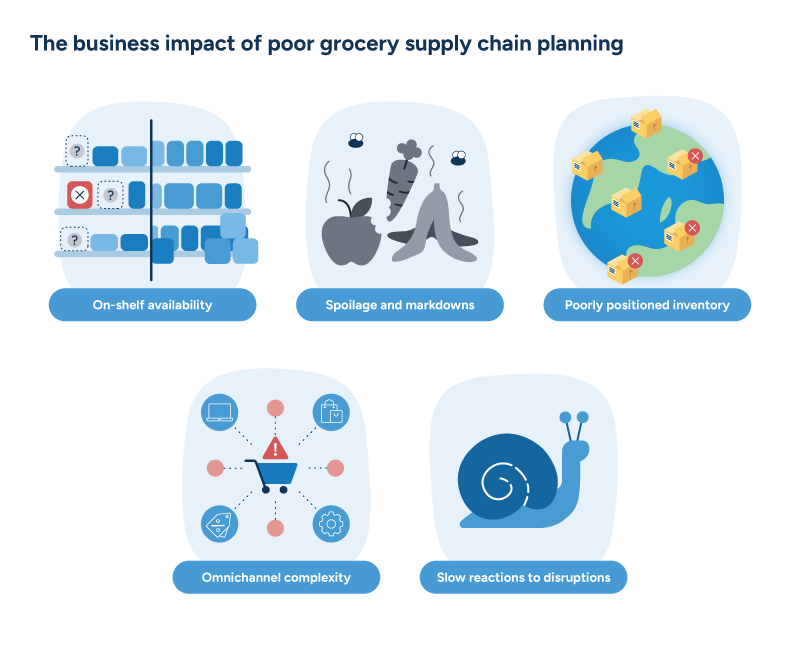
On-shelf availability and lost sales
Empty shelves mean immediate losses in revenue. Industry-reported out-of-stock (OOS) rates in grocery retail averaged 6.5% in 2023, though these rates can spike significantly higher during peak periods or for promoted items. For a typical North American grocery retailer generating $500 million in annual revenue, even a 1 percentage point improvement in availability, reducing the OOS rate from 6.5% to 5.5%, represents approximately $5 million in recovered sales annually.
When customers can’t find what they need, they either substitute with lower-margin items, skip the purchase entirely, or shop elsewhere next time. Stockouts are particularly damaging for fresh categories and promoted items because customers expect availability precisely when demand is highest. These missed sales compound beyond immediate revenue loss, as repeated stockout experiences erode customer loyalty and drive shoppers to competitors who can reliably meet their needs.
Food waste and markdowns
Perishable products create a constant balancing act for grocery retailers. Over-ordering drives spoilage and leads to price markdowns that erode already slim margins. In North America, spoilage can cost a grocery retailer an average of over $70 million per year, while larger, fresh-focused retailers can face losses of several hundred million. A 10-40% reduction represents $7-28 million in annual savings for a typical operation.
Inventory trapped in the wrong places
Poor inventory positioning across the network ties up working capital and incurs increased handling costs. Products sitting in distribution centers when stores need them create both stockouts and excess inventory simultaneously. This misalignment strains warehouse capacity during peaks and forces inefficient expedited shipments and forced-out allocations.
Service-level failures across channels
Online grocery shoppers expect the same freshness standards as in-store customers, but since they can’t inspect products themselves, the responsibility falls on store staff. This adds another layer of complexity to the grocery supply chain. When supply chains can’t separate and fulfill channel-specific demand, both in-store and online customers suffer from poor availability or compromised quality.
Inability to respond to disruption
Static planning cycles can’t adapt quickly as situations evolve, whether it’s promotions under or overperforming, weather patterns shifting, or suppliers facing unexpected delays. Supply chains built on manual processes and disconnected systems react slowly, turning manageable issues into costly crises that cascade across the network.
How grocery supply chains work in practice
Grocery supply chains function as a system of interconnected decisions that determine availability, waste, and efficiency across every stage of the network. Understanding how these decisions flow from forecast to execution reveals why alignment matters more than individual optimization.
Demand forecasting in grocery retail
Effective demand forecasting operates at the SKU-store-day level, capturing the granular variation that drives inventory decisions. A store selling 50 units of strawberries on Saturday and 15 on Tuesday needs forecasts precise enough to reflect that difference. Otherwise, incorrect replenishment orders can create stockouts or stock surpluses.
Forecasts should account for:
- Promotions
- Weather
- Local events
- Seasonality
- Cannibalization and substitution effects
- Varied omnichannel fulfillment requirements
Forecasts alone don’t move goods, but they do provide crucial transparency into expected demand patterns. Planners need visibility into the assumptions driving each forecast and the ability to adjust when business context requires it. This sets intent across the organization and creates alignment for the decisions that follow.
Inventory management across the grocery supply chain
Inventory management involves taking demand forecasts and determining the optimal stock levels to position in stores, distribution centers, and with suppliers. These buffers absorb demand variability and supplier uncertainty while minimizing capital tied up in inventory.
Safety stock requirements differ dramatically by category. Fresh products need dynamic safety stocks that rise and fall with weekday demand patterns (higher going into weekends, lower coming out of them). Meanwhile, center-store products with longer shelf lives can maintain steadier buffers, focusing instead on optimizing order quantities and delivery timing.
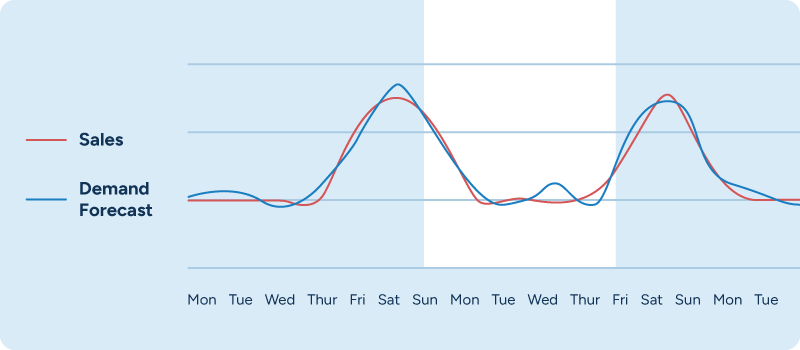
Batch-level tracking in distribution centers keeps expiry dates front and center, enabling precise spoilage projections that trigger force-outs to stores most likely to sell through aging inventory. Visual minimums ensure shelf displays look appealing without forcing excess stock that risks waste.
It’s also vital to monitor and correct store-level inventory accuracy. When system records deviate from physical reality due to shrinkage, checkout errors, or handling errors, replenishment decisions suffer. Modern planning systems detect inventory anomalies by comparing expected versus actual stock levels, enabling stores to correct discrepancies and ensure projected orders reflect true demand rather than distorted data.
Effective inventory management positions products intentionally based on where they’ll sell, not reactively based on where they happen to land. But positioning inventory correctly still requires a third element: the ability to move it.
Replenishment and delivery flow planning across the network
Replenishment planning determines when and how inventory moves through the supply chain. It connects forecasts and inventory targets to actual goods movement—from suppliers to distribution centers to stores.
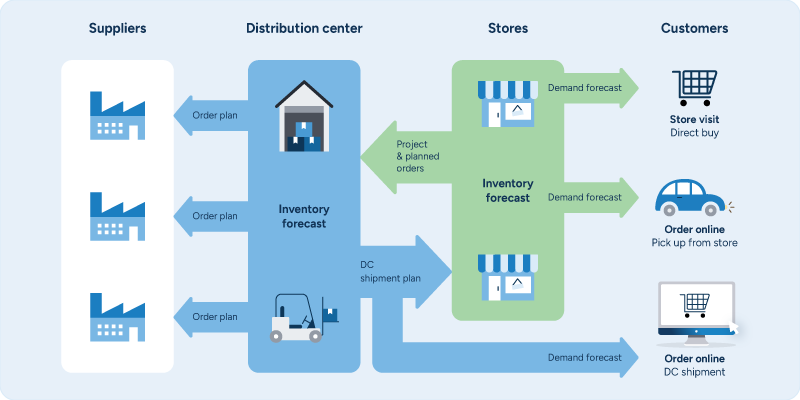
Store replenishment operates on defined cycles; however, not all products should utilize every available delivery opportunity. Main replenishment days concentrate center-store deliveries on specific weekdays, making store shelf stocking more efficient. For example, a store that receives cereal, pasta, and canned goods on Tuesday can stock an entire aisle in one trip, rather than making multiple small deliveries throughout the week.
Fresh products require different replenishment requirements. Key considerations include:
- Frequent, balanced replenishment. Fresh products need frequent replenishment to keep inventory moving quickly, but order quantities must balance the risk of stockouts against spoilage.
- Cost-benefit optimization. Each order automatically weighs the margin lost from an empty shelf against the cost of discarding unsold inventory.
- Dynamic pack size selection. Planning systems must select whether to ship case packs, pallet layers, or full pallets based on current demand and available shelf space. During peak seasons, full pallets move efficiently, but during off-peak periods, smaller case packs prevent backroom congestion.
- Projected store orders for DC planning. Distribution centers base shipment planning on projected store orders, not just demand forecasts. Projected orders indicate when stores will actually pull inventory, accounting for existing stock levels, planned promotions requiring pre-builds, and new product introductions. This visibility prevents distribution centers from reacting to demand peaks they should have anticipated.
- Coordinated push and pull flows. Push flows move promotional inventory to stores ahead of events while pull flows respond to realized demand. Both require coordination across the network, given that supplier lead times, distribution center capacity, delivery schedules, and store execution capabilities all constrain what’s possible.
- Multi-echelon coordination. End-to-end inventory optimization ensures goods flow smoothly from suppliers through distribution to stores without creating bottlenecks. Strategies like cross-docking for high-volume products and pick-to-zero reallocation enable retailers to minimize handling costs while adapting to supplier delivery variability.
When replenishment planning integrates with upstream forecasting and inventory decisions, the entire supply chain operates as a single system, rather than separate functions making isolated choices.
4 unique challenges that complicate grocery supply chain planning
Grocery supply chains face operational pressures that make planning particularly demanding compared to other retail sectors.
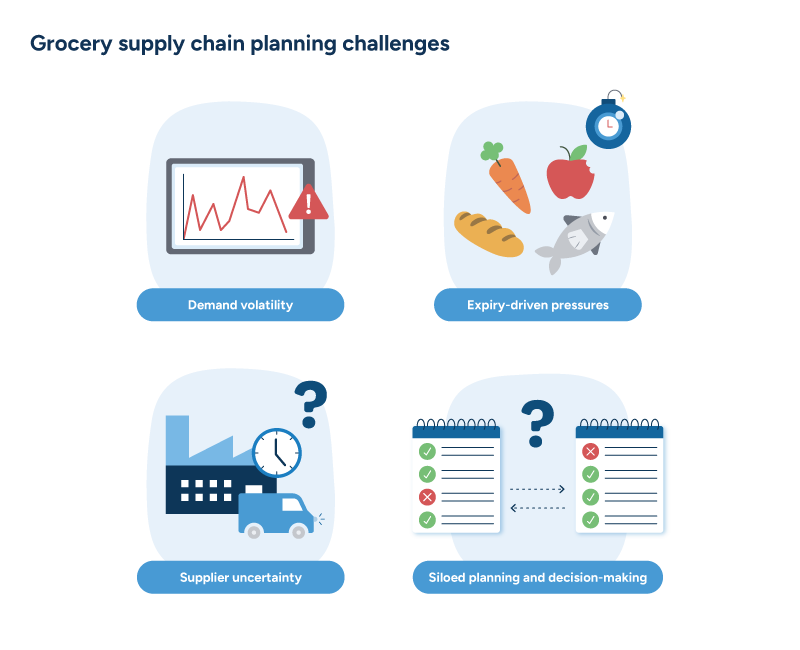
1. Demand volatility driven by promotions, weather, and local events
Grocery demand shifts rapidly in response to internal decisions and external factors:
- Promotions can triple or quadruple baseline demand overnight, requiring precise forecasting to avoid stockouts without building excessive safety stock.
- Weather patterns shift buying behavior—warm weekends spike demand for fresh produce and beverages, while storms drive runs on shelf-stable goods and cause delays in fresh deliveries.
- Local events, such as concerts or sports games, create sharp but temporary demand surges that vary by store location and timing.
- Fresh and ultra-fresh products amplify volatility through supply-side uncertainty. Seasonal supplier availability shifts throughout the year, quality variations lead to rejections that cause unexpected stockouts, and fragile products like berries can spoil quickly. A delayed harvest or unexpected quality issue can eliminate entire supply sources overnight, forcing retailers to quickly pivot to alternative suppliers or adjust their assortments in real-time.
Capturing these effects requires forecasting systems that process hundreds of demand-influencing factors simultaneously across thousands of store-product combinations.
2. Perishability and expiry-driven risk
Fresh products provide minimal margin for error. For example, a display of meat stocked for weekend grilling becomes waste by Monday if demand doesn’t materialize as expected. Short shelf lives compress decision windows, meaning orders placed today must account for sell-through rates three to seven days out. Static safety stocks often result in either weekend stockouts or weekday spoilage, rarely achieving the optimal balance.
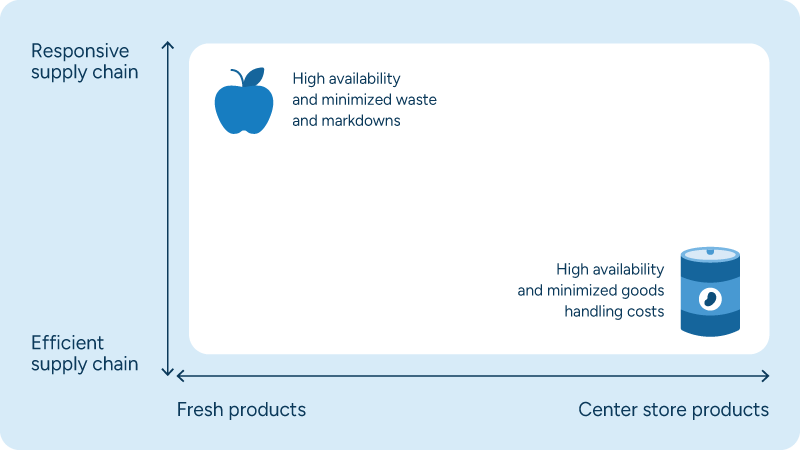
For other fresh categories, such as bakery and produce, these windows shrink even further. Harvest timing and weather affect demand while simultaneously impacting supply availability and product quality. An unsold baguette or loaf of bread can go stale overnight, while lettuce wilts and overripe bananas turn brown. Retailers must balance having attractive displays with accurate forecasts and orders to maximize their sales and minimize food waste.
3. Supplier variability and lead time uncertainty
Fresh sourcing changes weekly as crops rotate through growing regions, with quality issues emerging unpredictably and promised delivery windows stretching or compressing. For produce, the same consumer-facing product might involve dozens of supplier SKUs that planners must seamlessly substitute. For center-store products, lead times are longer but less reliable, complicating promotional stock builds.
Surplus fresh products available at reduced prices create margin opportunities, but only if retailers can quickly assess whether their stores can sell through the volume before spoilage occurs.
4. Disconnected planning and decision-making
Merchandising can set promotions without visibility into distribution center capacity. Store operations can design layouts without input from replenishment teams. Supply chain planners can forecast demand using outdated data from systems that don’t communicate with each other. These silos prevent the cross-functional alignment that grocery planning demands.
4 ways to optimize grocery retail planning with software solutions
Software built for grocery retail turns demand signals into action by forecasting with precision, strategically positioning inventory, and synchronizing goods flows across the network.
1. Turn demand into actionable decisions
Accurate demand forecasting drives performance throughout the grocery supply chain. Modern software solutions utilize machine learning to generate granular forecasts at the SKU-store-day level, automatically incorporating hundreds of demand-influencing factors that no human planner could track manually.
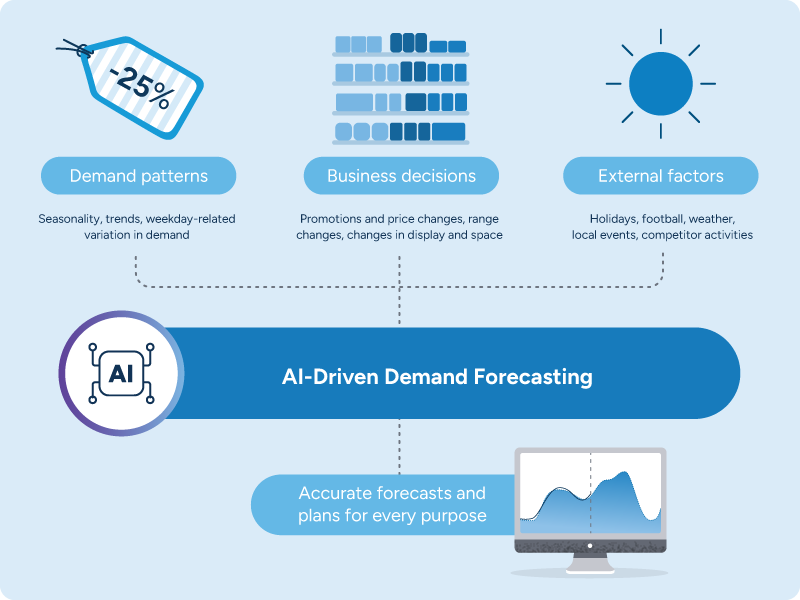
For grocery retailers, this means forecasts that separate in-store and online demand, accurately predict promotional uplifts, and dynamically adjust as new data becomes available. Planners maintain full transparency into how forecasts are generated and can apply their expertise where it matters most, rather than spending hours updating spreadsheets.
2. Position inventory across the network
Once demand is understood, inventory must be positioned intentionally across stores, distribution centers, and upstream in the supply chain. Planning software calculates dynamic safety stocks that fluctuate in response to weekday variations, seasonality, and forecast uncertainty. This is particularly critical for fresh products, where static inventory targets can lead to either waste or stockouts.
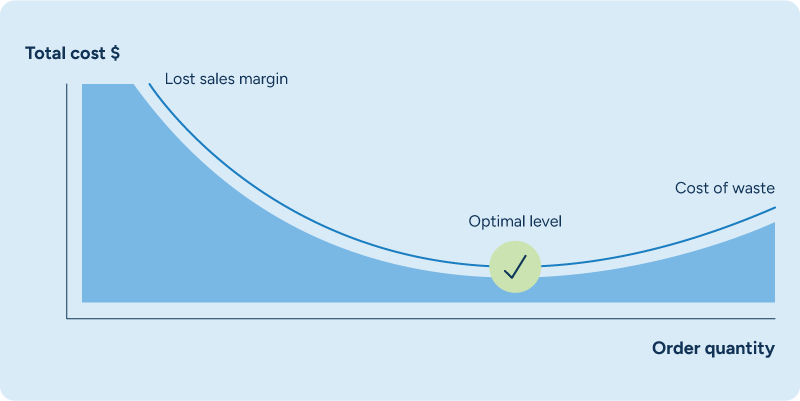
The system optimizes order quantities by balancing the cost of shrink against the risk of lost sales, automatically adjusting for product characteristics such as shelf life, batch sizes, and delivery schedules. For products with ultra-short shelf lives or multiple daily deliveries, the software determines optimal splits between order batches throughout the day.
Virtual ringfencing separates in-store and online demand at the forecast level, preventing channel conflicts that complicate supplier orders. When online and store inventory pools are managed distinctly, retailers can optimize supplier orders to serve each channel’s unique demand patterns. This precision reduces emergency orders triggered by unexpected channel-specific spikes and improves overall supplier order stability.
3. Coordinate with suppliers to reduce uncertainty
Advanced software addresses supplier-side complexity through two interconnected capabilities:
Supplier collaboration provides visibility into upstream constraints and capacity. Sharing projected purchase orders with suppliers enables better coordination around lead times, delivery windows, and availability. When suppliers face capacity constraints or quality issues, early visibility allows retailers to adjust forecasts, identify substitutes, or redirect inventory flows before stockouts occur.
Diagnostics and scenario planning help retailers understand where supplier-related problems originate and test potential solutions. When a supplier faces delays, scenario planning models the downstream impact on distribution centers and stores. Diagnostic tools identify systematic issues, such as consistently unreliable lead times from specific suppliers, enabling strategic decisions about supplier relationships and contract terms.
4. Synchronize replenishment and flow
Replenishment connects planning to execution. Leading retailers utilize modern planning systems that project store orders days and weeks into the future, based on:
- Current inventory
- Forecasted demand
- Delivery schedules
- Planned stock movements for promotions or seasonal periods
These projected orders become the demand forecast for distribution centers, eliminating the disconnect between store needs and DC planning that has plagued grocery retailers for decades.
This approach enables true multi-echelon coordination across the supply chain. DC planners see exactly when promotional stock-up orders will hit, suppliers receive accurate order projections, and the system automatically smooths goods flows to prevent capacity bottlenecks. Main replenishment days concentrate deliveries of center-store products on specific weekdays, making shelf-stocking more efficient without compromising availability.
Retailers using the latest planning software can execute pack size optimization, cross-docking logic, and pick-to-zero strategies across their organization because replenishment planning is driven by precise, forward-looking projections. No more reactive ordering. When promotional displays need to be stocked or seasonal allocations need to flow through the network, the system handles both push and pull flows seamlessly. This ensures goods arrive where they’re needed without manual intervention or capacity surprises.
How RELEX helps grocery retailers achieve this at scale
Grocery retailers need supply chains that respond continuously to what’s actually happening, not systems that lock decisions into static weekly or monthly cycles. RELEX enables this through a unified planning platform that keeps demand forecasts, inventory positioning, and replenishment flows aligned in real time. These solutions scale across millions of SKU-store combinations and hundreds of locations, delivering both the responsiveness required for fresh products and the efficiency needed for center-store operations.
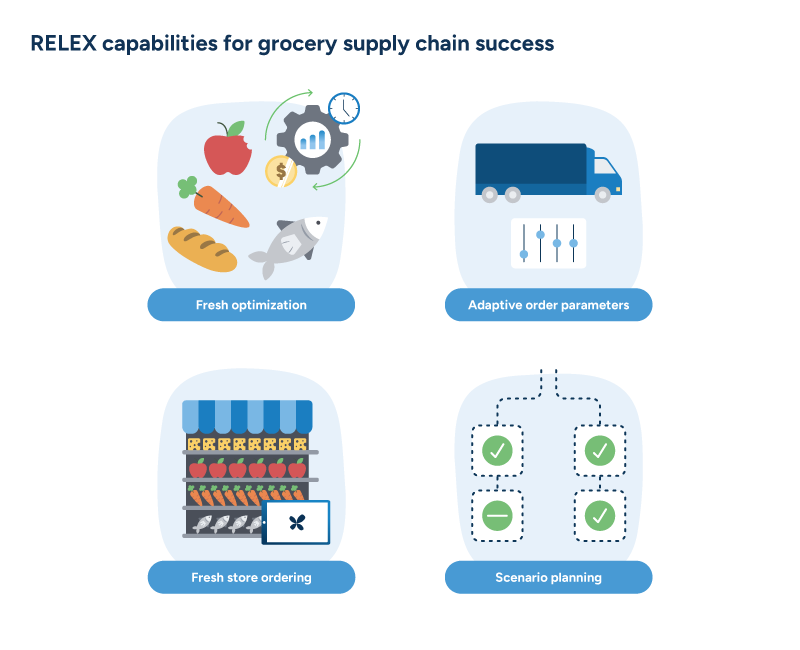
Optimize fresh inventory to balance availability against spoilage
RELEX Fresh Optimization manages perishable goods across the supply chain by balancing inventory levels, minimizing spoilage, and ensuring high availability. The solution uses advanced forecasting models tailored specifically for short shelf-life products, incorporating shelf-life constraints directly into replenishment calculations and using demand forecasts to predict spoilage before it happens. This automated approach to decision-making frees planners from managing hundreds of individual SKUs manually, allowing them to focus on exceptions and strategy.
Automatically adapt order quantities to reflect demand shifts
Traditional static safety stocks don’t work for fresh products with volatile weekday demand. RELEX Adaptive Order Parameters dynamically adjusts order quantities, safety stock levels, and lead times based on real-time data like demand fluctuations, spoilage rates, and remaining shelf life. The system continuously monitors demand and inventory data to ensure optimal stock levels without overstocking or understocking, adapting automatically as conditions change.
Streamline store ordering to cut workload and minimize waste
At the store level, RELEX Fresh Store Ordering automates and optimizes ordering for fresh products, ensuring the right quantities arrive at the right time. The solution uses perpetual inventory data to calculate order needs, incorporates demand forecasts along with shelf life and delivery schedules, and adjusts orders dynamically based on real-time sales and inventory data. This reduces spoilage and stockouts by aligning orders with actual demand, improving product freshness for customers and saving store staff time through automated order proposals.
RELEX also equips grocery retailers with mobile tools that guide them through exception-based workflows. This enables employees to validate and adjust orders efficiently while maintaining inventory accuracy without requiring extensive training or manual calculations.
Simulate supply chain scenarios to proactively identify and resolve bottlenecks
RELEX Scenario Planning enables planners to simulate conditions such as demand spikes, supply chain disruptions, and promotional impacts to assess their effects on inventory, spoilage, and service levels before adjusting plans. This helps retailers prepare for unexpected events and evaluate the best course of action under various scenarios, from supplier delays to holiday demand surges. The capability is particularly valuable for grocery retailers managing fresh and perishable products alongside center-store items, where each category requires different treatment during disruptions or planned promotional events.
Real-world grocery supply chain results
Getting grocery supply chains right demands software that can handle extreme complexity without sacrificing speed or accuracy. The following retailers are just two examples of companies that have partnered with RELEX to achieve tangible improvements in availability, waste reduction, and operational efficiency.
DoorDash (DashMart)
DoorDash‘s rapidly expanding DashMart micro-fulfillment network couldn’t keep pace with growth while using manual planning processes. The company needed to maintain optimal inventory levels across its network while responding quickly to changing demand patterns and seasonal variations. These challenges were critical to a business model built on speed and 15-minute delivery promises.
After selecting RELEX in 2022, DoorDash implemented forecasting and replenishment capabilities specifically designed for micro-fulfillment center operations. The solution automated complex inventory decisions to balance fresh product management with rapid fulfillment. This enabled DashMart’s planning teams to shift focus from manual data management to strategic business planning and scale efficiently without sacrificing service levels.
Results include:
- 1.8 percentage point improvement in availability.
- Substantial reduction in spoilage when accounting for sales growth.
- More efficient inventory levels maintained during rapid expansion.
Oda
Oda, Norway’s largest online fresh food retailer, faced the dual challenge of maintaining high availability while minimizing waste. A task made more demanding by customers’ heightened expectations for products selected on their behalf. The company’s proprietary forecasting and replenishment system struggled as operational complexity increased, leading to concerns about stockouts, excessive spoilage, and the time spent ordering and restocking fresh products with short shelf lives.
Working with RELEX, Oda introduced day-level forecasting with regression modeling for promotions, dynamic safety stocks that adjust daily, and automated routine ordering. This freed the purchasing team to collaborate more closely with suppliers and share forecasts. Also, introducing batch-level inventory management provided them with full visibility into the incoming goods flow and spoilage risk.
Results include:
- 49% reduction in spoilage value.
- 25% increase in inventory turnover.
- Availability levels maintained during a period of significant sales growth.
“By using RELEX we were able to see what was in danger of becoming unsellable before it’s too late so now we can take steps to minimize food waste.”
Simon Svensson, Purchaser, Oda
Build a grocery supply chain that drives profit and cuts waste
As markets become increasingly complex, grocery retailers must bridge the gap between strategy and execution by positioning themselves to meet volatile demand and protect freshness without compromising profitability. Those who embrace AI-driven forecasting, dynamic replenishment, and end-to-end supply chain coordination are best equipped to maintain the responsiveness that fresh categories require alongside the efficiency needs of center-store products.
Want to explore how leading grocers are putting these principles into practice? Take a look at our grocery retail playbook for actionable approaches to optimizing fresh operations, improving margins, and building more sustainable supply chains.
Grocery supply chain FAQ
What does an optimal grocery supply chain look like?
An optimal grocery supply chain ensures the right products are delivered to the right locations at the right time, maintaining high availability and cost-efficiency while minimizing waste and adapting to demand fluctuations seamlessly.
Key characteristics include:
- Demand signals driving decisions end-to-end.
- Inventory is positioned intentionally, not reactively.
- Freshness is protected without excessive waste.
- Goods flow is synchronized across suppliers, distribution centers, and stores.
- Planning adapts continuously as conditions change.
What is an integrated supply chain, and what are its benefits?
An integrated supply chain uses projected store orders, not just demand forecasts, to drive distribution center planning, automatically considering inventory levels, delivery schedules, promotions, and planned stock movements. RELEX enables this integration across the entire network, eliminating double-planning, enabling automatic exception resolution, and optimizing inventory flows across all echelons.
Who are the key people involved in managing grocery supply chain operations?
Grocery supply chain management involves strategic decision-makers (VPs of Supply Chain, CIOs, Directors of Operations/Merchandising) and operational practitioners (demand planners, store managers, DC planners). RELEX solutions support both groups: automating manual forecasting tasks for planners while providing executives with real-time visibility and analytics for data-driven decisions across the network.
What is demand forecasting, and why is it critical for grocery supply chains?
Demand forecasting is the central driver of the grocery supply chain, using data and AI to predict consumer demand at granular levels (day, SKU, store). Without detailed forecasts, it’s impossible to correctly position inventory to maximize sales and minimize waste.
How can machine learning improve grocery demand forecasting?
Machine learning enables forecasting systems to automatically learn and improve predictions using data alone, considering hundreds of demand-influencing factors that human planners cannot manage. RELEX excels at handling complex situations like overlapping promotions, sales cannibalization, and weather impacts, continuously adapting forecasts as conditions change.
What is the difference between fresh and center-store supply chain management?
Fresh products require highly responsive supply chains with frequent, demand-synchronized replenishment to minimize waste. RELEX Fresh Store Ordering addresses this through AI-powered, cost-optimized ordering that balances spoilage risk against stockout probability. Center-store products with longer shelf lives enable optimized inventory flows, efficient goods handling, leveled capacity utilization, and one-touch replenishment.
What are main replenishment days and how do they improve efficiency?
Main replenishment days concentrate center-store product deliveries on specific weekdays based on store layout and product categories, rather than spreading them throughout the week. This system reduces time moving between aisles, enabling more efficient shelving, optimizing safety stocks, and leveling out goods flows to distribution centers.
What is the pick-to-zero inventory strategy?
Pick-to-zero is an inventory policy in which supplier orders are based on store needs, but delivery quantities are reallocated to stores upon receipt, based on the latest inventory and forecast data. This policy allows for adjustments if suppliers can’t deliver in full or demand spikes occur, resulting in more accurate supply-demand matching than traditional cross-docking.
Written by