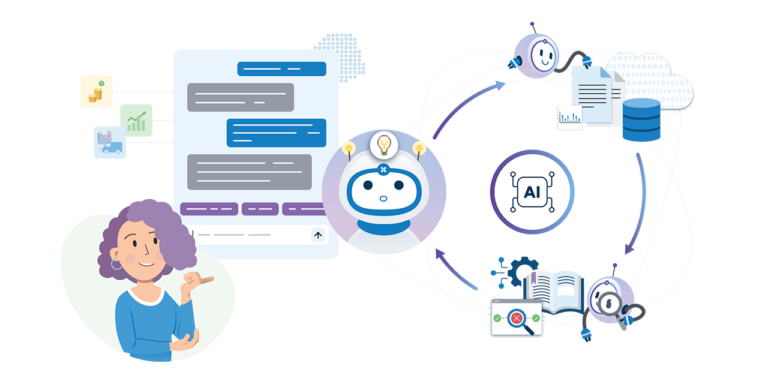
Most retailers know agentic AI is coming. Many are already evaluating it. But there is a trust gap between knowing it matters and actually adopting it.
According to the RELEX 2026 State of the Supply Chain report, 67% of supply chain leaders surveyed reported increased confidence in using AI for supply chain decision-making compared to last year. But only 32% are actively investing and scaling AI solutions right now.
Retail planning is in the middle of a massive shift. AI is moving from a tool that helps planners see problems more clearly to one that acts on them by analyzing, recommending, and executing decisions at a speed and scale that no planning team can match with manual planning.
That shift is being driven by compounding pressures, particularly cost environments that leave no room for inefficiency and supply chains that have become too complex for reactive management.
The retailers who pull ahead will not simply be the ones who adopt AI agents. They will be the ones whose planning infrastructure can orchestrate them, and whose vendors have earned the right to act.
Why agentic AI is more than hype
The word “agentic” is applied to many tools that don’t actually use agentic AI. A chatbot that summarizes an inventory report is not really an agent. A piece of software that recommends a safety stock adjustment is not an agent. An agent takes a defined task, reasons through it, and executes a decision, with or without a human initiating every step.
That distinction matters because action is where the value is. What costs retailers the most time and money is everything that happens between knowing and doing: the manual root cause analysis, the hours spent tracing an order anomaly, the reporting cycle that delays a corrective decision by days.
Agentic AI addresses that gap directly. Consider what the manual alternative actually looks like across a planning operation:
- A planner spending hours tracing a stockout to a partial delivery that came in two days prior.
- A merchandising team navigating form-heavy interfaces to set up a promotion, then waiting weeks to understand why it underperformed.
- Store execution teams escalating routine order questions to central planning because there is no faster path to an answer.
- New product forecasting built on manual attribute tagging, because there is no sales history to work from.
- Location segmentation for forecasting done by hand, meaning groupings based on geography or store format rather than actual sales behavior.
These and many other tasks comprise the daily workload of planning teams at scale. When agents handle them, planners have more time for decisions that actually require human judgment.
How agents change the role of the planner
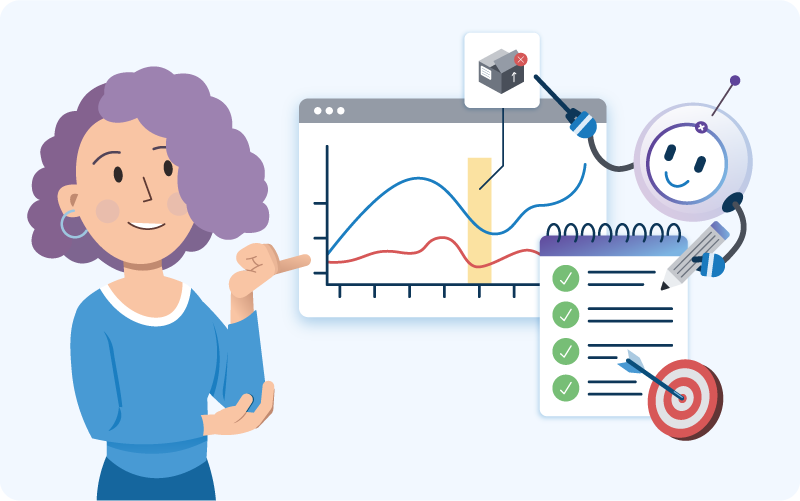
The most common concern about agentic AI in planning is also the most understandable: if agents handle analysis and execution, what does the planner actually do?
As agents take over the reactive and the repetitive, planners move into a different kind of work that requires the judgment, context, and domain expertise that no agent has, like:
- Setting strategy.
- Managing exceptions.
- Evaluating trade-offs and planning scenarios.
- Managing supplier relationships.
- Deciding what needs to be optimized with AI.
- Determining when to override agent recommendations.
Planners who adapt to this shift become arbiters of the system who know how to direct agents effectively, interpret their recommendations critically, and apply business context that the data alone does not capture.
| Before agentic AI | With agentic AI | |
|---|---|---|
| Morning review | Planner opens dashboards, manually scans exceptions, and spends an hour figuring out what needs attention and why. | Agent surfaces prioritized exceptions with root cause already identified. Review takes just a few minutes with suggested actions for review. |
| Stockout investigation | Planner traces a lost sales event back through order history, delivery logs, and forecast data. Manual tracing often takes 2–3 hours for a single SKU. | AI-Assisted Diagnostics agent identifies the cause (e.g., partial delivery two days prior), the reason code, and recommends an action to correct the problem. |
| New product setup | Planner manually tags product attributes to find reference products for forecasting: Slow, inconsistent, and degrades accuracy from day one. | Product Attribute agent analyzes the product description, identifies optimal reference products, and ranks them by suitability. |
| Inventory decisions | Models trade-offs manually, adjusting safety stock and replenishment parameters SKU by SKU. Strategic intent rarely translates cleanly to execution. | Inventory Control agent runs scenarios (e.g., “reduce waste by 10% in this category”), shows profit impact in real time, and executes at scale. |
| Store support | Store teams escalate routine order questions to central planning. Planner must pause other work to investigate and respond. | Store Support agent answers questions instantly through RELEX Mobile. Central team is freed for higher-value work. |
| Promotion setup | Navigates complex, form-heavy interfaces to create or modify a promotion, a time-consuming process, with a high learning curve for new users. | Promotion Strategy agent creates and modifies promotions via natural language prompts. Setup that used to take hours now takes minutes. |
| Post-promotion analysis | Manually pulls data across multiple sources to understand why a promotion over- or underperformed. Insights arrive weeks later, if at all. | Promotion Diagnostics agent breaks down performance (like gross lift, halo effects, cannibalization) into plain language. |
| End of day | Reactive: Planners spend most of the day investigating what happened rather than deciding what to do next. | Strategic: Planner has spent the day evaluating trade-offs, setting agent parameters, and applying judgment where it actually matters. |
Why specialized AI earns users’ trust
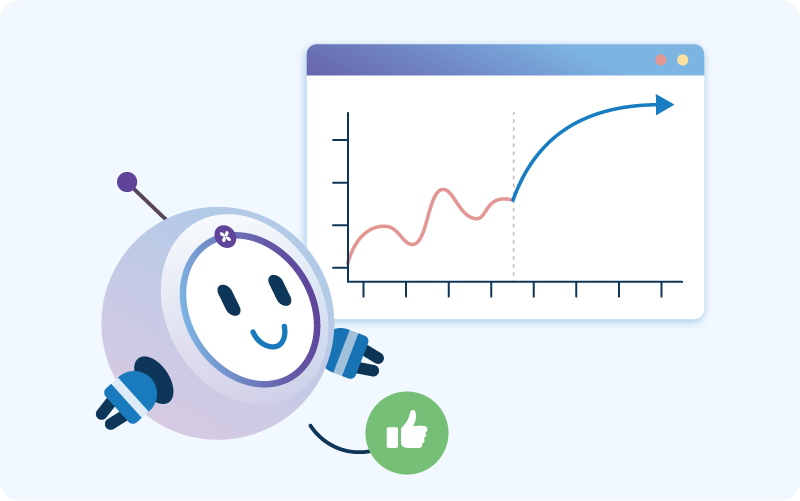
The vision of planners doing higher-value work only holds if the agents who do the work can be trusted.
Most AI applied to retail planning was not originally built for retail. General-purpose large language models generate plausible-sounding answers, but plausible is not the same as correct. In a planning context, a confident wrong recommendation is worse than no recommendation at all. Agents that hallucinate are dangerous.
This is the trust problem that sits at the center of agentic AI adoption, and it is why the vendor category matters as much as the capability.
RELEX agents are built different:
Specialized AI instead of general-purpose models
RELEX AI was trained on data from 700+ retailer datasets, embedded with 20 years of documented domain expertise, and designed around the decisions that matter in this industry. When a RELEX agent makes a recommendation, it runs math against actual data using models validated in production across hundreds of enterprise implementations.
Human-in-the-loop governance by design
RELEX could automate more than it does, but the choice not to is intentional. Every agent action in the platform is logged, explainable, and subject to human review before consequential decisions are accepted. Agents and planners use the same Business Rules Engine interface, meaning planners can see exactly what an agent is doing and why, and override it whenever they wish.
This is a design principle. Governing autonomy makes autonomy trustworthy and trust earns AI the right to scale.
Proven in production, not just in demos
The RELEX AI-Assisted Diagnostics agent has been live with customers since Q4 2025. It is the data foundation that powers the other F&R agents, converting raw metrics into contextual intelligence that enables autonomous action.
These capabilities are already delivering real results for our customers.
What agents look like in action
RELEX agents fall into two types: F&R agents built around replenishment, inventory, and store operations, and P&P agents built around promotions and pricing. Each targets a different part of the planning lifecycle, but the design principle is the same: Agents that explain their reasoning, operate within the Business Rules Engine, and stay under human oversight. The tables below break down what each agent solves and what it can do.
RELEX F&R agents
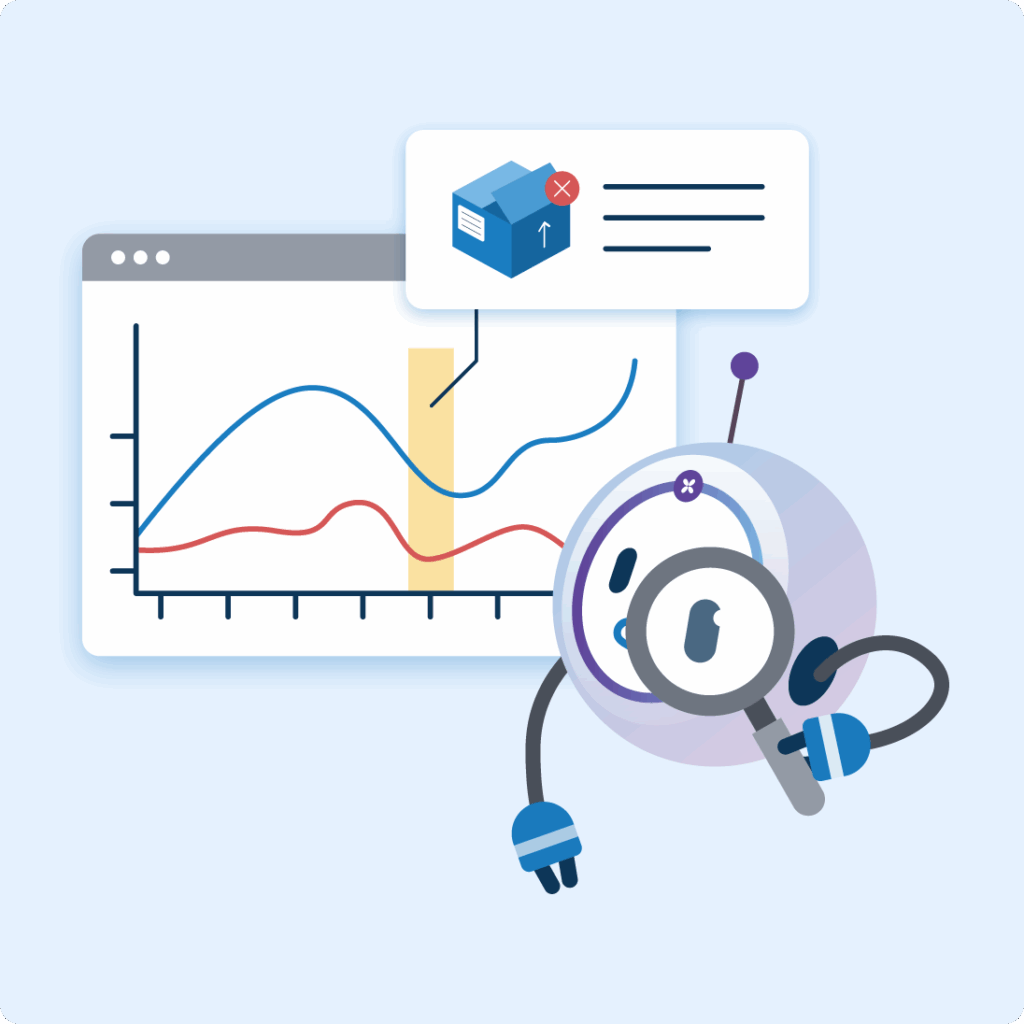
RELEX F&R agents were built around a problem that goes deeper than any individual workflow. A planner who spends two hours tracing back a stockout to a partial delivery three days prior is doing vital work that should only take two minutes.
But planners who can’t explain a decision won’t trust the system that made it, and trust is what determines whether an agent actually changes behavior or just runs quietly in the background. Every RELEX F&R agent operates within the Business Rules Engine, which means every action is logged, auditable, and subject to human review.
| Agent | What it solves | Key capabilities |
| AI-Assisted Diagnostics | Why did performance break down? | Root cause analysis across lost sales, spoilage, and excess stock; reason code identification; scenario planning for corrective actions |
| Inventory Control | How do we execute strategic goals at SKU scale? | Scenario planning across safety stock, waste targets, and replenishment frequency; real-time profit impact visibility |
| Order Proposal Troubleshooting | Why did RELEX recommend this order? | Plain-language explanations for any order proposal; proactive risk flagging; no requirement for deep calculation expertise |
| Product Attribute | How do we forecast a product with no history? | Reference product identification from descriptions; suitability ranking; attribute gap detection |
| Store Support | Who answers routine store questions without pulling planners off other work? | Real-time troubleshooting via RELEX Mobile Replenishment; instant answers to store-specific order issues |
| Location Clustering | Are we grouping stores by actual behavior or just assumption? | Sales pattern analysis across all locations; continuous adaptation as patterns shift |
RELEX P&P agents
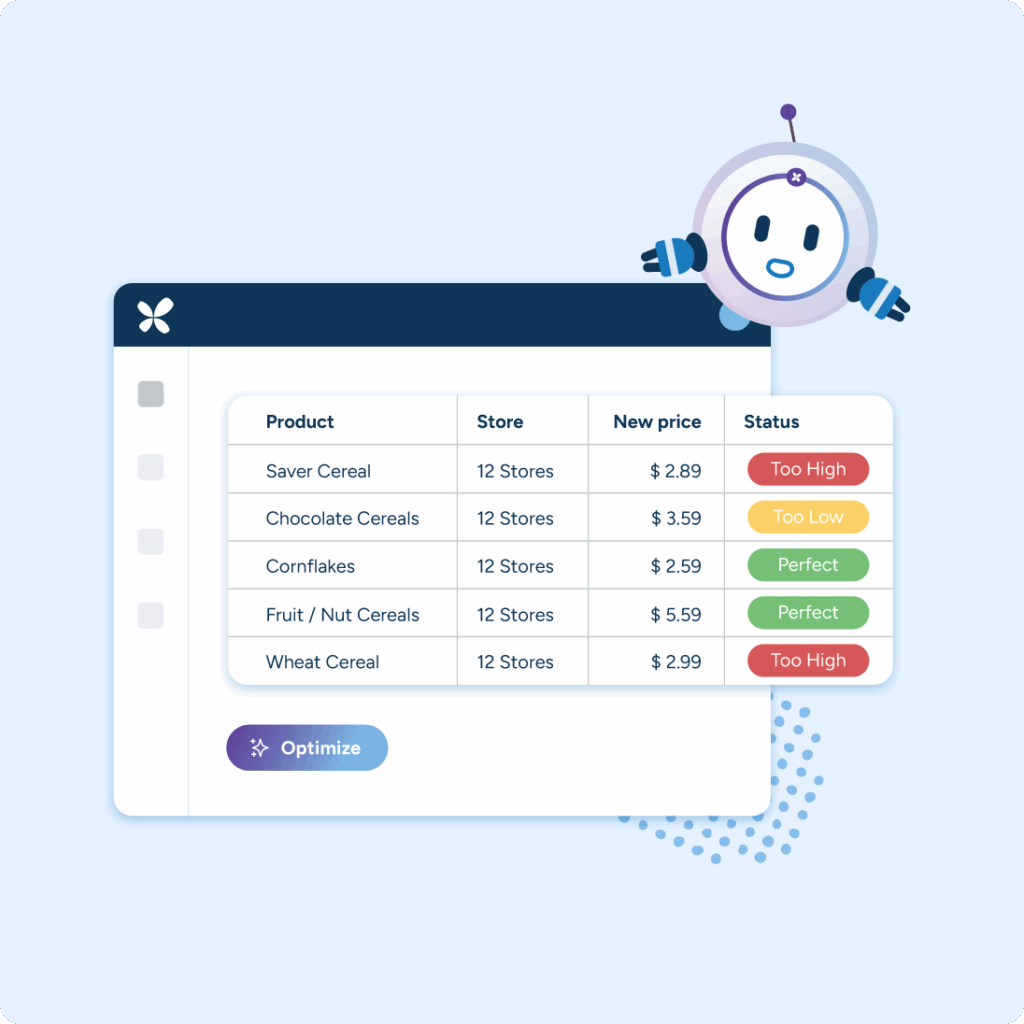
Slow execution costs margin. These agents were built around the workflows where that loss is most predictable: promotion setup, post-promo analysis, and pricing decisions that can’t wait on a data team.
| Agent | What it solves | Key capabilities |
| Promotion Diagnostics | Why did this promotion miss? | Right-click “Explain this” on any cell; covers gross lift, switching, halo effects, cannibalization; accelerates post-promo review from weeks to minutes. |
| Promotion Strategy | How do we build and edit promotions without the form-heavy friction? | Natural language creation and modification; automatic pull of historical performance data; lower learning curve for new users. |
| Analytics and Insights Reporting | How do we get answers without waiting on the data team? | On-demand interactive visualizations; covers performance trends, category breakdowns, brand comparisons, discount distribution. |
| Pricing Strategy | How do category managers set strategy without being pricing specialists? | Natural language configuration; automatic diagnostics within optimization groups; item-level price proposals balancing profit and margin. |
For a deeper look at what each agent does and how it was designed, see Meet the RELEX Agents.
Case study: One retailer’s results with RELEX agents
A grocery retailer in North America was wasting four hours every Wednesday on manual pricing analysis, building scenarios, and troubleshooting failures. By the time the analysis was ready, the window to act on it had often narrowed.
The team integrated RELEX into their weekly pricing cycle, orchestrated by Rebot. Instead of building scenarios manually, the pricing analyst could ask Rebot to run what-if tests, like comparing price points across dozens of stores, and get the sales and profit impact back in seconds. When a rule configuration problem had the analyst stuck, Rebot explained the conflict, identified the fix, and the analyst implemented it within 24 hours.
The results were immediate. Pricing scenarios that took four hours now take minutes.
“This would take me probably a good four hours to do manually. Building it, running it — and then of course it’s going to fail, and I have to go back and work on it again. Rebot already did it all for us.” Pricing analyst, grocery retailer
How to get started
The right starting point is narrow: one or two agents that address your highest-priority pain points, with clearly defined success criteria before you begin.
A structured pilot looks like this:
- Identify the one or two planning problems where manual work is costing the most time or margin.
- Define specific KPIs and a realistic timeline before the pilot starts — what does success look like in 90 days?
- Build a cross-functional team with executive sponsorship, clear ownership, and both planning and IT representation.
- Commit to a documented evaluation process: structured feedback, honest assessment, willingness to iterate.
Readiness is less about technical infrastructure than most teams assume. RELEX agents are designed for planning teams, not AI specialists. They use natural language, explain their reasoning in plain terms, and do not require data science skills or technical training to operate.
The goal is to build trust with the technology, with the vendor, and internally with the teams who will use it. Start there, measure what matters, and scale from a foundation that has already proven it works.
See what retail AI adoption looks like at a major retailer in our webinar, “Retail AI: what works, what doesn’t, what’s next?”
Written by