QSR supply chain planning: overcoming operational friction with ingredient-level forecasting and franchise-wide visibility
Oct 19, 2026 • 13 min
When a customer at a drive-through orders and receives their food in just a few short minutes, they don’t see everything that went into making their experience so efficient and hassle-free. Their focus is on their meal, not on the planning that ensured the right ingredients were available in the right restaurant, at the right time.
Quick-service restaurants have invested millions in the customer-facing aspect of their businesses, including ordering kiosks, loyalty apps, delivery integrations, and seamless checkout. But while front-of-house advancements have accelerated, the same isn’t necessarily true behind the counter. Many operations still run on siloed planning processes, relying on manual counts, gut feel, and spreadsheets that can’t keep pace with real demand.
When all is running smoothly, no one notices. But when a stockout occurs due to avoidable human error, the knock-on effect is telling. One missing ingredient can take multiple menu items off the board at once, leading to slow lines and a dent in customer satisfaction at every register.
In an industry defined by speed and heavy competition, faster manual work won’t close the QSR planning gap. Instead, AI-driven forecasting and replenishment software is emerging as a necessity for the restaurants that want to stay ahead.
A modern planning platform can help QSR staff forecast demand at the ingredient level, automate replenishment, and manage the fresh, frozen, and in-restaurant production elements unique to the industry. Particularly, a planning solution built with complexity in mind achieves all of this without adding headcount or extra tasks for restaurant teams. The back-of-house investment payoff shows up at the drive-through window. Customers consistently receive orders that are accurate and on time, and that positive experience keeps them coming back for more.
What is the QSR industry?
Quick-service restaurants (QSRs), commonly called fast food restaurants, are foodservice businesses built around speed, convenience, and consistency. Think drive-throughs, counter-service concepts, and delivery-first kitchens rather than sit-down dining. The category spans everything from global burger and coffee chains to regional pizza and chicken brands, typically operating under franchise, company-owned, or hybrid business models across large, often multi-country networks.
What are the stages involved in a QSR supply chain?
A QSR supply chain moves through six stages. Each stage adds its own layer of complexity before an order ever reaches the customer.
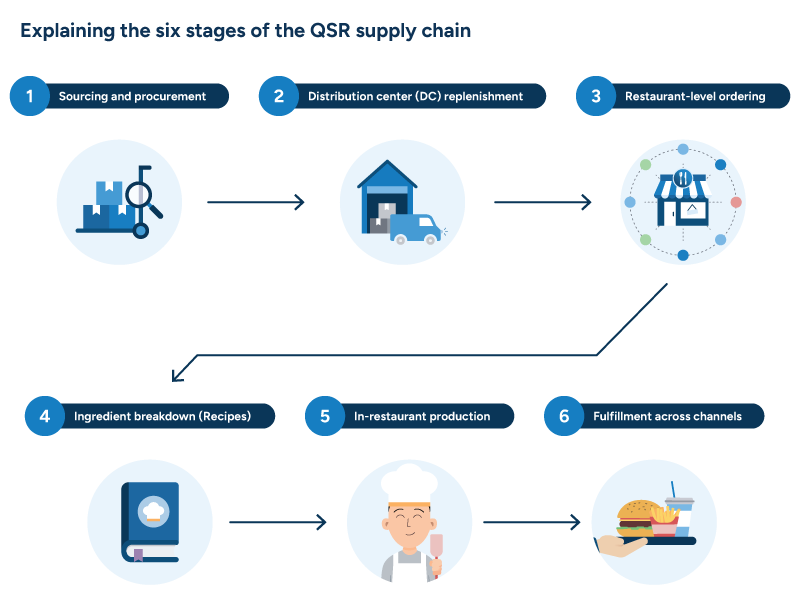
Fig 1: Ingredients travel from suppliers to distribution centers, then to restaurant kitchens, before reaching customers.
1. Sourcing and procurement
QSR sourcing typically combines two types of suppliers:
- Large distributors supply core ingredients at scale, generating the economies of scale that a multi-unit network depends on.
- Local suppliers that fill in around the large distributors, meeting regional taste preferences, sustainability commitments, or menu items unique to a market.
2. Distribution center (DC) replenishment
Distribution centers sit between suppliers and restaurants, holding inventory across ambient, frozen, and fresh temperature zones. Depending on the brand, a DC may be run in-house or by a third-party logistics (3PL) provider or foodservice distributor. Operational teams forecast demand across every restaurant they serve, then place replenishment orders with suppliers to keep the network stocked.
3. Restaurant-level ordering
Individual restaurants order from the DC, or in some cases, directly from suppliers. This step is often considered to be the most manual part of the chain. Local managers have to review on-hand stock and place an order based on experience rather than a system-generated forecast.
4. Ingredient breakdown (Recipes)
Every order a restaurant places starts as a forecast for finished menu items, not raw ingredients. A recipe, or bill of materials (BOM) as it’s known in manufacturing, translates that menu-item demand into the ingredient quantities needed to make it. Recipes account for yields, prep waste, and, in some cases, ingredients that are themselves made from other sub-recipes.
5. In-restaurant production
Once ingredients arrive, restaurant staff prepare them for service. Depending on the restaurant, this may involve cooking proteins, assembling sandwiches, baking goods, or brewing beverages. Production timing matters as much as volume here, since fresh items prepared too early or too late both create waste and lost sales.
6. Fulfillment across channels
The final stage is getting the finished item to the guest, whether that’s at a counter, a drive-through window, a kiosk, or a third-party delivery platform. Each channel carries different demand patterns, and a single restaurant may fulfill all of them simultaneously from the same kitchen.
Why is QSR supply chain planning so difficult?
When it comes to supply chains, the QSR industry stands out as one of the most complex use cases. Companies must juggle an intricate network while operating across different business models. Planners have to manage both direct and multi-tiered distribution channels, source products from large distributors to generate economies of scale, and from local suppliers to satisfy customer preferences and sustainability concerns. They also have to manage the procurement, picking, transportation, and storage of frozen, ambient, and fresh perishable products.
The result is a supply chain that is under pressure at every link. A supply chain where the right planning approach can be the difference between margin gained and margin lost.
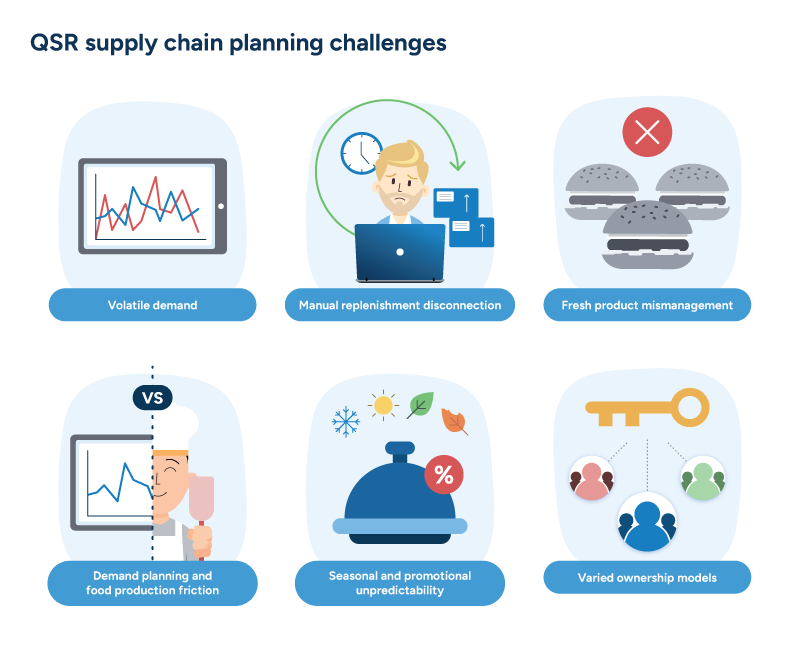
Fig 2: These six pressure points are where QSR teams most often lose margin to waste, stockouts, and missed sales.
Volatile demand creates forecasting blind spots
Demand in QSR shifts hourly rather than daily. A restaurant on a busy transit corridor operates at a completely different rhythm from a suburban drive-through. A nearby event or a rainy afternoon can throw yesterday’s numbers out the window. Layer in the growing mix of dine-in, kiosk, and third-party delivery channels, each with different ordering patterns, and forecasting becomes exponentially harder.
New restaurant openings compound the problem further. Teams lack sales history to build a forecast from, yet day-one demand still has to be met.
Manual, disconnected replenishment wastes time and money
Replenishment in QSR still relies heavily on manual work and manager intuition, even in centrally managed networks. That’s largely because translating menu-item demand into ingredient-level orders requires multi-layer calculations. After all, a burger may be a single item on the menu, but it’s made of a bun, a patty, and a sauce that’s itself made from several other ingredients.
That complexity multiplies when a single ingredient is sourced from multiple vendors under different SKUs. This added complication leads to restaurant managers spending hours on manual counts and orders instead of running their operations.
Mismanagement of fresh products leads to stockouts or food waste
Fresh ingredients drive better taste and customer experience, but they leave little room for error. If a restaurant over-orders, the product can spoil before it’s used. If it under-orders, a stockout of one ingredient used in multiple items can drastically affect the available menu options. Frozen alternatives help manage that risk, but only if the system knows when to thaw, how much to prepare, and how that decision affects the fresh stock on hand.
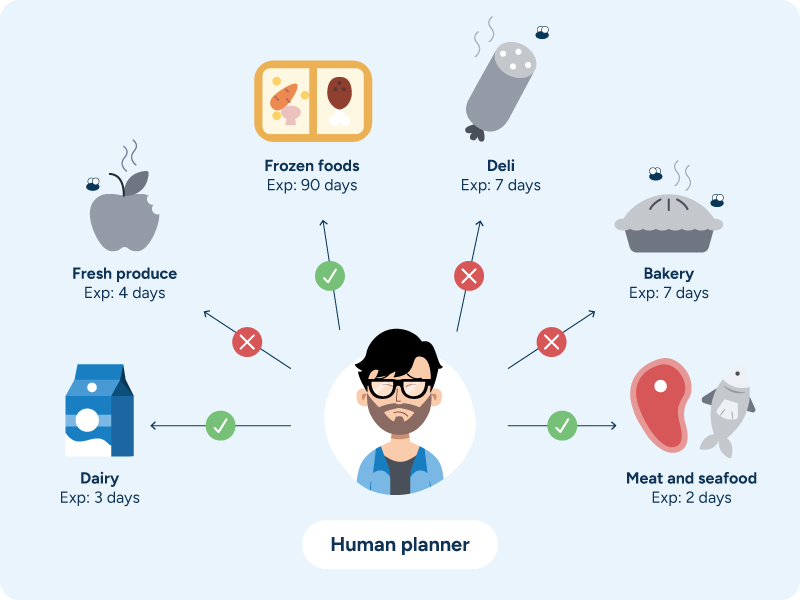
Fig 3: Products with different shelf lives are difficult for a human planner to manage accurately across every category.
The bigger underlying issue is that inventory records rarely reflect reality. Inaccurate portions, unlogged waste, and infrequent stock counts lead to replenishment decisions often based on numbers that were never accurate to begin with.
Gaps between demand planning and in-restaurant execution cut into margins
Every QSR kitchen is effectively a small production facility. But most run on fixed schedules and staff intuition, not the demand-driven planning that production environments typically depend on. When production doesn’t track demand accurately, restaurants end up with wasted food during slow periods and empty shelves during peak ones.
Decisions about how much to prepare and when are typically based on the expertise of team members and are often made without reliable visibility into what the rest of the shift will look like. That disconnect between the kitchen and the supply chain leads to overproduction or lost sales, with either result cutting into margin.
Promotions and seasonality unpredictability
Seasonal shifts and limited-time offers (LTOs) are core to QSR marketing, but they’re notoriously hard to plan for. An LTO behaves like a new product launch: no sales history, a short shelf life for the offer itself, and a real risk of cannibalizing existing menu items.
Measuring whether a promotion actually worked is just as difficult. Sorting genuine incremental sales from cannibalization and halo effects requires more precision than most planning processes can offer. Without that clarity, it’s hard to know which campaigns are worth repeating.
Varied ownership models contribute to visibility and execution issues
Most QSR brands operate through some mix of franchised, company-owned, and hybrid locations, and each model carries its own planning challenges. Franchise structures in particular create a gap between central visibility and local execution. Decentralized ordering can amplify overstock, understock, and waste across the network. Without clear visibility into restaurant-level demand, brands also struggle to negotiate effectively with suppliers.
For franchisors, this is more than just an operational problem. The quality of back-of-house tools has become a real factor in franchisee recruitment and retention. Brands that can’t offer a reliable, low-friction replenishment system risk losing prospective franchisees to competitors that can, and existing franchisees frustrated by manual processes are harder to retain.
What software capabilities does a QSR supply chain platform need?
Solving the challenges of the QSR industry doesn’t require a series of isolated fixes. It takes a single, connected planning platform built to handle the specific demands of QSR operations.
RELEX AI-driven forecasting and replenishment software addresses each of the key QSR pain points directly. The platform uses machine learning, automation, and end-to-end visibility to help team members respond proactively, before minor issues turn into major disruptions.
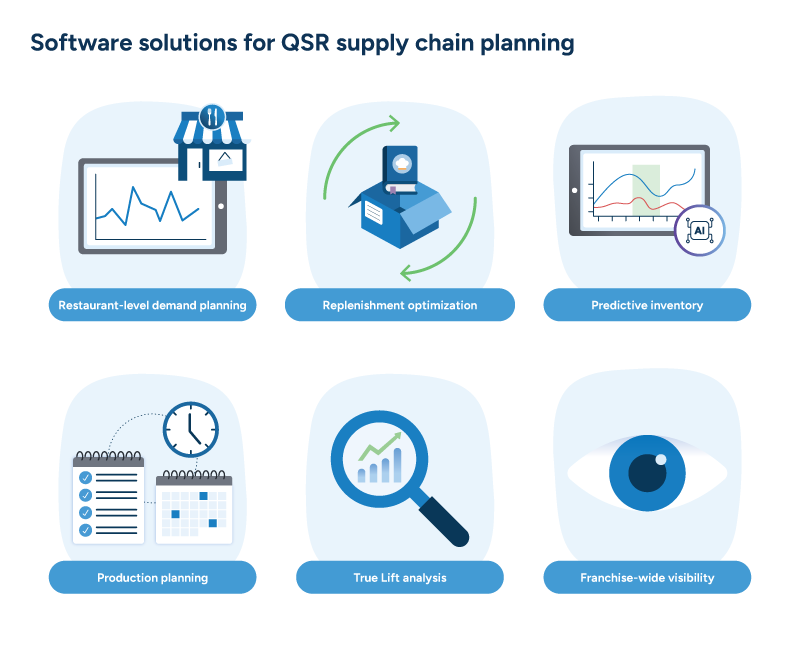
Fig 4: A connected planning platform addresses each QSR pain point, from restaurant-level demand planning to franchise-wide visibility.
Predict demand at the restaurant level
Static par levels, fixed targets based on historical sales and a manager’s knowledge, can’t keep pace with hourly demand shifts. Machine learning addresses this by incorporating location type, local events, weather, and seasonality to generate forecasts at the restaurant and SKU level. These forecasts are then continuously updated and improved as new data comes in.
RELEX puts this forecasting power directly in the hands of business teams without requiring data science expertise, performing these calculations at the scale QSR demands. This approach accommodates millions of product-location combinations, updated daily, right down to the individual restaurant level. Separate forecasts by sales channel reflect the different ordering patterns of dine-in, kiosk, and delivery.
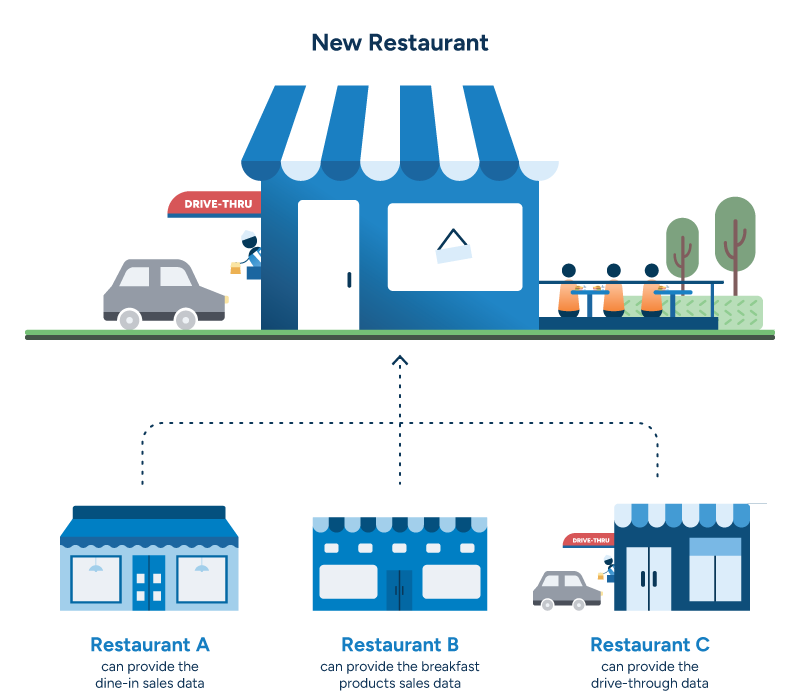
Fig 5: Reference restaurants with comparable attributes supply the sales data that builds a demand baseline for a new opening.
For new restaurant openings with no sales history, RELEX builds an initial demand baseline using reference restaurants with comparable attributes, then transitions automatically to ML-driven forecasting as real sales data accumulates.
Automate replenishment across every layer of the recipe
Manual replenishment can’t scale to the ingredient-level complexity of a QSR menu. Modern planning platforms remove the manual burden by basing replenishment on accurate demand projections rather than on static par levels and spreadsheet math.
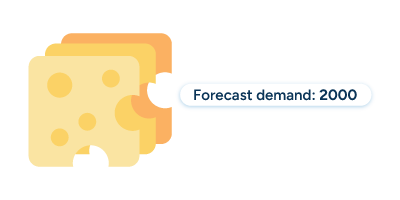
Demand forecasting needs to be conducted at the product level. For example, “domestic cheddar” uses historical sales data for all domestic cheddar, regardless of supplier.
Replenishment quantity must also be determined based on the available inventory of domestic cheddar and its forecasted demand.
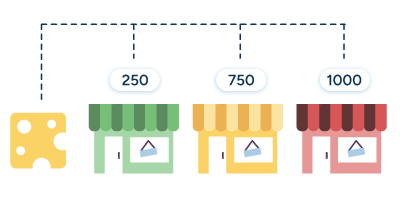

The replenishment order is where the planning system needs to move from the product level to the SKU level- from “domestic cheddar” to “domestic cheddar supplied by Grate Cheese Produce.”
Orders will often need to be split between several vendors, and the planning system must allocate the order accordingly, such as “65% to Grate Cheese Produce and 35% to Cheese Please.”
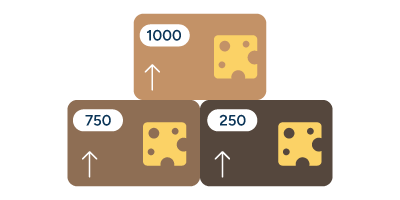
The RELEX approach to replenishment optimization supports an infinite hierarchy of recipes, automatically consolidating quantities at the ingredient level to generate order proposals. Where a single ingredient is sourced from multiple vendors, RELEX manages generic-product forecasting, inventory calculation, and SKU-level ordering simultaneously. This method allows for automatic allocation across vendors, with no manual re-entry.
Manage fresh and frozen inventory with predictive accuracy
It’s almost impossible to prevent over- or under-ordering on fresh product without an accurate view of both future demand and current stock. Predictive inventory solves this by building a theoretical stock balance continuously from transaction and delivery data, rather than waiting for the next manual count.
RELEX calculates spoilage projections and safety stock at the restaurant-SKU level and manages fresh-to-frozen ratios, recalculating frozen stock dynamically based on forecast demand and remaining fresh shelf life. Intraday forecasting precisely determines thawing quantities and timing. Anomalies are flagged automatically, replacing routine stockroom walkthroughs with targeted checks only where the data suggests a problem.
Connect kitchen production to real-time demand
Linking production planning directly to demand forecasting closes the visibility gap that impacts fresh production decisions. As a result, kitchens prepare food based on what’s actually expected to sell, rather than on a fixed schedule.
RELEX In-Store Production Planning delivers AI-driven intraday forecasts, broken down by time slot, that factor in oven capacity, batch sizes, and shelf space. Users are then presented with recommendations through a mobile-friendly interface built for restaurant staff. Because production planning runs on the same platform as ingredient replenishment, what’s prepared in the kitchen flows directly into what’s ordered from the DC or supplier.
Plan promotions and limited-time offers with measurable impact
Solving the unpredictability of LTOs requires its own specific planning logic rather than a standard promotion workflow, paired with a method for evaluating sales impact.
RELEX manages limited-time offers across three areas:
- LTO lifecycle planning covers pre-launch allocation based on similar past LTOs, in-season recalculation as early sales data comes in, and end-of-season clearance.
- Cannibalization modeling quantifies the impact on standard menu items.
- True Lift analysis measures whether a campaign drove genuine incremental sales, making it possible to identify which campaigns are worth repeating.
Support any mix of restaurant locations
Closing the gap that franchise structures create between central visibility and local execution requires giving central teams full visibility while still letting local staff act on restaurant-level demand.
RELEX generates outlet-level order proposals that restaurant teams can accept directly or adjust before submission. This includes configurable rules and parameters by location type, so franchise- and company-owned restaurants can operate under different terms within the same instance.
RELEX customers have reported up to 99% of orders being fully automated and a 67% reduction in stockouts. These results directly ease the friction franchisees face when choosing between brands.
Build a fast supply chain to match the speed of the QSR industry
The QSR teams that close the gap between what’s happening on the ground and what’s recorded in their planning systems are the ones who come out ahead of their competitors.
The more decisions are made based on real signals rather than yesterday’s numbers or a manager’s best guess, the better the process as a whole.
The shift happens when forecasting, replenishment, production, and promotions all run on the same data. If there’s a change in one area — be it a stockout, a slow lunch rush, or an LTO that’s overperforming — that change is noted and automatically adjusted for all aspects where it matters.
With RELEX handling the intricacies of QSR’s back-of-house operations, restaurant staff can focus on the customer at the counter with confidence in what’s happening behind it. A satisfied customer is a returning one, which is the whole point of getting the planning right.
For most QSR teams, the first place to start is overhauling their manual, intuition-based ordering of fresh products, as this is hardest habit to break but also the costliest when it goes wrong. See how RELEX automates fresh ordering at the store level, from daily forecasts to ingredient-level order recommendations, with accurate, needs-based ordering for fresh products.
Quick service restaurant (QSR) planning FAQ
How do QSR and fast-casual supply chains differ?
QSR and fast-casual restaurants are often grouped together, but their supply chains put pressure on different points. QSR typically runs on a standardized menu, high volumes, and centralized distribution across ambient, frozen, and fresh stock, so the core planning challenge is forecasting demand at the ingredient level across a large network. Fast-casual concepts emphasize fresh, made-to-order ingredients, which have shorter shelf lives, less room for error on spoilage, and more variation in what each order requires.
Both QSR and fast-casual supply chains depend on restaurant-level forecasts, but the fresh-heavy nature of fast-casual restaurants leans more heavily on spoilage projections and remaining shelf life to keep availability and waste in balance. RELEX calculates both at the restaurant-SKU level and feeds them directly into replenishment orders.
Is a recipe the same as a bill of materials (BOM)?
Yes, in principle, both describe how a finished item is built from its component parts and in what quantities. The difference is in origin and structure. BOM is a manufacturing term for a structured, engineering-defined list of components, while recipe is the term restaurants actually use. A recipe also carries more built-in variability than a formal BOM, since ingredient substitutions, seasonal swaps, and yield loss are expected rather than exceptions.
In QSR specifically, this variability shows up as sub-recipes, such as a house-made sauce built from several other ingredients. This adds a layer of calculation when translating menu demand into orders.
What is True Lift analysis in promotion planning?
True Lift analysis measures the actual incremental impact of a promotion or LTO. It isolates genuine lift from effects like cannibalization (customers switching from one menu item to another) and halo (a boost in sales of items not directly promoted). This distinction matters for QSR teams deciding which campaigns to repeat. A promotion that looks successful in raw sales numbers may simply be shifting demand, not creating it.
How does supply chain planning affect workforce scheduling in QSR?
Staffing and supply chain planning are often managed as separate functions, even though they depend on the same underlying demand signal. When a restaurant expects a lunch rush or a promotional spike, that same forecast should inform both how much inventory to have on hand and how many staff to schedule. Connecting the two reduces the risk of being overstaffed during slow periods or understaffed during a rush.
How long does it take to implement an AI planning platform in the QSR industry?
Implementation timelines vary by scope, but modern platforms are built to handle QSR’s scale without a multi-year rollout. RELEX customers with thousands of outlets have gone live within three to six months, with full ROI typically achieved within the same year.
Written by

Related Articles
Case Study: Coop Estonia
Coop Estonia selected RELEX to introduce this new pricing approach following an evaluation of functional fit.

Agentic AI in manufacturing supply chain planning
Learn why most manufacturers need both general and tailored agents, meet the five core RELEX agents for manufacturing, and see how RELEX Open lets you deploy, connect, and extend AI across your supply chain planning.
Case Study: Grupo Vinoteca
See how Grupo Vinoteca, a Mexican wine and spirits distributor, reduced lost sales by 34.7%, cut store replenishment time by around 50%, and saved on inventory with RELEX's unified planning.