7 ways AI planning software solves meat manufacturing’s supply chain challenges
Sep 3, 2026 • 16 min
In red meat processing, manufacturers are caught in the middle of a complex tug-of-war. Livestock supply tugs on one end of the rope, regardless of market conditions, while customer demand pulls from the other end with its own unpredictable variability. No manual planning process has the structural capability to hold that tension under current circumstances.
This is because red meat manufacturing is the simultaneous collision of four sources of uncertainty:
- Supply volumes vary with every kill cycle.
- Livestock quality and grade cannot be confirmed until the animals arrive.
- Order lead times are often short and unpredictable.
- Demand shifts across retail, foodservice, and export with its own variability.
Each of those forces is hard enough to manage in isolation. Managing all four at once across a single connected value chain is an issue that spreadsheets and siloed planning tools were never built to solve.
What most red meat manufacturers don’t yet have is a planning approach that tackles challenges with a single, continuously rebalanced plan rather than multiple separate problems requiring separate fixes. This kind of rebalancing is beyond the reach of manual planning effort.
Doing it successfully requires planning software built to model carcass economics, surplus timing, and demand shifts, enabling planners to make the necessary adjustments at the required speed. With this approach, businesses can close margin gaps, respond in hours to supply and demand disruptions, and have all functions, from livestock buyers to sales, working with greater cohesion.
Why problems build across the five stages of red meat production
Red meat processing runs through five stages from the ranch to the customer. Each stage hands the next one a problem it didn’t create.
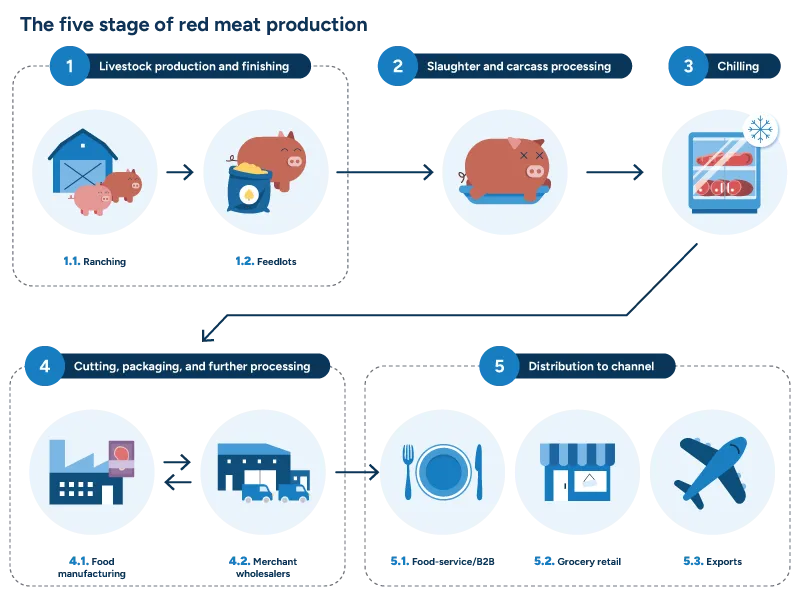
1. Livestock production and finishing.
Breeding and rearing take six to eighteen months; feedlot finishing adds four to six months, and pasture finishing can run twelve to twenty-four. The animal’s eventual weight and grade are shaped by various factors, including:
- Genetics
- Nutrition
- Health
- Environment
But neither can be confirmed until the animal reaches the plant. Every plan built downstream rests on a supply forecast that stays uncertain for the better part of a year.
2. Slaughter and carcass processing
A carcass yields a fixed set of cuts the moment the kill happens, and those yields can’t be revised afterward. Weight and grade, uncertain throughout the entire first stage, are only confirmed here, at the exact moment allocation across retail fresh, foodservice, further processing, and export has to be decided. A kill landing heavier or lighter than forecast changes that allocation instantly.
3. Chilling
Fresh meat loses roughly 2% of its weight per 24 hours in the chiller, so every hour of hold time incurs a direct cost. Several markets require 48 to 72 hours of chilling before further cutting can begin, a mandatory hold that runs straight into the pressure to minimize it. This is also where the shelf-life clock formally starts on everything downstream.
4. Cutting, packaging, and further processing.
Once chilled, the product splits across three streams with different economics:
- Fresh retail cuts packed and date-coded daily.
- Further-processed product that can run in longer campaigns because it freezes or holds longer.
- Custom-cut or foodservice product cut to a specific order.
An incorrect raw material decision here shows up as a margin problem two stages later.
5. Distribution to channel.
Retail grocery needs precise date-code management and on-shelf timing. Foodservice and B2B need flexible scheduling against variable order patterns. Export needs container-fill optimization and documentation compliance. Whatever imbalance survived the first four stages surfaces here, especially against customers with little tolerance for late or short deliveries.
The compounding problem
Many red meat manufacturers plan each of these five stages in a different spreadsheet, maintained by a different function. Livestock buyers work from one set of numbers, production planners from another, and sales from a third set, creating a fragmented system. When the numbers disagree, the loudest voice in the room tends to win, not the most accurate plan.
How to close the planning gaps in red meat supply chains
Rebalancing five compounding stages across spreadsheets limits the manufacturers’ ability to keep pace with how fast the industry actually moves. Purpose-built planning software provides planners with greater visibility across every stage of the meat manufacturing process, helping them identify trade-offs and act on them before the window closes.
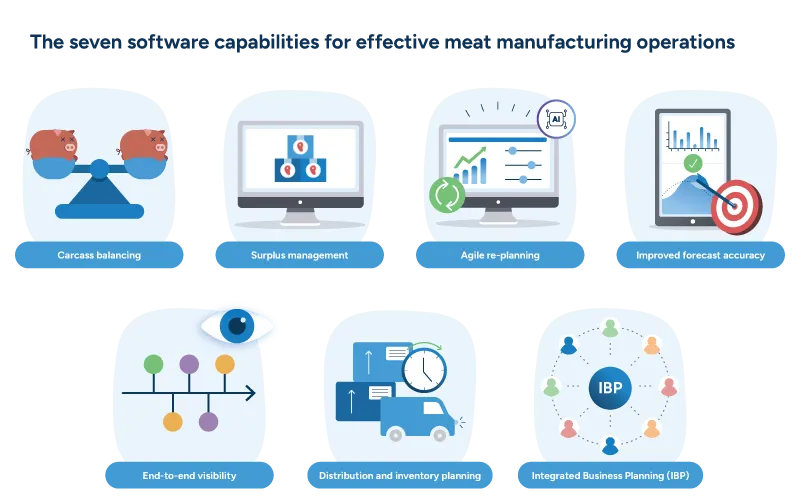
1. Use carcass balancing to maximize value from every animal
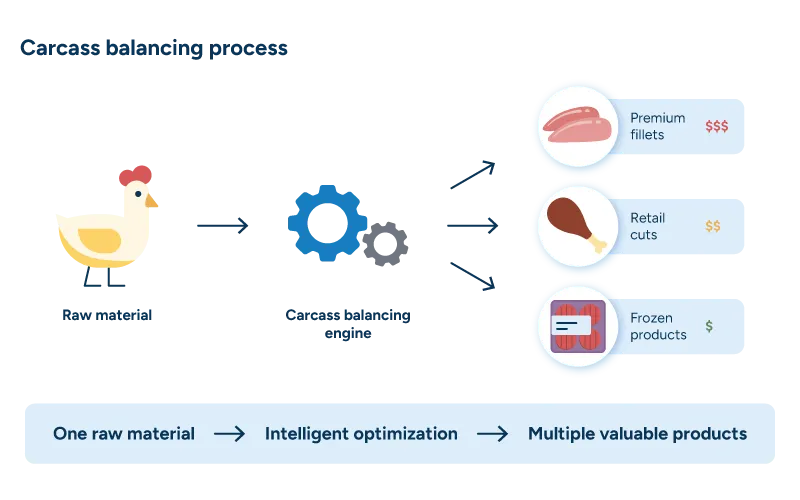
Balancing the carcass involves utilizing every part of the animal while matching available supply against customer demand across multiple product streams. In most cases, there will be an imbalance that forces planners to make trade-offs with real margin consequences that can quickly become complex.
Red meat production planners should strive to optimize the animal to maximize profit. This means using the carcass in its entirety, ensuring that all its parts find their way into the best possible revenue stream.
Price realization across channels is one key dimension of this challenge. Many cuts can satisfy more than one type of demand. A primal (a large wholesale carcass section) that meets a premium retail specification might equally serve a foodservice order or a further processing run. Customers may have strong preferences for specific cuts, while others are willing to accept substitutions.
The real difficulty in optimization is matching the full range of available supply to the full range of demand options simultaneously. Identifying the cut plan then means allocating the right cut, from the right carcass, to meet the right demand at the highest possible value.
READ MORE: 3 food manufacturing supply chain challenges — and how to solve them
When done manually, planners can only approximate these cut allocations, and getting them wrong leads directly to margin losses. This is where attribute-based planning becomes critical. This planning approach matches each cut’s quality grade, size, and specification to the most profitable available demand, rather than treating raw material as a uniform input.
RELEX uses an engine that combines heuristics and mathematical optimization to find the allocation that maximizes the total carcass value across all streams while considering all relevant constraints. The engine evaluates thousands of cut-plan combinations simultaneously, accounting for:
- Limited supply
- Confirmed orders
- Demand fluctuations
- Shelf life
- Substitution logic (internal as well as customer orders)
- Downgrades
- Business constraints
This approach ensures that premium-grade products are directed to premium-demand channels, while lower-grade cuts find their highest-value alternative home.
2. Use surplus management to catch excess before shelf life forces a decision
Surplus in red meat processing is an unavoidable reality that planners must account for. Carcass raw material produces joint yields across every cut, and demand never maps perfectly to that yield. The challenge for red meat processors is identifying surplus early enough to do something useful with it before it’s too late.
When the chiller is full, there are only three options for the surplus:
- Freeze at a significant discount
- Divert to lower-value manufacturing
- Markdown to clear space before shelf life expires
All three destroy margins. The price gap between fresh and frozen alone makes reactive surplus management one of the most reliable sources of margin erosion in red meat supply chains.
In this case, a capable planning system needs to shift the surplus signal from days to weeks. Surplus management stops being a damage-limitation exercise and becomes a commercial planning decision when the tool grants teams forward visibility of supply, demand, and inventory across a 16-week horizon. Sales teams can find a better home for the product before the clock runs out. Cut plans can be adjusted before production locks in the imbalance. The range of available options and the value recovered are directly proportional to how early the signal arrives.
RELEX allows planners to generate a single, connected plan that evaluates surplus, carcass balancing, and production scheduling decisions together against total chain profitability. The platform’s connected planning mechanism eliminates the need for different functions to make three sequential calls, turning surplus from an operational problem requiring reactive action into a controllable margin lever.
3. Gain the agility to replan as fast as disruption happens
In red meat processing, disruption doesn’t wait for the planning cycle. Any number of complications can change the carcass balance, the boning room schedule, and the customer commitment position at once.
For example:
- A grade shortfall from the feedlot leaves fewer premium cuts than estimated in the cut plan, forcing early substitution decisions across committed orders.
- A major retail order gets canceled with 72 hours’ notice, stranding cuts already committed to that channel.
- A promotional uplift confirmed with 48 hours’ notice, requiring more volume than the current cut plan allows.
- A transport delay leaves a kill sitting past its chilling window, forcing planners to choose between an emergency reallocation and a fresh-product write-off.
Each scenario demands a revised plan before the window to act closes. When restricted to a spreadsheet-driven planning environment, that revised plan takes days to produce.
For fresh retail cuts and custom-cut foodservice, that delay has a direct commercial cost. By the time production planners have reconciled the new supply signal against open orders and chiller inventory, the options available at the moment of disruption have already narrowed. Fresh product has moved through its shelf-life window, and what could have been redirected, repriced, or reallocated at full value is now a more expensive problem to solve.
The asymmetry between fresh and processed products matters. Further processing lines have a natural buffer. Most further-processed products are frozen or have an extended shelf life, which means the stream can absorb disruptions with more time to respond. However, fresh retail and custom-cut foodservice have no equivalent buffer. The urgency is sharpest precisely where shelf life is shortest.
The planner’s role shifts from rebuilding the plan to only managing the cases that require human judgment.
Planning systems need to absorb the disruption signal and re-optimize across the full value chain before the window closes. In RELEX, the system continuously captures numerous streams of essential information, ranging from livestock intake data and actual kill weights to customer demand signals and available production capacity.
When any of these signals change, the cut plan and production schedule reoptimize automatically, surfacing only the exceptions that require a human decision. Whether a kill comes in heavier than forecast, a major order shifts, a line goes down, or capacity becomes constrained, the planner’s role shifts from rebuilding the plan to only managing the cases that require human judgment.
4. Sharpen forecast accuracy to get granular enough to be useful
Forecast accuracy is the foundation on which every other planning capability is built. Carcass balancing optimizes against demand signals. Surplus management relies on forward visibility into supply and demand. Agile replanning recalculates against live demand positions. If the forecast that feeds those decisions is wrong, the downstream plan is wrong too, and the margin consequences compound across every function that relies on it.
Forecasting in red meat is about getting the timing right as well as the volume. Fresh retail cuts operate on a different logic to ambient or frozen categories: the shelf-life window is the governing constraint, and it does not wait for the planning cycle to catch up. These cuts are packed and date-coded every day, and any missed production day cannot be recovered. The demand that existed that morning belongs to a different date code by afternoon, and weekly or monthly forecasting granularity simply does not match how the product actually moves.
What makes forecasting in red meat particularly challenging is that the problem runs in both directions simultaneously.
- Demand must be forecast by product, cut, customer, and channel, each with its own variability, promotional pattern, and order behavior.
- Supply must be forecast by livestock grade, weight, and breed at the same time.
Both sides of that equation are uncertain, and a planning system that handles one without the other only solves half the problem.
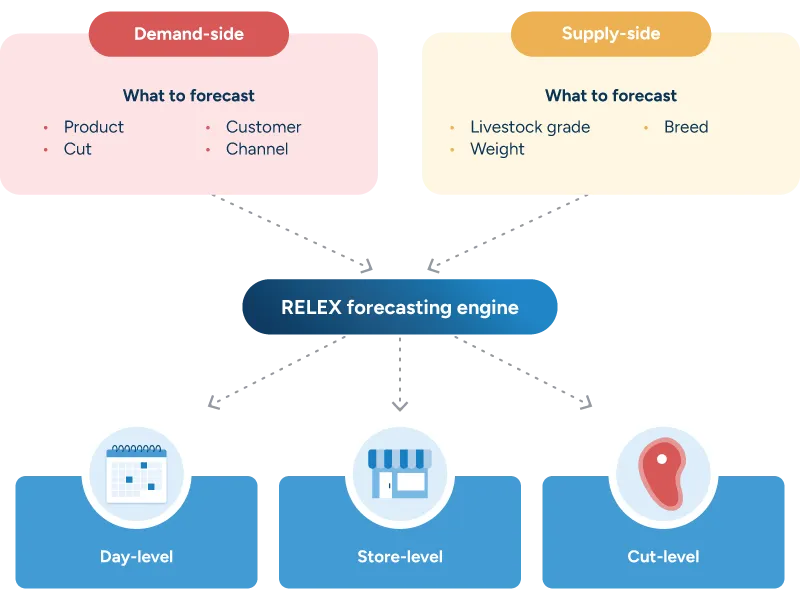
The RELEX machine learning (ML)-based forecasting engine automatically builds models at day-, store-, and cut-level granularities when required. It captures day-of-week patterns, promotional uplifts, seasonality, and customer-level variation without manual configuration. When data-sharing agreements are in place with retail partners, RELEX ingests point-of-sale data and store inventory positions directly, driving replenishment recommendations upstream into the processor’s production and packing schedules.
For foodservice operators, the same engine operates at the outlet level across potentially hundreds of locations. This sees red meat processors move from being order takers to becoming supply chain partners embedded in their customers’ planning cycles.
5. Use end-to-end visibility to see the full picture before decisions close
Without a complete view of the supply chain, every planning decision, from carcass balancing to distribution scheduling, is built on partial information. Supply chain planners can optimize a carcass balance, flag a surplus 16 weeks out, and re-optimize a cut plan in response to a disruption signal. That’s only possible if the data that feeds those decisions is complete, up to date, and stored in one place.
True end-to-end visibility in red meat spans a planning horizon of 13 to 16 weeks and covers every layer of the value chain:
- Livestock supply and grade profile across the forward procurement window.
- Production capacity across the kill floor, boning room, and further processing lines.
- Inventory levels across fresh, frozen, and further-processed categories
- Customer order coverage.
- Projected service levels by account, surplus positions with time-to-expiry for fresh product in the chiller.
- Distribution requirements and transport capacity.
Without a complete view across all of those dimensions, the planning process becomes reactive by default. It results in near misses, actual misses, inventory frozen at a discount, and a persistent race to clear surplus before expiry.
Every decision made without full visibility carries a cost that doesn’t appear on a single line in the profit and loss account. It accumulates across every suboptimal allocation, every unplanned freeze, and every service failure that could have been avoided with an earlier signal.
RELEX provides dashboard-driven visibility across short, medium, and long-term planning horizons, with automated exception alerts that surface only the conditions requiring planner intervention. That’s the same exception-based mechanism that makes agility replanning tractable. Planners aren’t manually scanning every SKU and every order; they’re working from a system that has already identified where attention is needed.
6. Use distribution and inventory planning to keep production promises
Distribution and inventory management is where the commercial promises made upstream are either kept or broken. Managing finished goods inventory across fresh/chilled, and frozen categories while coordinating dispatch across retail, foodservice, B2B, and export channels requires connected planning between the production schedule and the customer delivery calendar.
Inventory management in red meat spans multiple product states, each with distinct shelf-life characteristics, storage requirements, and margin implications:
- Fresh product inventory, including primals, sub-primals, and packed retail cuts in the chiller. Shelf-life windows are short and unforgiving; products that miss their fresh window must be frozen or discarded.
- Frozen product inventory, including surplus fresh product, frozen further-processed lines, and export stock held in frozen storage. Frozen stock carries ongoing storage costs.
- Ingredients and packaging, including raw materials for further processing, packaging components, and labeling materials. Ingredient inventory directly impacts production planning and adherence to the further processing schedule.
Stock parameter settings differ fundamentally between fresh products and frozen or further-processed categories.
For fresh primals and packed retail cuts, shelf life is the governing constraint: the planning system builds ahead by a defined number of days of coverage, sized to the production run frequency and the delivery lead time to the customer. The goal is to have enough product to satisfy demand without accumulating stock that will expire before it can be shipped. This is a days-of-coverage problem, not a statistical safety stock optimization problem.
For frozen and further-processed products, the calculus is different. These products can be held for weeks or months, allowing stock parameters to be set using proper statistical optimization. Safety stock levels are calculated based on demand variability, forecast accuracy, supply lead times, and the cost of a stockout versus the cost of holding inventory. Maximum stock parameters can be defined to actively constrain frozen accumulation and prevent margin erosion from long-held inventory.
The role of third-party logistics (3PL) providers also falls under this category. The cost of receiving, holding, and dispatching pallets must be accurately captured and factored into planning decisions.
On the distribution side, the challenge is coordinating dispatch across multiple customer channels simultaneously, each with different order patterns, lead times, packaging requirements, and compliance obligations. Retail grocery programs have precise requirements for date codes and on-shelf availability, while foodservice and B2B customers require flexible scheduling and accurate lead-time commitments. Export customers require container fill optimization and documentation compliance. Load optimization and vehicle scheduling must be integrated with the production plan to avoid the costly disconnect between what has been produced and what can actually be shipped.
RELEX manages expiry across the supply chain, ensuring that inventory levels are actively controlled and that no product ages beyond its commercial window without a plan to move it. Safety stock parameters are set by product category. Fresh, frozen, and further-processed each carry different holding economics, and the system calibrates accordingly. Production planning is aligned directly with demand, stock holding targets, and distribution schedules, so what is produced reflects what is needed and when it needs to ship.
For export, RELEX holds container release until the container is fully loaded. This prevents part-filled containers from being dispatched prematurely and protects both freight economics and customer compliance.
7. Use integrated business planning to build one connected plan
Integrated business planning (IBP) is the structured process that compels all business functions to work from the same plan. IBP connects livestock supply, production planning, sales, and finance into a single integrated view of the business. It outlines a clear meeting cadence, defined ownership, explicit inputs and outputs, and accountability for adherence.
The distinction matters because without governance, IBP meetings quickly become reporting sessions rather than decision-making forums. Functions arrive with their own numbers, defend their own positions, and leave without a shared plan.
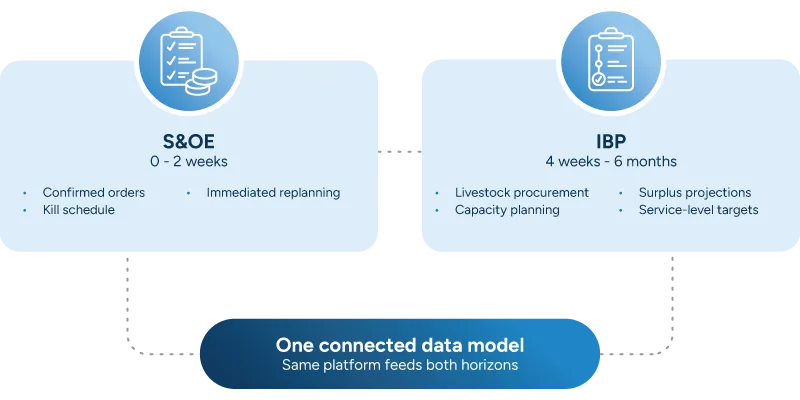
The planning horizon for red meat typically spans two distinct layers.
- Sales and operations execution (S&OE).
This addresses the short-term horizon of 0-2 weeks, covering confirmed orders, kill schedules, and the immediate replanning decisions that agility and visibility make tractable.
- Integrated business planning (IBP).
IBP covers the medium- to long-term, from 4 weeks to 6 months, which includes:
- Livestock procurement commitments
- Capacity planning
- Forward surplus projections
- Service-level projections
This planning horizon gives commercial teams enough runway to act. Both layers depend on the same connected data model, meaning the decisions made at each horizon are informed by the same data rather than reconciled across conflicting spreadsheets afterward.
When IBP works, it makes carcass balancing trade-offs visible to the whole business and resolves them collaboratively. A livestock shortfall in week four isn’t a production problem or a sales problem; it’s a business problem, and IBP is the forum where the business solves it as one. RELEX provides the data foundation that makes that forum possible. Pre-built IBP dashboards summarizing supply position, demand outlook, surplus risk, and service level projections, with automated exception reporting surfacing the decisions for cross-functional judgment.
Supply chain problems solved collaboratively in one connected plan.
Evaluate your red meat planning approach
The supply chain planning challenges involved in red meat manufacturing aren’t due to seven independent capability gaps. It’s best to think about it as seven dimensions of one connected problem, where a miss in any one of them creates consequences across all the others. The checklist below gives supply chain planners a framework for evaluating any planning approach, including their current setup, against all seven requirements.
| Capability | What to look for |
| Carcass balancing | – Are you maximizing the value of each carcass? – Can the system evaluate multiple cut-plan combinations simultaneously across all product streams and customer specifications? – Can it consider shelf life, substitution logic, demand variation, trim allocation, and the full range of business constraints, all at the same time and not sequentially? |
| Surplus management | – Does the business have a clear view of future surplus? – Does the system surface surplus positions weeks ahead of the problem and not after the chiller is full? – Can planners see which product is at risk, how much time remains, and what the cost of each available option is, before shelf life forces the decision? |
| Agility & responsiveness | – How quickly can a new plan be generated when supply or demand signals change? – When livestock comes in heavier than forecast, an order cancels, or a grade shortfall emerges, does the system reoptimize the cut plan and production schedule automatically? – Or does replanning require a planner to manually reassemble the picture from scratch? |
| Forecast accuracy | – Do you measure forecast accuracy, and if so, with what lag and how accurate is the forecast? – Does the system forecast at day-level, cut-level, and customer-level granularity? – Does it handle both demand and supply forecasting simultaneously, including livestock grade, weight, and breed variation, rather than treating them as separate processes? |
| End-to-end visibility | – Is everyone in the business looking at the same set of numbers? – Does the system give you a single, current view across a 13–16 week planning horizon? – Does the current view cover livestock supply, production capacity, inventory positions, order coverage, surplus risk, and distribution requirements, without assembling it manually from multiple sources? |
| Distribution & inventory management | – How well is the business managing expiry and inventory and storage levels? – Does the system apply days-of-coverage logic for fresh product and statistical safety stock optimization for frozen and further-processed categories? – Is load and vehicle scheduling connected directly to the production plan, so what is scheduled to ship reflects what has actually been produced? |
| Integrated business planning (IBP) | – Does the system support a governed IBP process with structured meeting cadence, defined inputs and outputs, and clear ownership, or does it just produce reports? – Does it connect livestock, production, sales, and finance across both the short-term S&OE horizon and the medium-to-long term planning horizon? |
For red meat processors looking to understand how a unified planning platform addresses all seven requirements in practice, the RELEX meat processors page covers the full scope of what that looks like across the value chain.
Written by

Related Articles

How to build a consumer decision tree: why the best CDTs start with shopper behavior, not supply logic
See why CDTs based on shopper behavior beat vendor- and workshop-built trees, and how RELEX CDT Builder applies the method.

Agentic AI in manufacturing supply chain planning
Learn why most manufacturers need both general and tailored agents, meet the five core RELEX agents for manufacturing, and see how RELEX Open lets you deploy, connect, and extend AI across your supply chain planning.

Case Study: Grupo Vinoteca
See how Grupo Vinoteca, a Mexican wine and spirits distributor, reduced lost sales by 34.7%, cut store replenishment time by around 50%, and saved on inventory with RELEX's unified planning.