Most manufacturers see upstream risk, yet few plan for it
May 19, 2026 • 5 min
Manufacturers can tell you exactly where their supply chain is most vulnerable.
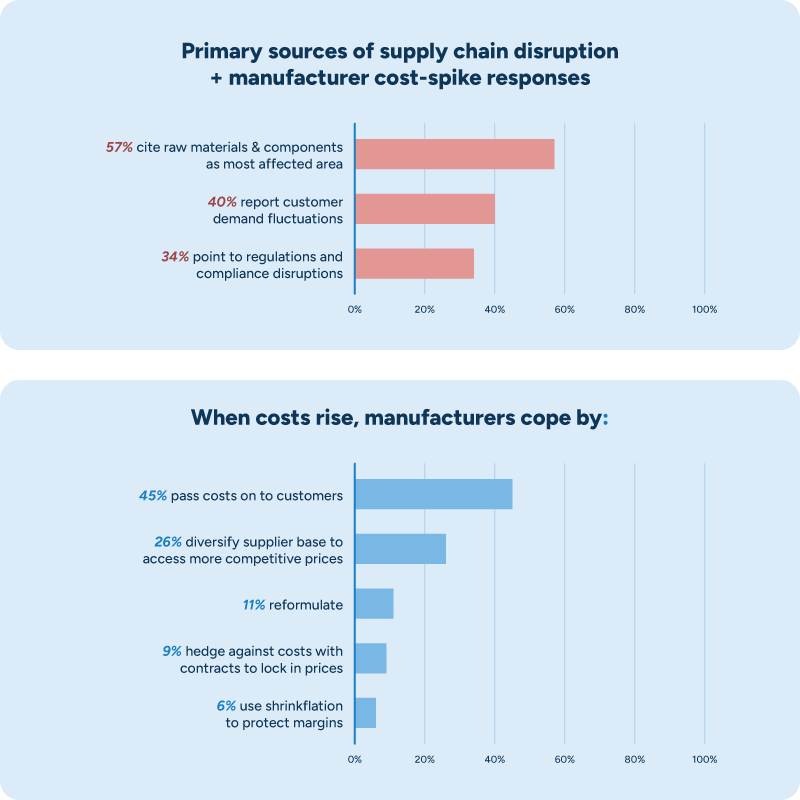
In our 2026 State of the Supply Chain report, 57% of manufacturers identify raw materials and components as their most disrupted area.
Yet when costs spike, the most common response is to pass them downstream. Not to hedge. Not to reformulate. Not to build structural alternatives.
Upstream disruption is well-understood, documented, and discussed. It’s not a hidden or emerging problem. But despite awareness of the issue, we find that developing a successful strategy is where manufacturers often struggle.
Upstream disruption hits manufacturing the hardest
Raw materials and components sit at the top of the disruption stack, but they’re not the only pressure point.
40% of manufacturers we surveyed cite customer demand fluctuations as a major source of disruption, and 34% cite regulations and compliance as a pain point. This reflects what we’re seeing in the industry: that manufacturers are dealing with disruption on multiple fronts simultaneously. It’s not just one problem.
But that 57% at the top matters because upstream risk is structurally harder to absorb than downstream risk. Lead times are longer, substitutes are fewer, and geography and geopolitics drive risk more than demand signals do. Unlike downstream variability, which often gives some lead time through demand signals, upstream disruption can arrive faster than the buffers manufacturers built to absorb it.
Upstream risk is also harder to quantify than downstream risk. It’s difficult to predict that a specific trade route would be disrupted or that a key supplier in a certain region would face regulatory changes. This complexity often means upstream considerations are deprioritized in planning cycles, despite being the area of greatest exposure.
Reaction is outpacing preparation
Our survey also found that when costs spike, 45% of manufacturers pass them downstream — the most common response by a wide margin.
Compare it to the other responses: 26% diversify their supplier base to access more competitive pricing and reduce dependency on single sources. This is a step toward structural change but doesn’t address commodity price exposure or route concentration.
Other responses showed:
- Only 11% reformulate inputs with alternative ingredients.
- 9% hedge commodity costs via contracts.
- 6% reduce pack sizes.
Some manufacturers are applying more than one of these tactics simultaneously, but the pattern holds. Reactive responses dominate over structural ones.
That context matters, because 89% of manufacturers report material impact from trade policies (higher than retail or distribution). But the most common response to that significant pressure isn’t cutting it. Manufacturers are reacting, but reaction has become the default response rather than one tool among several.
Take cost pass-through. It’s a transaction, not a strategy. It doesn’t change anything about a manufacturer’s underlying position. Their exposure to that raw material at that price, through those suppliers, along those routes, is exactly the same after the pass-through as it was before. It recovers margin in the short term but leaves the vulnerability intact and strains customer relationships over time.
Cost pass-through is a transaction, not a strategy.
The gap between the 57% who identify raw materials as their top risk and the 9% who hedge against it is an investment and prioritization gap that can be closed.
What readiness looks like now
The report shows that manufacturers are quietly abandoning the strategies that have traditionally defined supply chain resilience. For instance, manufacturers who report keeping extra safety stock dropped from 43% to 28% year-over-year, and supplier base expansion dropped from 50% to 37%.
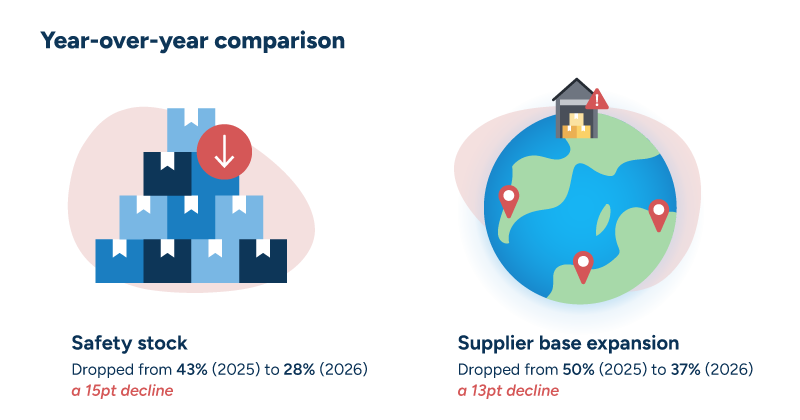
These figures suggest that companies are pulling back from breadth-based resilience, where manufacturers spread across more suppliers, inventory, and geographies to protect against disruption. Holding extra safety stock is capital-intensive and ineffective against supply-side disruption rather than demand-side and has lost its appeal as a result. These inventory buffers also fail to address sourcing failures and create their own carrying cost risk.
Manufacturers are moving away from breadth and toward depth-based resilience. 24% say they’re partnering more closely with retailers on planning and assortment than they have in the past. This alternative approach involves fewer suppliers, but closer ones, built on shared visibility, joint contingency planning, and collaborative forecasting. That’s a different bet than breadth and trades the appearance of optionality for actual coordination with the suppliers who matter most.
The same logic plays out internally. Rather than holding more stock, 34% of manufacturers are using tech-optimized inventory to get smarter about what they hold onto. Instead of building a buffer and just hoping it’s thick enough, manufacturers can use data to precisely anticipate their needs.
47% of manufacturers are already using or planning to use AI for inventory and supply optimization, to manage existing stock more efficiently, and to reduce carrying costs. That’s valuable, but it’s still largely an internal, operational application. It’s optimizing what manufacturers already have.
The next step is using the same capability to model what hasn’t happened yet: modeling route closures, supplier failures, and commodity price spikes before they happen, not after. Procurement scenario planning offers a more anticipatory use of the same capability. Instead of using AI to manage inventory that already exists, you’re using it to model hypothetical possibilities before they happen.
That shift is part of a broader AI posture: 54% of manufacturers prefer a hybrid model in which AI makes recommendations, but humans finalize decisions. AI deployment is real and growing, but the industry clearly favors a particular way of interacting with it.

The uncertain future
With all the uncertainty and change, it’s easy to assume manufacturers are likely feeling down about the future. That’s just not the case.
We found that about three-quarters of supply chain leaders actually report feeling optimistic about the future. They don’t expect volatility to ease, but they’re building the capacity to adapt faster than the disruption travels.
Supply chain leaders who report optimism about the next 12-18 months are betting on their own organizations’ ability to adapt to volatility around them. The question for manufacturers still defaulting to cost pass-through is whether they’ll make the same investment before the next disruption forces their hand.
Understanding where the industry stands now is the first step toward closing that gap. The 2026 RELEX State of the Supply Chain report surveyed over 500 supply chain leaders across retail, wholesale, and manufacturing to find out how organizations are responding to disruption, where strategies are shifting, and where the gaps remain.
Written by

Related Articles

QSR supply chain planning: overcoming operational friction with ingredient-level forecasting and franchise-wide visibility
Discover how connected QSR supply chain planning closes the gap between the kitchen and customer demand.

Agentic AI in manufacturing supply chain planning
Learn why most manufacturers need both general and tailored agents, meet the five core RELEX agents for manufacturing, and see how RELEX Open lets you deploy, connect, and extend AI across your supply chain planning.

Case Study: Grupo Vinoteca
See how Grupo Vinoteca, a Mexican wine and spirits distributor, reduced lost sales by 34.7%, cut store replenishment time by around 50%, and saved on inventory with RELEX's unified planning.