Fish supply chain planning operates under a constraint that most planning tools were never built for: the raw material that doesn’t wait. A fresh fillet loses commercial value by the hour. A harvest that arrives short, off-grade, or at the wrong size requires a decision before the processing line commits, not after the weekly planning meeting.
Whether they’re a producer managing their own stock or a processor buying whole fish to spec, the decisions with the highest commercial consequences in fish are the ones suppliers have the least time to make. Most fish companies are still making them with tools built for businesses under considerably less pressure to operate at speed. Here’s a map of the gaps that cost fish companies the most — and how they can plan to close it.
The primary challenges at each production stage of the fish supply chain
Fish supply chain planning has five major points of failure, and they compound each other. Each section below describes these stages in detail and explains why closing the planning gap requires addressing all of them, not just the most visible one.
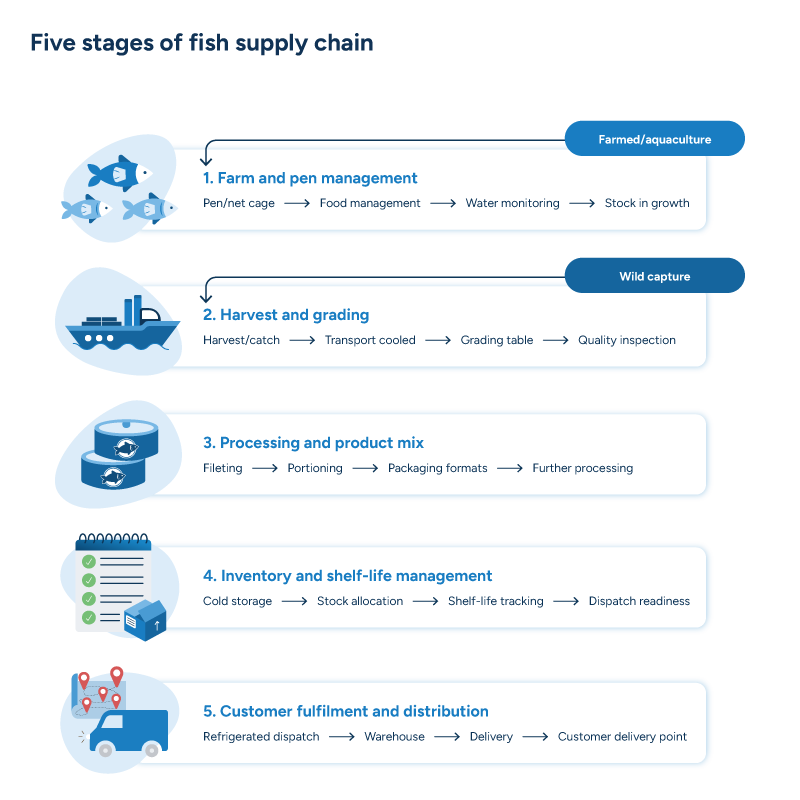
1. Variability and visibility during farm and pen management
For aquaculture producers, the supply chain starts years before a fish reaches a customer. Fish are bred, fed, and raised across multiple pens and sites, with harvest quality and volume shaped by decisions made 18 months or more in advance. Wild-capture operations face a different version of the same constraint: landings are shaped by weather, sea state, quotas, and seasonal stock abundance rather than farm management decisions.
The planning challenge here is visibility, an issue compounded by how much can change over an 18-to-24-month grow-out cycle. Weather events, sea lice, and health incidents can shift harvest volumes and quality grades significantly before the fish ever reaches the processing facility. Better farm-level monitoring has improved the picture over time, but variability remains.
At any given point, the business needs to know:
- How many fish will be available to harvest over the next 12 weeks?
- What size distribution can be expected?
- Which farms will produce which grades?
Without a rigorous, pen-by-pen, site-by-site picture of what’s in the water — and how it’s likely to look when it comes out — every downstream planning decision is built on an unreliable estimate rather than a data-driven projection.
2. Time crunches during harvesting and grading
This stage is where planning urgency, exacerbated by variability, becomes the greatest challenge. Fish arrive at processing facilities within hours of leaving the water. The size distribution, grade split, and total volume of a given harvest may not be fully known until they’re on the processing line. That uncertainty arrives at exactly the moment planning decisions need to be locked in. For instance, a harvest that comes in 15% lighter than forecasted, or skewed toward lower grades than expected, requires an allocation decision before the processing line commits.
Plus, with no pre-agreed framework, no visibility into which customers will accept a substitution, and no model of what the best available outcome looks like, the planner is forced to make a high-stakes commercial decision under maximum time pressure with minimum information.
3. Poorly optimized processing and product mix
A single fish can be sold in many forms:
- Whole
- Gutted
- Filleted
- Portioned
- Smoked
- Frozen
- Processed (like salmon burgers)
Each processing route produces a different product with a different shelf life, customer base, and margin profile. Deciding which fish goes to which route is one of the highest-value and most complex choices in the supply chain.
When it comes to making these decisions, optimizing capacity becomes the biggest planning challenge. Customer requirements may or may not be flexible, and reworking lower-grade fish into higher-quality products can entail additional processing time and labor, which places its own demands on capacity.
Processing capacity places a hard ceiling on what’s possible at any given time, and the fish arriving may not match what was planned — in grade, volume, or both.
4. Complex, time-sensitive inventory and shelf-life management
Once processed, fish products enter inventory with a countdown running. Unlike most food categories, holding stock is a cost, not a buffer against uncertainty.
Each unit needs to go:
- To the right customer.
- Through the right channel.
- Fast enough that value is preserved.
Optimizing inventory to this degree requires forward visibility of both supply and demand across a rolling horizon, not a snapshot of today’s stock position. The problem is that most companies have muddy data that obscures and inhibits smart inventory and shelf-life decisions.
A product that isn’t positioned well ends up in markdowns, emergency freezing, or the spot market. And the spot market prices fish by the seller’s urgency, not its value.
5. Ad hoc decisions around customer fulfillment and distribution
From processing, product moves to retailers, foodservice operators, and export markets, each with distinct requirements around temperature, timing, traceability, and specification.
Tolerance for variation differs significantly across customers. Some will accept a smaller fish or a different cut when their preferred specification isn’t available; others won’t, and the relationship suffers if they receive one anyway.
The planning challenge here is prioritization. Supply shortfalls don’t wait for considered decisions. Allocation calls made reactively, based on who phones first rather than commercial logic, damage relationships and erode margin. The same decision, made against a pre-agreed framework that reflects customer tier and strategic priority, becomes manageable.
How to close the planning gap in fish supply chains
The challenges at each production stage have direct commercial costs. And left unmanaged, these pressures evolve into clearance sales, missed customer commitments, and vanishing margins.
The right approach, supported by AI-powered planning software, gives fish suppliers the speed and precision to address those challenges. Here’s how companies can reconsider their planning processes.
1. Treat shelf life as a variable, not a constraint
Every fish product has a timeline that determines what format to process it in, which customer it can reach, and whether freezing makes commercial sense. The planner who treats those decisions as background constraints rather than active variables is giving up margin before the processing line even starts. Shelf life needs to become a live input to every production and allocation decision.
The clock runs differently depending on what the fish becomes. For instance, a whole fresh fish could have days, while a fresh fillet may have a commercial delivery window of a day or two once processing, QA, and transport are factored in. Freezing extends the window but typically reduces the fish’s value, since frozen commands lower prices than fresh in most channels.
The right format isn’t determined by what’s easiest to process. It’s determined by:
- What demand looks like today.
- Which customers can still be reached in time.
- What the margin trade-off looks like across every available option.
The RELEX platform runs that calculation continuously. Production planning considers expiry as a live constraint, weighing the cost of spoilage against lost demand across every product and processing route, and flagging where products need to be redirected or converted before time runs out. Planners work from exception views that surface the decisions that need attention, not a manual scan of every SKU.
When shelf life is treated as a live planning input rather than a deadline to beat, format decisions stop being reactive. The margin that was going to clearance sales and emergency freezing stays in the plan where it belongs.
2. Plan for the fish you received, not the fish you wanted
In fish production, supply doesn’t wait for a convenient moment. A harvest scheduled for Thursday doesn’t hold because Friday’s demand picture looks better. A wild-capture landing can’t be redirected back to sea while the sales team confirms orders.
Most manufacturing planning starts with demand and works backwards. Fish is more complicated. Supply and demand arrive together, rarely in perfect alignment. The plan has to reconcile the two fast, matching what came out of the water with what customers ordered, in the time the processing line allows.
The solution requires a model that can answer one question faster than the processing line moves: given what has actually arrived today, what’s the best possible product mix?
A single harvest can become dozens of finished products. The right combination depends on grades, customer specifications, processing capacity, and comparative margin. These inputs need to be factored into plans simultaneously, not sequentially.
Within RELEX, production planning with reverse BOM and recipe optimization matches available supply to demand across every possible product structure. Whatever remains is directed toward the most cost-effective downstream route. When supply comes in short on premium grades, the model redistributes toward the next best option for each customer. When it’s long, it finds where the value is before the window closes.
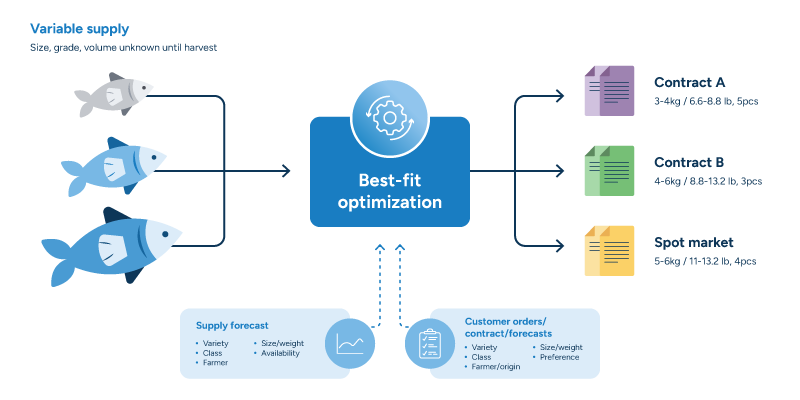
When the planning model holds supply and demand together rather than treating them sequentially, a harvest that doesn’t match the plan stops being a crisis and becomes a calculation.
3. Build surplus visibility early enough to act
When supply exceeds confirmed orders, most companies default to one of four responses, typically in order from most reactive to most proactive:
- Stock-clearing discounts, which erode the margin that better forward visibility would have protected.
- Emergency freezing, which changes the product’s commercial positioning and typically reduces its value in fresh-driven channels.
- Reactive spot market sales, where fish prices have already dropped to reflect everyone else’s excess by the time the surplus arrives.
- Delayed harvests (aquaculture only), which can preserve value but depends on surplus visibility as well as labor rules and processing capacity that may not flex easily.
For wild-capture operations, option four was never on the table. (You can’t hold a catch at sea.) For aquaculture producers it exists, but only if they can surplus coming far enough out to act on it. By the time excess supply arrives at the dock, spot market prices have already moved to reflect everyone else’s. The time to sell well has passed.
When surplus is visible weeks out rather than hours out, the list of available responses looks very different.
In RELEX, supply and demand visibility runs across a rolling horizon, surfacing where a given product is likely to be, long before it arrives at the processing facility. Sales teams see the picture early enough to secure contracts, open channels, or position volumes against the spot market while prices still reflect normal supply levels. Planners see it early enough to adjust harvest timing where that option exists.
4. Know what’s in the water before it reaches the facility
For aquaculture producers, the harvest arriving on any given morning is the result of decisions made 18 months or more before. For wild-capture operations, the equivalent uncertainty arrives with the weather, the quotas, and the sea state. In both cases, the supply picture that reaches the processing facility is rarely exactly what was planned.
The problem is that decisions made downstream on what to produce, which customers to fulfil, and how to allocate capacity are only as good as the supply data they’re built on. When harvest grades come in below projection, every customer commitment and margin assumption attached to that harvest is affected simultaneously, whether the business can see it or not.
Decisions made downstream on what to produce, which customers to fulfil, and how to allocate capacity are only as good as the supply data they’re built on.
Most businesses compound this by holding supply information in separate places. Farm managers, sales teams, and processing planners often work from different versions of the same data. The gaps between those versions are where planning errors live.
Closing that gap means a single supply model that every function works from — one that is updated continuously with harvest projections, grade estimates, and volume forecasts. This model must also be connected to the production plan.
That’s how it works in RELEX. Fish producers typically run specialized systems to monitor feed consumption, growth estimates, certifications, and more. RELEX takes those projections and matches them against demand, giving sales, operations, and finance teams a consistent view across the horizon. When projections change, the system updates the plan so businesses know whether to sell more, buy in external fish, or adjust customer commitments before the harvest arrives.
5. Treat processing capacity as a planning input, not a ceiling
A smokehouse, a high-speed filleting line, or a grading and gutting system represents a significant capital investment that needs to keep running to justify its cost. The processing schedule has to be built around that reality, which means capacity shapes what gets harvested, when, and in what sequence, not the other way around.
The problem arrives when harvest timing shifts unexpectedly. A health event in a pen, a weather window for wild-capture, or a price signal that makes early harvest commercially attractive can push volume through the facility at a moment the schedule wasn’t built for. Disease outbreaks, lice infestations, or environmental events can force an entire pen to slaughter within days. A smokehouse already running at capacity leaves the operation with unplanned overtime, delayed processing, or fish diverted to a lower-value outlet.
Where harvest timing can be controlled, fish suppliers can build capacity into the planning model before those moments arrive. This action smooths the load across a rolling horizon so that decisions are made with a clear view of what the facility can actually absorb, and when.
When unplanned harvests occur, the facility has to absorb the volume regardless of what the schedule says. The planning model can’t prevent that, but it can reduce how often unplanned volume lands on an already-loaded line.
In RELEX, production scheduling optimizes across processing resources and shift patterns simultaneously, sequencing orders, managing changeovers, and surfacing where planned harvests create bottlenecks in advance. Planners can model shift extensions or adjusted harvest timing against real capacity constraints rather than discovering the conflict on the day.
When capacity is built into the plan, the processing schedule stops limiting which harvests are commercially viable.
6. Prioritize customers before supply runs short, not after
Customers aren’t interchangeable. Some will accept a smaller fish or a different cut when their preferred specification isn’t available. Others won’t, and supplying one anyway costs more than the shortfall did. Some markets restrict fish below a certain grade or harvested by a particular method. Export accounts may have provenance requirements that limit which fish can go to which channel entirely.
When supply falls short, every allocation decision is a commercial decision. Made reactively, those decisions favor whoever called most urgently. Made against a pre-agreed framework, they reflect the commercial logic the business actually wants to apply.
When supply falls short, every allocation decision is a commercial decision.
That framework needs two things: which customers are prioritized when supply is constrained, and which will accept a variance and which won’t. Both need to be captured in advance and visible to the planner when the decision is required, not reconstructed under pressure.
In RELEX, customer prioritization and substitution rules are configured into the planning model directly. When a harvest comes in short, allocation follows pre-agreed logic. For instance, one framework might see:
- Top-tier customers fulfilled first.
- Substitution-tolerant accounts offered alternatives.
- Planners focused on exceptions that genuinely need judgment.
When the framework exists before the shortage arrives, supply shortfalls stop being a test of who reacts fastest.
7. Make same-day decisions before the day forces them
In fish, no amount of medium- and long-term planning eliminates the need for real-time decisions.
Fish come out of the pen, move to a coastal processing facility, get graded, and need to be allocated to orders — all within hours. And at the moment of grading, the plan may need to change. The size distribution that arrived may not match what was expected. The premium-grade volume may be lower than confirmed orders require. Every minute spent working through those variables on a spreadsheet is a minute of shelf life gone.
Two things make same-day decisions manageable:
- Pre-harvest sampling, which gives planners an early signal on size and grade before the processing line commits.
- Pre-agreed allocation rules, which provide a framework to apply when the harvest doesn’t match the plan without escalating every variance to a judgment call.
In the RELEX system, exception management handles the same-day crunch directly. Rather than reviewing every order and every allocation manually, planners work from an automatically generated view of what needs attention. Whether that’s a harvest that deviated significantly from the forecast, an order that can’t be fulfilled as specified, or a product approaching its shelf-life limit, the solutions highlights the major anomalies for planners to assess and automatically handles the business-as-usual decisions.
Same-day planning done well means the morning’s surprises are smaller, and the ones that do arrive meet a plan that already accounts for them.
8. Connect daily decisions to the strategy behind them
When specific planning horizons don’t talk to each other, the resulting disconnection is expensive. Farm investment decisions get made without visibility into what customers will need two years from now. The morning’s harvest arrives without a framework to receive it.
Integrated Business Planning (IBP) is the discipline that keeps those horizons aligned. IBP is a governed cycle that simultaneously gives sales, operations, procurement, and finance a single, consistent picture of the business.
The practical test is simple. When those functions arrive at a planning meeting and can work from the same numbers, decisions get made. When they don’t, the meeting becomes a reconciliation exercise, and the decisions that should have been made last week get made this week, under more pressure, with fewer options.
For fish specifically, IBP has to span three time scales:
- The same-day horizon that allocates that morning’s harvest against confirmed orders.
- The tactical horizon that keeps production scheduling and customer commitments aligned over the next three to six months.
- The strategic horizon, extending to 18 months or more, that connects farm growth projections to sales forecasts and flags supply constraints before they become crises.
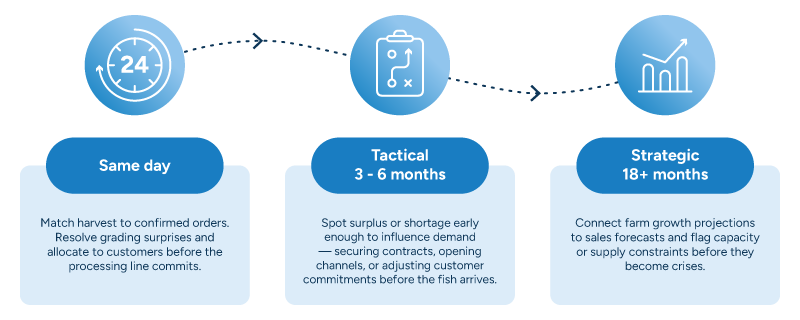
IBP within RELEX is built as a native extension of operational planning, not a separate layer on top. Scenario planning runs against real operational constraints like capacity, shelf life, and customer commitments to ensure that the plans that get approved are ones the business can actually execute. So, when a harvest projection changes at the farm level, the tactical and same-day plans are updated. And when a customer commitment changes, the supply plan reflects it.
For fish suppliers operating across multiple horizons with variable supply and time-compressed decisions, the gap between strategic intent and daily execution is where margin gets lost. IBP is what closes it.
Why fish supply chain planning requires a different class of software
The practices described above share something in common beyond fish. Each one of them requires making a decision that involves more variables than any planning team working manually can resolve reliably, and at a speed that even the best team can’t sustain.
Consider what’s actually being asked of the planning process:
- Shelf life optimization requires continuously evaluating the right processing format for every product across every customer lane, updated as batch data and demand signals change.
- Customer allocation requires determining which fish follow which route, to which customer, at what margin — across dozens of finished products and hundreds of orders, simultaneously, before the processing line commits.
- Attribute-based planning requires matching fish to markets by size, grade, certification, and regulatory eligibility, because not all fish can go to all places, and those rules are non-negotiable.
- Customer prioritization under shortage requires applying a tiered allocation framework across a full customer portfolio in hours, not days.
- Supply and demand visibility across 18 months of farm projections, tactical commitments, and same-day allocation requires holding the entire fish supply chain in a single, continuously updated model.
Spreadsheets, disconnected systems, and instinct-based allocation aren’t built for decisions of this speed or complexity. They were built for businesses where time is available, variables are manageable, and the raw material holds still.
Fish is none of those things. More experienced planners working harder in better-maintained spreadsheets don’t close the planning gap. At best, they manage it, but at significant cost in planning time and missed margin.
Industry-tailored planning with RELEX
RELEX is a unified supply chain planning platform for fish and seafood manufacturers. It provides the computational engine behind the best practices described above and the four capabilities that help fish supplier resolve complexity-driven problems:
- RELEX uses machine learning to generate demand forecasts that update continuously as new signals arrive, rather than waiting for the next planning cycle. In fish, where conditions can shift within days, that responsiveness keeps the forecast useful.
- The solution’s mathematical optimization evaluates every possible product mix combination, processing sequence, and allocation decision simultaneously to find the plan that best fits all constraints and costs. It runs at the speed that fish requires and that manual processes cannot support.
- RELEX’s exception management capabilities surface the priorities that actually need a planner’s attention and automatically handling the business-as-usual decisions, saving teams the time and effort associated with arduous, SKU-by-SKU reviews.
- RELEX Scenario Planning lets planners test decisions before making them, modeling whether a rush order can be absorbed without compromising existing customer commitments.
RELEX Solutions brings all of these capabilities to fish and seafood manufacturers on a single unified platform, connecting demand planning, production planning, supply planning, and IBP in one data model. A change at the farm level carries through to tactical commitments and same-day allocation without manual translation between systems.
With RELEX, the decisions with the highest commercial consequences get made faster, with better information, and at the pace the business actually requires.
Written by