The AI glossary buyers actually need
Jun 22, 2026 • 13 min
Cut through the jargon with this plain-language guide for platform and solution buyers
The pace of AI development has accelerated dramatically, and with it has come an avalanche of new terminology. From Gen AI and Agentic AI to skills, plugins, and MCP connectors, the vocabulary of AI has rapidly gone from manageable to overwhelming.
New capabilities arrive faster than the language to describe them stabilizes, and vendors compound the problem by using terms inconsistently. The same word can describe meaningfully different capabilities depending on who’s presenting.
Each of these terms encodes a specific architectural choice: how an AI planning platform is built, what it can do, and what it will let you build on top of it. But buyers often nod along during vendor demos and then move on, only to make platform decisions without fully understanding what they’ve actually been promised.
At RELEX, we work with supply chain and retail merchandising teams navigating these exact conversations every day, and we incorporate AI terminology into our own product and marketing. This puts us in a good position to shed light on the terms buyers are most likely to encounter in vendor discussions and the questions worth asking when they do.
Why AI vocabulary matters
The terminology explosion in AI is a communications problem and a buying risk. Vendors frequently use terms like “AI-powered,” “agentic,” and “open” without attaching them to anything specific. A platform can be marketed as “agentic” because it has a chatbot. It can be called “open” because it launched an API in 2019.
The platform decision a buyer makes today will be difficult to reverse as AI capabilities compound. Getting the vocabulary right before signing protects that decision — and helps you ask the right questions to get beyond the hype.
This matters particularly in retail and supply chain, where planning decisions are becoming increasingly automated. The architectural choice you make now directly determines what your team can build, connect, and adapt in the years ahead.
Foundational AI terms
These terms are the baseline concepts. If a vendor uses any of these during a demo (and they will), here is what they actually mean.
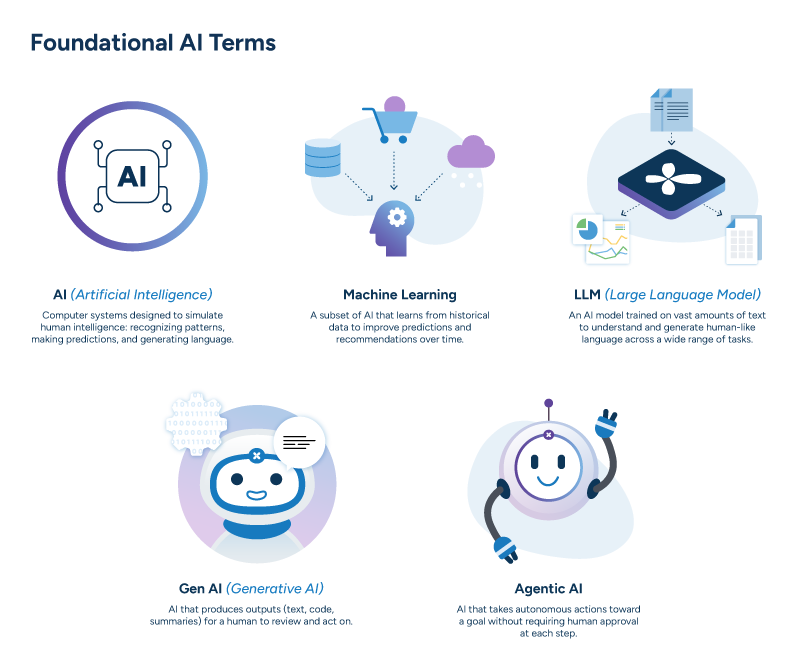
AI (Artificial Intelligence)
Artificial Intelligence is the simulation of human intelligence in machines. These intelligent systems are designed to think, learn, and make decisions using algorithms, data, and computational models. This enables them to recognize patterns, make predictions, and generate language.
In vendor conversations, “AI” is often used as an umbrella term that can mean almost anything. This is why the other terms in this guide matter: so buyers can understand the nuanced differences between how different systems work.
Ask your vendor: When you say this capability is ‘AI-powered’, which type of AI does it actually use? How long has this capability been in production?
ML (Machine Learning)
Machine Learning is a subset of AI that includes deep learning, in which systems identify patterns from historical data rather than following fixed rules. In supply chain planning, most “AI” is really ML: statistical models trained on past demand, sales, or supply data that learn from experience to improve predictions and recommendations over time. In this context, it is neither generative nor agentic.
Most vendors present ML-driven capabilities under the “AI” banner without distinguishing them from newer, more powerful approaches. Knowing whether they’re looking at ML or something more sophisticated helps buyers calibrate how much the vendor’s AI roadmap actually offers. ML is mature, well-understood, and valuable, but critically, it doesn’t do what agentic AI does. A vendor who leads with ML under an “AI” banner may not have the autonomous planning capabilities a buyer is looking for.
Ask your vendor: Is this ML model trained on my data, your broader customer base’s data, or both — and what does that mean for accuracy in my context?
LLM (Large Language Model)
A Large Language Model (LLM) is a type of AI model pre-trained on large amounts of text data to understand and generate human-like text. Because they’re trained broadly, LLMs can be applied to a wide range of tasks, including:
- Answering questions
- Summarizing content
- Writing code
They learn relationships between words and language patterns using deep learning neural networks, processing text by converting it into numerical values and back again. This makes them flexible across many contexts. One thing to note about LLMs is that they can only work with knowledge from their training data. LLMs have no inherent access to a company’s data. Without grounding, they’re working from general knowledge only.
Ask your vendor: Is the LLM in your platform a third-party model (e.g. ChatGPT, Claude, or Google Gemini) or a proprietary model? How is it grounded in my planning data?
Gen AI (Generative AI)
Generative AI produces outputs in response to prompts. This is typically text, code, recommendations, or summaries. Gen AI is not inherently autonomous; it generates something for a human to review and act on while the human remains in the loop. Most “AI assistant” and “copilot” features in enterprise software are Gen AI.
The distinction matters because Gen AI and agentic AI carry very different implications for human oversight and process change. A platform that relies on Gen AI still requires humans to review and act on every output. This entails different staffing and workflow assumptions than a system that uses agentic capabilities, something buyers should consider if reducing manual workload is part of the business case.
Ask your vendor: Is this system generating outputs for humans to act on, or is it taking actions itself? Who reviews and approves the output before anything changes?
Agentic AI
Agentic AI takes autonomous actions toward a goal, without requiring a human decision at each step. The key distinction is agency: the system can plan a sequence of actions, execute them, and adjust when something goes wrong, all without waiting for approval at each stage. This is a meaningful architectural difference from Gen AI, not just a marketing trend.
Whether agentic AI is appropriate for a given planning context depends heavily on the task, the guardrails, and the tolerance for unsupervised action. Not everything should be agentic, but the question of where autonomy begins and ends is among the most consequential a buyer can ask. This is because it determines how much human oversight planning teams will still need to maintain.
Ask your vendor: Where in this platform does the system take an autonomous action without a human trigger? What is the agent’s goal, how does it plan, and what does it do if something goes wrong? How does it learn and refine its behavior over time?
Platform architecture terms
These terms describe how a platform is built and what a planning team can do with it.
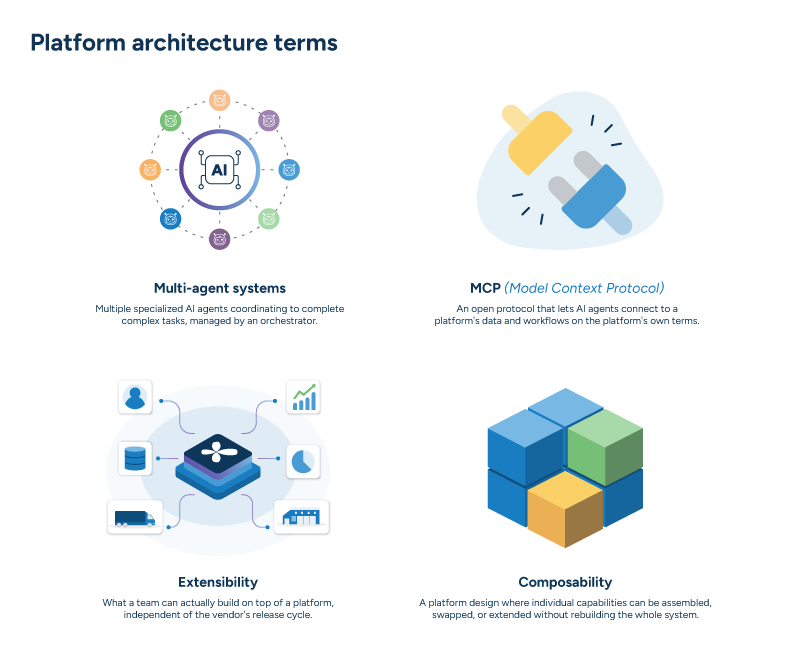
Multi-agent systems
A multi-agent system is an architecture where multiple specialized AI agents coordinate to complete complex tasks. Rather than a single AI handling everything, different agents handle specific functions, coordinated by an orchestrator that manages handoffs, dependencies, and exceptions.
For example, a forecasting agent analyses demand signals and predicts what will be needed, where, and when, while a replenishment agent takes that forecast and determines what orders need to be placed to meet it. A supplier communication agent then acts on those decisions, drafting purchase orders, flagging lead time risks, or escalating when supply won’t meet demand in time. (Worth nothing: in true multi-agent architectures, agents often run in parallel, negotiate, or loop back rather than following a strictly linear sequence.)
In supply chain planning, multi-agent architectures can support the kind of complex, cross-functional decision-making that a single model would struggle to handle alone. In a demo, a vendor may demonstrate agents working together without revealing how coordination is actually handled. If there’s no visible orchestration layer, the “multi-agent” label may be more aspirational than a reality, so it’s important to question this to understand what’s happening below the surface.
Ask your vendor: Do your AI agents operate independently, or can they coordinate across planning functions? How are handoffs between agents managed, and where can I see that coordination?
MCP connectors
Model Context Protocol (MCP) was developed by Anthropic, the AI safety company behind Claude, and released as an open standard in late 2024. It has since been adopted broadly across the AI industry. MCP enables AI agents to connect to external tools and data sources. In the MCP model, the agent connects to a platform’s data and workflows, while the platform acts as the server, exposing what it makes available.
This is an important distinction for security-conscious buyers. The direction of the connection runs from agent to platform, not the other way around. A platform supporting MCP chooses what it exposes; agents reach out to use it. Platforms that support MCP servers are making their data and workflows accessible to the broader AI agent ecosystem on their own terms rather than being restricted to their own system.
This is an extensibility story as much as it is an AI one. MCP matters because it determines whether the platform will work with the broader AI ecosystem, or only with the vendor’s own tools.
Ask your vendor: Does your platform support open protocols like MCP to allow the AI tools in my existing tech stack to work with the data and workflows in your system?
Extensibility (“Open platform” vs. “closed platform”)
Extensibility refers to what a buyer’s team can actually build on top of a platform, and under what conditions. An extensible platform lets customers add new capabilities (data models, workflow logic, integrations) without depending on the vendor’s release cycle. An open platform connects to external AI systems and lets buyers bring their own tools and agents, whereas a closed platform is limited to what the vendor built and shipped — no extensions, no external connections.
“Open platform” is a commonly inflated claim. It can mean anything from “we have a REST API” to “you can extend the core data model, bring your own AI, and connect to any external system.” The difference is significant.
As the name suggests, RELEX Open sits at the open end of the spectrum. It’s built around deploying proven planning capabilities, connecting external AI via open protocols, and enabling teams to extend what they build on top of RELEX. Some of those capabilities are live with customers today; others are still on the roadmap.
Buyers who push vendors on extensibility can determine how much they’ll be able to shape their own AI strategy versus waiting on vendor upgrades.
Ask your vendor: Can I bring or build my own AI models on your platform, including open source models? Or am I locked into yours?
Composability
A composable platform is one in which capabilities can be assembled, extended, and replaced in parts rather than delivered as a fixed, all-or-nothing system. In practice, this means a planning platform lets customers and partners combine components — custom models, external agents, proprietary data logic — without rebuilding the core system each time.
Composability is closely related to extensibility and openness, but goes further: the platform is designed so that individual capabilities can be swapped or augmented independently, rather than bolted on at the edges.
For planning teams with existing models and tools they want to retain, composability is worth raising in vendor discussions. In supply chain, composability determines whether a team can bring its own forecasting model, plug in an external AI agent, without waiting on the vendor’s roadmap.
Ask your vendor: Is your platform designed to be assembled in parts, or is it a fixed system with add-ons at the edges? Can I replace or extend a specific capability without affecting the rest of the platform?
Builder and developer terms
These terms come up when vendors discuss extensibility and the development of custom capabilities. Two of them, plugins and skills, are frequently confused, including by the vendors themselves.
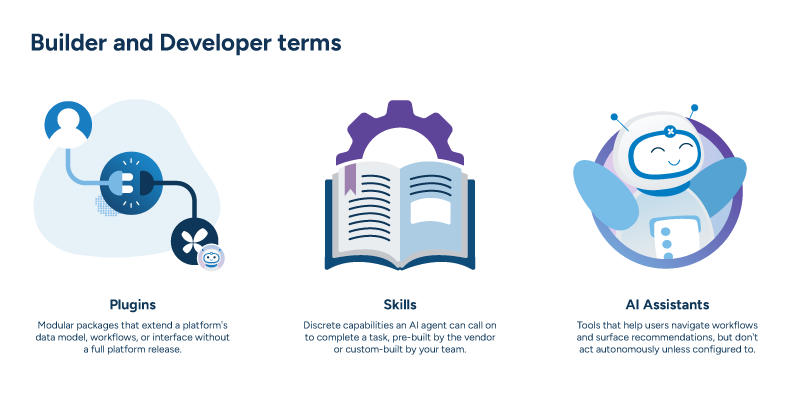
Plugins
A plugin is a modular, versioned package that extends a planning platform’s data model, workflow actions, or interface, without requiring a full platform release or system restart. Plugins are the mechanism through which a team can add new capabilities that run natively inside the platform.
The critical question is what a plugin actually extends. A plugin that only adds a UI widget is very different from one that extends the underlying data model or introduces new workflow logic. One is a small cosmetic change while the other is a larger structural one.
Ask your vendor: What does a plugin actually extend — the UI only, or the underlying data model and logic? Can my team build, test, and deploy plugins without vendor involvement or a platform release? Are plugins vendor-built only or can my team and partners build them, too?
Skills
A skill is a set of instructions that defines how an agent behaves. A composable and discrete piece of functionality that an AI agent can use as part of completing a task. Plugins and skills are related but distinct. A plugin extends the platform’s capabilities, such as adding new data models, workflow actions, or UI components. A skill extends what an AI agent can do — giving it a specific capability it can call on while completing a task.
Examples of skills include:
- Executing a Python script
- Calling an external API
- Accessing a specific data source
- Applying a domain-specific rule to a planning decision.
The distinction between a pre-built skill and a custom skill matters. Pre-built skills are what the vendor ships, whereas custom skills are what planning teams can build. The ability to create custom skills determines how much the platform can be shaped to a company’s specific planning context. But the governance of these skills matters just as much. It’s important to determine who is permitted to build skills, how they are reviewed before deployment, and whether there is a formal process for testing and approving them. For enterprise planning environments, this is not a minor detail. A poorly governed skill running inside an agentic system can affect automated decisions at scale.
Ask your vendor: Are skills pre-built only, or can my team create custom skills? What’s the development environment for building skills, and how are they tested and deployed?
AI assistants
An AI assistant helps users navigate workflows, surface recommendations, and answer questions in natural language. Critically, an assistant does not take autonomous actions unless it is explicitly configured to do so. This is the key distinction from an agent: an AI assistant helps users act; an agent acts on their behalf.
Many “agentic” features in vendor demos are, in practice, AI assistants that suggest, surface, and prompt. That’s not necessarily a bad thing, but it is a different investment case to be aware of. An AI assistant requires users to stay in the loop for every action, whereas an agent does not. Knowing which one buyers are investing in determines how much efficiency they’ll actually see.
RELEX’s own Rebot illustrates how quickly this boundary is shifting. What launched as an AI assistant embedded in RELEX Plan is now evolving to take on agentic capabilities as the orchestrator in a multi-agent system.
Where a vendor’s product is situated on the assistant-to-agent spectrum today shapes what your team’s workload will look like tomorrow. So, it’s worth pressing them on exactly where that line currently sits.
Ask your vendor: Is this feature an AI assistant that helps users act, or an agent that acts autonomously on their behalf? In which scenarios does it take action without a user trigger?
3 key topics to discuss in your next demo
The glossary above provides the vocabulary. Now, it’s a matter of using it.
These three topics are the ones that most sharply separate platforms from each other and are discussion points that should be brought up in every demo.
1. Decode the agentic AI claim
“Agentic” is currently one of the most overloaded words in enterprise software. Most vendors will use it at some point in a demo, but the gap between marketing language and actual capability is wide.
The real distinction is how and when a human is involved in the process. An agentic system is given a goal, runs autonomously through a sequence of steps (reflecting, deciding, and acting), and calls on other tools or agents as needed to complete the task. By contrast, a non-agentic system surfaces a recommendation and waits.
Building in human checkpoints for certain decisions is good design, not evidence that the system isn’t agentic. What makes it agentic is the loop: a system that works toward a goal between those checkpoints without waiting for a human trigger at every step.
Understanding how a vendor’s agentic AI works matters because agentic architecture is a fundamental design choice. It’s not a feature that can be easily bolted on without significant re-architecture. If a platform is not built around autonomous action, the roadmap will reflect that constraint for years to come.
Buyers who can’t distinguish between a claim and a capability are likely to overpay for a sophisticated recommendation engine rather than something truly agentic. That’s a poor return on investment and entirely defeats the efficiency case for AI.
2. Test openness and extensibility separately
These two terms often appear together in vendor conversations, but they describe different things. A platform can be open, meaning it accepts connections from external AI systems. But without extensibility, a planning team can’t actually build new capabilities natively inside it. Conflating them is one of the most common sources of post-purchase disappointment in AI platform decisions.
The distinction has direct consequences for long-term build flexibility. Openness determines what buyers can connect to. Extensibility determines what can be created. A platform that scores well on one but not the other will constrain options as AI capabilities continue to develop and switching costs in planning infrastructure are high. Understanding where each vendor sits on both dimensions, with specifics, is one of the clearest signals of whether a vendor’s AI story is architectural or cosmetic.
3. Understand the AI underneath
The quality and relevance of an AI platform depend significantly on the data it was trained on and on how it continues to learn and improve its outputs over time. A platform with years of domain-specific training data has a structural advantage that a general-purpose LLM cannot replicate out of the box, no matter how capable it might be. This isn’t always visible in a demo, which is exactly why the buyer should ask about it directly.
How a vendor handles shared learning across their customer base is also a meaningful signal of both capability and trust. Platforms that learn from a broad customer dataset can surface patterns that single-customer models can’t, but only if the data architecture is designed to do that safely.
The best platforms do this by anonymizing or aggregating data so one customer’s information isn’t exposed to another. Understanding the mechanics behind the AI, not just the outputs it produces, is what separates an informed platform decision from one made on demo performance alone.
But the vocabulary is only half the job
The vocabulary covered here describes real architectural differences that buyers need to know to avoid investing in a platform that doesn’t meet their needs. With this glossary at your fingertips, you’re prepared to ask vendors for specifics, not just slides, helping you make a fully informed decision.
The right vendor will understand your challenges as well as they understand their own technology. Take a look at the purpose-built AI agents RELEX has already deployed with our customers to enhance assortment, promotions, pricing, and other retail and supply chain planning operations.
Written by

Related Articles

How to build a consumer decision tree: why the best CDTs start with shopper behavior, not supply logic
See why CDTs based on shopper behavior beat vendor- and workshop-built trees, and how RELEX CDT Builder applies the method.
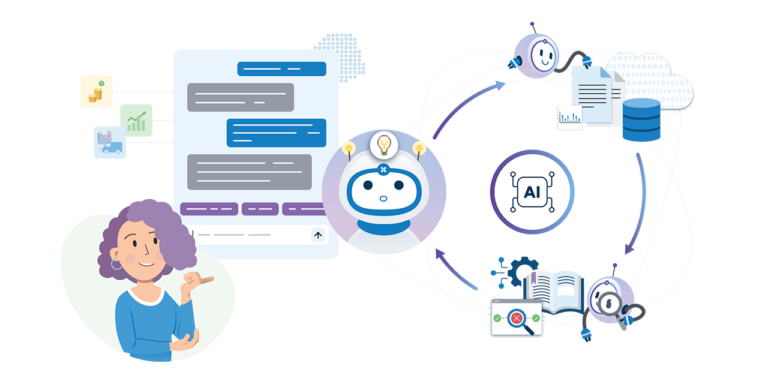
Agentic AI in manufacturing supply chain planning
Learn why most manufacturers need both general and tailored agents, meet the five core RELEX agents for manufacturing, and see how RELEX Open lets you deploy, connect, and extend AI across your supply chain planning.
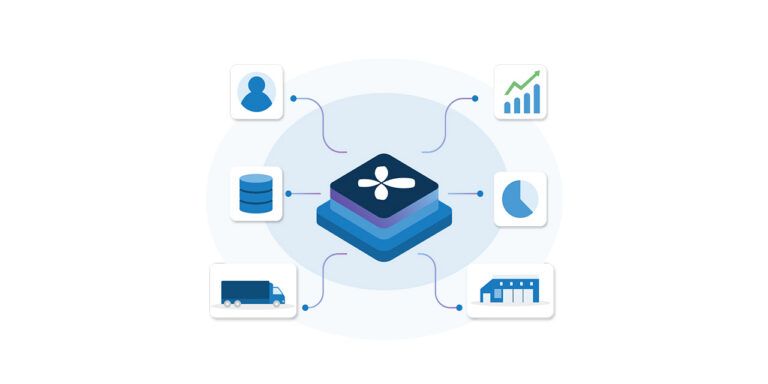
Make AI work at scale.
This session works through what leading retailers and manufacturers are doing instead: deciding what to own, what to buy, and how to make the two work together. You'll see it working through examples drawn from real deployments, not a vision deck.