
After over 15 years in supply chain and manufacturing, I’ve seen many vendor selection processes. Selecting a demand planning solution often involves tenuously connected stakeholders, an expanding list of requirements, and conflicting objectives that surface late and skew project timelines.
In my experience, the project champions who go live sooner and generate value quickly and steadily are the ones who understand the concerns of each stakeholder before they even start researching vendors. From the beginning, they know what their solution has to do for them and for every other stakeholder.
With that in mind, I’ve compiled the questions and pain points we hear most frequently at RELEX during vendor selection, along with how RELEX Demand Planning & Sensing addresses each one. These insights will help project champions translate software requirements into each primary stakeholder’s language, placing them in the context of the organization’s diverse objectives and KPIs.
The Head of Demand Planning’s top questions and considerations
If you’re like many manufacturers I’ve known, your business has long outgrown legacy systems and cumbersome spreadsheets. Scattered, clunky processes and poor data confuse decisions across teams. Constant demand fluctuations only exacerbate these problems, leaving planners to use their best guesses to estimate forecasts.
Our teams field these questions most often from the Head of Demand Planning. RELEX helps manufacturers overcome these problems through a centralized, automated solution that improves forecast accuracy, highlights the decisions that need human judgment, and channels data throughout the organization.
Head of Demand Planning: An overview of requirements and benefits
| Question | RELEX Demand Planning & Sensing |
|---|---|
| How can I automate decisions without losing human supervision? | RELEX provides “touchless planning,” which automates data-heavy calculations and highlights anomalies so planners can apply their expertise to nuanced situations and test scenarios. Plus, RELEX is not a “black box system.” Planners can see the weight of different demand-influencing factors, as calculated by the forecasting model, to gauge and monitor SKU behaviors across markets. |
| How easily can I adapt the RELEX systems to my changing business needs? | The RELEX business rules engine (BRE) allows users to view, configure, and adapt the rules that govern calculations and automated workflows. |
| What level of forecast granularity and aggregation does RELEX offer? | RELEX Demand Planning & Sensing supports any level of forecast granularity and aggregation, so teams can easily analyze data and reconcile near-term decisions with long-term strategies. |
| How does RELEX support data sharing and collaboration? | RELEX users can share data and decisions across business tiers, roles, and teams. Pre-defined guardrails control viewing and editing permissions. Use can comment directly within the system and configure dashboards for stakeholder and S&OP reviews. |
| Does RELEX have forecast lag capabilities for monitoring KPIs? | Yes, RELEX users can configure lag periods and automate alerts to highlight deviations that need immediate attention and measure short-term forecasts against weekly KPIs. |
| Does the RELEX solution support product lifecycle management? | Yes, RELEX gives users insights into and control over new product introductions, replacements, and ramp-downs. |
| How can RELEX help me manage long-tail items and intermittent demand? | RELEX uses pooled models to identify demand trends and calculate more stable, accurate forecasts for long-tail items. |
With RELEX, you can fit automation to your business and:
- Increase planning productivity and forecast accuracy.
- Enhance service levels without carrying more inventory.
- Better react to market shifts, weather events, and promotional performance.
- Improve KPIs like OTIF rates, inventory turnover, and waste reduction.
1. Q: How can we automate our forecasting process but still ensure planners can identify and review the decisions that require human expertise?
A: I see this question a lot from departments trying to move away from spreadsheets. What you’re talking about here is touchless planning. Touchless planning automates supply chain decisions so that planners can focus their attention on prioritized exceptions and help shape strategies that support overall business objectives.
On the back end, the RELEX approach to touchless planning delegates the labor-intensive, data-heavy, mathematical work to machines that can handle it quickly and accurately. Then, on the user side of the process, the platform makes it easy for planners to identify and apply their expertise to more nuanced situations.
The back end: How touchless demand planning automatically calculates forecasts
RELEX Demand Planning & Sensing uses advanced machine learning (ML) models, optimization tools, and data management techniques to generate forecast calculations. Our system determines the impact of each demand driver and automatically optimizes the forecast using:
- Sales history.
- Transactional data.
- Contextual data.
- Item and location data.
- External data, like POS data, weather, and other events.
It can also manage seasonality and step changes, calculating and measuring forecast accuracy to improve outcomes over time.
That much data can get messy. But the RELEX solution helps you overcome the constant challenges to data integrity. Our forecasting engine automatically handles outliers and corrects and cleanses sales history. So, data-driven decisions are driven by data you can actually trust. The solution also uses RELEX’s proprietary in-memory database and computational power, allowing manufacturers to scale their data and processes, regardless of business requirements or growth.
The user experience: How demand planners interact with a touchless planning system
RELEX Demand Planning & Sensing gives users visibility into their data and control over their forecasts through configurable dashboards. These dashboards highlight exceptions, so your planners can focus on high-priority anomalies, instead of reviewing every forecast for every SKU.
And because RELEX isn’t a “black box” solution, the forecast is explainable. For instance, your users can easily visualize demand-influencing factors using regressor coefficients.
Regressor coefficients are numbers generated by our machine learning models that represent the weight of a particular factor, like “days of sunshine.” Planners can use these numbers to gauge how and how much that factor will affect demand. In other words: “Will this make demand go up or down and to what extent?” They can compare different situations to see how the same factor affects the same SKU differently depending on the location or market.
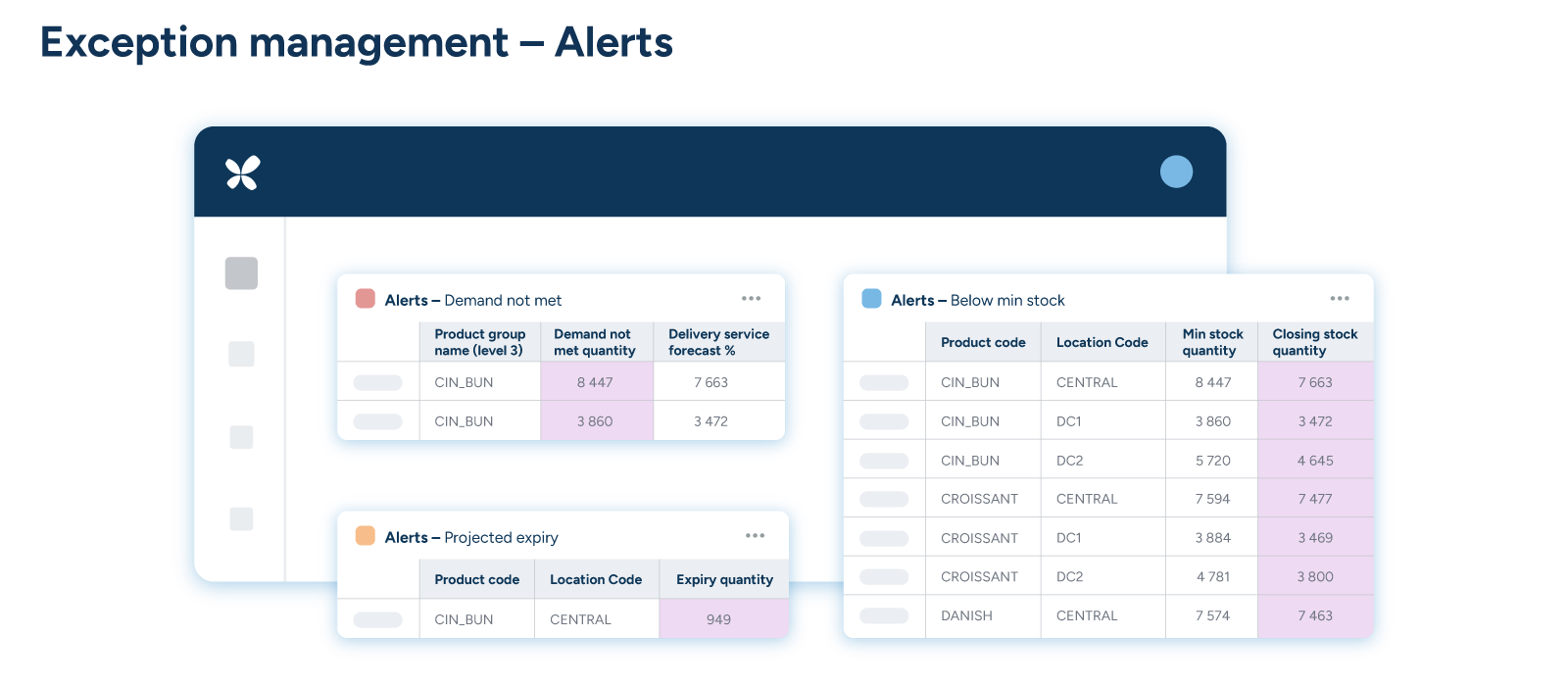
Plus, the RELEX user interface makes it easy for planners to review and adjust plans. Scenario planning capabilities allow users to compare multiple plans at once, weighing and balancing potential outcomes to find the best option. When they finalize the plan, the system automatically disseminates the updates to integrated teams and planning solutions. Planners can also export reports to keep stakeholders in the loop on the latest supply chain performance metrics.
Last but not least, planners have access to Rebot, RELEX’s built-in AI assistant. Rebot acts as an on-demand consultant and answers solution questions immediately so planners can onboard more quickly, learn to troubleshoot potential issues, and become expert RELEX users.
WATCH: From Machine Learning to Agentic AI: The Touchless Supply Chain Planning
2. Q: How can I maintain transparency and control when using RELEX? How easily can I calibrate the system to changing business needs and processes?
A: Even with all the potential gains of AI and automation, manufacturers understandably still want to know how the solution determines calculations and recommendations. They don’t want hidden, generic workflows governing their business processes.
The RELEX business rules engine (BRE) allows users to easily modify configurations, redefine business rules, and adjust calculation methods. This “configure, don’t code” approach” allows companies to tailor and maintain control over their processes, even as they scale.
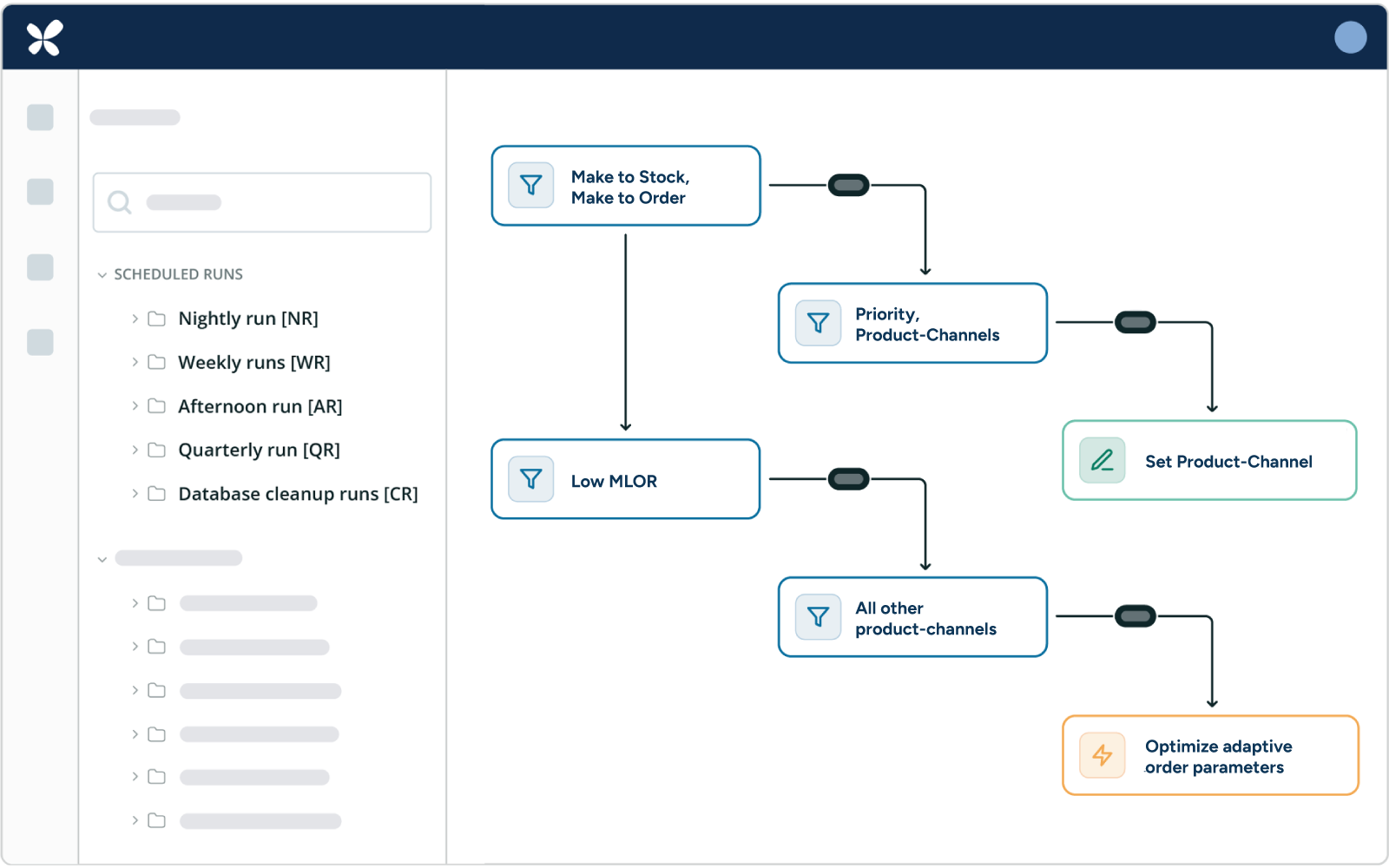
The BRE is a graphical interface that allows manufacturers to automate workflows that trigger specific actions based on default or custom thresholds. And users can control these triggers, all within the UI and without technical expertise. The system provides a clear, visual outline of how and why the system is calculating certain outcomes, making it easy for teams to review and amend the decision-making mechanisms that guide calculations.
So unlike other solutions that require costly, time-consuming coding projects to customize solutions, the RELEX BRE allows users to make changes quickly, in-house.
Plus, the BRE’s configuration layer is separate from the underlying software layer, so companies can update to the latest software version without disrupting pre-configured workflows.
READ MORE: The RELEX business rules engine: Configure and scale your planning processes
3. Q: I need to manage both near-term emergencies and longer-term strategies over different time horizons. What level of forecast granularity and flexible aggregation does RELEX offer?
A: The RELEX Demand Planning & Sensing dashboard lets you view your forecast at any level of granularity or aggregation across all combinations of product and customer hierarchies. Our system supports multi-level forecasting, dynamic drill-down or roll-up, and near real-time updates within a user-friendly interface.
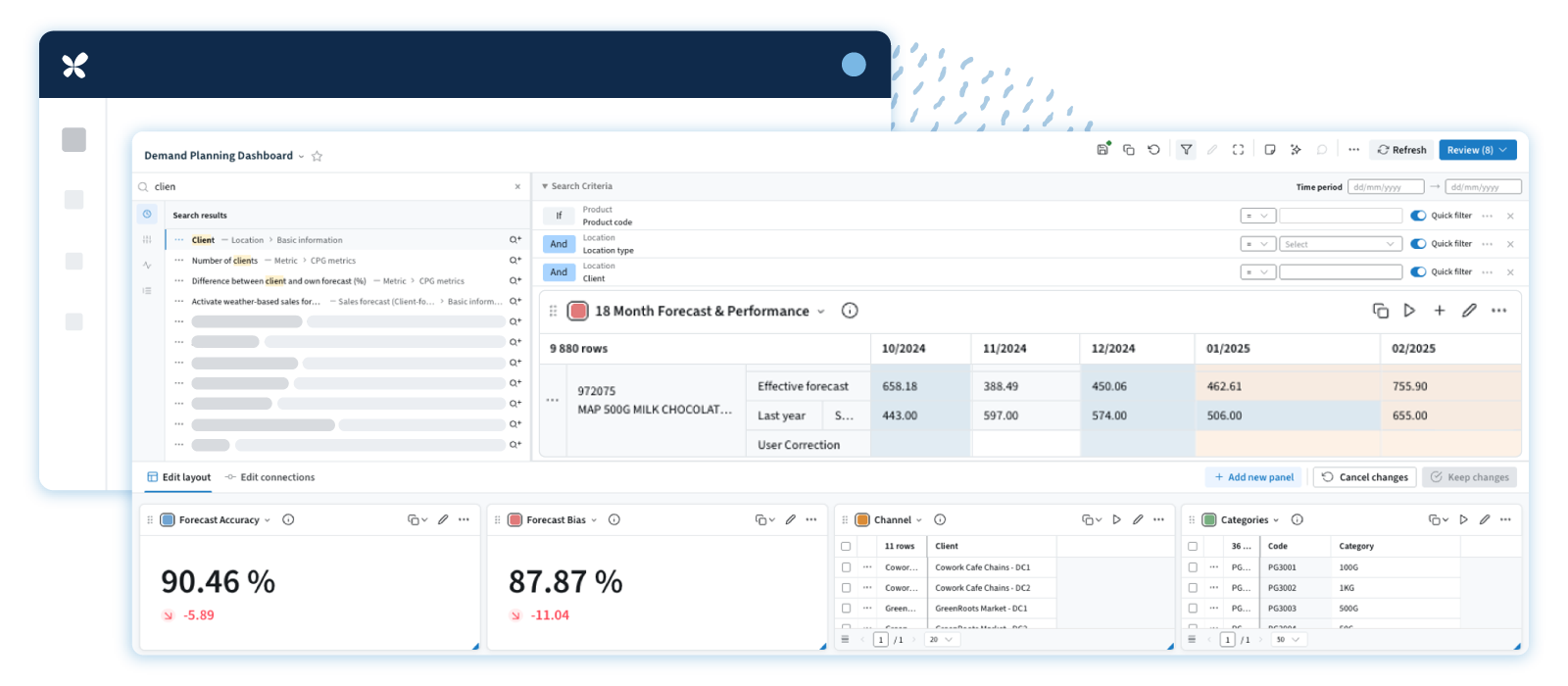
RELEX also offers workspace configuration capabilities for precise navigation and analysis at any level of aggregation. Your users can apply filters based on any attribute, adjust workspace layouts responsively, save configured views, and integrate filters with forecasting tools.
4. Q: How does the RELEX demand planning solution make it easy for different teams to collaborate using the same dataset?
A: With RELEX Demand Planning & Sensing, users can share data and collaborate at any tier of the business across roles and teams. You can predefine guardrails to ensure that each user or group has the appropriate viewing and editing permissions.
Since data and plans can be adjusted from the top down or from the bottom up, teams at different tiers can edit simultaneously. Users can leave comments explaining their updates and use exceptions to trigger sequential workflows between different parties.
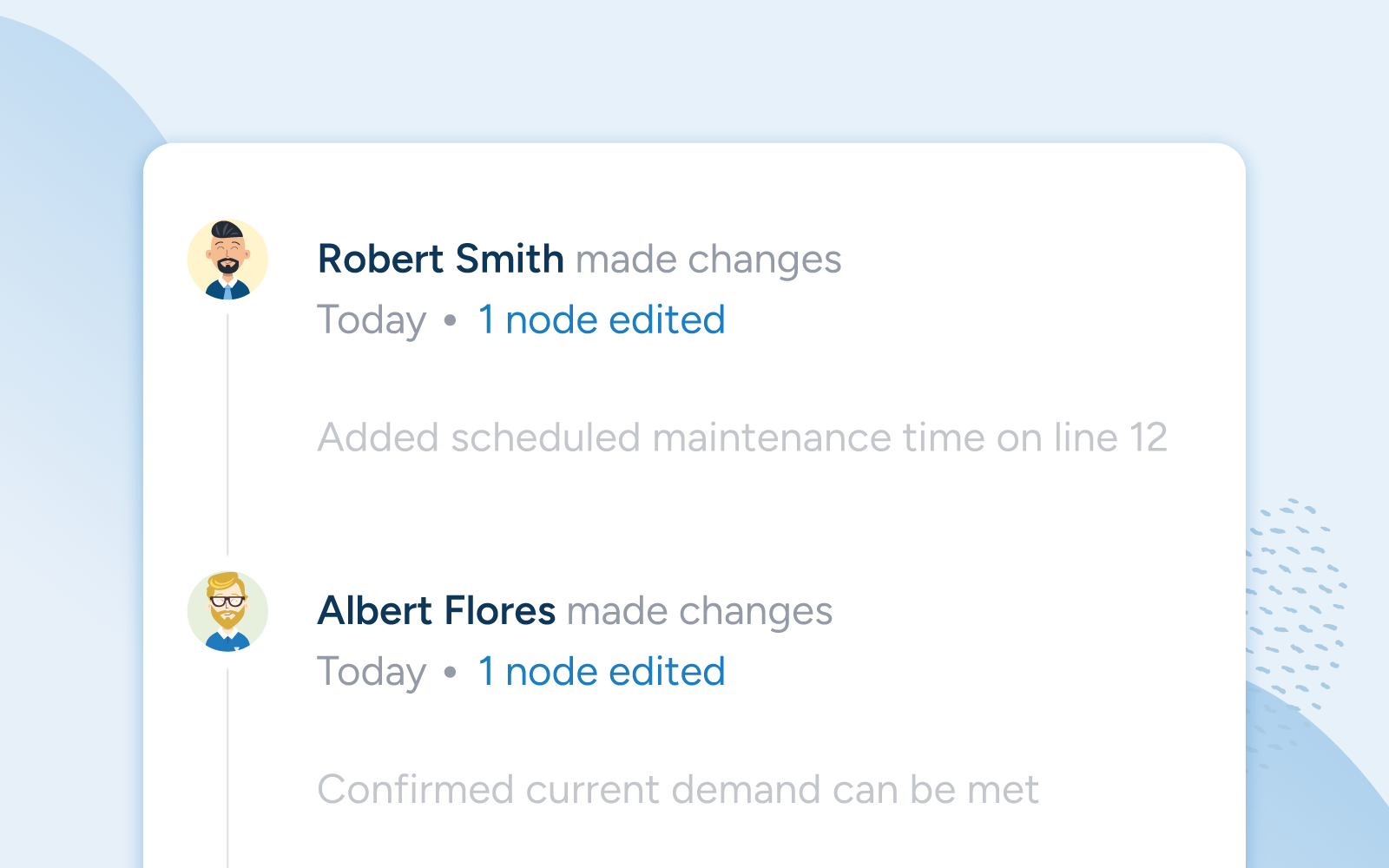
And since RELEX Demand Planning & Sensing is also part of our end-to-end supply chain planning platform, teams on this platform can use, share, and update the same dataset across planning functions so that everyone is working from a single source of truth.
Plus, RELEX has graphical reporting capabilities, including interactive dashboards, charts, and visualizations that allow users to analyze key metrics, such as forecast accuracy, sales trends, and inventory levels. These visual tools help stakeholders interpret data and make informed decisions during demand planning and S&OP processes.
5. Q: Can the RELEX system show me short-term forecast KPIs at a daily level so I can compare them to longer-term weekly metrics?
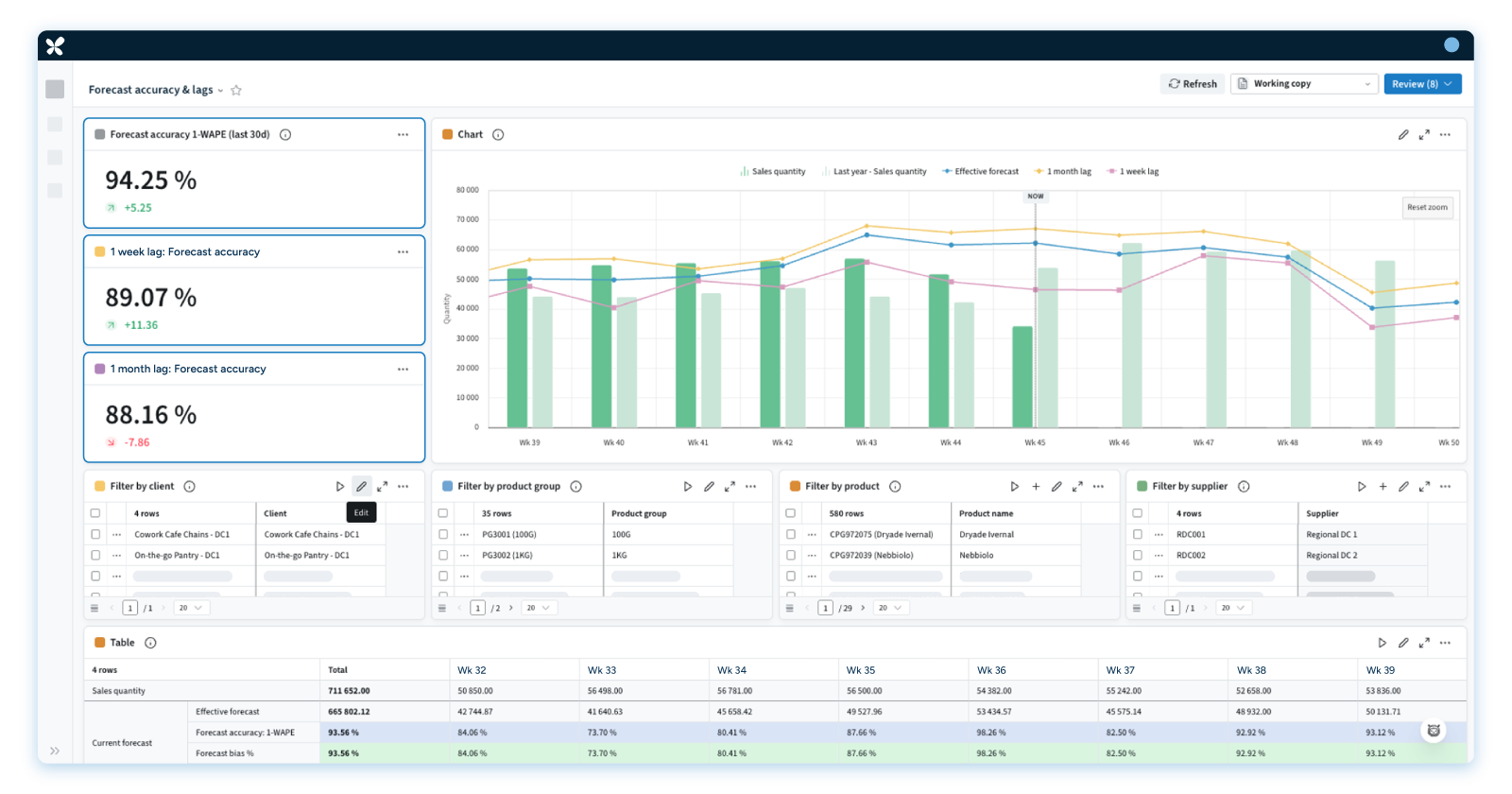
A: Yes, RELEX provides forecast lag capabilities specifically for manufacturers. For example, RELEX Demand Planning & Sensing provides a highly configurable dashboard and dedicated forecast tables that allow you to retain records of forecasts from previous days or weeks. You can configure lag periods and automate alerts to highlight deviations that need immediate attention. Your team can monitor KPIs in near real-time, using charts, heatmaps, trend lines, and drill-down capabilities. You can track metrics like:
- Mean Absolute Error (MAE)
- Mean Squared Error (MSE)
- Bias
- Weighted Absolute Percentage Error (WAPE)
This shorter feedback loop helps you check near-term forecast accuracy and supply chain performance and course-correct to support longer-term planning.
6. Q: How does the RELEX solution handle product lifecycle management?
A: Whether you’re planning replacements, new product introductions, or phase-out decisions, RELEX has you covered.
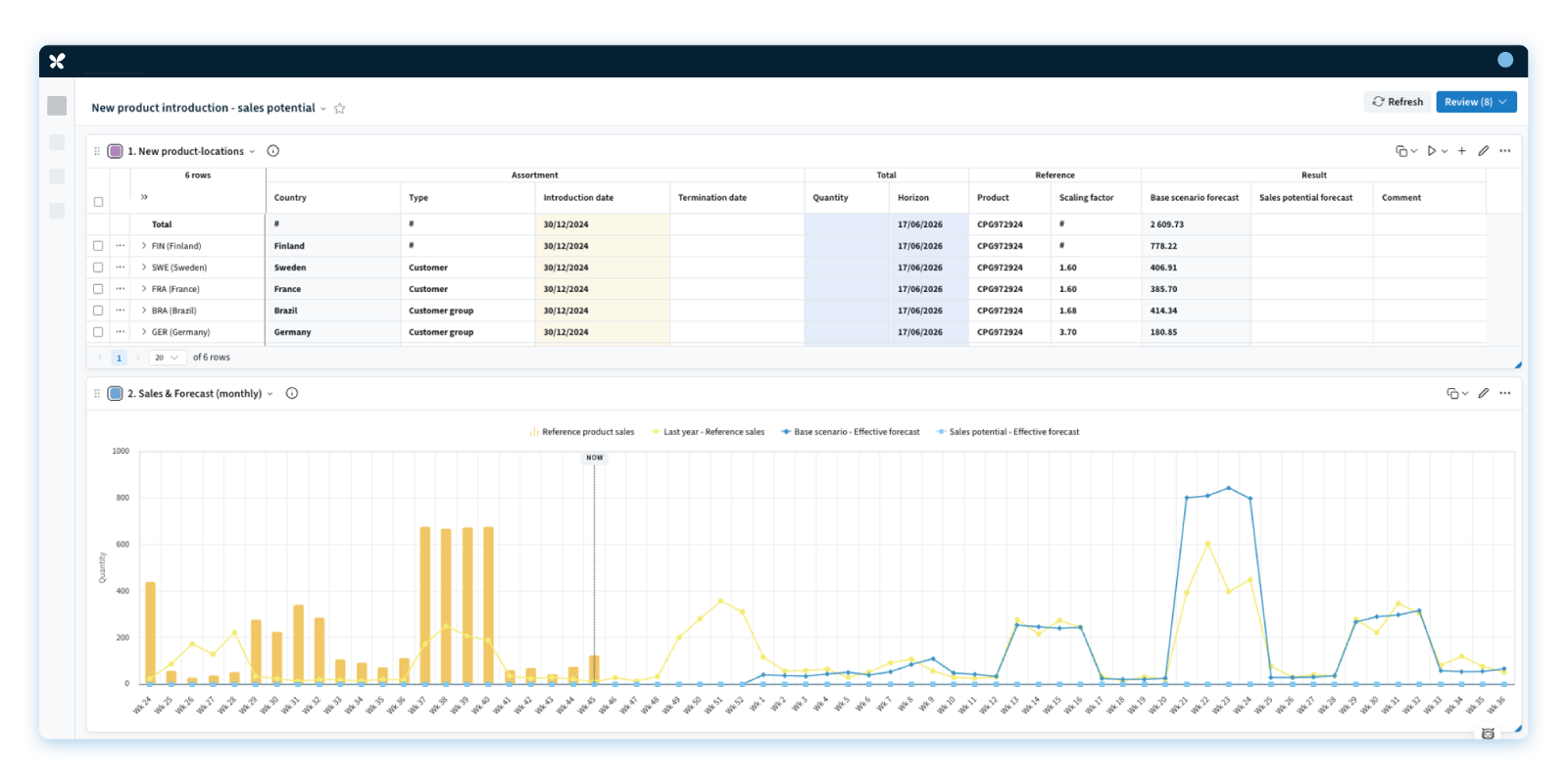
For replacements, RELEX Demand Planning & Sensing automatically incorporates the previous item’s sales history into the replacement’s forecast.
For new products, RELEX automatically identifies the best possible reference product, comparing the new item to existing products’ seasonality characteristics, weekday patterns, product and group attributes, or any custom attributes available in the master data. As the product accrues sales history, the system revises the forecast based on the latest available data. It can also incorporate manual adjustments or external data, such as a customer demand plan.
Industry use case: Let’s say you’re a beverage manufacturer. For a year, you’ve been selling a new flavor quite successfully through a big box retailer. Now, you want to extend that product to another major retailer with a similar business model and customer base. Using RELEX Demand Planning & Sensing, you can get a good idea of how that product is likely to sell and calculate a reliable baseline forecast for that new retailer.
The RELEX system also helps manufacturers manage product ramp-downs:
- It uses introduction and termination dates to set the replenishment time period and taper the forecast towards the end of the lifecycle.
- It automatically calculates the remaining demand and applies the chosen run-down profile, distributing the forecast proportionally across locations or based on historical trends.
This dynamic forecast adjustment optimizes inventory, so you can minimize waste while maintaining availability during the delisting phase.
Plus, thanks to the RELEX business rules engine, you can configure the automated rules guiding these forecasting parameters and apply them at scale.
7. Q: How can RELEX help me manage long-tail items and intermittent demand?
A: RELEX’s advanced forecasting methods include pooled models for slow-moving products, making them particularly effective in spare parts, automotive, and industrial manufacturing. They pool data across similar product-locations that have sparse sales history and provide a macro view of demand behaviors to improve forecast accuracy and stability.
RELEX Demand Planning & Sensing can also dynamically adjust forecasting techniques based on product characteristics, such as demand patterns. This approach ensures that slow-moving items are forecasted appropriately.
The VP of Supply Chain’s top concerns
The VPs of Supply Chain I’ve spoken to tend to echo the same concerns around service levels, costs, capital, and risk. They face disruptions and inconsistent lead times; they deal with complex capacity, material, and labor constraints; and their teams don’t have the technology to keep up with market swings and changing data.
Amid this complexity, they’re trying to align sales, operations, procurement, and finance decisions.
Demand forecast accuracy underpins all of those decisions.
VP of Supply Chain: An overview of requirements and benefits
| Question | RELEX answer |
|---|---|
| How can RELEX help me improve long-term supply chain strategies and performance? | RELEX’s demand sensing capabilities eliminate data lags and create a dependable forecast based on clear macrolevel demand behaviors for better long-term planning. |
| Does RELEX provide scenario planning? | Yes, RELEX’s scenario planning capabilities allow users to test decisions and avoid costly mistakes by simulating the impact of changes to orders, capacity, and demand. |
| How does RELEX support consensus plans and collaboration? | RELEX offers customizable, at-a-glance dashboards that display information at both volume and value levels to streamline review meetings. |
| How does RELEX Demand Planning & Sensing support end-to-end planning and feed into other processes? | RELEX Demand Planning & Sensing provides the reliable, data-driven demand forecasts requisite for effective IBP, purchasing planning, production planning and scheduling, and retail collaboration. |
RELEX Demand Planning & Sensing helps you synchronize end-to-end planning functions and balance trade-offs so you can:
- Raise service levels without corresponding inventory spikes.
- Free up working capital.
- Reduce costs related to logistics, procurement, and expedited shipments.
- Refine your S&OP and IBP processes through forecast-driven planning alignment.
- Shore up vulnerabilities in your supply chain.
1. Q: How will RELEX’s forecasting capabilities help me develop long-term strategy and improve supply chain performance?
A: The answer here lies in the “demand sensing” side of RELEX Demand Planning & Sensing.
Using and aggregating updated demand signals provides a macrolevel view of market conditions that helps increase forecast accuracy and better inform long-term planning.
RELEX’s demand sensing capabilities provide reliable, near-term demand signals that protect manufacturers from getting caught off guard by disruptions or lagging demand data. The solution absorbs data pertaining to weather, promotions, events, cannibalization, halo effects, and other external factors, so planners can better understand and adapt plans to real-world demand drivers.
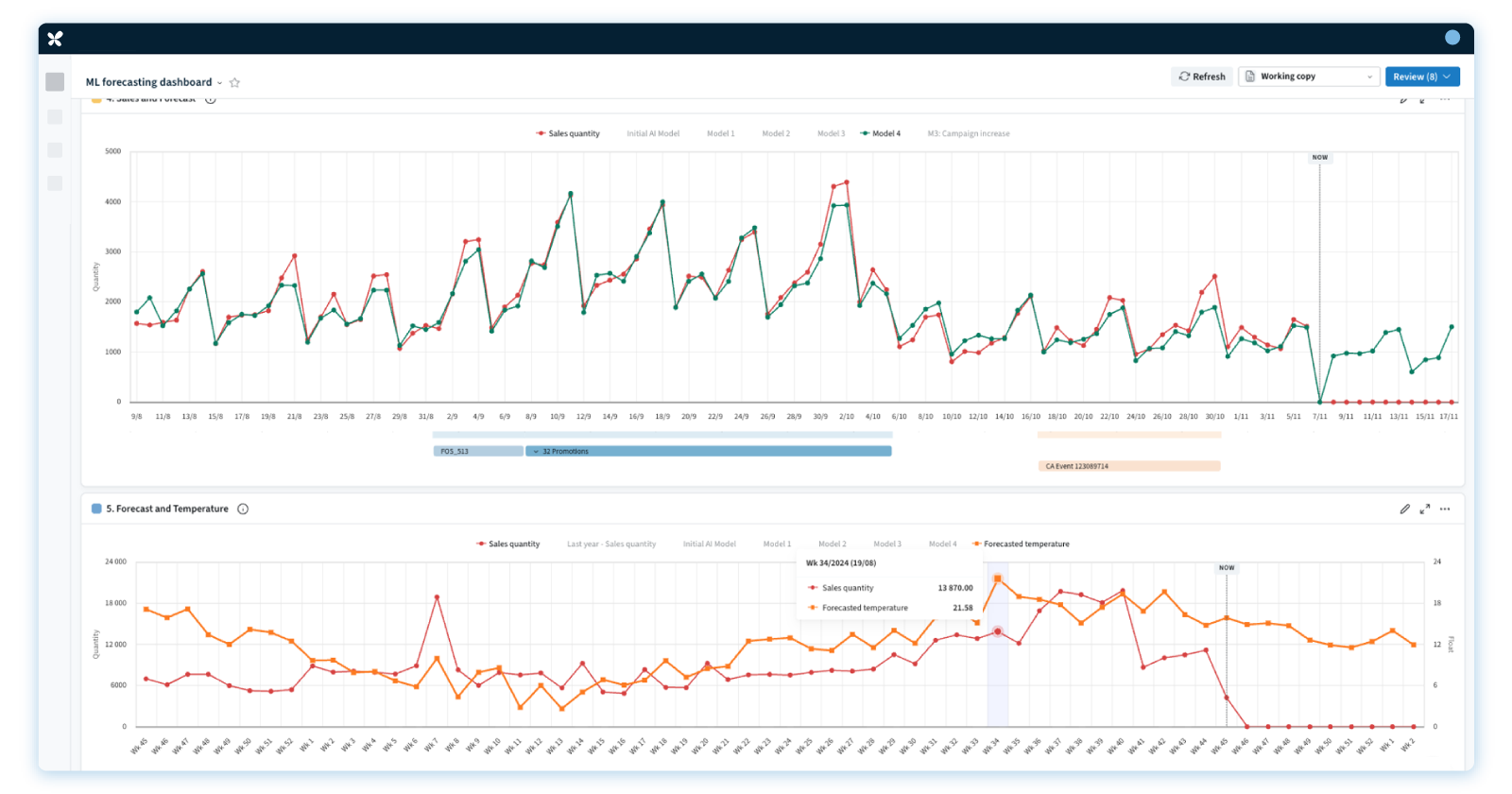
With faster, cleaner data inputs, manufacturers can:
- Reduce forecast latency and bullwhip effects.
- Improve service without sinking working capital into excessive inventory levels.
- Stabilize production and purchasing plans.
- Develop a steady, reliable cadence of aligned IBP decisions.
- Improve planning efficiency.
- Scale strategies as businesses grow.
Industry use case: I’ve seen demand sensing prove particularly effective for manufacturers incorporating retail POS data. Typical supply chain planning solutions calculate demand using sell-in data. “Sell-in data” refers to the orders the manufacturer sends to the retailer.
RELEX Demand Sensing, on the other hand, allows manufacturers to augment sell-in data with sell-out data. “Sell-out data” refers to what shoppers actually buy from retailers. Combining sell-in and sell-out data allows manufacturers to compile a clearer picture of consumer demand and refine their forecasts for each retailer.
In my experience, the manufacturer applying our demand sensing capabilities to POS data sometimes has a better sense of what the retailers will need than the retailers do!
2. Q: I want to test scenarios before deploying critical changes. What are the scenario planning capabilities on the RELEX platform?
A: RELEX’s scenario planning capabilities let users simulate and evaluate the impact of various “what-if” scenarios, such as changes in order schedules, capacity constraints, or demand fluctuations. Your users can test and compare different planning solutions in a controlled environment to figure out the best decisions. Many of the teams I’ve worked with use scenarios for capacity planning, seasonal buys, and stress-testing supply chain networks.
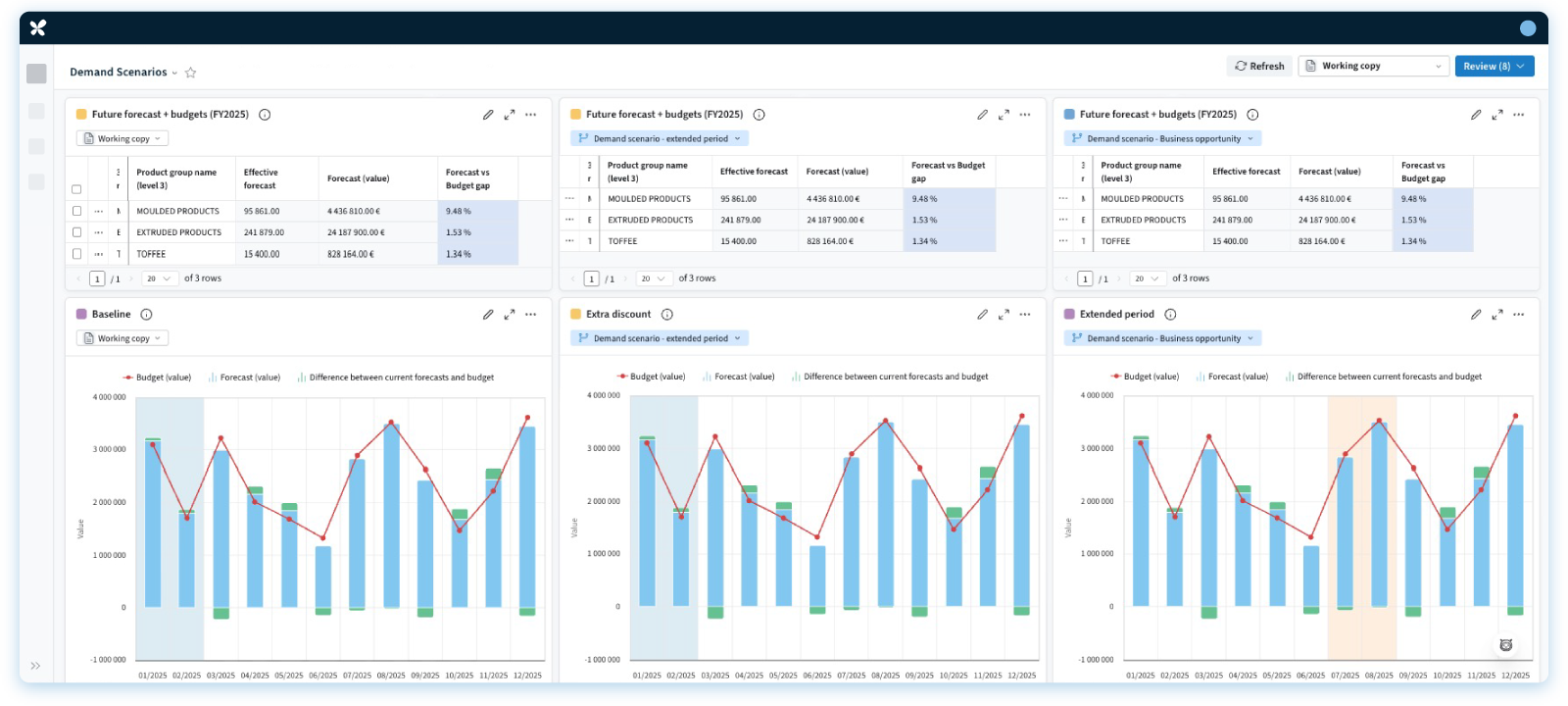
3. Q: I need to build a consensus forecast that includes inputs from different stakeholders like product line managers and commercial teams. How does RELEX support consensus plans and collaboration?
A: RELEX Demand Planning & Sensing helps teams build a consensus plan through customizable dashboards that display all layers of the enriched forecast, including various inputs at both volume and value levels. These dashboards are accessible at any layer in the hierarchy, making forecast review meetings easier and more efficient.
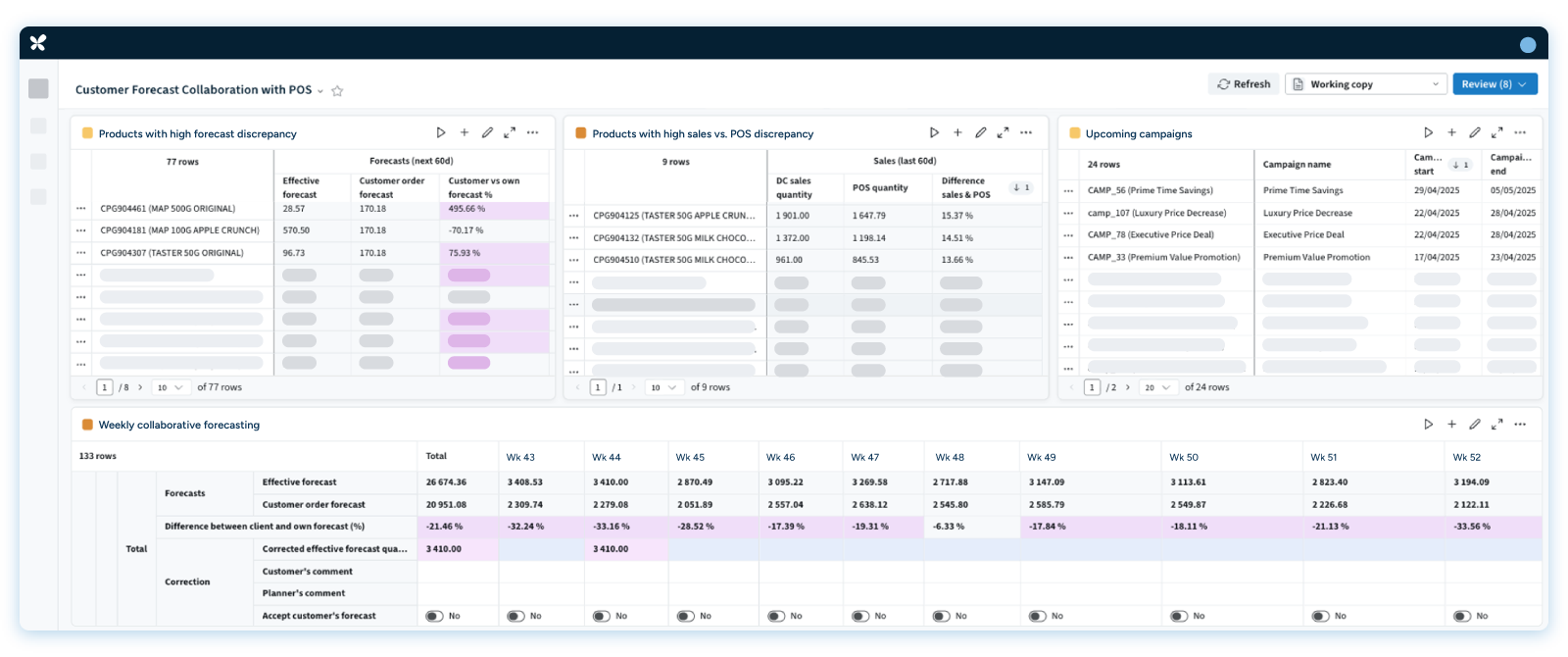
With advanced scenario planning and collaboration tools, your organization can make fast, confident decisions to maximize profit, reduce risk, and identify new opportunities.
4. Q: How does RELEX Demand Planning & Sensing support end-to-end planning and feed into other processes like IBP and production planning?
A: RELEX Demand Planning & Sensing underpins end-to-end planning because each connected process requires a reliable demand forecast. For instance, better forecast accuracy:
- Gives leadership the bottom-up demand signals that strengthen IBP and S&OP decisions.
- Helps purchasing teams fine-tune procurement volumes and timing, keeping excess inventory to a minimum.
- Feeds into production plans so teams can meet targets and avoid skyrocketing production costs.
- Gets production scheduling teams faster demand signals so they can react more quickly and strategically to disruptions or changes.
- Supports retail collaboration by calculating granular channel- and account-level forecasts, reducing the bullwhip effect and strengthening joint business planning.
All the capabilities I mentioned above exist on the scalable RELEX platform. This shared architecture allows manufacturers to easily share data and decisions and incorporate innovations like generative and agentic AI into their workflows.
The Commercial Director’s top questions
When I talk to Commercial Directors about demand planning, the main takeaway is that they’re going to need a strong, easily accessible forecast to achieve their goals. For instance, they’re trying to pull sales, marketing, e-commerce, and revenue growth management into one cohesive commercial strategy. They’re managing margin pressures, balancing price increases, and organizing decisions across channels. Accomplishing these objectives requires a clear, timely understanding of demand behaviors.
Commercial Director: An overview view of requirements and benefits
| Question | RELEX answer |
|---|---|
| Can RELEX incorporate promotional data? | Yes, RELEX can use any promotional input that exists within the master data. |
| How does RELEX help us evaluate different sales and promo scenarios before committing to customers? | RELEX users can run sales and promo scenarios before plans are confirmed to see if any changes need to be made. They can also leave comments in the system itself to align decisions across teams. |
| What level of financial reporting does RELEX Demand Planning & Sensing provide? | RELEX lets users build views and reports around any KPIs, aggregating according to need at any product, location, time period, or custom dimension. |
| How does the solution improve forecast accuracy at the customer or account level? | RELEX Demand Planning & Sensing improves channel-level forecasts by incorporating POS data, easing retail collaboration, and using special models for long-tail product forecasts. |
With RELEX Demand Planning & Sensing, you can:
- Protect key accounts with channel- and account-level forecasts.
- Give supply chain planning teams visibility into commercial decisions and incorporate promotional input into the forecast.
- Align commercial strategies with supply realities so teams can make decisions that account for available supply, capacity constraints, and market conditions.
- Reduce stockouts, excess inventory, and spoilage, minimizing the effects of poor forecasting on commercial outcomes.
These capabilities ensure you can keep your commitments to customers, grow revenue and market share, and increase trade promotion ROI.
1. Q: What promotional variables can the system use as input for forecast calculations?
A: RELEX Demand Planning & Sensing can use any promotional variable as an input as long as the data is available. Typically, teams will start with a few variables and incorporate more over time. The system’s dashboards make it easy to visualize how different factors are influencing promotional performance.
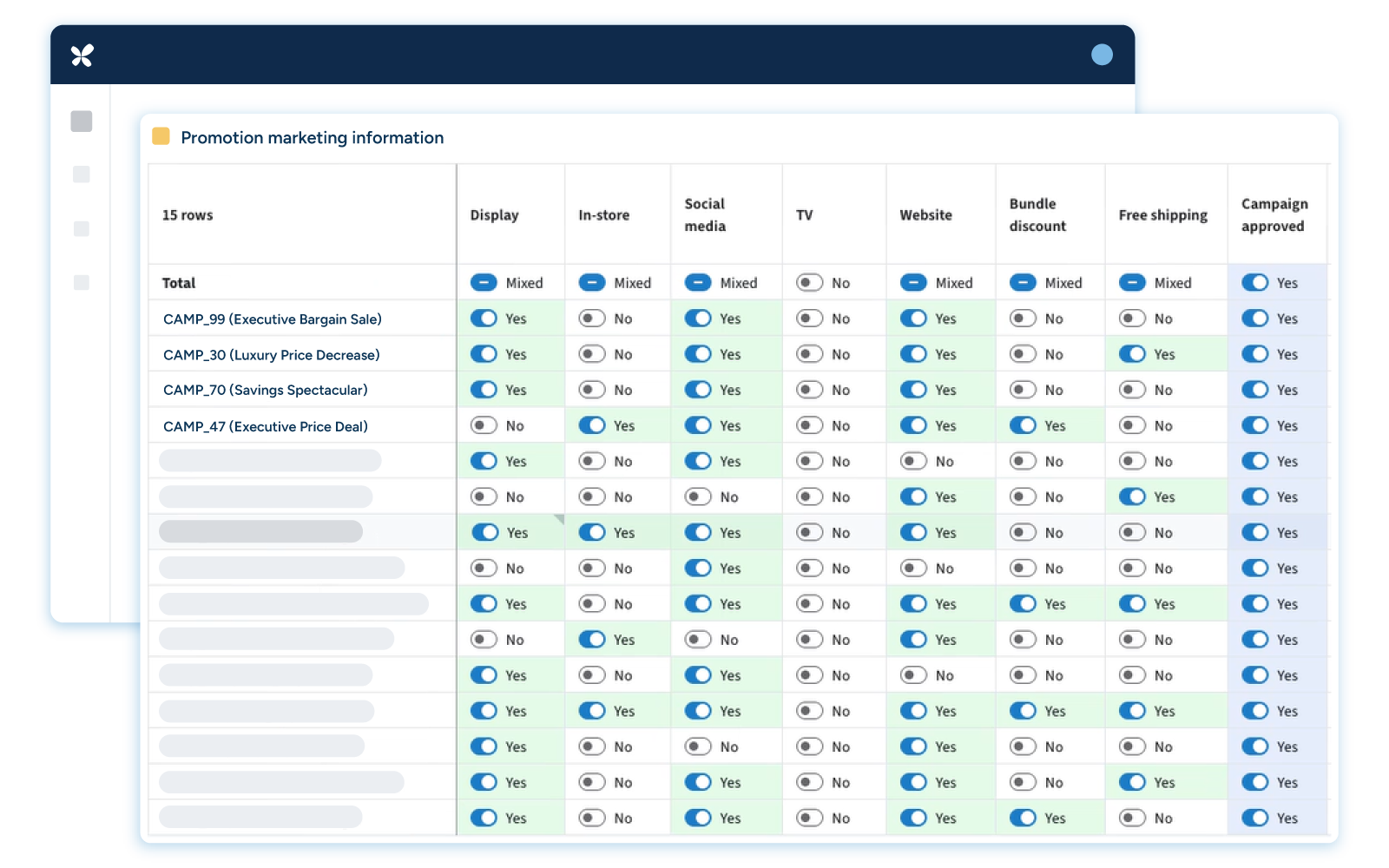
2. Q: I want to be confident when committing volume to a retailer. Can the RELEX system help us evaluate different sales and promo scenarios before committing to customers, even if those plans are unconfirmed?
A: Yes, RELEX Demand Planning & Sensing lets you run various sales and promo scenarios before those plans are confirmed.
For example, in the case of promotions, users can assign different statuses to individual promos such as “Planned,” “Awaiting Approval,” “Approved,” and “In flight.” Users can build out the scenarios and see if there are any changes they need to make.
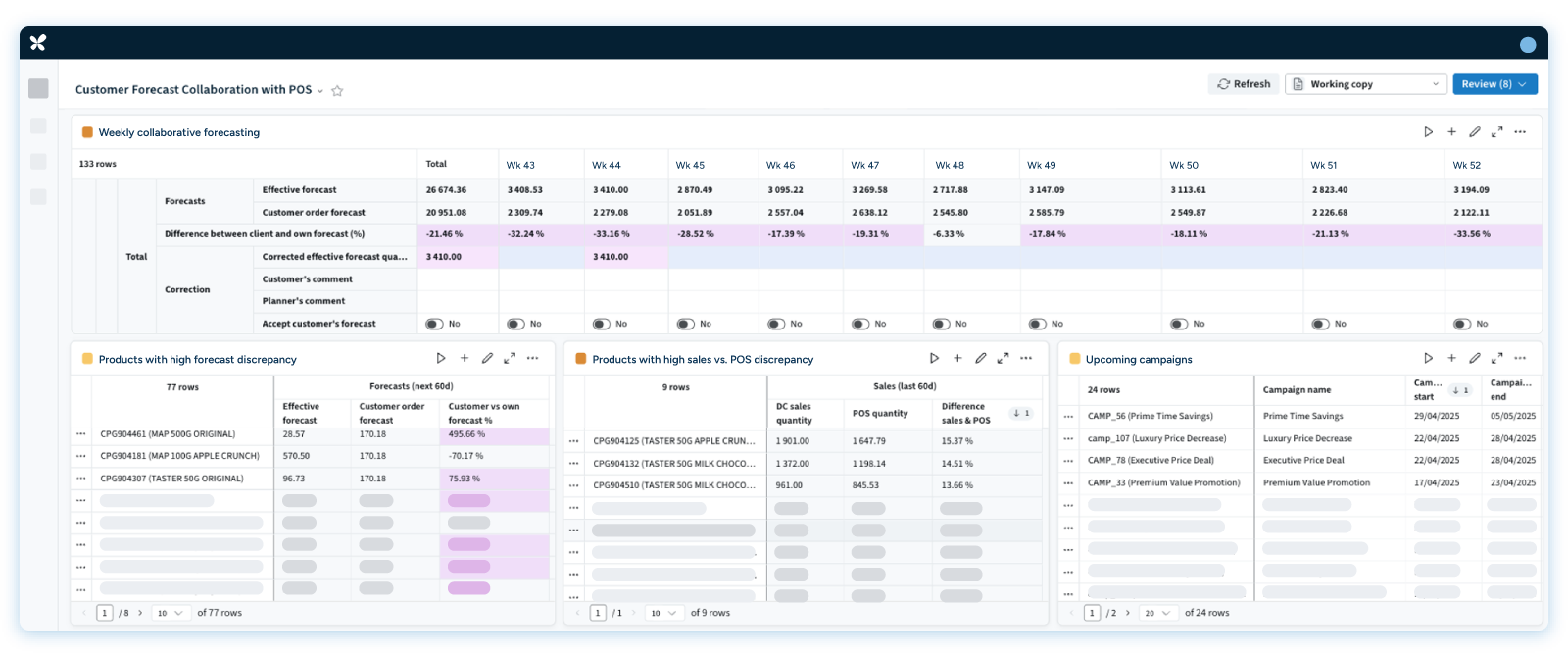
Use case: I’ve seen a lot of manufacturers that started off with decision-making processes scattering information across spreadsheets and emails. With RELEX, these companies can instead set plans, update statuses, and leave comments for colleagues, all on the RELEX dashboard. This ensures everyone is on the same page, working with the same data at the same time.
3. Q: What level of financial reporting does the RELEX system provide?
A: RELEX Demand Planning & Sensing lets you build views and reports around any KPIs you choose and create and modify those reports ad hoc. And because we can calculate at such a granular level, users can easily aggregate and disaggregate according to their needs at any product, location, time period, or customer dimension.
For instance, the sales team views the business at a different level of aggregation than a demand planner. The demand planner may work in daily buckets for a single product, while the sales team views those same plans at the product group-level by month. Changes made at a higher level of aggregation are disaggregated based on the forecast. This level of flexibility and control gives you increased overall supply chain visibility while allowing users to focus their attention on their most vital KPIs.
4. Q: How does the RELEX solution improve forecast accuracy at the customer or account level?
A: RELEX Demand Planning & Sensing improves forecast accuracy at the customer or account level by:
- Integrating POS data and generating granular forecasts at the channel level.
- Exchanging plans and information with retail partners.
- Using special models for long-tail product forecasts.
Let’s take these one at a time.
Incorporating POS data
First, RELEX helps you access better data, and more of it, by incorporating retail POS data into your forecasts. It provides channel-specific forecasting, considering demand variables like:
- Baseline demand
- Weekday profiles
- Demand level shifts
- Trends
- Seasonality
- Events
- Past promotions
These account-level forecasts have SKU/day granularity. So instead of relying on averages that distort demand behaviors, you have a clear, granular picture of consumer demand and an accurate forecast for each customer.
Improving retail collaboration
Second, RELEX makes it easy for you to collaborate with your retail customers. The system can automatically upload customer-provided order forecasts for key accounts using workflows. It also allows users to schedule forecast exports to customers to make joint planning easier.
Forecasting slow movers
Third, RELEX can forecast slow-moving items with sparse sales history. Slow movers pose a challenge to standard statistical models, but RELEX uses pooled models to combine demand signals from similar products and calculate behavioral patterns for each SKU. So you can generate accurate forecasts, even for niche or seasonal SKUs by account.
All together, these capabilities help you improve your OTIF rates and strengthen your relationships with key accounts.
Other C-suite concerns
C-suite leaders have their own KPIs to measure and report to the board. Here are the concerns that come up often in my conversations with the C-suite and how I’ve seen project champions win executive buy-in.
| Question | RELEX answer |
|---|---|
| How does RELEX ensure a smooth implementation and user adoption? | RELEX has a 100% implementation success rate, thanks to proven best practices and on-demand, gen AI-assisted support for onboarding and continual learning. |
| Does RELEX integrate with our existing ERP, data, or tech stack? | Yes, RELEX integrates with data sources across your business, including ERPs, reporting tools, REST APIs, files, and other systems. |
| How can RELEX help us overcome data quality issues and poor datasets? | RELEX uses data cleansing techniques and ML-based algorithms to speed up pre-processing during implementation and maintain data quality going forward. |
| How is RELEX ensuring data security? | RELEX adheres to strict data security standards and practices and has earned multiple data security certifications with rigorous requirements. |
| How will RELEX help us scale AI and improve the longevity of our tech investment? | We reinvest up to 25% of our revenue back into R&D, powering the innovation that helped us launch the first gen AI assistant for retail and supply chain planning, now joined by AI agents across multiple planning functions. These innovations are supported by a scalable platform, industry-proven machine learning and optimization tools, and 20 years’ worth of document best practices. |
1. Q: A new solution isn’t worth much if people don’t use it. How does RELEX ensure a smooth implementation and user adoption?
A: I get this question frequently from CIOs. The good news is that RELEX has a 100% implementation success rate, with over 600 customers worldwide. We also have a 97% percent customer retention rate and a Net Promoter Score (NPS) of 61, well above the SaaS industry average of 40.
This success stems from our customer-first RELEX core values, focused on treating our customers as friends, providing measurable value, and putting an end to stupid things that would hamper our ability to innovate and deliver results.
Besides our tried-and-true implementation process, every user now has access to Rebot, our proprietary gen AI assistant. Rebot is essentially an on-demand consultant, capable of communicating in users’ native languages. It helps RELEX users learn the ropes, better understand the solution’s capabilities, and become expert users faster.
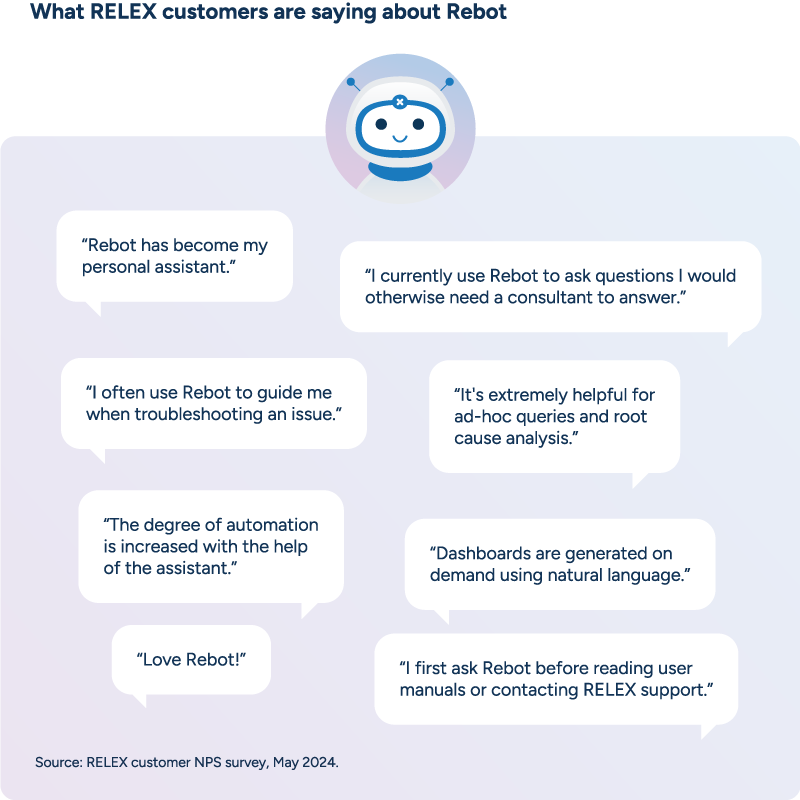
We’ve seen customers significantly speed up onboarding and improve operational efficiency, and we’re already implementing new agentic developments.
READ MORE: Beijer Byggmaterial (STARK Group) boosts operational efficiency with Rebot
2. Q: How will you integrate with our existing ERP, data, or tech stack?
A: This is another common CIO question. RELEX integrates with data sources across your business. That includes ERPs, reporting tools, REST APIs, files, and other systems. We’ve integrated with over 500 customers, and even after 20 years, we’ve never had a failed implementation.
3. Q: Our data is not perfect. Can RELEX still work with it?
A: I’ve seen many manufacturers postpone updating their processes and tech stacks because they were worried about their data and thought they had to make it perfect first. But RELEX has built-in data management that helps create usable, quality data, including:
- Data cleansing techniques that correct small mistakes such as duplicates and gaps.
- Advanced machine learning that detects data inconsistencies, especially helpful during the pre-processing phase of implementation.
- Outlier detection that protects the forecast from stray data points.
- Noise detection that differentiates true demand signals from random variations.
- Level shift detection that uses machine learning to identify and adapt to major, unexplained step changes in demand.
And once you have a good data set, you can maintain and grow it, thanks to RELEX’s in-memory database and scalable computational power.
READ MORE: Use AI to make messy datasets useful, not perfect
4. Q: How is RELEX ensuring data security?
A: RELEX is dedicated to ensuring your data stays safe. We’ve earned multiple data security certifications, including an ISO 27001 certification, which requires adherence to the strictest standards for establishing, maintaining, and improving an information security management system. We also have strict and ongoing internal infosec training and established procedures to mitigate the risk of data leaks.
For more information on our infosec policies, check out these resources:
- Information Security – Frequently Asked Questions | RELEX Solutions
- Privacy Notice – RELEX Knowledge Hub | RELEX Solutions
- RELEX AI Governance | RELEX Solutions
- Security Compliance | RELEX Solutions
5. Q: Tell me about RELEX’s AI development strategy and AI capabilities. How are you going to help us scale AI and increase the longevity of our solution?
A: RELEX Solutions helps companies get the most out of their tech investments through an approach we call self-funded AI diversification.
So, AI diversification just means you’re pulling lots of different AI and optimization tools together. Everyone gets fixated on generative and agentic AI planning capabilities, but before you implement them, you have to think to yourself, “What are the foundations of these generative and agentic tools that make them effective? What are gen AI assistants and AI agents actually using to complete tasks?” On the RELEX platform, they’re using specialized AI, like machine learning models and optimization tools, and they’re applying those tools to the available data.
At RELEX, AI diversification involves multiple elements:
- A unified data platform.
- Specialized AI that’s been trained specifically for supply chain use cases.
- Generative AI that pulls from our knowledge base of 20 years of documented experience and best practices.
- AI agents.
In fact, shared data, specialized AI, and a machine-readable knowledge base are the reasons our gen AI assistant and AI agents can make effective decisions. We can tell these agents what to do, but we also give them the context they need to understand how best to do it.
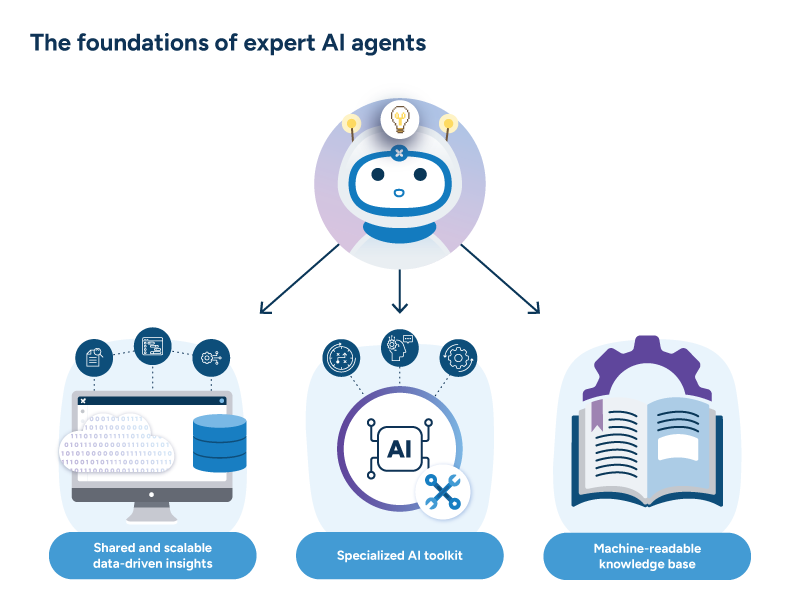
So when you think about the three types of AI – specialized, generative, and agentic – you get the most out of each type of AI when you combine it with the other types. This is a strategy you can build over time.
Which brings us to self-funded transformation. With a self-funded approach to scaling AI, you can implement and scale your AI tools over time using the ROI from previous implementations to fuel the next.
Plus, RELEX invests up to 25% of our revenue back into R&D to continuously fuel AI innovations. We were the first to deliver a supply chain and retail planning AI assistant to the market. Our focus on innovation also ensures your previously implemented solutions never grow stagnant and remain effective far into the future. And since the RELEX platform is built to support AI from the get-go, integrating these innovations is seamless. The fact that RELEX is AI-native makes it easier for you to implement new developments as they become available.
I usually get this question from CFOs who need to be sure the technology they choose is worth the investment. And the emerging role of Chief AI Officer (CAIO) is also certainly beginning to play a bigger role in manufacturers’ technology investment decisions. If you’re interested in more information on our AI agents, strategies, and developments, check out the following resources:
- Beyond the hype: RELEX AI agents
- AI at RELEX: Building scalable, profitable tech stacks
- How RELEX turns agents into experts
- The RELEX multi-agent system: A practical approach to realizing AI’s full potential
Customer success stories
With RELEX, leading manufacturers have made the switch from spreadsheets to efficiency-boosting automation. They’ve minimized supply chain waste, adjusted to market shifts with precision and speed, and kept their teams and strategies aligned.
Our customer base includes manufacturers across the globe and spanning industries like:
- Baked goods manufacturers
- Beverage consumer brands
- Dairy processors
- Meat and poultry
- Fresh food producers
- Health, beauty, and hygiene
- Home and living
- Industrial manufacturing
- Apparel and footwear
For instance, Atria Finland, a leading Nordic meat manufacturer serving grocery retailer, good service, and food industry sectors, leveraged RELEX demand planning to achieve 98.1% weekly forecast accuracy and a 13% reduction in manual forecast adjustments.
“With RELEX, the transparency we have into our retailers’ forecasts has genuinely put us on the pulse of the end-customer demand. Seeing the changes in short-term demand — almost in real time — gives us more time to adjust and time our production accordingly.“
Mikko Soini, Planning Manager at Atria Finland
Another RELEX customer, Ametller Origen, a Spanish food company specializing in high quality fresh and packaged foods, saw a 10% increase in product availability, a 13% reduction in inventory, and 30% reduction in fresh spoilage after only three months.
“Having RELEX as the single source of demand foresight helps us optimize all our processes within the supply chain, in the broadest sense of the word. Every step in our supply chain has been improved.”
José Ramón Franco, Purchasing Director of Dry and Refrigerated Products, Ametller Origen
Blount Fine Foods used RELEX’s demand planning and supply chain optimization solutions to reduce waste by 35%. The company, a family-owned and operated manufacturer of premium fresh prepared foods, also saw a 5% increase in annual production pounds and a 2% improvement in production efficiency.
“We accomplished our goals, and then some, with RELEX.”
Jonathan Wells, Sr. Director of Demand Management, Blount Fine Foods
What RELEX customer success tells us about technology investments
One of my favorite success stories to share is about a manufacturing customer who ditched over 150 spreadsheets, thanks to RELEX. It’s one of my favorite examples because it’s a rather common one. Not every manufacturer has that many spreadsheets floating around. But plenty of them are looking to AI-driven platforms to automate and improve decisions because they know it will improve efficiency and margins.
Ultimately, the most successful and resilient companies are those willing to rethink their fundamental planning processes. Your solution provider should demonstrate that same willingness to rethink and reinvent.
So what solution characteristics will ensure the technology you invest in grows with you and pays dividends into the future?
RELEX offers manufacturers the whole package: scalable AI and optimization tools, clean data, configurable automation, and documented best practices to inform both our users and our AI assistants and agents. With these advantages, business leaders can be sure their AI investments bring about actual improvements and don’t just automate poor processes or unleash AI agents that don’t know how to operate in a supply chain context.
Questions? Let’s continue the conversation.
Written by