How health and beauty retailers can prevent fragmented planning using modern supply chain software
Jun 22, 2026 • 14 min
Health and beauty is one of retail’s most resilient growth sectors, on track to reach $590 billion by 2030. Yet it records the highest rate of unsold product of any non-perishable consumer category. That gap is the symptom of a planning infrastructure that wasn’t built for a sector that moves this fast.
Health and beauty retailers don’t have an inventory problem; they have a planning fragmentation problem. All the issues these companies face trace back to the same root cause: commercial and supply chain decisions made in separate systems, against shared inventory. RELEX’s health and beauty retail planning capabilities help retailers close that gap, unifying merchandising, promotional planning, supply chain, and operations into a single view.
What makes health and beauty retail planning uniquely difficult?
Retail supply chain planning comes with certain inherent challenges, but for the health and beauty sector, these are amplified due to a few reasons:
- It’s a sector shaped by some of the fastest-moving demand signals in consumer goods.
- It uses a promotional model where a significant share of revenue is tied to campaign windows that the supply chain is often the last to know about.
- Health and beauty demand patterns are shaped by social media and influencer activity that can move a product from normal velocity to sold out in a matter of hours.
- There’s a customer experience expectation that most planning architectures were not built to deliver.
The main challenges health and beauty retailers face are distinct in their symptoms but share a common cause: commercial and operational decisions made within systems that were not designed to communicate with one another. The result is channels that grew independently instead of complementing each other.
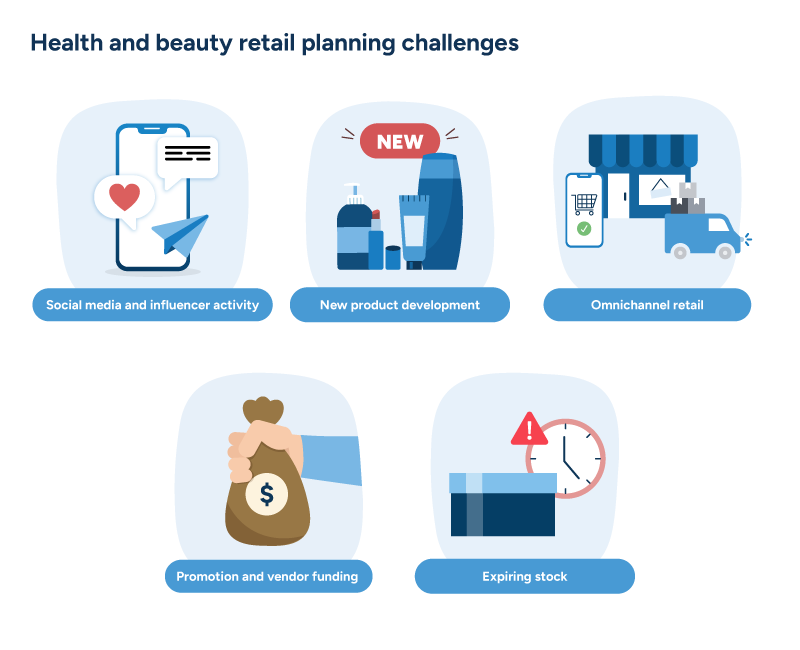
Social media and influencer-driven demand spikes
Social commerce has fundamentally changed how beauty purchases are made, and so has the speed at which demand can move. Health and beauty consumers spent $1.83 billion through TikTok Shop in the US over a 12-month period ending April 2025, making it the platform’s most dominant product category in that time. That concentration reflects a fundamental aspect of how beauty purchases are made. Consumers discover products through social media, intent forms fast, and when a product breaks through, it breaks through everywhere at once.
These demand spikes come in two forms:
1. Unplanned virality
Social media hysteria can create organic moments that produce sudden mass demand for certain products without warning, leaving retailers scrambling to respond.
In June 2024, Prada Beauty’s Astral Pink Lip Balm appeared in Sabrina Carpenter’s music video, sold out at every major retailer within 72 hours, and was still awaiting restock more than a month later. No forecast could have anticipated this reaction.
When demand moves in hours, the planning problem is more about agility and inventory visibility than it is about predictions.
There is a further data integrity problem. If a viral demand event is not isolated as an outlier, the algorithm carries it into next year’s baseline, building a forecast against demand that will not recur.
2. Planned influencer activity
Paid sponsorships have start dates, expected uplifts, and supply commitments. Yet even when a commercial relationship exists, the connection between the promotional signal and the supply plan is typically missing.
When a brand commits a budget and agrees on a start date for a planned influencer promotion, that information exists on the commercial side. But the supply chain doesn’t have it. Replenishment orders are placed against baseline demand because no one passed the signal across. The result is a known demand event that the supply chain was never told about and isn’t prepared for.
New product launches and product lifecycle management
New product development (NPD) is the engine that drives health and beauty retail. However, without the right planning infrastructure, it can also be one of its most reliable sources of margin loss. Leading specialty health and beauty retailers can launch over a hundred new brands in a single year, but the pace of these launches creates a compounding planning problem. Every new product arrives with no sales history and an immediate question of where to place it.
Most NPD in health and beauty retail isn’t truly additive. Just 46% of beauty and personal care launches in 2024 were genuinely new products- the majority were renovations, reformulations, or range extensions. The dominant NPD pattern in the category is cannibalistic by design, but most planning systems treat every new SKU as an addition rather than a substitution. Because planning systems often don’t account for this cannibalization, the net impact on category revenue remains invisible until after production decisions have been made.
Undersupplied launches squander the window of maximum consumer interest while oversupplied launches create an immediate markdown problem. Localization adds complexity that is particularly acute in health and beauty.
For instance, a foundation shade range suited to one market may not be suited to another, and without store-cluster-level data informing initial allocations, ranges are distributed uniformly. This creates overstock in mismatched markets and stockouts in markets with the highest demand.
Omnichannel and unified commerce
For health and beauty retailers, omnichannel has a planning infrastructure problem. Omnichannel customers in health and beauty spend nearly three times as much as retail-only customers. Yet, at major specialty retailers, less than one in five loyalty members shop across both channels.
This structural failure is most visible in BOPIS (Buy Online, Pick Up In Store) orders. A customer may place an order online for same-day in-store pick up for a promoted product that the app shows as in stock. The order is confirmed, and the customer drives to the store. But when they arrive, they find that the product is out of stock. The product was likely sold in-store that morning while the order was being queued.
The gap is due to inventory inaccuracies; in-store sales and BOPIS reservations draw from the same inventory pool, but the online availability doesn’t reflect what is physically on the shelves. It’s been found that up to 60% of retailers’ inventory records in health & beauty are inaccurate. Testers, high-velocity SKUs, and multi-location stock movements create constant discrepancies; phantom inventory is endemic.
Omnichannel pricing inconsistencies compound the problem. Online promotional prices frequently fail to reflect those in physical stores, with different rules applying across store formats and retail partnerships. Although some promotions are designed to be online-only, unintentional omnichannel price discrepancies can erode margins and customer trust at exactly the moment a promotion is meant to be driving both.
Promotions and vendor funding management
In health and beauty retail planning, promotions are the single biggest revenue lever and also the most reliable source of supply chain failure.
What makes this structurally different from most retail sectors is the funding model. About 70% of health and beauty promotions are vendor-funded. Typically, a brand commits a promotional budget to a retailer weeks or months before anyone in the supply chain is informed. As a result, the commercial negotiation and the supply plan operate in separate rooms, and the result is predictable.
The promotion has been agreed, the funding committed, the shelf space allocated, and the replenishment orders have been placed at baseline demand. Within hours of launch, top-promoted SKUs sell through. Real customer accounts document orders canceled the morning after placement, with products still showing in stock at nearby stores but no longer available at the promotional price.
Expiration dates and aging stock
Something that may be underestimated in health and beauty retail operations is the expiration and shelf life of products. An estimated $4.8 billion in beauty products go to waste in brands’ supply chains annually, driven by overproduction and excess inventory at 6.2% and spoilage and damage at 4%. The sector has the highest inventory loss rate of any measured consumer category, compared to apparel at 3.9%, pharmaceuticals at 3%, and food at 2.9%.
The two main issues are standard aging stock and minimum shelf-life requirements. On the former, when “first-expired, first-out (FEFO)” logic isn’t applied, older batches get stranded in warehouse locations while newer deliveries are shipped to stores. This leads to products expiring before they even reach the shelves.
In terms of the latter, many markets require a minimum shelf life of 6 months at the point of delivery. This means that a technically in-date product can be unsellable in its intended channel. The same batch may be saleable in one market and blocked in another.
What is the cost of poor planning in health & beauty retail?
When merchandising, supply chain, and store operations run as separate workstreams across an expanding number of channels, the gaps between them compound.
The most visible impact is lost revenue at the moment it matters most. In a category where promotions drive close to half of purchase decisions, a stockout mid-campaign means a lost sale — and a customer at peak intent who can’t buy and may not come back. A viral moment can open and close a demand window in a matter of hours, faster than most planning cycles can register the signal, let alone respond to it.
BOPIS failures carry a different kind of cost. A confirmed order against inaccurate inventory results in a refund and undermines a customer’s trust in the brand. In fact, six of the top ten US beauty retailers saw decreases in customer loyalty in 2024. For a category where loyalty is already under pressure, trust is hard to rebuild.
Then there’s the quieter cost: the gradual margin erosion that accumulates across the business and garners little attention until it’s too late. Excess promotional stock gets cleared at a discount, and trade funds get spent on promotions that move volume but don’t move the needle.
Fragmented planning rarely fails all at once; it shows up in write-offs, exceptions, and post-mortems. Each one of these is manageable in isolation until the cumulative cost becomes impossible to defend.
What strategic approaches can health and beauty retailers take to end fragmented planning?
The strategies that address fragmented health and beauty retail planning share a common logic. When a decision is made, its implications need to be immediately visible and understood across every function, not communicated downstream long after the fact.
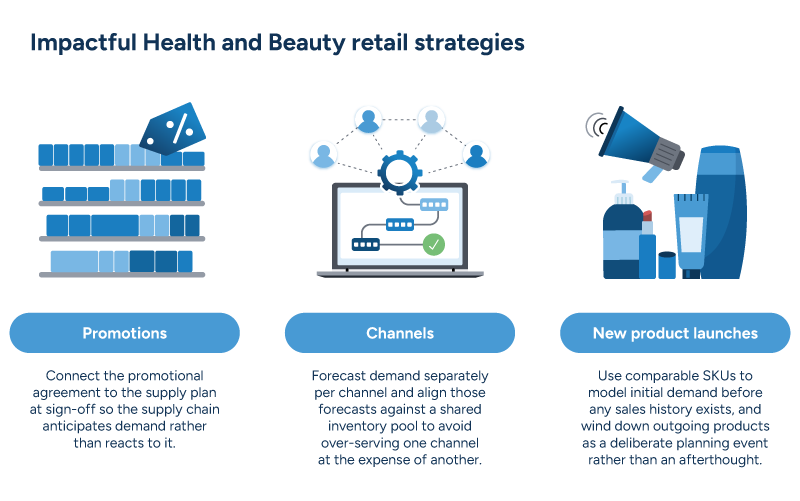
Aligned promotional agreements and supply plans
For promotions, that means connecting the commercial agreement to the supply plan at the point of sign-off, not after the campaign goes live. When trade fund commitments, discount depth, and promotional windows are visible to replenishment the moment they’re agreed, the supply chain stops reacting to promotions and starts anticipating them.
Planned influencer activations should also be modeled as promotional events with expected uplift built into the forecast before activation. Unplanned viral spikes require real-time inventory visibility and fast reallocation. Once the spike passes, it needs to be isolated as a non-repeating event so it doesn’t inflate next year’s baseline.
Forecast demand separately by channel against a shared inventory pool
Managing multiple channels effectively involves using separate demand forecasts for each channel — stores, e-commerce, marketplace — and reconciling them against a shared inventory pool. A single blended forecast consistently over-serves one channel and under-serves the other. Ringfencing inventory at the DC protects BOPIS and online fulfillment from being consumed by store replenishment before a confirmed order can be picked.
Replace gut feel on new launches with analog-based forecasting
Planners can reference SKUs with comparable attributes to generate an initial demand model before any sales history exists. That model is then localized by store cluster rather than distributed uniformly across the network. When a new range enters, the outgoing one needs an explicit wind-down plan. Residual stock at discontinuation is a margin problem that starts at the planning stage, not at the clearance rack.
How RELEX helps health and beauty retailers unify their planning
Fragmented planning is ultimately a data problem. Promotional commitments, replenishment signals, channel demand, and inventory positions all exist within the same business; they just live in different systems that are updated at different times and by different teams.
RELEX addresses this by running every planning decision on a single data model, whether commercial, operational, or financial. When one input changes, every downstream decision updates with it. That is the architectural difference between reacting to fragmentation and eliminating it.
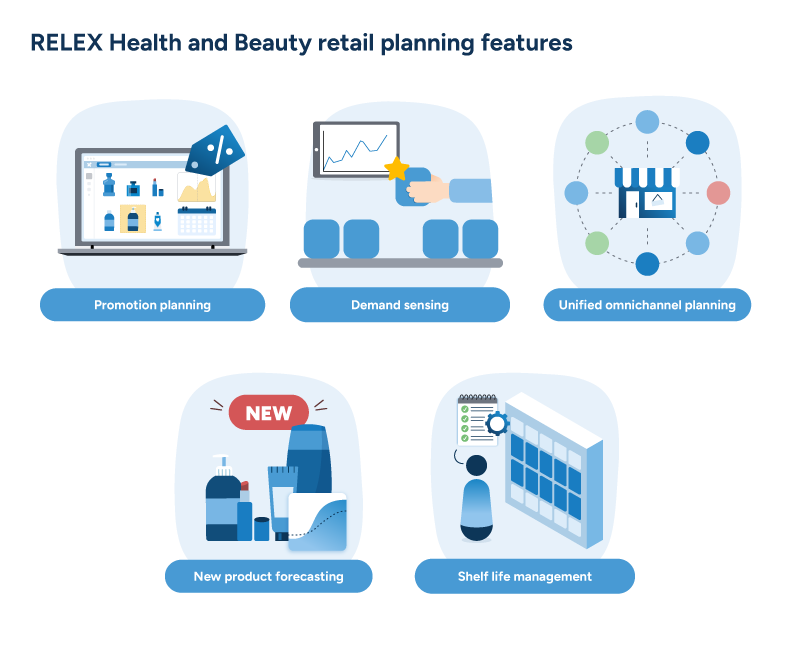
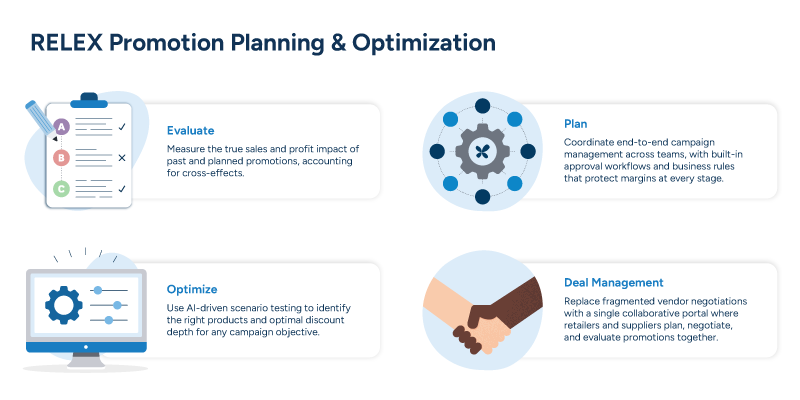
Promotion planning that starts before the campaign goes live
RELEX Promotion Planning connects the commercial agreement to the supply chain at sign-off. When a trade fund commitment, promotional window, and discount depth are entered into the system, the expected demand impact is immediately visible to replenishment — no manual handoff, no lag.
The Evaluate module measures the true performance of every promotion, quantifying baseline, switching, stockpiling, and halo effects. In practice, that means planners can see exactly which promotions drove genuine incremental revenue and which simply redistributed existing demand. That evidence becomes the foundation for vendor negotiations, replacing conversations grounded in precedent with ones grounded in proof.
Deal Management brings retailers and brand partners into a shared environment where vendor-funded promotions can be negotiated, planned, and tracked in one place. Instead of promotional agreements living across email chains and spreadsheets, both sides work from a single source of truth. That means supply chain is no longer the last to know when a deal is agreed; its implications flow directly into the replenishment plan.
The same capability applies to planned influencer campaigns. A paid partnership with a known start date and expected uplift can be modeled and fed into the supply plan ahead of activation, treating it the same way as any other promotional event.
Demand sensing for signals that move faster than the planning cycle
Unplanned virality can’t be forecast, but it can be managed. RELEX handles it in three steps:
Detect. RELEX Demand Sensing detects real-time demand shifts across channels, giving planners the visibility to make fast reallocation decisions before a stockout becomes a lost sales window.
Respond. The Digital Twin models the impact of a spike across the full supply network, allowing planners to simulate how available inventory should flow before committing to allocation decisions under constrained supply.
Protect. After the spike, Event and Outlier Management tags it as a non-repeating event, protecting future forecast baselines from being built against demand that won’t recur.
Unified commerce planning across every channel
The RELEX approach to omnichannel fulfillment allows retailers to operate their channels independently when necessary and holistically when it matters. Forecasts of demand can be generated independently for stores, e-commerce, and marketplace channels, and reconciled against a shared inventory pool.
Virtual ringfencing at the DC protects online and marketplace fulfillment commitments from being consumed by store replenishment — the structural fix for the confirmed-order-against-phantom-inventory failure mode.
RELEX True Inventory underpins it all. Using probabilistic modeling to detect inventory inaccuracies at the store level, it provides the accurate on-hand positions that make any availability promise on a website or app holdable.
Across deployments, True Inventory has delivered a 27% reduction in total inventory balance errors versus ERP. Prices remain consistent across online and in-store channels, automatically aligned to the retailer’s pricing strategy.
New product forecasting without historical data
RELEX NPI Forecasting automatically matches a new SKU to reference products with comparable attributes, such as:
- Brand
- Format
- Price point
- Category
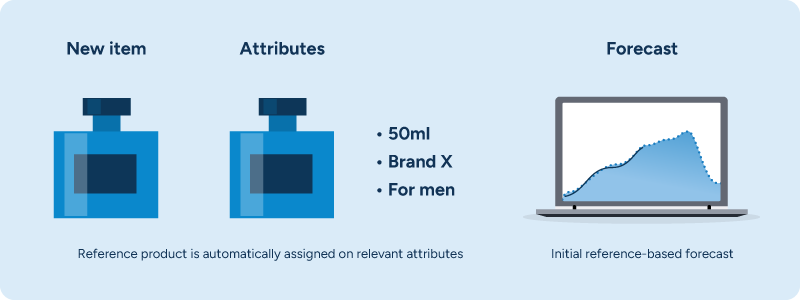
Fig. 5: RELEX NPI Forecasting ensures every new product enters the market with a plan behind it, not a guess.
These matched attributes are used to generate an initial demand forecast before a single unit has been sold, which the Recommendation Engine translates into store and cluster placement decisions at launch. This replaces uniform national distribution with placement decisions grounded in where demand is actually likely to materialize.
Shelf life management built for health and beauty complexity
RELEX Fresh Optimization applies FEFO logic across the full network, incorporating remaining shelf life directly into replenishment calculations to prevent over-ordering against stock that will expire before it sells. Configurable minimum remaining shelf life rules by market ensure that allocation decisions account for destination-specific compliance thresholds. This prevents the common scenario in which a product, within its total shelf life, is blocked on arrival because the remaining life falls below the import requirement.
Real-world examples of RELEX health and beauty retail planning in action
For health and beauty retailers already using RELEX, unified planning has produced measurable results across availability, inventory, and promotional performance.
How DOUGLAS unified their European planning operations
DOUGLAS, Europe’s leading premium beauty platform, operating more than 130,000 products across 2,000+ stores and online channels in 8 countries, faced a challenge familiar to every major omnichannel beauty retailer: each market was running its own planning tool, with no single view of what the business actually needed.
After selecting RELEX to replace its legacy SAP-based forecasting and replenishment functionality, DOUGLAS built what its COO Dr. Christian Korte describes as a “master branch” approach: one planning environment where decisions made centrally execute consistently across every country and channel in the network.
“We were able to significantly reduce our inventory levels and days of supply. That is exactly the magic you want.”
Dr. Christian Korte, COO at DOUGLAS
Where promotional plans had previously existed separately from replenishment, RELEX connected the two, meaning that when a promotion was planned, its supply chain implications were immediately visible. Where each market had operated independently, a single environment now governed ordering parameters across all of them. And where planners had been managing replenishment manually across the full assortment, ordering automation freed them to focus only on exceptions.
The results demonstrate what unified planning delivers in practice across the entire business:
- 97–98% automation of ordering
- +2% omnichannel product availability
- 66pp improvement in promotional forecast bias (from 33.4% to 98.8%)
- 98.56% average online forecast accuracy throughout 2021
How Rossmann cut promotional out-of-stocks
Germany’s second-largest drugstore chain, Rossmann, had reached the limits of a planning setup built on disconnected modules and in-house promotional add-ons. Promotional and continuous inventory flows were managed separately, with no unified system governing both — creating inconsistency across all 2,200 German stores and making promotional planning a largely manual, error-prone process.
After implementing RELEX, Rossmann gained unified visibility into demand forecasts and upcoming capacity bottlenecks, allowing the team to improve the timing and prioritization of promotional ordering and deliveries. Promotional and continuous delivery flows could now be individually controlled within a single centralized system — giving planners the flexibility their business model required without sacrificing consistency across the store network.
- 30% reduction in inventory of promotional items
- 10% reduction in out-of-stocks during promotions
- 85% reduction in in-store availability issues within three months of implementation
“RELEX gives us the ability to react quickly to new circumstances and requirements — and we don’t even need programming skills to do so.”
Jürgen Mattulke, Director of Supply Chain at Rossmann
Stop adding makeup to a foundational problem. Address the root cause instead.
The fast-moving health and beauty retail sector requires a planning infrastructure behind it that can keep pace- a challenge that is intensifying over time. When promotional commitments, replenishment signals, channel demand, and inventory positions all live in different systems, the gaps between them show up where it hurts most: a stockout mid-campaign, a BOPIS promise that can’t be kept, a new launch that sells out in three stores and sits untouched in three hundred others.
The companies pulling ahead aren’t doing so by working harder across those disconnected systems. They’re eliminating the disconnection altogether. RELEX was built for exactly this. By connecting commercial and supply chain decisions on a single platform, health and beauty retailers can make necessary adjustments to certain inputs and have those changes reflected further downstream. The result is a planning operation that’s more proactive than reactive, capable of moving at the speed the category demands.
Written by

Related Articles

QSR supply chain planning: overcoming operational friction with ingredient-level forecasting and franchise-wide visibility
Discover how connected QSR supply chain planning closes the gap between the kitchen and customer demand.
Case Study: Coop Estonia
Coop Estonia selected RELEX to introduce this new pricing approach following an evaluation of functional fit.

How to build a consumer decision tree: why the best CDTs start with shopper behavior, not supply logic
See why CDTs based on shopper behavior beat vendor- and workshop-built trees, and how RELEX CDT Builder applies the method.