Supply chain AI in 2026: The numbers behind the hype
Jun 16, 2026 • 7 min
Supply chain AI confidence has never been higher. Autonomous decision-making remains rare.
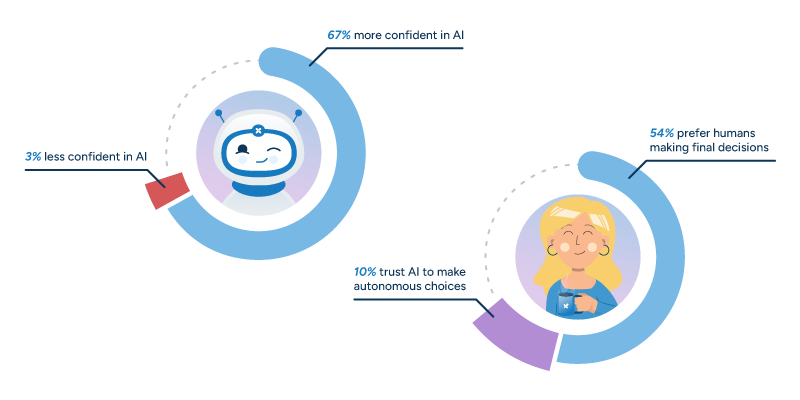
According to our 2026 State of the Supply Chain report, 67% of supply chain leaders are more confident in AI than they were last year and only 3% say their confidence in AI has decreased. Yet despite this widespread acceptance of AI, only 10% of those we surveyed say they’re trusting AI for making critical decisions without human review.
This data shows that while there is growing interest in using AI, there’s still a lot that AI needs to prove before planners are ready to let agentic tools make decisions unsupervised.
The confidence gap in AI adoption follows a familiar pattern
The recent jump in AI confidence sticks to the classic tech adoption curve: You have a small group of early adopters, the larger group of followers who join soon after the first wave of excitement, and then the last few laggards who eventually catch up. It looks like the same pattern holds for AI in supply chains, meaning adoption for this newer technology will continue to follow adoption patterns we’ve seen before.
Confidence in AI for supply chain optimization is rising in part because people are getting comfortable with the natural language interfaces they’ve used either at work or at home. They’re seeing productivity gains at the margins when this technology is applied to their work. Even if enterprise-scale ROI on AI isn’t fully realized yet, people are starting to understand AI and how it could relate to their jobs in the near future.
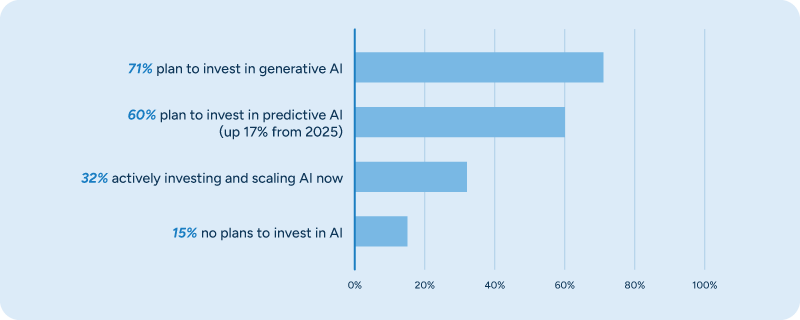
In fact, the report found that 71% plan to invest in generative AI over the next three to five years. That’s up 12 percentage points from 2025. This growth isn’t surprising given the widespread popularity of generative AI tools, like ChatGPT and Claude.
But investment in other forms of AI is also up: 60% of respondents plan to invest in predictive AI (an increase of 17 points from 2025). While only 32% are actively investing and scaling AI solutions right now, we expect that number to continue to climb in the next few years due to increasing enthusiasm for the technology.
In short: Organizations are moving from experimentation to operational deployment in targeted, practical applications of AI.
Where agentic AI is making a difference in supply chain planning
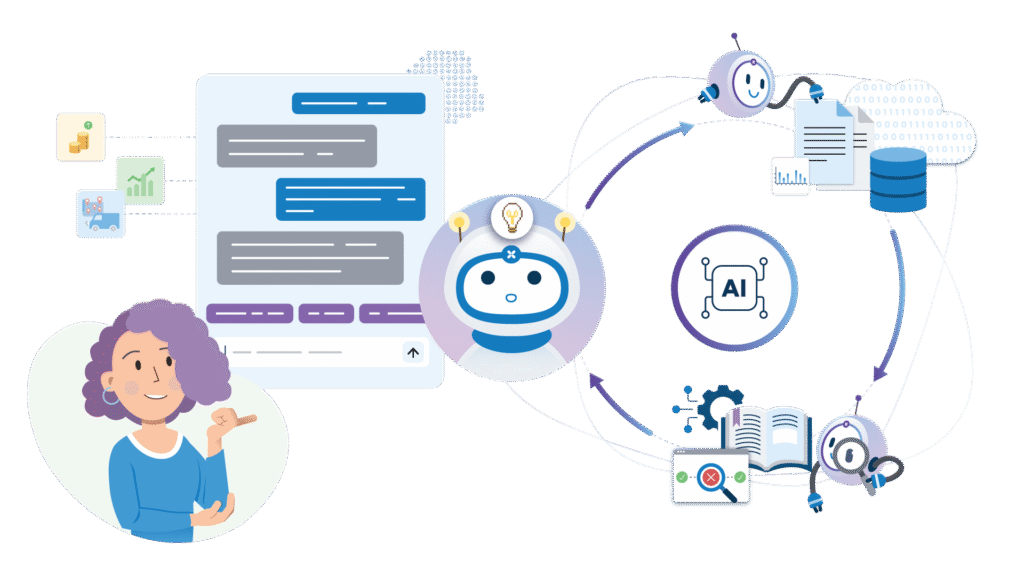
A new category of AI application is taking hold at forward-thinking companies, ones where agentic AI is built into the planning software. Agentic AI can take on reasoning work across complex, multi-stakeholder processes. And there are three areas that stand out as ideal for agentic AI.
Purchase optimization
As a part of distribution center buying, purchase optimization involves a lot of back and forth between different parties with scattered data across various emails and systems. Prices tend to be all over the place and you need advanced reasoning along with the ability to pull data from the different sources to make sense of it all.
For companies willing to let AI take on that coordination work, the payoff is working capital savings that were previously buried in the friction of the process.
Always-on IBP
The monthly integrated business planning cycle has long been a fixture of manufacturing operations, and it’s been a source of persistent frustration the whole time. For decades, cross-functional teams have pulled together spreadsheets and slide decks to align on numbers that were already partially stale by the time the meeting started.
Agentic AI can change that cadence. At companies where it’s already in use, this functionality can continuously reconcile demand signals, capacity constraints, and financial targets in near real-time, surfacing deviations before they compound into larger problems. The result is IBP that runs as a continuous state rather than a structured monthly event, giving planners a shared and ever-current picture of the business, instead of a snapshot that starts aging the moment it’s produced.
Autonomous root cause analysis
When a forecast misses or a supplier underperforms, tracing the root cause has traditionally meant days of manual work pulling data from multiple systems, filtering out noise, and working through the causal chain step by step. It’s time consuming, error prone, and pulls planners away from forward-looking decisions.
Agentic AI can handle the number-crunching legwork and agents can surface a clear recommended action and execute necessary changes. Planner attention is preserved for the exceptions that genuinely require human judgment, not wasted reconstructing what went wrong two weeks ago.
What about companies with no AI plans?
While most organizations report plans to invest in AI, if they aren’t already deploying it, there is a small group of businesses that currently have no interest. Our survey found that 15% of respondents don’t plan to adopt any kind of AI into their supply chain management at all. This group isn’t monolithic, and the number itself may be misleading before you look deeper.
AI is more than advanced chatbots
Some of those who say they don’t plan to use AI may already be doing so without realizing it. When people think about AI, they often only think about generative AI.The widespread popularity of LLMs (large language models) has led to a public perception of AI that’s quite limited. Many people don’t even know that RELEX has used a specialized form of AI from the beginning 20 years ago.
Companies are busy trying to survive
While some might not know they’re already investing in AI, others simply aren’t looking to have to adopt entirely new forms of technology for their business. Their resistance is less about ideology and more about capacity: Many businesses in retail, wholesale, and manufacturing are in a fierce battle for survival right now.
If a company is struggling to stay open, the people on their teams won’t feel like they have extra time to consider larger changes. They also might feel like they don’t have the luxury to think long term. It’s hard to plan five or 10 years down the line when you’re worried about next month.
Moving slow in a rapidly changing world
There’s also the fact that many businesses in supply chain management have historically moved slowly, and that strategy served them well in the past. If they watched other new innovations come and go and found they could stay open without adopting other technological leaps, why jump on AI the minute it appears?
But there’s a high probability that the 15% of supply chain leaders with no plans to invest in AI will change their mind in the next few years. Our survey found that 86% are already dealing with material trade policy disruption. Circumstances will likely soon persuade everyone in the supply chain to consider new ways to cope with ongoing disruption and constant volatility that has become the new normal over the last few years.
Augmentation is the middle step, not the destination
Currently, the most popular way to incorporate AI into supply chain optimization is with a hybrid approach where the tools offer suggestions and human planners decide what suggestions to implement. 54% of respondents report preferring this approach, while only 10% are comfortable letting AI make some decisions solo. This is expected, given where the industry is at with AI adoption.
But the real ROI will come with automation. Augmentation is the natural middle step that will also last for a time, but it’s not the end goal. Getting to the point of allowing for some automated decision-making level will significantly change the ROI outlook for most companies. And they’ll get there in time.
The path to automation is incremental. It’s natural for people to want to fully test out a new type of technology before allowing for full automation. But, eventually, as AI proves it can make smart decisions on its own, planners will get more comfortable with letting their AI tools work autonomously on some tasks in the background.

The cost of waiting out AI integration
It’s the small number of companies sitting out this move towards AI integration entirely that are ceding competitive ground.
Those embracing AI now are able to make better decisions faster, and they have significantly cut time-to-market. Those without any plans to incorporate AI are opening themselves up to fast-moving competitors potentially becoming so much more efficient that they can serve customers better with lower prices.
The smart strategy for many incumbent players is to invest in these emerging technologies as soon as possible. At a minimum, be open to change so you don’t get left behind your competitors.
Learn more about how leading organizations are embracing change. The 2026 RELEX State of the Supply Chain report surveyed over 500 supply chain leaders across retail, wholesale, and manufacturing to find out how organizations are responding to disruption, where strategies are shifting, and where the gaps remain.
Written by

Related Articles

How to build a consumer decision tree: why the best CDTs start with shopper behavior, not supply logic
See why CDTs based on shopper behavior beat vendor- and workshop-built trees, and how RELEX CDT Builder applies the method.
Agentic AI in manufacturing supply chain planning
Learn why most manufacturers need both general and tailored agents, meet the five core RELEX agents for manufacturing, and see how RELEX Open lets you deploy, connect, and extend AI across your supply chain planning.

Case Study: Grupo Vinoteca
See how Grupo Vinoteca, a Mexican wine and spirits distributor, reduced lost sales by 34.7%, cut store replenishment time by around 50%, and saved on inventory with RELEX's unified planning.